


Al-Alimi Calls for Containing Escalation in Eastern Yemen, Praises Saudi Role

 
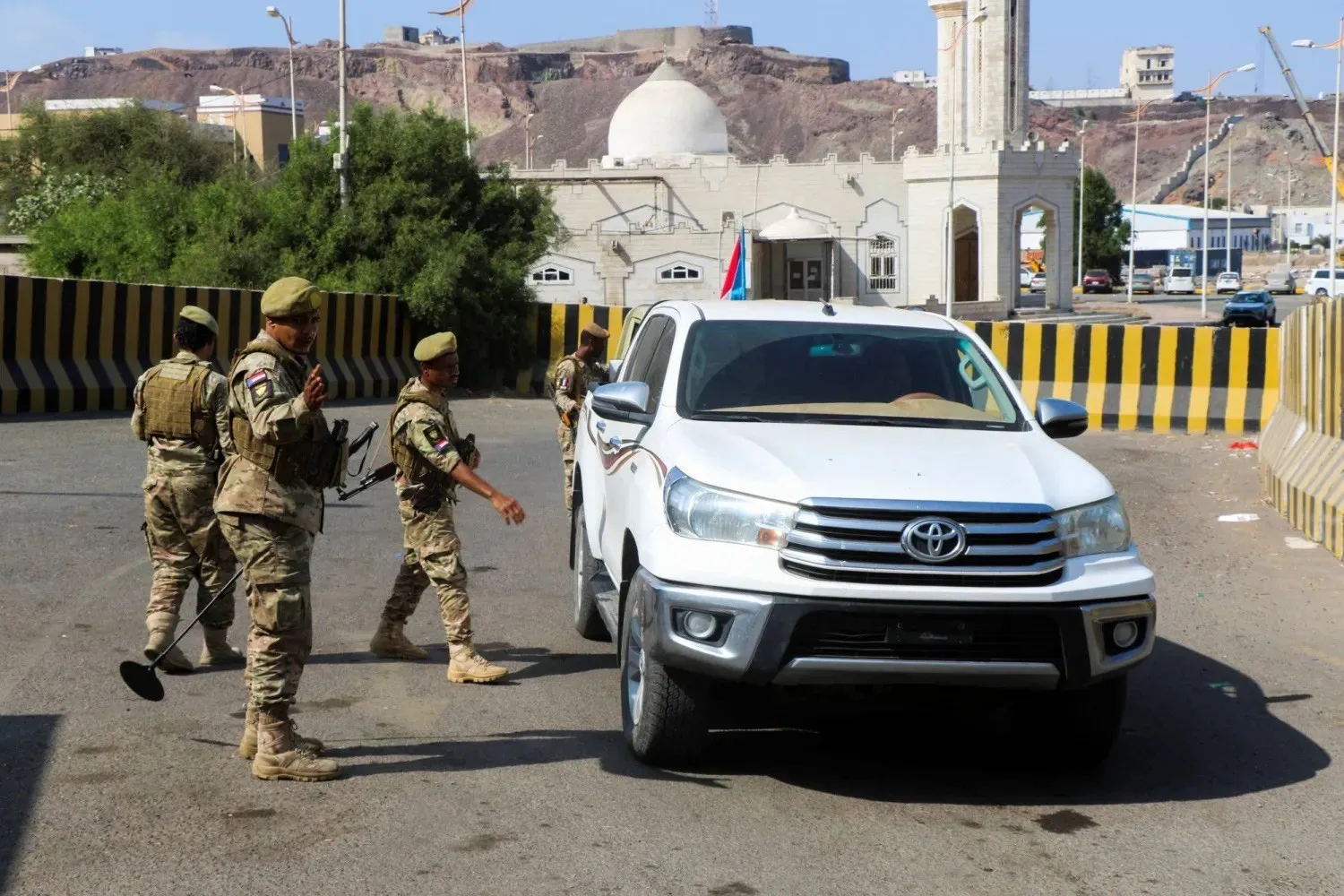
Caption: Soldiers loyal to Yemen’s Southern Transitional Council inspect a truck outside the presidential palace complex in Aden (Reuters)
  Caption: Soldiers loyal to Yemen’s Southern Transitional Council inspect a truck outside the presidential palace complex in Aden (Reuters)
TT

Al-Alimi Calls for Containing Escalation in Eastern Yemen, Praises Saudi Role

 
Caption: Soldiers loyal to Yemen’s Southern Transitional Council inspect a truck outside the presidential palace complex in Aden (Reuters)
  Caption: Soldiers loyal to Yemen’s Southern Transitional Council inspect a truck outside the presidential palace complex in Aden (Reuters)

Yemen’s Presidential Leadership Council Chairman Rashad al-Alimi on Thursday urged political, tribal and social forces in the eastern provinces of Hadramawt and Al-Mahra to close ranks behind state efforts and local authorities to contain the fallout from the recent security and military escalation.

While praising Saudi Arabia’s role in easing tensions, al-Alimi warned of the repercussions of continued unrest on Yemen’s economic and living conditions, noting early warning signs, including the International Monetary Fund’s announcement that it has suspended key activities in the country due to the deteriorating security environment.

A source in the presidential office said al-Alimi, during two phone calls with Hadramawt Governor Salem al-Khanbashi and Al-Mahra Governor Mohammed Ali Yasser, stressed the need for all forces brought in from outside the two provinces to withdraw, and for local authorities to be fully empowered to carry out their security and service responsibilities in line with the constitution and the law.

He also reiterated earlier directives to conduct a comprehensive investigation into all human rights violations linked to what he described as the Southern Transitional Council’s “unilateral measures,” including arbitrary arrests, enforced disappearances, and attacks on public and private property, emphasizing accountability and an end to impunity.

Al-Alimi cautioned against any further escalation that could lead to more bloodshed and deepen the economic and humanitarian crisis, stressing that the national priority must remain confronting the Iran-backed Houthi militia, which he described as the greatest threat to security and stability.

He commended Saudi efforts to de-escalate tensions and support stability in Hadramawt and Al-Mahra, affirming the state’s full backing for these initiatives and its commitment to strengthening the role of local authorities in safeguarding social peace and citizens’ interests.

According to the presidential source, al-Alimi underscored the need to restore conditions in the two provinces to their pre-escalation state, respect the frameworks governing the transitional period, and enable the government and local authorities to fulfill their constitutional duties.

He warned that the severe living conditions facing Yemenis “cannot withstand the opening of additional internal fronts,” calling on all parties to prioritize the public interest and preserve national gains, ensuring focus remains on the main battle against the Houthis and allied terrorist groups.

The appeal comes amid broader rejection of unilateral actions in the east. Parliament issued a statement condemning any military moves outside national consensus, describing recent developments as a “clear violation of constitutional legitimacy” and the powers of the Presidential Leadership Council.

Lt. Gen. Mohammed al-Qahtani, who headed a Saudi delegation that visited Hadramawt, stressed that Riyadh rejects “any attempts to impose a fait accompli by force” in the two provinces and supports restoring conditions to what they were prior to the escalation.

Al-Qahtani said Saudi Arabia, as leader of the Coalition to Support Legitimacy in Yemen, is working to resolve the crisis through a series of measures agreed upon with all parties, including the Southern Transitional Council.



Former Iraq President Named UN Refugee Chief, Document Shows

Former Iraqi President Barham Salih. (Reuters)
TT

Former Iraq President Named UN Refugee Chief, Document Shows

Former Iraqi President Barham Salih. (Reuters)

Iraq's former president Barham Salih has been chosen as the next High Commissioner for Refugees for the United Nations, a letter showed on Friday, breaking with a tradition of appointing leaders from major donor countries.

The letter, signed by UN Chief Antonio Guterres and dated December 11, says Salih has been appointed for a five-year term beginning January 1.

He replaces Italy's Filippo Grandi, a veteran UN official, who has held the position since 2016. The appointment is provisional and needs to be approved by UNHCR's Executive Committee, the document showed.

Salih, a British-educated engineer from Iraq's Kurdish region, faces major challenges with global displacement at record highs and about double the levels it was when Grandi first began.

In parallel, funding has fallen this year as key donors like the United States have cut back and other Western donors have shifted funds to defense.

About a dozen candidates were competing for the role, including several politicians as well as an IKEA executive, an ER doctor and a TV personality. More than half of them were from Europe, in keeping with a tradition of the Geneva-based agency's chief coming from top donor states.


Trump: ‘We Actually Do Have a Real Peace in the Middle East’

US President Donald Trump delivers remarks during the Congressional Ball in the Grand Foyer of the White House in Washington, DC, on December 11, 2025. (Photo by Alex WROBLEWSKI / AFP)
TT

Trump: ‘We Actually Do Have a Real Peace in the Middle East’

US President Donald Trump delivers remarks during the Congressional Ball in the Grand Foyer of the White House in Washington, DC, on December 11, 2025. (Photo by Alex WROBLEWSKI / AFP)

US President Donald Trump has said that there are prospects for “a real peace in the Middle East.”

When asked by a reporter at the White House about reports that he was planning to appoint an American two-star general to command the International Stabilization Force (ISF) in Gaza, Trump said Thursday: “We actually do have a real peace in the Middle East ... it’s never happened before and I think it’s very strong actually.”

The ceasefire, in effect since October 10, halted the war but it remains fragile as Israel and Hamas accuse each other almost daily of violations.

The agreement is composed of three phases. Israeli Prime Minister Benjamin Netanyahu recently indicated that he expected the second phase to begin soon.

That phase involves the Israeli army pulling farther back, the ISF deploying to Gaza, and a new governing structure coming into force, including the Trump-led Board of Peace.

Trump told reporters Wednesday that he's planning to announce the Gaza Board of Peace in early 2026.

Gaza’s population of around 2 million is almost entirely displaced, and most people live in vast tent camps stretching along the coast, or set up among the shells of damaged buildings.


Series of Israeli Strikes Hit Lebanon

A convoy of Lebanese army vehicles drives near the border with Israel in the village of Alma al-Shaab during a Lebanese army media tour in south Lebanon, Friday, Nov. 28, 2025. (AP Photo/Bilal Hussein)
TT

Series of Israeli Strikes Hit Lebanon

A convoy of Lebanese army vehicles drives near the border with Israel in the village of Alma al-Shaab during a Lebanese army media tour in south Lebanon, Friday, Nov. 28, 2025. (AP Photo/Bilal Hussein)

A series of Israeli strikes hit south and east Lebanon on Friday, state media reported, as Israel's army said it was targeting Hezbollah sites, the latest such raids despite a year-old ceasefire.

Lebanon's state-run National News Agency (NNA) reported strikes in around a dozen locations, including up to around 30 kilometers (20 miles) from the Israeli border, citing at times "heavy raids".

Israel has kept up strikes on Lebanon despite a November 2024 ceasefire that was supposed to end more than a year of hostilities with the Iran-backed militant group Hezbollah, and has also kept troops in five areas it deems strategic, reported AFP.

The Israeli military said in a statement that its forces "struck a training and qualification compound" used by Hezbollah's elite Radwan Force where operatives "underwent shooting exercises and additional training on the use of various types of weapons".

The army also "struck additional Hezbollah military infrastructure in several areas in southern Lebanon", it said.

According to the ceasefire, Hezbollah was required to pull its forces north of the Litani River, some 30 kilometers from the border with Israel, and have its military infrastructure there dismantled.

Under a government-approved plan, Lebanon's army is to dismantle Hezbollah's military infrastructure south of the Litani by the end of the year, before tackling the rest of the country.

The sites struck on Friday were generally north of the river.

Earlier this week, Israel launched a series of strikes on southern Lebanon, also saying it hit a Hezbollah training center and other targets.