


US Unseals Warrant for Tanker Seized off Venezuelan Coast

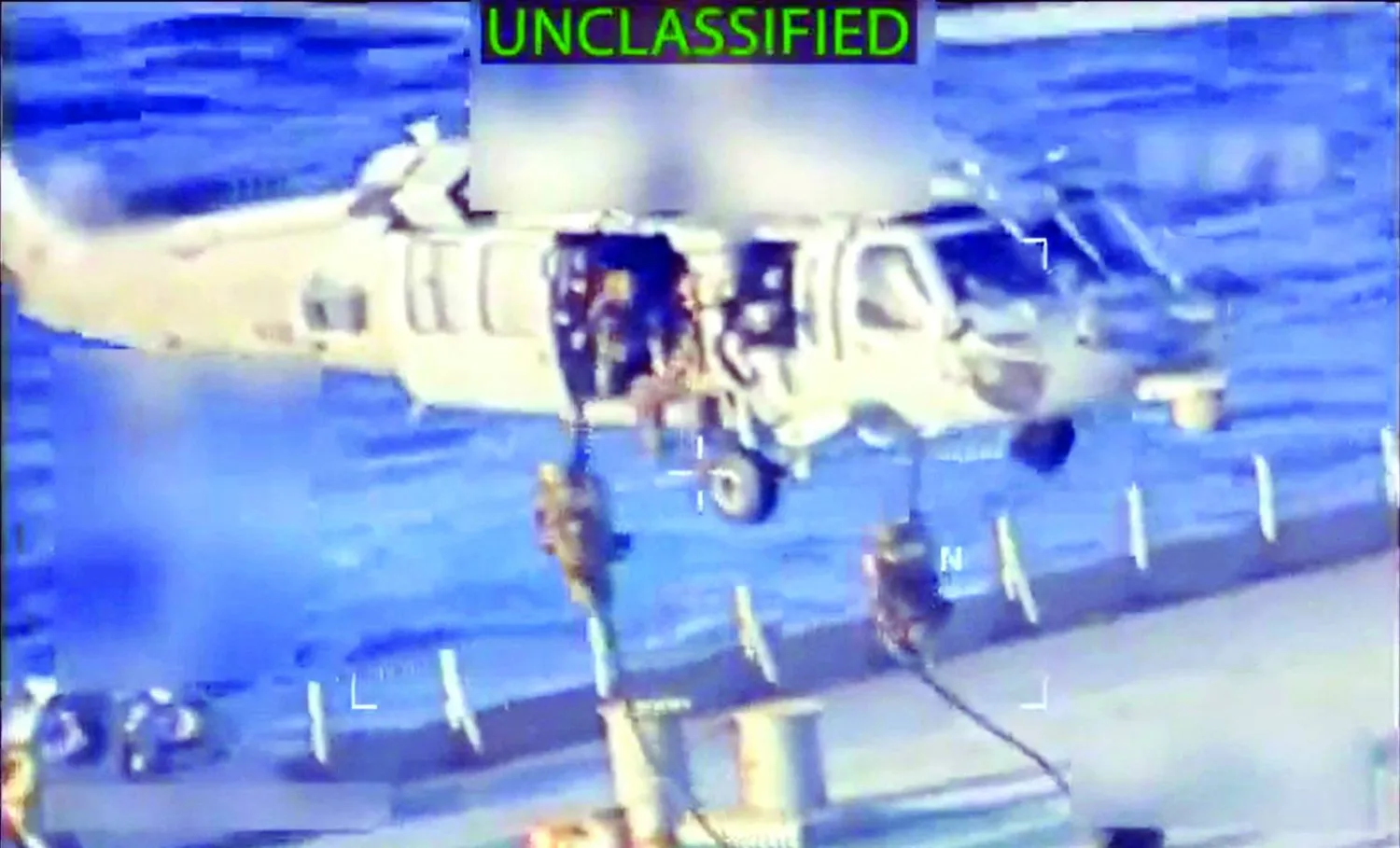
This screen grab from a video posted by US Attorney General Pam Bondi on her X account on December 10, 2025 shows what Bondi says is the execution of "a seizure warrant for a crude oil tanker used to transport sanctioned oil from Venezuela and Iran" off the coast of Venezuela on December 10. (Photo by Handout / US Attorney General Pam Bondi's X account / AFP)
TT

US Unseals Warrant for Tanker Seized off Venezuelan Coast

This screen grab from a video posted by US Attorney General Pam Bondi on her X account on December 10, 2025 shows what Bondi says is the execution of "a seizure warrant for a crude oil tanker used to transport sanctioned oil from Venezuela and Iran" off the coast of Venezuela on December 10. (Photo by Handout / US Attorney General Pam Bondi's X account / AFP)

US authorities on Friday unsealed the warrant for an oil tanker seized off the coast of Venezuela decried as "international piracy" by Caracas.

President Donald Trump's administration has been piling pressure on Venezuela for months, with a major naval buildup in the region that has been accompanied by deadly strikes on alleged drug-trafficking boats, killing nearly 90 people, AFP said.

In a dramatic raid this week that Homeland Security Secretary Kristi Noem said was aimed at Maduro's "regime," Washington took control of the tanker, with US forces roping down from a helicopter onto the vessel.

The warrant, signed by a magistrate judge on November 25, was carried out Wednesday by the US Coast Guard.

The US Treasury Department said the vessel, dubbed the Skipper and formerly called the Adisa, was used to transport the sanctioned oil "in an oil shipping network supporting Hezbollah" and a unit of Iran's Revolutionary Guard.

The agency also imposed sanctions on relatives of Venezuelan leader Nicolas Maduro and six companies shipping the South American country's oil.

"The FBI's Counterintelligence Division and our partners will continue to enforce US sanctions and cut off our adversaries from financial markets and critical technology," FBI Director Kash Patel said in a statement.

"The seizure of this vessel highlights our successful efforts to impose costs on the governments of Venezuela and Iran."

White House Press Secretary Karoline Leavitt told journalists on Thursday that the seized tanker "will go to a US port and the United States does intend to seize the oil."

"We're not going to stand by and watch sanctioned vessels sail the seas with black-market oil, the proceeds of which will fuel narco-terrorism of rogue and illegitimate regimes around the world."

The tanker was expected to dock in Galveston, Texas, two unnamed US officials told NBC News, adding that the crew would be released upon arrival.

- 'Blatant theft' -

A video released earlier this week by US Attorney General Pam Bondi showed American forces descending from a helicopter onto the tanker's deck, then entering the ship's bridge with weapons raised.

Bondi said the ship was part of an "illicit oil shipping network" that was used to carry sanctioned oil.

Venezuela's foreign ministry said it "strongly denounces and condemns what constitutes blatant theft and an act of international piracy."

"They kidnapped the crew, stole the ship and have inaugurated a new era, the era of criminal naval piracy in the Caribbean," Maduro said Thursday at an event.

"Venezuela will secure all ships to guarantee the free trade of its oil around the world," he added.

- 'Days are numbered' -

US media reported that the seized tanker had been heading for Cuba -- another American rival -- and that the ship was stopped by the US Coast Guard.

Washington has accused Maduro of leading the alleged "Cartel of the Suns," which it declared a "narco-terrorist" organization last month, and has offered a $50 million reward for information leading to his capture.

Trump told Politico on Monday that Maduro's "days are numbered" and declined to rule out a US ground invasion of Venezuela.

The Trump administration alleges that Maduro's hold on power is illegitimate and that he stole Venezuela's July 2024 election.

Maduro -- the political heir to leftist leader Hugo Chavez -- says the United States is bent on regime change and wants to seize Venezuela's oil reserves.



Bangladesh Cuts Working Hours to Save Energy Amid Middle East Crisis

Motorcyclists queue to refuel at a fuel station, as concerns grow over fuel supply amid fhe US-Israel conflict with Iran, in Dhaka, Bangladesh, March 15, 2026. (Reuters)
TT

Bangladesh Cuts Working Hours to Save Energy Amid Middle East Crisis

Motorcyclists queue to refuel at a fuel station, as concerns grow over fuel supply amid fhe US-Israel conflict with Iran, in Dhaka, Bangladesh, March 15, 2026. (Reuters)

Bangladesh has ‌launched fresh measures to curb energy consumption, cutting office hours and trimming public spending as conflict in the Middle East disrupts global fuel markets and strains power supply in the South Asian nation.

Officials said the steps approved by cabinet on Thursday aim to stabilize the energy situation in Bangladesh, heavily dependent on fuel imports and battered by price volatility and supply uncertainty ‌from the ‌US-Israeli war with Iran.

Under the ‌new ⁠rules, government offices ⁠will run from 9 a.m. to 4 p.m., while markets and shopping centers must shut by 6 p.m. to reduce electricity use.

The government has also ordered cuts in non-essential public expenditure and urged lower power consumption ⁠in industry, with curbs on excessive lighting, ‌for example.

The education ‌ministry will issue guidelines for schools from Sunday, with ‌options such as adjusting timetables and shifting to ‌online classes being considered.

Authorities will also allow duty-free imports of electric buses for schools, with incentives for those that participate.

Bangladesh has rationed fuel ‌to mitigate shortages, besides limiting vehicle sales and shortening fuel station hours ⁠amid panic buying, ⁠hoarding and long queues.

Authorities have warned that supplies remain tight, despite some easing during major holidays.

Bangladesh' state-run agencies are scrambling to secure energy supplies for a population of about 175 million, while exploring alternative sources in the face of volatile global markets.

The government is also seeking external financing of more than $2.5 billion to help pay for imports of fuel and liquefied natural gas, as rising energy costs further squeeze foreign exchange reserves.


Trump Threatens to Strike Iran’s Bridges and Electric Power Plants

US President Donald Trump delivers an address to the nation about the Iran war at the White House in Washington, DC, US, April 1, 2026. (Reuters)
TT

Trump Threatens to Strike Iran’s Bridges and Electric Power Plants

US President Donald Trump delivers an address to the nation about the Iran war at the White House in Washington, DC, US, April 1, 2026. (Reuters)

US President Donald Trump warned late on Thursday about striking and destroying bridges and electric power plants in Iran in his latest threat to hit the country's infrastructure.

The US military "hasn't even started destroying what's left in Iran. Bridges next, then Electric Power Plants," Trump wrote on social media.

His post said that Iran's leadership "knows what has to be done, ‌and has ‌to be done, FAST!"

Trump, who has previously ‌offered ⁠shifting timelines and objectives ⁠for the war, said in a televised speech on Wednesday that the war could escalate if Iran did not give in to Washington's terms, with strikes on its energy and oil infrastructure possible.

Dozens of international law experts in the US signed an open letter released earlier on Thursday saying that US strikes on ⁠Iran may amount to war crimes.

The 1949 ‌Geneva Conventions on humanitarian conduct ‌in war prohibit attacks on sites considered essential for civilians.

The Geneva Conventions ‌and additional protocols say that parties involved in military conflict ‌must distinguish between "civilian objects and military objectives", and that attacks on civilian objects are forbidden.

"We are going to hit them extremely hard over the next two to three weeks. We are going to ‌bring them back to the Stone Ages, where they belong," Trump said in his Wednesday address.

While ⁠he said ⁠Washington was nearing the completion of its goals in Iran, Trump did not lay out a timeline to end the war.

The war began on February 28 when the US and Israel attacked Iran. Tehran responded by launching its own attacks on Israel and Gulf states with US bases. Joint US-Israeli strikes in Iran and Israeli attacks in Lebanon have killed thousands and displaced millions.

The war has also raised oil prices and shaken global markets. Trump's mixed messages thus far have done little to ease the concerns over his country's biggest military attacks since the 2003 invasion of Iraq.


Israel Wary of Sudden Trump Shift Despite War Pledge

Israeli security forces and first responders inspect the site of an Iranian strike that hit a residential neighborhood in Petah Tikva on April 2, 2026. (AFP)
TT

Israel Wary of Sudden Trump Shift Despite War Pledge

Israeli security forces and first responders inspect the site of an Iranian strike that hit a residential neighborhood in Petah Tikva on April 2, 2026. (AFP)

Despite reassurances in Israel after US President Donald Trump said the war on Iran would continue for another two to three weeks, Israeli assessments still warn of a possible abrupt policy shift that could halt the conflict “before its objectives are complete.”

Security sources say Iran’s Revolutionary Guard Corps (IRGC) remains intent on prolonging the war despite heavy losses, seeking to turn it into a drawn-out war of attrition. Trump, however, is viewed as aiming to deny Tehran that leverage.

Sources quoted by Israeli outlet Walla said ending the war sooner could allow Israel and the United States to better assess the impact of their strikes, amid growing opposition to the conflict in the United States and Western countries, as well as waning support within Israel.

According to Channel 12, Iran has sustained extensive damage. The United States and Israel have struck 19,650 targets — including 11,000 by US forces — killing 55 senior figures, among them 22 top-level leaders. Around 4,700 sites linked to ballistic missile production and storage were destroyed, eliminating about 90 percent of that capability, along with 150 naval vessels.

Still, Iran has continued to launch missiles. Only 14 percent of its strikes targeted Israel — 411 barrages involving 585 missiles and 765 drones — while the rest were directed at roughly 14 countries, most of them Arab or Muslim states, the report underlined.

Better prepared than expected

Danny Citrinowicz, a researcher at Tel Aviv University’s Institute for National Security Studies and former head of the Iran desk in Israeli military intelligence, told Ynet that Iran retains significant capabilities and appears better prepared than Israel and the United States had expected.

He said statements by Iranian parliament speaker Mohammad Bagher Ghalibaf about an “eye-for-an-eye” policy indicate that Iran’s command structure remains intact and that its missile launches follow a coordinated strategy.

“This is not random fire,” Citrinowicz said. “There is a strategic and operational plan.”

He cited a pattern of reciprocal strikes, including attacks in southern Iran followed by the first strike on the Haifa oil refinery, then an attack on the Natanz nuclear facility and a retaliatory strike on Israel’s Dimona reactor.

Further exchanges included strikes on Iranian steel plants and on an Israeli facility in Neot Hovav in the Negev desert. Iran later targeted the Haifa refinery again after Israeli attacks on its electricity infrastructure.

Citrinowicz said Tehran is seeking to establish a deterrence equation that goes beyond Israel alone. He pointed to an attack on Ras Laffan that disrupted 17 percent of Qatar’s gas production following strikes on the South Pars field in southern Iran.

He also highlighted a new risk: threats by Yemen’s Iran-backed Houthis to close the Bab el-Mandeb Strait in response to any major escalation or ground incursion.

Such a move would mark a significant escalation, he warned. Iran’s strategy is not parity, but escalation to impose new rules of engagement and deter future attacks.

Citrinowicz said the next phase could include strikes on academic institutions, noting recent threats by the Revolutionary Guard against Israeli universities.

These assessments reflect a broader shift in Israel, where officials increasingly believe the war will not destroy Iran, but could delay its strategic programs for several years, requiring future confrontation.

Israeli Foreign Minister Gideon Saar said Israel had removed an existential threat, but cautioned the conflict would not be its last.

He stated: “Our enemies still exist. They have suffered a severe blow, but we must remain prepared.”

Israeli and US forces, meanwhile, are continuing their intensive strikes, aiming to further weaken Iran. According to Maariv, both sides agree Iran will not return to its pre-war status after the conflict.