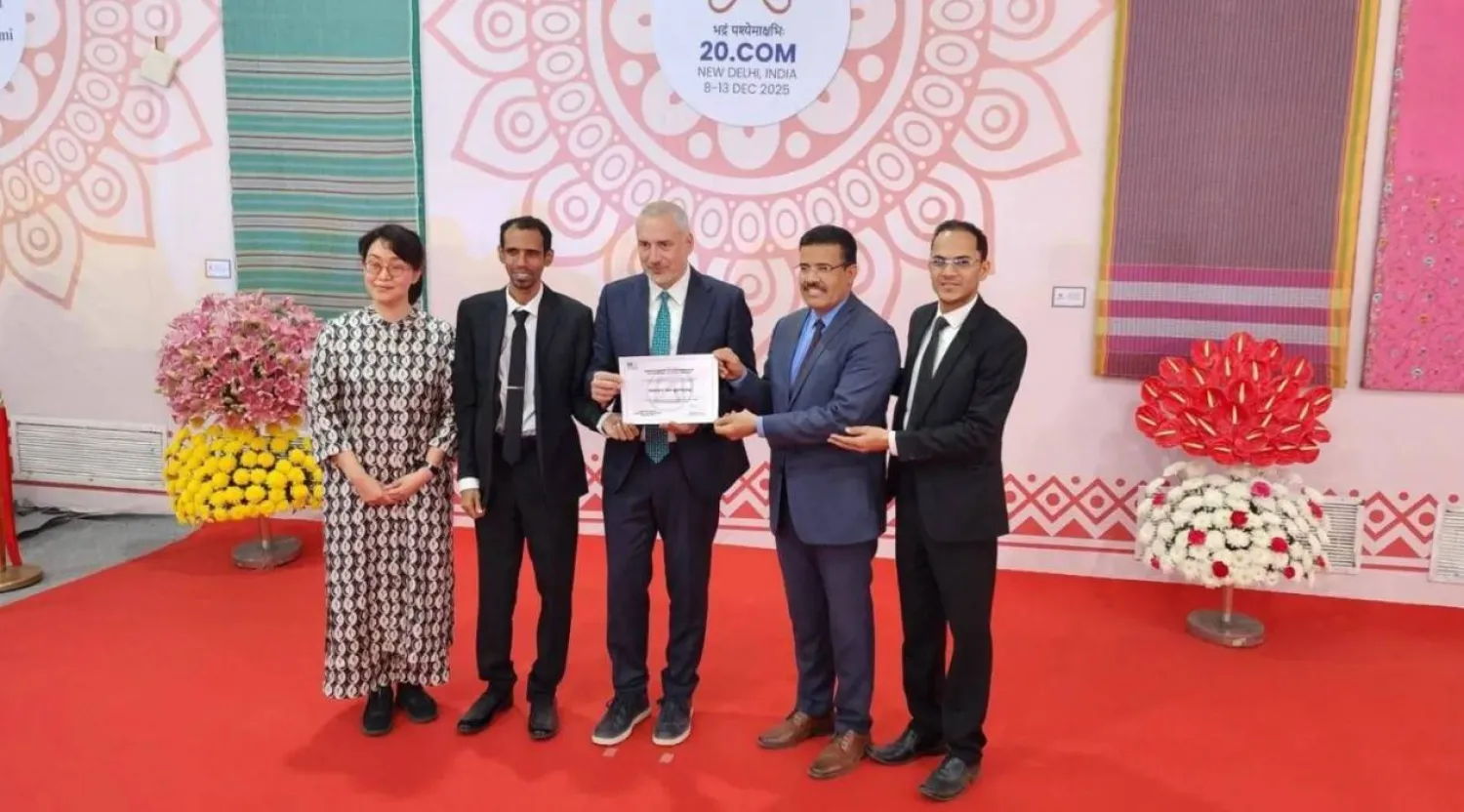

Hadrami Dan Added to UNESCO’s Intangible Cultural Heritage of Humanity List

The Hadrami Dan included on the Representative List of the Intangible Cultural Heritage of Humanity following a long and diligent process. Photo: X
TT

Hadrami Dan Added to UNESCO’s Intangible Cultural Heritage of Humanity List

The Hadrami Dan included on the Representative List of the Intangible Cultural Heritage of Humanity following a long and diligent process. Photo: X

The Intangible Cultural Heritage Committee of UNESCO, during its ongoing 20th session in New Delhi, included the Hadrami Dan on the Representative List of the Intangible Cultural Heritage of Humanity.

Hadrami Dan is a traditional performance and community gathering that combines spontaneous poetry, music and dance, widespread practiced across Hadhramaut Governorate. A typical Hadrami Dan gathering includes at least one singer and poet, with the audience seated in rows or circles.

Yemen’s Ambassador to UNESCO Mohammed Jumaih said the Hadrami Dan deserves this recognition, following a long and diligent process to reach this goal.

Jumaih thanked the Ministry of Culture and its staff, and the National Commission for Education, Culture, and Science.

He offered special gratitude to the Hadhramaut Foundation for Culture, which undertook the preparation and financing of the nomination file.

He also expressed his appreciation to the Intangible Cultural Heritage Committee, its Chairperson (India’s Ambassador to UNESCO, Vishal Sharma), the committee members, its secretariat, and the Evaluation Body experts for their efforts.

Minister of Information, Culture, and Tourism Muammar Al-Eryani in the Yemeni government said this achievement represents “a well-deserved international recognition of one of the most important creative expressions in Hadhramaut and Yemen in general.”

The Hadrami Dan embodies the depth of Yemeni cultural identity, which successive generations have preserved despite the harsh transformations the country has undergone, he said.

Al-Eryani added that it is the result of a joint national effort involving the Ministry of Culture and the Hadhramaut Foundation for Culture, alongside the prominent role played by Jumaih in following up on the issue within UNESCO.
Jazan Cultural House Explores Symbolism of Saudi Flag

The evening featured a critical reading on the symbolism of the Saudi flag and its ties to national identity and core values
TT

Jazan Cultural House Explores Symbolism of Saudi Flag

The evening featured a critical reading on the symbolism of the Saudi flag and its ties to national identity and core values

The Jazan Cultural House hosted a cultural evening on the Saudi flag, in collaboration with the Cultural Café, a literary partner of the Literature, Publishing, and Translation Commission.

The evening featured a critical reading on the symbolism of the Saudi flag and its ties to national identity and core values. Speakers discussed its historical and cultural significance as a symbol of unity and sovereignty, reflecting themes of faith, strength, and national cohesion.

The reading also explored the flag's role in fostering a sense of belonging and national pride, as well as various interpretations of its significance in cultural and intellectual discourse.


Prince Mohammed bin Salman Project Restores Historic Al-Qalaah Mosque in Riyadh Region

The mosque is a prime example of traditional Najdi architecture - SPA
TT

Prince Mohammed bin Salman Project Restores Historic Al-Qalaah Mosque in Riyadh Region

The mosque is a prime example of traditional Najdi architecture - SPA

The Prince Mohammed bin Salman Project for the Development of Historical Mosques continues its mission to preserve the Kingdom’s architectural heritage by restoring Al-Qalaah Mosque in Hawtat Bani Tamim, Riyadh Region. Built in 1250 AH (1834 CE), this historic landmark is situated within the fortress of Second Saudi State founder Imam Turki bin Abdullah.

The mosque is a prime example of traditional Najdi architecture, featuring stone foundations, mud walls constructed using molded brick techniques, and a roof of tamarisk trunks and palm fronds supported by stone-bead cylindrical columns, SPA reported.

Through the current renovation, the mosque’s area has expanded from 608.68 to 625.78 square meters while maintaining a capacity for 180 worshippers. Executed by specialized Saudi firms under expert engineering supervision, the project balances traditional standards with modern sustainability to ensure the mosque remains a living testament to Islamic and national history.

This initiative aligns with Vision 2030 objectives to rehabilitate historical sites for worship, highlight cultural heritage, and preserve the Kingdom’s authentic architectural identity for future generations.


UNESCO Fears for Fate of Historical Sites during Iran War

Debris at the historical monument Golestan Palace after it was damaged in an Israeli and US strike, amid the US-Israeli conflict with Iran, in Tehran, Iran, March 3, 2026. Majid Asgaripour/WANA (West Asia News Agency) via REUTERS/File Photo
TT

UNESCO Fears for Fate of Historical Sites during Iran War

Debris at the historical monument Golestan Palace after it was damaged in an Israeli and US strike, amid the US-Israeli conflict with Iran, in Tehran, Iran, March 3, 2026. Majid Asgaripour/WANA (West Asia News Agency) via REUTERS/File Photo

UNESCO said it is deeply concerned about the fate of world heritage sites in Iran and across the region, after Tehran's Golestan palace, often compared to Versailles, and a historic mosque and palace in Isfahan were damaged in the war.

The United Nations' cultural agency on Wednesday urged all parties to protect the region's outstanding cultural sites, saying four of Iran's 29 world heritage sites had been damaged since the start of the US and Israeli war with Iran.

"UNESCO is deeply concerned by the first impact that the hostilities are already having on many world heritage sites," Lazare Eloundou Assomo, director of the World Heritage Centre, told Reuters, adding he was also concerned for sites in Israel, Lebanon and across the Middle East.

Tehran's Golestan palace, damaged in US–Israeli strikes, is testimony to the grandeur of Iran's civilization in the 19th century, he said.

The palace was chosen as the Persian royal residence and seat of power by the Qajar family and shows the introduction of European styles in Persian arts, according to the UNESCO website. The last Shah of Iran, Mohammad Reza Pahlavi, held a coronation ceremony there in 1969.

"We sometimes even compare it with the Versailles Palace in France, for instance, and it has suffered, unfortunately, some damage. We don't know the extent for the moment. But clearly, with the images that we have been able to receive, we can confirm ... it has been affected," Eloundou Assomo said.

Photos of the interior of the palace have shown piles of smashed glass and shards of wood on the floor, and shattered woodwork.

Isfahan was one of Central Asia's most important cities and a key point on the Silk Road trading route. Its Masjed-e Jame (Jameh Mosque) is more than 1,000 years old and shows the development of Islamic art through 12 centuries.

Buildings close to the buffer zone of the prehistoric sites of the Khorramabad Valley have also been damaged, UNESCO said.

UNESCO has shared coordinates of key cultural sites to all parties, Eloundou Assomo said, and was monitoring damage.

"We are calling for the protection of all sites of cultural significance ... everything that tells the history of all the civilisations of the 18 countries in the region," he said.