

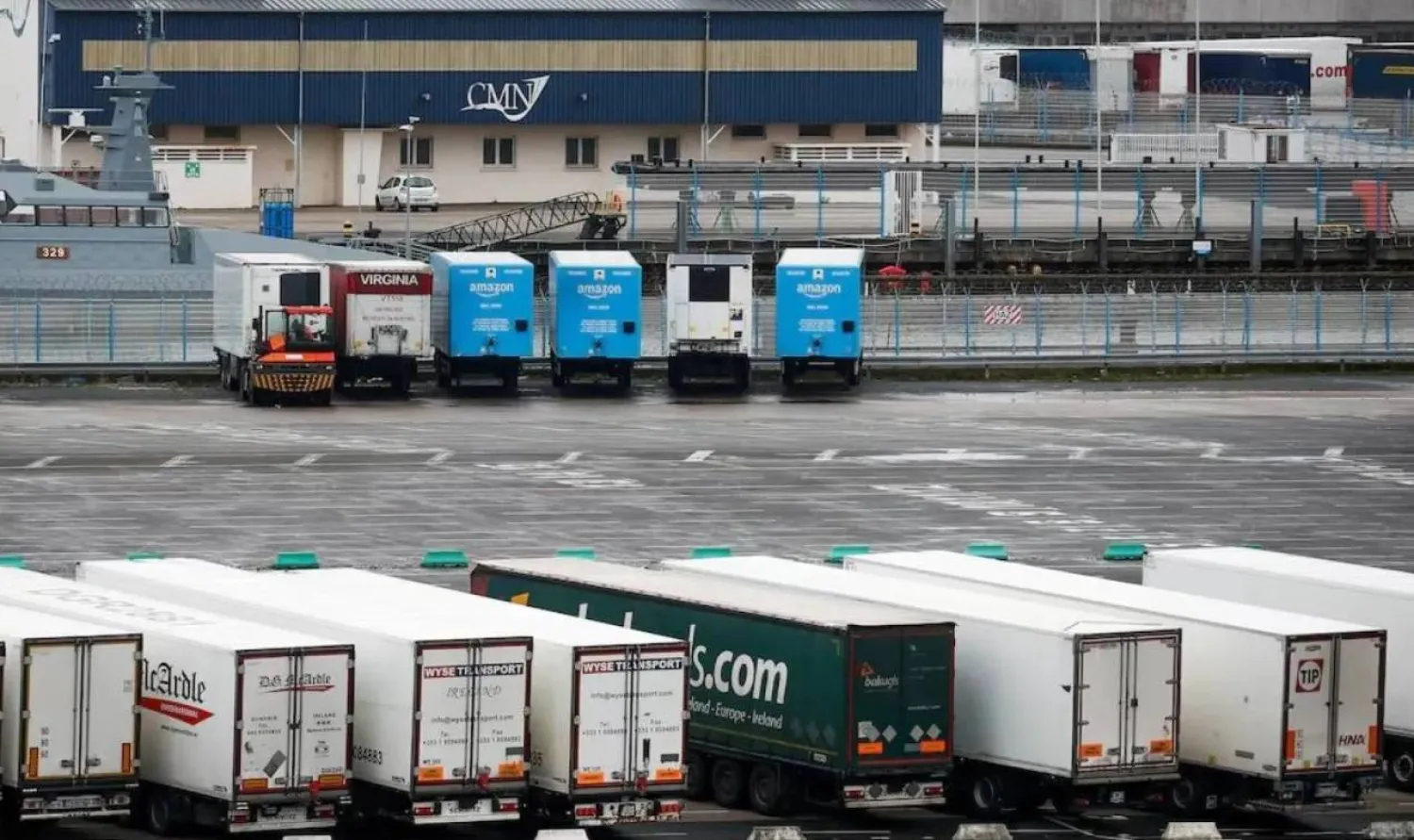

Europe Aims for Simpler Import Procedures

Amazon trailer trucks are seen at Cherbourg Harbor, France January 21, 2021. REUTERS/Gonzalo Fuentes
TT

Europe Aims for Simpler Import Procedures

Amazon trailer trucks are seen at Cherbourg Harbor, France January 21, 2021. REUTERS/Gonzalo Fuentes

Every day, more than 12 million packages enter the European Union – making it increasingly difficult for customs officers to check for illegal or undeclared goods or assess duties.

Many of those packages are small fry – in 2024, around 4.6 billion packages with a declared value of less than 22 Euro ($25.6) entered the EU. The Commission reported in August that only 0.0082% of all imported products were checked by customs authorities.

According to the EU court of auditors, customs checks in some member states are not rigorous enough and the uneven application of rules across the bloc makes fraud easy.

Customs Reform: What’s the plan?

Back in 2023, the European Commission presented proposals for a comprehensive reform with the aim to reduce bureaucracy and respond to challenges such as the steep rise in e-commerce.

A central point in the EU’s reform plans is how to manage this enormous flood of packages and parcels that enter the bloc from third countries, in particular China.

The EU also plans to abolish the current 150-Euro duty free limit on packages to ensure a level playing field for companies by 2028 – until then the temporary measures are to remain in force. In mid-December, the Member States also supported the introduction of a general 3-Euro-duty on low value parcels, effective from July 2026. This is also a temporary measure.

In a nutshell, the reform aims to modernize customs procedures, strengthen cooperation between member states’ customs authorities and improve checks on imports and exports. Furthermore, it promises improved collection of duties and taxes and better protection of the internal market.

To this end, there is to be a new EU Customs Data Hub which is to be overseen by the – still to be established – EU Customs Authority (EUCA).

The EUCA is intended to serve as a central hub to support national customs agencies. Once implemented, it will streamline customs procedures, improve the safety of online purchases for EU citizens, and provide national authorities with simpler, more uniform tools.

With this reform in place, a number of benefits should be realized – such as simplified reporting requirements via one single interface – which dovetails with Commission President Ursula von der Leyen’s promises to cut red tape. The EU also envisages savings of up to 2 billion Euro a year as the hub will replace customs IT infrastructure in member states.

EU Customs Authority

The EU Customs Authority is to be established from 2026, with the European Commission responsible for its launch: First access by companies to the Data Hub is scheduled by 2028, voluntary use of all businesses by 2032 and use becoming obligatory by 2038.

The first key decision will be its location. Nine member states have thrown their hats in the ring. The competitors are Belgium (Liège), Croatia (Zagreb), France (Lille), Italy (Rome), the Netherlands (The Hague), Poland (Warsaw), Portugal (Porto), Romania (Bucharest), and Spain (Málaga).

The EU executive will now assess the nine applications, seeking to ensure that the location will enable the authority to carry out its tasks and powers, recruit highly qualified and specialized staff, and offer training opportunities.

A decision is expected around February and will be made together with the member states and the EU Parliament.

The host country must offer immediately available buildings, advanced IT and security infrastructure, space for at least 250 employees, high-tech meeting rooms, and a “secure area” for the management of confidential information, among many other criteria.

Protecting EU markets

“Safer trade means a safer Europe,” said Polish Finance Minister Andrzej Domanski, explaining that a “strong and resilient” customs union guarantees the protection of the internal market, consumer safety and stable economic development.

But how to go about those joint trade and customs policies is still a bone of contention.

The customs reform is timely, as European capitals look to protect key strategic sectors against stiffening international trade headwinds.

Calls are growing in some parts for a “Made in Europe” scheme that would favor home-grown products. This position is being promoted especially by France.

The commission originally planned to publish a related EU initiative this month, but met with resistance from the Czechs, Slovaks, Irish, Swedes and Latvians and others.

The proposal has now been postponed until early next year, according to the Financial Times daily.



Egypt Plans $1 Billion Red Sea Marina, Hotel Development

This picture shows a partial view of Egypt's Red Sea city of Sharm el-Sheikh, October 7, 2025. (AFP)
TT

Egypt Plans $1 Billion Red Sea Marina, Hotel Development

This picture shows a partial view of Egypt's Red Sea city of Sharm el-Sheikh, October 7, 2025. (AFP)

Egypt announced plans on Monday for a new $1 billion marina, hotel and housing development on the Red Sea in a bid to boost the region's tourist industry.

Construction on the "Monte Galala Towers and Marina" project would ‌start in ‌the second ‌half ⁠of the ‌year and run for seven years, Ahmed Shalaby, managing director of the main developer, Tatweer Misr, said.

The 10-tower development - a partnership with the ⁠housing ministry and other state bodies ‌including the armed ‍forces' engineering authority - ‍would cost about 50 ‍billion Egyptian pounds ($1.07 billion), he added.

The project, also announced by the cabinet, will cover 470,000 square meters on the Gulf of Suez, about ⁠35 km south of Ain Sokhna, Shalaby said.

Egypt aims to boost total tourist arrivals to around 30 million by 2030, from around 19 million recorded by the tourism ministry in 2025.


Saudi-Polish Investment Forum Explores Prospects for Economic and Investment Cooperation

The forum brought together government officials, business leaders, and investors from both countries with the aim of enhancing economic cooperation - SPA
TT

Saudi-Polish Investment Forum Explores Prospects for Economic and Investment Cooperation

The forum brought together government officials, business leaders, and investors from both countries with the aim of enhancing economic cooperation - SPA

The Saudi-Polish Investment Forum was held today at the headquarters of the Federation of Saudi Chambers in Riyadh, with the participation of Minister of Investment Khalid Al-Falih, Minister of Finance of the Republic of Poland Andrzej Domański, and Vice President of the Federation of Saudi Chambers Emad Al-Fakhri.

The forum brought together government officials, business leaders, and investors from both countries with the aim of enhancing economic cooperation, expanding investment partnerships in priority sectors, and exploring high-quality investment opportunities that support sustainable growth in Saudi Arabia and Poland.

During a dedicated session, the forum reviewed economic and investment prospects in both countries through presentations highlighting promising opportunities, investment enablers, and supportive legislative environments.

Several specialized roundtables addressed strategic themes, including the development of the digital economy, with a focus on information and communication technologies (ICT), financial technologies (fintech), and artificial intelligence-driven innovation, SPA reported.

Discussions also covered the development of agricultural value chains from production to market access through advanced technologies, food processing, and agricultural machinery. In addition, participants examined ways to enhance the construction sector by developing systems and materials, improving execution efficiency, and accelerating delivery timelines. Energy security issues and the role of industrial sectors in supporting economic transformation and sustainability were also discussed.

The forum witnessed the announcement of two major investment agreements. The first aims to establish a framework for joint cooperation in supporting investment, exchanging information and expertise, and organizing joint business events to strengthen institutional partnerships.

The second agreement focuses on supporting reciprocal investments through the development of financing and insurance tools and the stimulation of joint ventures to boost investment flows.

The forum concluded by emphasizing the importance of continued coordination and dialogue between the public and private sectors in both countries to deepen Saudi-Polish economic relations and advance shared interests.


Gold Rises as Dollar Slips, Focus Turns to US Jobs Data

FILE PHOTO: An employee places ingots of 99.99 percent pure gold in a workroom at the Novosibirsk precious metals refining and manufacturing plant in the Siberian city of Novosibirsk, Russia, September 15, 2023. REUTERS/Alexander Manzyuk/File Photo
TT

Gold Rises as Dollar Slips, Focus Turns to US Jobs Data

FILE PHOTO: An employee places ingots of 99.99 percent pure gold in a workroom at the Novosibirsk precious metals refining and manufacturing plant in the Siberian city of Novosibirsk, Russia, September 15, 2023. REUTERS/Alexander Manzyuk/File Photo

Gold prices rose on Monday, buoyed by a softer dollar as investors braced for a week packed with US economic data that could offer more clues on the US Federal Reserve's monetary policy.

Spot gold rose 1.2% to $5,018.56 per ounce by 9:30 a.m. ET (1430 GMT), extending a 4% rally from Friday.

US gold futures for April delivery also gained 1.3% to $5,042.20 per ounce.

The US dollar fell 0.8% to a more than one-week low, making greenback-priced bullion cheaper for overseas buyers.

"The big mover today (in gold prices) is the US dollar," said Bart Melek, global head of commodity strategy at TD Securities, adding that expectations are growing for weak economic data, particularly on the labor front, Reuters reported.

Investors are closely watching this week's release of US nonfarm payrolls, consumer prices and initial jobless claims for fresh signals on monetary policy, with markets already pricing in at least two rate cuts of 25 basis points in 2026.

US nonfarm payrolls are expected to have risen by 70,000 in January, according to a Reuters poll.

Lower interest rates tend to support gold by reducing the opportunity cost of holding the non-yielding asset.

Meanwhile, China's central bank extended its gold buying spree for a 15th month in January, data from the People's Bank of China showed on Saturday.

"The debasement trade continues, with ongoing geopolitical risks driving people into gold," Melek said, adding that China's purchases have had a psychological impact on the market.

Spot silver climbed 2.9% to $80.22 per ounce after a near 10% gain in the previous session. It hit an all-time high of $121.64 on January 29.

Spot platinum was down 0.2% at $2,092.95 per ounce, while palladium was steady at $1,707.25.

"A slowdown in EV sales hasn't really materialized despite all the policy softening, so I do see that platinum and palladium will possibly slow down," after a bullish run in 2025, WisdomTree commodities strategist Nitesh Shah said.