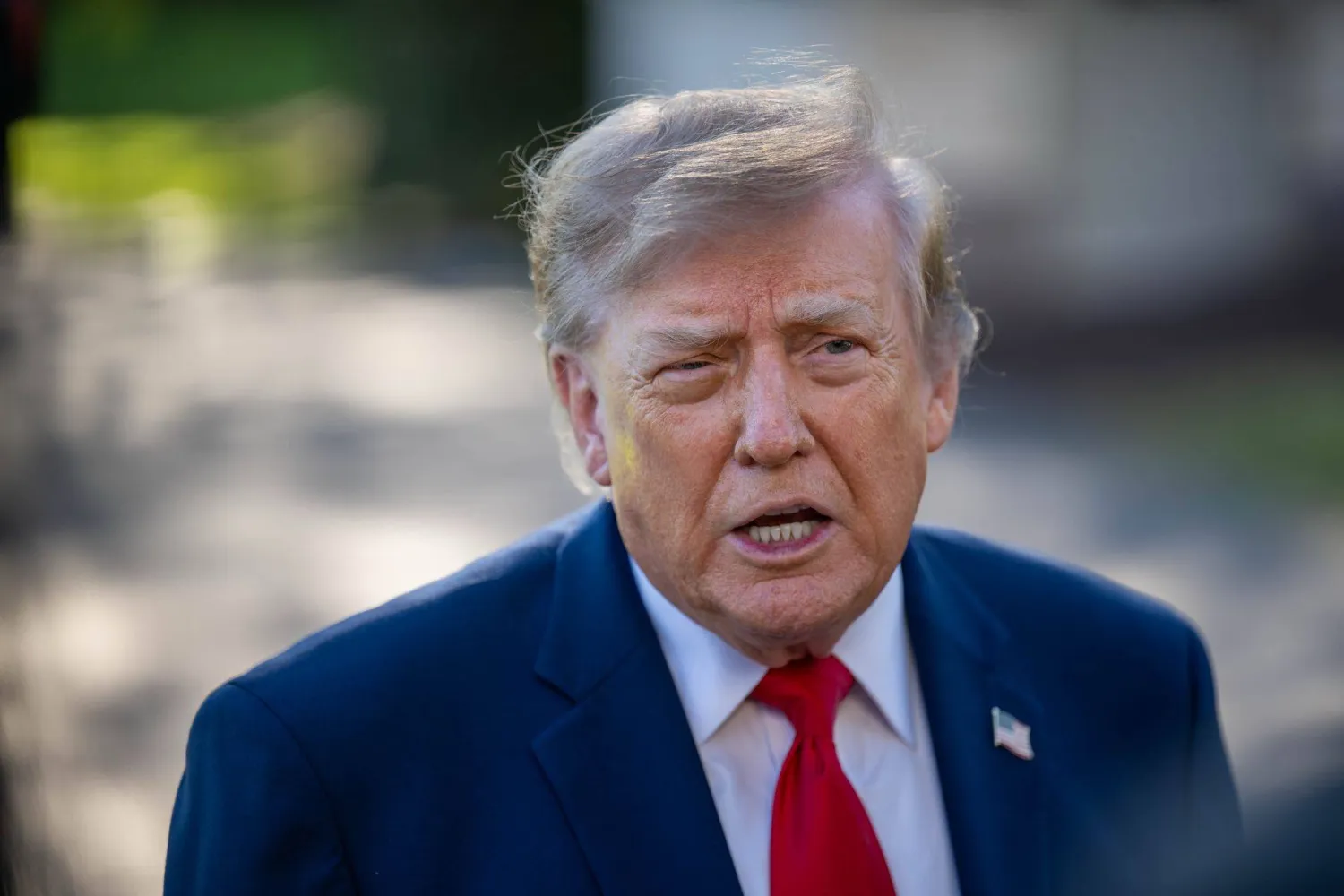

US Envoys in Berlin for Another Round of Ukraine Peace Talks

14 December 2025, Berlin: Jared Kushner (R), entrepreneur and former chief advisor to the President of the United States, arrives at the Hotel Adlon. Photo: Kay Nietfeld/dpa
TT

US Envoys in Berlin for Another Round of Ukraine Peace Talks

14 December 2025, Berlin: Jared Kushner (R), entrepreneur and former chief advisor to the President of the United States, arrives at the Hotel Adlon. Photo: Kay Nietfeld/dpa

US envoys arrived in Berlin Sunday morning for another round of talks intended to secure a deal to end the war in Ukraine.

US President Donald Trump’s special envoy Steve Witkoff and Trump’s son-in-law Jared Kushner were spotted in downtown Berlin by a photographer for German news agency dpa.

Ukrainian President Volodymyr Zelenskyy said that Ukrainian, US and European officials will hold a series of meetings in Berlin in the coming days.

“Most importantly, I will be meeting with envoys of President Trump, and there will also be meetings with our European partners, with many leaders, concerning the foundation of peace — a political agreement to end the war,” Zelenskyy said in an address to the nation late Saturday.

Washington has tried for months to navigate the demands of each side as Trump presses for a swift end to Russia’s war and grows increasingly exasperated by delays. The search for possible compromises has run into major obstacles, including control of Ukraine’s eastern Donetsk region, which is mostly occupied by Russian forces, and security guarantees for Ukraine.

“The chance is considerable at this moment, and it matters for our every city, for our every Ukrainian community,” The Associated Press quoted Zelenskyy as saying. “We are working to ensure that peace for Ukraine is dignified, and to secure a guarantee — a guarantee, above all — that Russia will not return to Ukraine for a third invasion.”

Russian President Vladimir Putin has demanded that Ukraine withdraw its forces from the part of the Donetsk region still under its control and abandon its bid to join NATO among the key conditions for peace — demands Kyiv has rejected.

Putin's foreign affairs adviser Yuri Ushakov told the business daily Kommersant that Russian police and national guard troops would stay in parts of eastern Ukraine’s Donbas even if they become a demilitarized zone under a prospective peace plan — a demand likely to be rejected by Ukraine as US-led negotiations drag on.

Ushakov warned that a search for compromise could take a long time, noting that the US proposals that took into account Russian demands had been “worsened” by alterations proposed by Ukraine and its European allies.

Speaking to Russian state TV in remarks broadcast Sunday, Ushakov said that “the contribution of Ukrainians and Europeans to these documents is unlikely to be constructive," warning that Moscow will “have very strong objections.”

Ushakov added that the territorial issue was actively discussed in Moscow when Witkoff and Kushner met with Putin earlier this month. “The Americans know and understand our position," he said.

German Chancellor Friedrich Merz, who has spearheaded European efforts to support Ukraine alongside French President Emmanuel Macron and UK Prime Minister Keir Starmer, said Saturday that “the decades of the ‘Pax Americana’ are largely over for us in Europe and for us in Germany as well.”

He warned that Putin's aim is “a fundamental change to the borders in Europe, the restoration of the old Soviet Union within its borders.”

“If Ukraine falls, he won’t stop,” Merz warned on Saturday during a party conference in Munich.

Putin has denied plans to restore the Soviet Union or attack any European allies.

As peace efforts continued, Russia and Ukraine exchanged another round of aerial attacks.

Ukraine’s air force said overnight Russia launched ballistic missiles and 138 attack drones at Ukraine. In its daily report, the air force said 110 had been intercepted or downed but missile and drone hits were recorded at six locations.

Zelenskyy said Sunday that hundreds of thousands of families were still without power in the south, east and north-east regions and work was continuing to restore electricity, heat and water to multiple regions following a large-scale attack the previous night.

The Ukrainian president said that in the past week, Russia had launched over 1,500 strike drones, nearly 900 guided aerial bombs and 46 missiles of various types at Ukraine.

“Ukraine needs peace on decent terms, and we are ready to work as constructively as possible. These days will be filled with diplomacy. It’s very important that it brings results,” Zelenskyy said.

Russia’s Defense Ministry said that air defenses downed 235 Ukrainian drones late Saturday and early Sunday.

In the Belgorod region, a drone injured a man and set his house ablaze in the village of Yasnye Zori, regional governor Vyacheslav Gladkov said.

Ukrainian drones struck an oil depot in Uryupinsk in the Volgograd region, triggering a fire, according to the regional governor, Andrei Bocharov.

In the Krasnodar region, the Ukrainian drones attacked the town of Afipsky, where an oil refinery is located. The authorities said that explosions shattered windows in residential buildings but didn’t report any damage to the refinery.


UN Warns Hormuz Standstill Will Hit World’s Most Vulnerable

 The Parnassos crude oil tanker sits anchored as the traffic is down in the Strait of Hormuz, amid the US-Israeli conflict with Iran, in Muscat, Oman, March 10, 2026. (Reuters)
The Parnassos crude oil tanker sits anchored as the traffic is down in the Strait of Hormuz, amid the US-Israeli conflict with Iran, in Muscat, Oman, March 10, 2026. (Reuters)
TT

UN Warns Hormuz Standstill Will Hit World’s Most Vulnerable

 The Parnassos crude oil tanker sits anchored as the traffic is down in the Strait of Hormuz, amid the US-Israeli conflict with Iran, in Muscat, Oman, March 10, 2026. (Reuters)
The Parnassos crude oil tanker sits anchored as the traffic is down in the Strait of Hormuz, amid the US-Israeli conflict with Iran, in Muscat, Oman, March 10, 2026. (Reuters)

The standstill in the Strait of Hormuz caused by the Middle East war could hammer some of the world's most vulnerable people, the United Nations warned Tuesday.

The strait is the only sea passage from the Gulf towards the Indian Ocean, through which nearly a quarter of the world's seaborne oil supplies pass, as well as a significant amount of cargo.

Iran has all but blocked the waterway following the launch of the February 28 US-Israeli airstrikes on the country that triggered the war.

"The current shock comes at a time when many developing economies struggle to service their debt, face a tightening of fiscal space and limited capacity to absorb new price shocks," the UN trade and development agency UNCTAD said.

"Higher energy, fertilizer and transport costs -- including freight rates, bunker fuel prices and insurance premiums -- may increase food costs and intensify cost-of-living pressures, particularly for the most vulnerable," it said.

UNCTAD added that, in terms of seaborne trade volume, in the week before the conflict 38 percent of crude oil, 29 percent of liquified petroleum gas, 19 percent of liquified natural gas and 19 percent refined oil products went through the strait.

But while an average of 129 ships transited daily through the passage between February 1 and 27, that number dropped to just three on March 3.

UNCTAD said the disruptions underscored the vulnerability of critical maritime chokepoints and their potential for disruption to them to send shocks across supply chains and commodity markets.

"Rising energy, transport and food costs could strain public finances and increase pressure on household budgets, potentially heightening economic and social pressures... particularly in economies heavily dependent on imported energy, fertilizers and staple foods," it said.

- Food aid hit -

UN rights chief Volker Turk echoed the alarm for the effect the plunge in commercial shipping activity could have, "particularly for the world's most vulnerable".

"The impact of an oil price surge will have a knock-on effect for macro-economic and social stability in many countries, particularly those already experiencing debt distress," he said.

The UN's World Food Program said the costs and time lost to the Strait of Hormuz disruptions were already impacting its humanitarian operations.

"This is nothing less than another seminal moment in global supply chain history," Jean-Martin Bauer, the director of WFP's food and nutrition analysis service, told reporters in Geneva.

Speaking from the WFP's Rome headquarters, he said shipping lines were diverting services and adding surcharges, leading to congestion "in places that are very far from Hormuz".

"We're seeing congestion in Asia. It's quite a severe disruption that's taking place right now," Bauer said.

"We're needing to go the long way around the Cape of Good Hope to reach some of our key geographies."

WFP's biggest operation is in Sudan, but now it is facing approximately 25 days of additional shipping time.

"It's basically 50 percent more than we would usually have. So that's really extending the supply chain and adding to cost," said Bauer.


Israel Says Iran Hacked Security Cameras

People exercise on the beach in Tel Aviv, Israel, 10 March 2026. (EPA)
TT

Israel Says Iran Hacked Security Cameras

People exercise on the beach in Tel Aviv, Israel, 10 March 2026. (EPA)

Israel's cybersecurity directorate said it had identified "dozens of Iranian breaches into security cameras for espionage purposes" since the start of the war in the Middle East, urging the public to be vigilant.

"The directorate is working to alert hundreds of camera owners and calls on the public to change their passwords and update their software to prevent any security risk, whether national or personal," Cyber Israel wrote on X Monday.

Cyberattacks between Iran and Israel have been a frequent occurrence in recent years, as the two foes conducted a shadow war that culminated in open conflict last June and again on February 28.

In December 2025, former Israeli prime minister Naftali Bennett -- who is set to run against incumbent premier Benjamin Netanyahu in a general election this year -- said he had been the victim of a cyberattack targeting his Telegram account, after hackers claimed to have broken into his phone.

Private messages, videos and photographs said to be taken from Bennett's phone were published on a hacker site named after "Handala", a character symbolizing the Palestinian cause, and on an associated X account.

Iran-linked hackers have stepped up their operations in the region since strikes began on the country, an expert told AFP.

Israeli cybersecurity firm Check Point said in a report that since the launch of the US-Israeli offensive on February 28, it has seen hackers accessing surveillance cameras, which are widely used but often poorly secured.

The images were likely used to assess damage caused by the attacks or "to gather the necessary information" on "the habits (of targeted individuals) or locations to hit", Gil Messing, head of cyberintelligence at Check Point, told AFP.

The hackers "are part of (Iran's) army" and "are largely supported by the state", notably by the Revolutionary Guards and the ministry of intelligence and security, he added.

Last week, the Financial Times reported that Israel had hacked nearly all of Tehran's traffic cameras for years in preparation for the operation that killed Iran's supreme leader Ali Khamenei on the first day of the offensive.


Israeli Army Says Half of Iranian Missiles Have Cluster Munitions

An Iranian missile with cluster munitions flies toward Israel, amid the US-Israel conflict with Iran, as seen from Tel Aviv, Israel, March 9, 2026. (Reuters)
TT

Israeli Army Says Half of Iranian Missiles Have Cluster Munitions

An Iranian missile with cluster munitions flies toward Israel, amid the US-Israel conflict with Iran, as seen from Tel Aviv, Israel, March 9, 2026. (Reuters)

Israel's army estimated on Tuesday that around half of the missiles being fired at the country by Iran contained cluster munitions, posing an added danger to people on the ground.

"Approximately 50 percent of Iranian missiles fired toward Israel carry cluster warheads that disperse into smaller bombs in the air, creating additional falling debris hazards," a military official said, in comments shared by the defense ministry.

Cluster munitions explode in mid-air and scatter bomblets. Some of these submunitions do not explode on impact and can cause casualties over time, particularly among children.

"The radius of the impact is about ten kilometers. Although these contain less explosive material than a standard missile, the impact can still be lethal," the official said.

Two construction workers died from shrapnel wounds after missiles were fired at central Israel on Monday, with emergency workers at the site telling AFP the damage appeared to have been caused by a cluster munition.

Iran and Israel are not among the more than 100 countries that are party to the 2008 Convention on Cluster Munitions, which prohibits their use, transfer, production and storage.

Both have reportedly used the munitions in earlier conflicts.

During the 12-day war between Iran and Israel in June 2025, Amnesty International said Tehran used cluster munitions at least three times, based on analysis of photos and videos, as well as media reports.

In 2007, a US government investigation found that Israel had probably violated arms export agreements with Washington when it dropped US-made cluster bombs in Lebanon during its war with Hezbollah the previous year.