

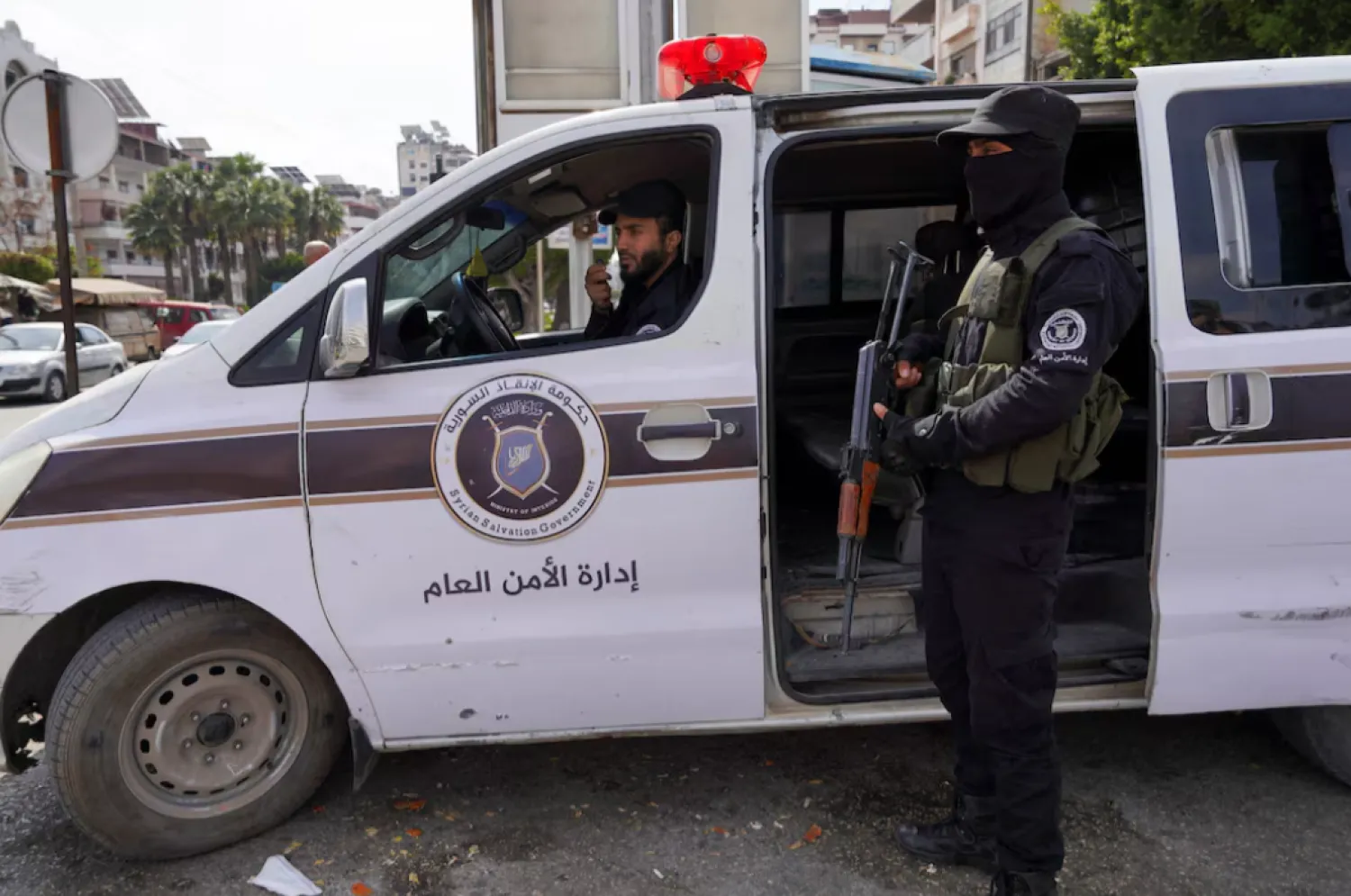

Syrian Who Killed Americans was Part of Security Forces

Members of the Syrian security forces secure an area -REUTERS/Karam al-Masri
TT

Syrian Who Killed Americans was Part of Security Forces

Members of the Syrian security forces secure an area -REUTERS/Karam al-Masri

Syria's interior ministry said Sunday the gunman who killed three Americans in the central Palmyra region the previous day was a member of the security forces who was to have been fired for extremism.

Two US troops and a civilian interpreter died in what the Syrian government described as a "terrorist attack" on Saturday, while Washington said it had been carried out by an ISIS militant who was then killed.

The Syrian authorities "had decided to fire him" from the security forces before the attack for holding "extremist ideas" and had planned to do so on Sunday, interior ministry spokesman Noureddine al-Baba told state television.

A Syrian security official told AFP on Sunday that "11 members of the general security forces were arrested and brought in for questioning after the attack".

The official who spoke on condition of anonymity said the gunman had belonged to the security forces "for more than 10 months and was posted to several cities before being transferred to Palmyra".

Palmyra, home to UNESCO-listed ancient ruins, was controlled by ISIS at the height of its territorial expansion in Syria.

The incident is the first of its kind reported since the overthrow of longtime Syrian ruler Bashar al-Assad in December last year, and rekindled the country's ties with the United States.

US President Donald Trump vowed "very serious retaliation" following Saturday's attack.

A Syrian defense ministry official told AFP on condition of anonymity that prior to the attack, US forces had "arrived by land from the direction of the Al-Tanf military base" in southeastern Syria, near the border with Jordan.

"The joint Syrian-American delegation first toured the city of Palmyra, then proceeded to the T-4 airbase before returning to a base in Palmyra", the source added.

A Syrian military official who requested anonymity said on Saturday that the shots were fired "during a meeting between Syrian and American officers" at a Syrian base in Palmyra.

However, a Pentagon official speaking on condition of anonymity told AFP that the attack "took place in an area where the Syrian president does not have control."

- Warnings -

Pentagon spokesman Sean Parnell said the soldiers "were conducting a key leader engagement" in support of counter-terrorism operations when the attack occurred, while US envoy to Syria Tom Barrack said the ambush targeted "a joint US-Syrian government patrol".

Trump called the incident "an ISIS attack against the US, and Syria, in a very dangerous part of Syria, that is not fully controlled by them", using another term for the group.

He said the three other US troops injured in the incident were "doing well".

The official SANA news agency said the attack also wounded two members of the Syrian security forces.

Syrian Foreign Minister Asaad al-Shaibani said Damascus "strongly condemns the terrorist attack".

In an interview on state television on Saturday, Syrian Interior Ministry spokesman Anwar al-Baba said there had been "prior warnings from the internal security command to allied forces in the desert region".

"The international coalition forces did not take the Syrian warnings of a possible ISIS infiltration into consideration," he said.

ISIS seized swathes of Syrian and Iraqi territory in 2014 during Syria's civil war, before being territorially defeated in the country five years later.

Its fighters still maintain a presence, however, particularly in Syria's vast desert.

Last month, during Syrian President Ahmed al-Sharaa's historic visit to Washington, Damascus formally joined the US-led global coalition against ISIS.

US forces are deployed in Syria's Kurdish-controlled northeast as well as at Al-Tanf near the border with Jordan.



Lebanon FM Urges Iran to Find ‘New Approach’ on Hezbollah Arms

Iranian Foreign Minister Abbas Araghchi (L) shakes hands with Lebanese Minister of Foreign Affairs and Emigrants Youssef Raggi (R) at the Foreign Ministry in downtown Beirut, Lebanon, 09 January 2026. (EPA)
TT

Lebanon FM Urges Iran to Find ‘New Approach’ on Hezbollah Arms

Iranian Foreign Minister Abbas Araghchi (L) shakes hands with Lebanese Minister of Foreign Affairs and Emigrants Youssef Raggi (R) at the Foreign Ministry in downtown Beirut, Lebanon, 09 January 2026. (EPA)

Lebanese Foreign Minister Youssef Raggi on Friday urged his visiting Iranian counterpart to find a "new approach" to the thorny issue of disarming the Iran-backed Hezbollah group.

Lebanon is under heavy US pressure to disarm Hezbollah, which was heavily weakened in more than a year of hostilities with Israel that largely ended with a November 2024 ceasefire, but Iran and the group have expressed opposition to the move.

Iran has long wielded substantial influence in Lebanon by funding and arming Hezbollah, but as the balance of power shifted since the recent conflict, officials have been more critical towards Tehran.

"The defense of Lebanon is the sole responsibility of the Lebanese state", which must have a monopoly on weapons, Raggi told Iranian Foreign Minister Abbas Araghchi, a Lebanese foreign ministry statement said.

Raggi called on Iran to engage in talks with Lebanon to find "a new approach to the issue of Hezbollah's weapons, drawing on Iran's relationship with the party, so that these weapons do not become a pretext for weakening Lebanon".

He asked Araghchi "whether Tehran would accept the presence of an illegal armed organization on its own territory".

Last month, Raggi declined an invitation to visit Iran and proposed meeting in a neutral third country.

Lebanon's army said Thursday that it had completed the first phase of disarming Hezbollah, doing so in the south Lebanon area near the border with Israel, which called the efforts "far from sufficient".

Araghchi also met President Joseph Aoun on Friday and was set to hold talks with several other senior officials.

After arriving on Thursday, he visited the mausoleum of former Hezbollah leader Hassan Nasrallah, who was killed in a massive Israeli air strike on south Beirut in September 2024.

Last August, Lebanese leaders firmly rejected any efforts at foreign interference during a visit by Iran's security chief Ali Larijani, with the prime minister saying Beirut would "tolerate neither tutelage nor diktat" after Tehran voiced opposition to plans to disarm Hezbollah.


Hamas Says Israeli Strikes on Gaza ‘Cannot Happen without American Cover’

 Palestinians inspect damaged tents at a displacement camp following an Israeli strike in Gaza City, Friday, Jan. 9, 2026. (AP)
Palestinians inspect damaged tents at a displacement camp following an Israeli strike in Gaza City, Friday, Jan. 9, 2026. (AP)
TT

Hamas Says Israeli Strikes on Gaza ‘Cannot Happen without American Cover’

 Palestinians inspect damaged tents at a displacement camp following an Israeli strike in Gaza City, Friday, Jan. 9, 2026. (AP)
Palestinians inspect damaged tents at a displacement camp following an Israeli strike in Gaza City, Friday, Jan. 9, 2026. (AP)

A Hamas official said Friday that Israeli strikes on Gaza "cannot happen without American cover", the day after Israeli attacks killed at least 13 people according to the Palestinian territory's civil defense agency.

Since October 10, a fragile US-sponsored truce in Gaza has largely halted the fighting between Israeli forces and Hamas, but both sides have alleged frequent violations.

Gaza's civil defense agency -- which operates as a rescue force under Hamas authority -- said Israeli attacks across the territory on Thursday killed at least 13 people, including five children.

In a statement on Friday morning, the Israeli military said it "precisely struck Hamas terrorists and terror infrastructure" in response to a "failed projectile" launch.

"Just yesterday, 13 people were killed in different areas of the Strip on fabricated pretexts, in addition to the hundreds of killed and wounded who preceded them after the ceasefire," Hamas political bureau member, Bassem Naim, wrote on Telegram.

"This cannot happen without American cover or a green light."

Israeli forces have killed at least 439 Palestinians in Gaza since the ceasefire took effect, according to the health ministry in the Hamas-run territory.

The Israeli military said gunmen have killed three of its soldiers during the same period.

Media restrictions in Gaza and difficulties in accessing many areas mean AFP is unable to independently verify the tolls and details provided by both sides.

Naim also accused Israeli Prime Minister Benjamin Netanyahu of "evading his commitments and escalating in order to sabotage the agreement and return to war".

He said the Palestinian movement had "complied with all its obligations under the agreement" and was "ready to engage positively and constructively with the next steps of the plan".

Israel has previously said it is awaiting the return of the last hostage body held in Gaza before beginning talks on the second phase of the ceasefire and has insisted that Hamas disarm.

Hamas officials told AFP that search operations for the remains of deceased hostage Ran Gvili resumed on Wednesday after a two-week pause due to bad weather.


Germany Calls on Israel to Halt E1 Settlement Plan

A view of Israeli settlement of Maale Adumim, in the West Bank, Sunday, June 18, 2023. (AP)
TT

Germany Calls on Israel to Halt E1 Settlement Plan

A view of Israeli settlement of Maale Adumim, in the West Bank, Sunday, June 18, 2023. (AP)

Germany calls on Israel to halt its controversial ​E1 settlement project, said a foreign ministry spokesperson in Berlin on Friday, warning that construction carries the risk of ‌creating more ‌instability in the ‌West ⁠Bank ​and ‌the region.

"The plans for the E1 settlement project, it must be said, are part of a comprehensive ⁠intensification of settlement policy in ‌the West Bank, ‍which ‍we have recently ‍observed," said the spokesperson at a regular government press conference.

"It carries the ​risk of creating even more instability, as it ⁠would further restrict the mobility of the Palestinian population in the West Bank," as well as jeopardize the prospects of a two-state solution, the spokesperson added.