


Ukraine Peace Talks Stretch into Second Day at Start of Pivotal Week for Europe

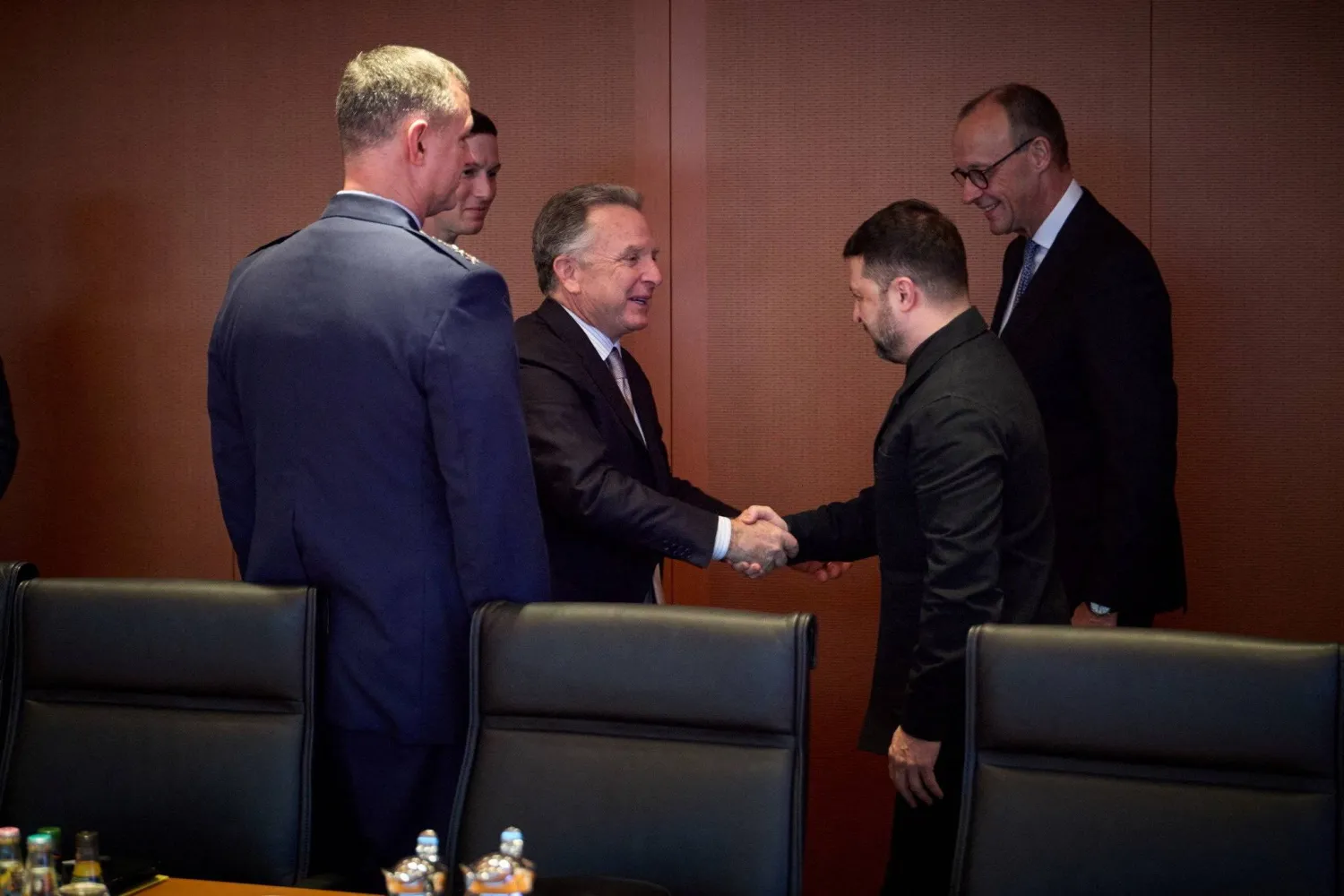
Ukraine's President Volodymyr Zelenskiy shakes hands with US Special Envoy to the Middle East Steve Witkoff next to U.S. President Donald Trump's son-in-law Jared Kushner, German Chancellor Friedrich Merz and NATO Supreme Allied Commander Europe (SACEUR), US Air Force General Alexus Grynkewich, amid Russia's attack on Ukraine, in Berlin, Germany, December 14, 2025. Ukrainian Presidential Press Service/Handout via REUTERS
TT

Ukraine Peace Talks Stretch into Second Day at Start of Pivotal Week for Europe

Ukraine's President Volodymyr Zelenskiy shakes hands with US Special Envoy to the Middle East Steve Witkoff next to U.S. President Donald Trump's son-in-law Jared Kushner, German Chancellor Friedrich Merz and NATO Supreme Allied Commander Europe (SACEUR), US Air Force General Alexus Grynkewich, amid Russia's attack on Ukraine, in Berlin, Germany, December 14, 2025. Ukrainian Presidential Press Service/Handout via REUTERS

Ukrainian President Volodymyr Zelenskiy will resume talks with US President Donald Trump's envoys in Berlin on Monday, after the US side said a "lot of progress" had been made on ending Europe's deadliest conflict since World War Two.

Zelenskiy will again meet US envoy Steve Witkoff and Trump's son-in-law Jared Kushner after five hours of talks on Sunday, with other European leaders also holding meetings in the German capital throughout the day.

Ukraine said on Sunday it was willing to drop its ambition to join the NATO alliance in exchange for Western security guarantees. But it was not immediately clear how far talks had progressed on that or other vital issues such as the future of Ukrainian territory, and how much the talks in Berlin could persuade Russia to agree to a ceasefire.

EUROPEAN DIPLOMACY FACES CRUCIAL WEEK

The talks come at the start of a pivotal week for Europe, with an EU summit on Thursday set to decide whether it can underwrite a massive loan to Ukraine with frozen Russian central bank assets.

Europe has come under fire from the Trump administration in recent weeks over its policies on migration, security and regulating big tech. The European Union and national governments have struggled to find a unified response to the US criticism.

EU foreign ministers are meeting in Brussels on Monday to agree on new sanctions against Russia, although the possibility of an 11th-hour hitch to agreeing an EU trade deal with Latin America threatens to further undermine their attempts to put on a show of strength.

"We will continue to do everything we can to ensure that Ukraine can achieve the best possible negotiating position and, in the event of failure, that it has all the necessary means to retaliate against this war of aggression," German Foreign Minister Johann Wadephul told Deutschlandfunk radio.

Finnish President Alexander Stubb, who has been closely involved in the Ukraine talks and was meeting Zelenskiy on Monday morning ahead of the US negotiations, sounded a tentatively hopeful note.

"I think we are at a critical moment in negotiations for peace," he told Dutch TV program Buitenhof broadcast on Sunday.

"And at the same time, we're probably closer to a peace agreement than we have been at any time during these four years," said Stubb, who also met Kushner in Berlin on Sunday evening.

SECURITY GUARANTEES AMONG ISSUES IN FOCUS

Stubb said the sides were working on three main documents - the framework of a 20-point peace plan, one relating to security guarantees for Ukraine, and a third on reconstruction of the country.

"So we're looking at the details together with the Americans, Europeans, and the Ukrainians," he added.

European Commission President Ursula von der Leyen and the leaders of Britain, Italy, the Netherlands, Poland and Sweden were among those expected in the German capital on Monday.

Russian President Vladimir Putin has repeatedly demanded that Ukraine officially renounce its NATO ambitions and withdraw troops from the roughly 10% of the eastern Donbas region which Kyiv still controls.

Moscow has also said that Ukraine must be a neutral country and that no NATO troops can be stationed there.

Russian sources earlier this year said Putin wants a "written" pledge by major Western powers not to enlarge the US-led NATO alliance eastwards - shorthand for formally ruling out membership to Ukraine, Georgia, Moldova and other former Soviet republics.

EU foreign policy chief Kaja Kallas said on Monday that taking over Ukraine's Donbas region will "not be Putin's endgame".

"We have to understand that if he gets Donbas, then the fortress is down and then they definitely move on to taking the whole of Ukraine," Kallas, a former Estonian prime minister, told reporters.

"If Ukraine goes, then other regions are also in danger."


Thousands Protest Israeli President Herzog’s Visit to Australia

 Demonstrators gather at Town Hall Square to protest against Israeli President Isaac Herzog's state visit to Australia following a deadly mass shooting during a Jewish Hanukkah celebration at Bondi Beach on December 14, 2025, in Sydney, Australia, February 9, 2026. (Reuters)
Demonstrators gather at Town Hall Square to protest against Israeli President Isaac Herzog's state visit to Australia following a deadly mass shooting during a Jewish Hanukkah celebration at Bondi Beach on December 14, 2025, in Sydney, Australia, February 9, 2026. (Reuters)
TT

Thousands Protest Israeli President Herzog’s Visit to Australia

 Demonstrators gather at Town Hall Square to protest against Israeli President Isaac Herzog's state visit to Australia following a deadly mass shooting during a Jewish Hanukkah celebration at Bondi Beach on December 14, 2025, in Sydney, Australia, February 9, 2026. (Reuters)
Demonstrators gather at Town Hall Square to protest against Israeli President Isaac Herzog's state visit to Australia following a deadly mass shooting during a Jewish Hanukkah celebration at Bondi Beach on December 14, 2025, in Sydney, Australia, February 9, 2026. (Reuters)

Thousands gathered across Australia on Monday to protest the arrival of Israeli President Isaac Herzog, who is on a multi-city trip aimed at expressing solidarity with Australia's Jewish community following a deadly mass shooting last year.

Herzog is visiting Australia this week following an invitation from Australian Prime Minister Anthony Albanese in the aftermath of the December 14 shooting at a Hanukkah event at Sydney's Bondi Beach that killed 15.

The visit has attracted the ire of some people in Australia, who accuse Herzog of being complicit in civilian deaths in Gaza. Pro-Palestine groups have organized protests ‌in cities and ‌towns across the country on Monday evening.

In Sydney, thousands gathered ‌in ⁠a square ‌in the city's central business district, listening to speeches and shouting pro-Palestine slogans.

"The Bondi massacre was terrible but from our Australian leadership there’s been no acknowledgment of the Palestinian people and the Gazans," said Jackson Elliott, a 30-year-old protestor from Sydney.

"Herzog has dodged all the questions about the occupation and says this visit is about Australia and Israeli relations but he is complicit."

There was a heavy police presence with a helicopter circling overhead and officers patrolling on horseback.

About 3,000 police personnel ⁠will be deployed across Sydney during Herzog's visit to the city.

PRESIDENT COMMEMORATES LIVES LOST

Herzog began his visit at Bondi ‌Beach, where he laid a wreath at a memorial for ‍the victims of the attack. He ‍also met survivors and the families of 15 people killed in the shooting.

"This was ‍also an attack on all Australians. They attacked the values that our democracies treasure, the sanctity of human life, the freedom of religion, tolerance, dignity and respect," Herzog said in remarks at the site.

In a statement, the Executive Council of Australian Jewry Co-Chief Executive Alex Ryvchin said Herzog's visit "will lift the spirits of a pained community."

Some Jews oppose the visit.

The Jewish Council of Australia, a vocal critic of the Israeli government, released an open letter ⁠on Monday signed by over 1,000 Jewish Australian academics and community leaders, urging Albanese to rescind Herzog's invitation.

POLICE DEPLOY SPECIAL POWERS

Authorities in Sydney have declared Herzog's visit a major event and have been authorized to use rarely invoked powers during the visit, including the ability to separate and move crowds, restrict their entry to certain areas, direct people to leave and search vehicles.

The Palestine Action Group organizing the protest failed in a legal challenge in a Sydney court on Monday against restrictions placed on the expected demonstration.

"We're hoping we won't have to use any powers, because we've been liaising very closely with the protest organizers," New South Wales Police Assistant Commissioner Peter McKenna told Nine News on Monday.

"Overall, it is all of the community that we ‌want to keep safe ... we'll be there in significant numbers just to make sure that the community is safe."


Crackdown on Dissent After Nationwide Protests in Iran Widens to Ensnare Reformist Figures

Iranians cross a road near an anti-US and anti-Israeli billboard reading "You start... we finish it" in Palestine Square in Tehran, Iran, 09 February 2026, amid heightened regional tensions. (EPA)
TT

Crackdown on Dissent After Nationwide Protests in Iran Widens to Ensnare Reformist Figures

Iranians cross a road near an anti-US and anti-Israeli billboard reading "You start... we finish it" in Palestine Square in Tehran, Iran, 09 February 2026, amid heightened regional tensions. (EPA)

Iranian security forces have launched a campaign to arrest figures within the country's reformist movement, reports said Monday.

That widens a crackdown on dissent after authorities earlier put down nationwide protests in violence that killed thousands and saw tens of thousands more detained.

Detained Nobel Peace Prize laureate Narges Mohammadi has received another prison sentence of over seven years. It signals a widening effort to silence anyone opposed to the bloody suppression of unrest by Iran's theocracy as it faces new nuclear talks with the United States. President Donald Trump has repeatedly warned he could launch an attack on the country if no deal is reached.

Media reports quoted officials within the reformist movement, which seeks to change Iran's theocracy from inside, as saying at least four of their members had been arrested. They include Azar Mansouri, the head of the Reformist Front, which represents multiple reformist factions; and former diplomat Mohsen Aminzadeh, who served under reformist President Mohammad Khatami.

Also detained was Ebrahim Asgharzadeh, who led students who stormed the US Embassy in Tehran in 1979, sparking the 444-day hostage crisis.

Their arrests likely stem from a reformist statement in January that called for Iran's 86-year-old Supreme Leader Ali Khamenei to resign from his position and have a transitional governing council oversee the country.

Iran's state-run IRNA news agency quoted a statement from prosecutors in Tehran, the country's capital, saying four people had been arrested and others summoned to meet authorities. It accused those allegedly involved of “organizing and leading ... activities aimed at disrupting the political and social situation in the country amid military threats from the United States and the Zionist regime.”

“Having bludgeoned the streets into silence with exemplary cruelty, the regime has shifted its attention inward, fixing its stare on its loyal opposition,” wrote Ali Vaez, an Iran expert at the International Crisis Group.

“The reformists, sensing the ground move beneath them, had begun to drift — and power, ever paranoid, is now determined to cauterize dissent before it learns to walk.”

However, it remains unclear just how much political support reformists have within Iran. The anger on the streets of Iran during the demonstrations, heard in people shouting “Death to Khamenei!” and in support of the country's exiled crown prince, appeared to lump reformists in with all other politicians now working in the country.

Iran and the US held new nuclear talks last week in Oman. Foreign Minister Abbas Araghchi, speaking Sunday to diplomats at a summit in Tehran, signaled that Iran would stick to its position that it must be able to enrich uranium — a major point of contention with Trump, who bombed Iranian atomic sites in June during the 12-day Iran-Israel war.

Israeli Prime Minister Benjamin Netanyahu is to travel to Washington this week, with Iran expected to be the major subject of discussion, his office said.

The US has moved the aircraft carrier USS Abraham Lincoln, ships and warplanes to the Middle East to pressure Iran into an agreement and have the firepower necessary to strike the country should Trump choose to do so.

Meanwhile, Iran issued a warning to pilots that it planned “rocket launches” Monday into Tuesday in an area over the country’s Semnan province, home to the Imam Khomeini Spaceport. Such launches have corresponded in the past with Iran marking the anniversary of its 1979 revolution.


China Vows ‘Resolute Response’ to Any Reckless Acts After Japan Election

 Japan's Prime Minister Sanae Takaichi, leader of the ruling Liberal Democratic Party (LDP), arrives at the Prime Minister's office after her party's historic election win in Sunday's poll in Tokyo, Japan, February 9, 2026. (Reuters)
Japan's Prime Minister Sanae Takaichi, leader of the ruling Liberal Democratic Party (LDP), arrives at the Prime Minister's office after her party's historic election win in Sunday's poll in Tokyo, Japan, February 9, 2026. (Reuters)
TT

China Vows ‘Resolute Response’ to Any Reckless Acts After Japan Election

 Japan's Prime Minister Sanae Takaichi, leader of the ruling Liberal Democratic Party (LDP), arrives at the Prime Minister's office after her party's historic election win in Sunday's poll in Tokyo, Japan, February 9, 2026. (Reuters)
Japan's Prime Minister Sanae Takaichi, leader of the ruling Liberal Democratic Party (LDP), arrives at the Prime Minister's office after her party's historic election win in Sunday's poll in Tokyo, Japan, February 9, 2026. (Reuters)

Beijing warned Tokyo on Monday that reckless actions would be met with a "resolute response", a day after Japan's Prime Minister Sanae Takaichi, who is viewed as critical of China, won a landslide election.

China and Japan have been locked in a spat over comments by Takaichi in November that Tokyo could intervene militarily in any attack on self-ruled Taiwan.

China claims the democratic island as part of its territory and has not ruled out force to annex it.

A spokesman for China's foreign ministry on Monday urged Japan to retract the comments and warned of consequences for any rash actions.

"If the far-right forces in Japan misjudge the situation and act recklessly, they will inevitably face resistance from the Japanese people and a resolute response from the international community," spokesman Lin Jian told a regular news conference.

"We once again urge the Japanese side to retract the erroneous remarks made by Takaichi regarding Taiwan and demonstrate basic sincerity in safeguarding the political foundation of China-Japan relations, through concrete actions," he said.

In the wake of Takaichi's comments in November, China has discouraged its nationals from travelling to Japan, citing deteriorating public security and criminal acts against Chinese nationals in the country.

In the latest escalation of the row in December, Chinese military aircraft locked radar onto Japanese jets, prompting Tokyo to summon Beijing's ambassador.

Beijing also reportedly choked off exports to Japan of rare-earth products crucial for making everything from electric cars to missiles.

And last month, two popular pandas departed Tokyo for China, leaving Japan without any of the beloved bears for the first time in 50 years.
