


Iran: IAEA Has No Right to Inspect Nuclear Sites Attacked in June 

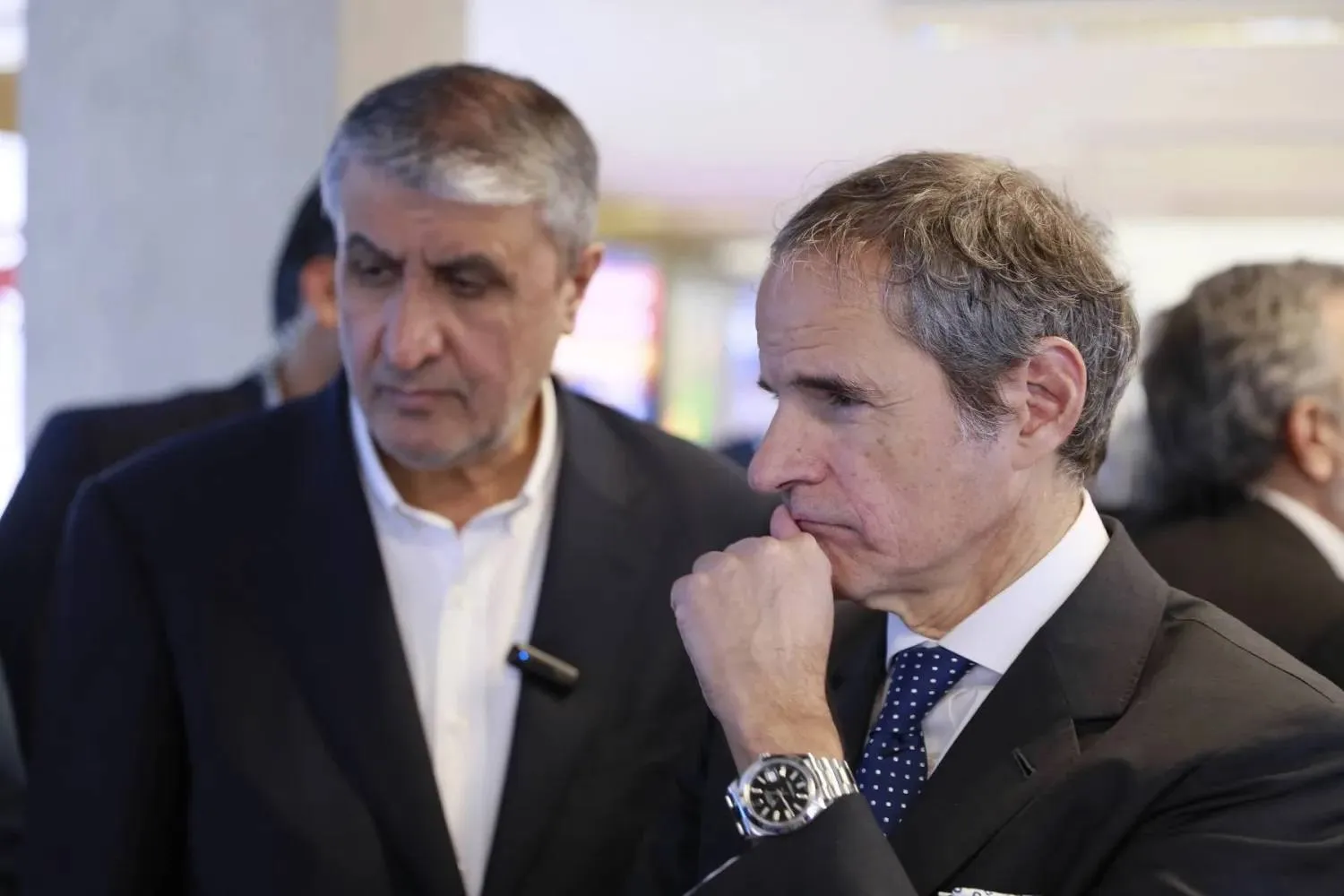
A photo released by the Atomic Energy Organization of Iran (AEOI) shows its chief Mohammad Eslami, and IAEA director Raphael Grossi in Tehran last month.
TT

Iran: IAEA Has No Right to Inspect Nuclear Sites Attacked in June 

A photo released by the Atomic Energy Organization of Iran (AEOI) shows its chief Mohammad Eslami, and IAEA director Raphael Grossi in Tehran last month.

The UN atomic watchdog has no right to demand inspections of sites attacked by the United States and Israel during the June war, said head of the Atomic Energy Organization of Iran (AEOI), Mohammad Eslami, stressing the need for a clear protocol to allow UN inspectors in such facilities.

Speaking to reporters in Tehran, Eslami criticized the International Atomic Energy Agency’s (IAEA) call for renewed inspections of three nuclear sites hit during the 12-day war, saying Tehran had already allowed inspectors to visit undamaged sites.

On Monday, IAEA chief Rafael Grossi reiterated that Iran must allow inspectors access to the three key nuclear facilities that enrich uranium and that were hit by the US and Israel.

Speaking to RIA Novosti, Grossi said: “The agency’s activities in Iran are very limited. We are only allowed to access sites that were not hit.”

“The other three sites, Natanz, Fordow, and Isfahan, are even more significant since they still contain substantial amount of nuclear material and equipment, and we need to return there,” he urged.

In another interview with Radio France International (RFI), Grossi said: “Contact with Iran remains in place. We haven’t yet been able to restore cooperation to the required level, but I believe it is critically important.”

The dialogue continues through behind-the-scenes negotiations and confidential contacts, he added.

In response to Grossi’s demands, Eslami emphasized that inspections of facilities hit during the June war require a clear and defined protocol, reported the state-run ISNA agency.

“The UN agency, which has issued no condemnation [regarding Israel and US attacks on Iran in June] and has no established guidelines, has no right to claim it intends to conduct inspections,” he added.

“Pressure exerted on us under the influence of Israel, three European countries, and the United States has no impact on Iran. It is the agency that must answer to Iran and to the world,” he stressed.

Eslami also said that all of Iran’s nuclear facilities are fully registered with and have been under IAEA supervision.

“The current situation demands accountability from the agency, not further questioning of Iran,” he said, calling on the IAEA to clarify its position, explain why no condemnation was issued, and specify what procedures it intends to follow.

Also in Tehran, AEOI spokesperson Behrouz Kamalvandi said there are currently no IAEA inspections under way, adding that inspections carried out in recent weeks were conducted with the permission of the Supreme National Security Council of Iran and in line with the law on suspending cooperation with the IAEA.

He said all of those inspections were related to industrial matters at the sites that had not been attacked in June.

“Measures must definitely be considered regarding facilities that have been attacked,” he said, stressing that the safeguards agreement does not contain provisions for wartime conditions, and therefore, an understanding must be reached on this issue.

In such circumstances, he added, security becomes the most important matter and negotiations must be conducted with a security-oriented approach.


UK Police Charge Two Men with Belonging to Hezbollah, Attending Terrorism Training

Hezbollah flags flutter as protesters, mainly Houthi supporters, rally to show support to Palestinians in the Gaza Strip and Lebanon's Hezbollah, in Sanaa, Yemen September 27, 2024. (Reuters)
TT

UK Police Charge Two Men with Belonging to Hezbollah, Attending Terrorism Training

Hezbollah flags flutter as protesters, mainly Houthi supporters, rally to show support to Palestinians in the Gaza Strip and Lebanon's Hezbollah, in Sanaa, Yemen September 27, 2024. (Reuters)

Two British-Lebanese men appeared in a London court on Tuesday, charged with belonging to the banned Iran-backed group Hezbollah and attending terrorism training camps, with one of the two accused of helping procure parts for drones.

Annis Makki, 40, is charged with attending a terrorist training camp at the Birket Jabbour airbase in Lebanon in 2021, being involved in the preparation of terrorist acts, being a member of Hezbollah, and expressing support both for Hezbollah and the banned Palestinian group Hamas.

Mohamed Hadi Kassir, 33, is also accused of belonging to Hezbollah and attending a training camp in Baffliyeh in south Lebanon in 2015 and at the Birket Jabbour airbase in 2021. He indicated not guilty pleas to the charges.

Prosecutor Kristel Pous told Westminster Magistrates' Court that Kassir was "an entrenched member of Hezbollah" and that images had been found of him "training in a Hezbollah-controlled camp and undertaking hostage training exercises in 2015".

Pous also said Makki had access to a "wide-ranging Hezbollah network" which was linked to facilitating the acquisition of parts to be used in unmanned aerial vehicles.

Judge Paul Goldspring remanded both men in custody until their next court appearance at London's Old Bailey court on January 16.

The men were arrested at their home addresses in London in April and rearrested last week when they were subsequently charged.

Commander Dominic Murphy, head of London's Counter Terrorism Policing, said in a statement before Tuesday's hearing: "I want to reassure the public that I do not assess there is an ongoing threat to the wider public as a result of the activities of these two individuals."


Millions Facing Acute Food Insecurity in Afghanistan as Winter Looms, UN Warns

Boys stay on a hilltop overlooking Kabul, Afghanistan, Feb. 27, 2022. (AP)
TT

Millions Facing Acute Food Insecurity in Afghanistan as Winter Looms, UN Warns

Boys stay on a hilltop overlooking Kabul, Afghanistan, Feb. 27, 2022. (AP)

More than 17 million people in Afghanistan are facing crisis levels of hunger in the coming winter months, the leading international authority on hunger crises and the UN food aid agency warned Tuesday.

The number at risk is some 3 million more than a year ago.

Economic woes, recurrent drought, shrinking international aid and influx of Afghans returning home from countries like neighboring Iran and Pakistan have strained resources and added to the pressures on food security, reports the Integrated Food Security Phase Classification, known as IPC, which tracks hunger crises.

"What the IPC tells us is that more than 17 million people in Afghanistan are facing acute food insecurity. That is 3 million more than last year," said Jean-Martin Bauer, director of food security at the UN's World Food Program, told reporters in Geneva.

"There are almost 4 million children in a situation of acute malnutrition," he said by video from Rome. "About 1 million are severely acutely malnourished, and those are children who actually require hospital treatment."

Food assistance in Afghanistan is reaching only 2.7% of the population, the IPC report says — exacerbated by a weak economy, high unemployment and lower inflows of remittances from abroad — as more than 2.5 million people returned from Iran and Pakistan this year.

More than 17 million people, or more than one-third of the population, are set to face crisis levels of food insecurity in the four-month period through to March 2026, the report said. Of those, 4.7 million could face emergency levels of food insecurity.

An improvement is expected by the spring harvest season starting in April, IPC projected.

The UN last week warned of a "severe" and "precarious" crisis in the country as Afghanistan enters its first winter in years without US foreign assistance and almost no international food distribution.

Tom Fletcher, the UN humanitarian chief, told the Security Council on Wednesday that the situation has been exacerbated by "overlapping shocks," including recent deadly earthquakes, and the growing restrictions on humanitarian aid access and staff.

While Fletcher said nearly 22 million Afghans will need UN assistance in 2026, his organization will focus on 3.9 million facing the most urgent need of lifesaving help in light of the reduced donor contributions.


Suspected Militants Kill 2, Including a Police Officer Guarding Polio Team in Northwestern Pakistan

A health worker marks a child’s finger after administering a polio vaccination in Hyderabad, Pakistan, 15 December 2025. EPA/NADEEM KHAWAR
TT

Suspected Militants Kill 2, Including a Police Officer Guarding Polio Team in Northwestern Pakistan

A health worker marks a child’s finger after administering a polio vaccination in Hyderabad, Pakistan, 15 December 2025. EPA/NADEEM KHAWAR

Suspected militants opened fire on a police officer guarding a team of polio workers in northwestern Pakistan on Tuesday, killing the officer and a passerby before fleeing, police said.
No polio worker was harmed in the attack that occurred in Bajaur, a district of Khyber Pakhtunkhwa province bordering Afghanistan, according to local police chief Samad Khan, The Associated Press said.
No group immediately claimed responsibility for the attack, but suspicion is likely to fall on the Pakistani Taliban and other militant groups blamed by the government for similar attacks in the region and elsewhere in the country.
The shooting came a day after Pakistan launched a weeklong nationwide vaccination campaign aimed at immunizing 45 million children. According to the World Health Organization, Pakistan and Afghanistan remain the only two countries where polio has not been eradicated.
Prime Minister Shehbaz Sharif condemned the attack in a statement and vowed strong action against those responsible.
Pakistan has reported 30 polio cases since January, down from 74 during the same period last year, according to a statement from the government-run Polio Eradication Initiative.
Pakistan regularly launches campaigns against polio despite attacks on the workers and police assigned to the inoculation drives. Militants falsely claim the vaccination campaigns are a Western conspiracy to sterilize children.
More than 200 polio workers and police assigned to protect them have been killed in Pakistan since the 1990s, according to health and security officials.
