

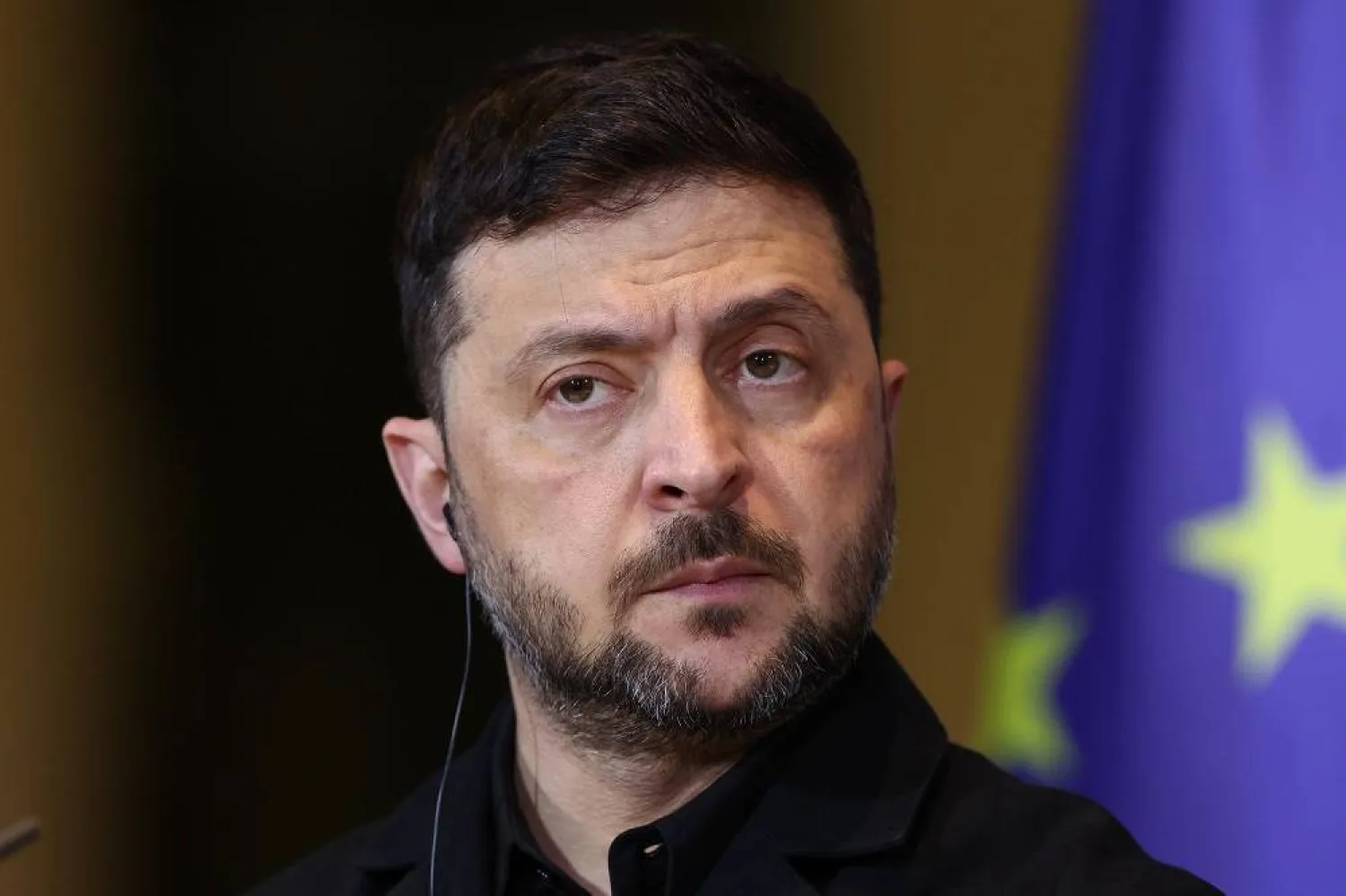

Zelenskyy Says Peace Proposals to End War in Ukraine Could Be Presented to Russia within Days 

Ukraine's President Volodymyr Zelenskyy listens during a press conference with German Chancellor Friedrich Merz at the Chancellery in Berlin, Germany, Monday, Dec. 15, 2025. (AP)
TT

Zelenskyy Says Peace Proposals to End War in Ukraine Could Be Presented to Russia within Days 

Ukraine's President Volodymyr Zelenskyy listens during a press conference with German Chancellor Friedrich Merz at the Chancellery in Berlin, Germany, Monday, Dec. 15, 2025. (AP)

Ukrainian President Volodymyr Zelenskyy says proposals negotiated with US officials on a peace deal to end his country’s nearly four-year war with Russia could be finalized within days, after which American envoys will present them to the Kremlin before further possible meetings in the United States next weekend.

Zelenskyy told reporters late Monday that a draft peace plan discussed with the US during talks in Berlin earlier in the day is “very workable.” He cautioned, however, that some key issues — notably what happens to Ukrainian territory occupied by invading Russian forces — remain unresolved.

US-led peace efforts appear to be picking up momentum. But Russian President Vladimir Putin may balk at some of the proposals thrashed out by officials from Washington, Kyiv and Western Europe, including postwar security guarantees for Ukraine.

American officials on Monday said there's consensus from Ukraine and Europe on about 90% of the US-authored peace plan. US President Donald Trump said: “I think we’re closer now than we have been, ever” to a peace settlement.

Plenty of potential pitfalls remain, however.

Zelenskyy reiterated that Kyiv rules out recognizing Moscow’s control over any part of the Donbas, an economically important region in eastern Ukraine made up of Luhansk and Donetsk. Russia's army doesn’t fully control either.

“The Americans are trying to find a compromise,” Zelenskyy said, before visiting the Netherlands on Tuesday. “They are proposing a ‘free economic zone’ (in the Donbas). And I want to stress once again: a ‘free economic zone’ does not mean under the control of the Russian Federation.”

The land issue remains one of the most difficult obstacles to a comprehensive agreement.

Putin wants all the areas in four key regions that his forces have seized, as well as the Crimean Peninsula, which Moscow illegally annexed in 2014, to be recognized as Russian territory.

Zelenskyy warned that if Putin rejects diplomatic efforts, Ukraine expects increased Western pressure on Moscow, including tougher sanctions and additional military support for defense. Kyiv would seek enhanced air defense systems and long-range weapons if diplomacy collapses, he said.

Ukraine and the US are preparing up to five documents related to the peace framework, several of them focused on security, Zelenskyy said.

He was upbeat about the progress in the Berlin talks.

“Overall, there was a demonstration of unity,” Zelenskyy said. “It was truly positive in the sense that it reflected the unity of the US, Europe, and Ukraine.”



Japan Restarts World's Biggest Nuclear Plant Again

Participants demonstrate in front of Tokyo Electric Power Company's headquarters against the restart of the Kashiwazaki-Kariwa Nuclear Power Plant, in Tokyo on February 9, 2026. (Photo by Kazuhiro NOGI / AFP)
TT

Japan Restarts World's Biggest Nuclear Plant Again

Participants demonstrate in front of Tokyo Electric Power Company's headquarters against the restart of the Kashiwazaki-Kariwa Nuclear Power Plant, in Tokyo on February 9, 2026. (Photo by Kazuhiro NOGI / AFP)

Japan switched on the world's biggest nuclear power plant again on Monday, its operator said, after an earlier attempt was quickly suspended due to a minor glitch.

The Kashiwazaki-Kariwa plant in the Niigata region restarted at 2:00 pm (0500 GMT), AFP quoted the Tokyo Electric Power Company (TEPCO) as saying in a statement.

A glitch with an alarm in January forced the suspension of its first restart since the 2011 Fukushima disaster.

The facility had been offline since Japan pulled the plug on nuclear power after a colossal earthquake and tsunami sent three reactors at the Fukushima atomic plant into meltdown.

But now Japan is turning to atomic energy to reduce its reliance on fossil fuels, achieve carbon neutrality by 2050 and meet growing energy needs from artificial intelligence.

Conservative Prime Minister Sanae Takaichi, who pulled off a thumping election victory on Sunday, has promoted nuclear power to energize the Asian economic giant.

TEPCO initially moved to start one of seven reactors at the Kashiwazaki-Kariwa plant on January 21 but shut it off the following day after an alarm from the monitoring system sounded.

The alarm had picked up slight changes to the electrical current in one cable even though these were still within a range considered safe, TEPCO officials told a press conference last week.

The firm has changed the alarm's settings as the reactor is safe to operate.
The commercial operation will commence on or after March 18 after another comprehensive inspection, according to TEPCO officials.


Israel Threatens to Hit Iran’s Ballistic Missiles, Questions ‘Value’ of Deal

People walk past a huge anti-US billboard displayed on a building in Tehran's Valiasr Square on February 8, 2026. (Photo by ATTA KENARE / AFP)
TT

Israel Threatens to Hit Iran’s Ballistic Missiles, Questions ‘Value’ of Deal

People walk past a huge anti-US billboard displayed on a building in Tehran's Valiasr Square on February 8, 2026. (Photo by ATTA KENARE / AFP)

Israel on Sunday said it could launch military strikes on Iran's ballistic missile program, expressing deep skepticism regarding the viability of any potential nuclear deal between Washington and Tehran.

Israeli Energy Minister Eli Cohen considered a possible agreement between the US and Iran to be worthless - and a further military confrontation with Iran to be possible.

His comments came as representatives of the US government and Iran began talks in the Omani capital Muscat on Friday. A date for a possible continuation has not yet been set.

Israeli Prime Minister Benjamin Netanyahu is expected to travel to Washington on Wednesday to discuss the ongoing talks with Iran with US President Donald Trump.

“An agreement with the current regime has no value,” said Cohen, the Israeli news portal ynet reported on Sunday. “Regime change in Tehran is in the interest of all Muslim states surrounding Iran.”

“Even in the event of an agreement, if a threat against Israel develops and we are forced to act, we will act,” Cohen emphasized.

Also on Sunday, Israeli Foreign Minister Gideon Sa’ar said: “The Iranian regime spreads terror beyond the Middle East, including to Latin America and we commend Paraguay's designation of the IRGC as a terror organization.”

During a meeting with Paraguay’s Foreign Minister Ruben Ramirez Lezcano, Sa’ar said Iran’s long-range ballistic missile program poses a threat not only to Israel but also to Europe.

Israel is demanding that any agreement between the US and Iran must also include a limit on ballistic missiles and an end to support for Iran's allies in the region.

On Sunday, The Jerusalem Post reported that Israeli defense officials recently told their US counterparts that Iran’s ballistic missile program represents an existential threat, and that Jerusalem is prepared to act unilaterally if necessary.

According to security sources, Israeli intentions to dismantle Iran’s missile capabilities and production infrastructure were conveyed in recent weeks through a series of high-level exchanges. Military officials outlined operational concepts to degrade the program, including strikes on key manufacturing sites.

“We told the Americans we will strike alone if Iran crosses the red line we set on ballistic missiles,” the source said, adding that Israel is not yet at that threshold but is continuously tracking developments inside Iran.

The officials stressed that Israel reserves freedom of action and emphasized that it will not allow Iran to restore strategic weapon systems on a scale that threatens Israel’s existence.

One defense official described the current moment as a “historic opportunity” to deliver a significant blow to Iran’s missile infrastructure and neutralize active threats to Israel and neighboring states.

During recent talks, Israel also presented plans to target additional facilities connected to the missile program, according to the official.

The newspaper said concerns were raised by several officials that Trump may adopt a limited strike model - similar to recent US operations against the Houthis in Yemen - which, they fear, could leave Iran’s critical capabilities intact.

“The worry is he might choose a few targets, declare success, and leave Israel to deal with the fallout, just like with the Houthis,” another military official said, adding that partial measures won’t eliminate the core threat.


Prime Minister Takaichi’s Party Wins a Supermajority in Japan's Lower House

TOPSHOT - Japan's Prime Minister and President of the Liberal Democratic Party (LDP) Sanae Takaichi reacts as she speaks with media on the House of Representatives election day at the LDP headquarters in Tokyo on February 8, 2026. (Photo by Kim Kyung-Hoon / POOL / AFP)
TT

Prime Minister Takaichi’s Party Wins a Supermajority in Japan's Lower House

TOPSHOT - Japan's Prime Minister and President of the Liberal Democratic Party (LDP) Sanae Takaichi reacts as she speaks with media on the House of Representatives election day at the LDP headquarters in Tokyo on February 8, 2026. (Photo by Kim Kyung-Hoon / POOL / AFP)

Japanese Prime Minister Sanae Takaichi 's governing party secured a two-thirds supermajority in parliamentary elections, Japanese media reported, citing preliminary results. The landslide victory was due, in large part, to the extraordinary popularity of Japan's first female prime minister, and allows her to pursue a significant conservative shift in Japan’s security, immigration and other policies.

Takaichi, in a televised interview with public television network NHK following her victory, said she will emphasize policies meant to make Japan strong and prosperous, The Associated Press said.

NHK, citing vote count results, said Takaichi’s Liberal Democratic Party, or LDP, alone secured 316 seats by early Monday, comfortably surpassing a 261-seat absolute majority in the 465-member lower house, the more powerful of Japan's two-chamber parliament. That marks a record since the party's foundation in 1955 and surpasses the previous record of 300 seats won in 1986 by late Prime Minister Yasuhiro Nakasone.

With 36 seats won by its new ally, Japan Innovation Party, Takaichi's ruling coalition has won 352 seats.

A smiling Takaichi placed a big red ribbon above each winner’s name on a signboard at the LDP's headquarters, as accompanying party executives applauded.

Despite the lack of a majority in the upper house, the huge jump from the preelection share in the superior lower house would allow Takaichi to make progress on a right-wing agenda that aims to boost Japan’s economy and military capabilities as tensions grow with China and she tries to nurture ties with the United States.

Takaichi said she would try to gain support from the opposition while firmly pushing forward with her policy goals.

“I will be flexible,” she said.

Takaichi is popular, but the LDP, which has ruled Japan for most of the last seven decades, has struggled with funding and religious scandals in recent years. She called Sunday’s early election after only three months in office, hoping to turn that around while her popularity is high.

Popular leader

The ultraconservative Takaichi, who took office as Japan’s first female leader in October, pledged to “work, work, work,” and her style, which is seen as both playful and tough, has resonated with younger fans who say they weren't previously interested in politics.

The opposition, despite the formation of a new centrist alliance and a rising far-right, was too splintered to be a real challenger. The new opposition alliance of LDP’s former coalition partner, Buddhist-backed dovish Komeito, and the liberal-leaning Constitutional Democratic Party of Japan, is projected to sink to half of their combined preelection share of 167 seats.

Takaichi was betting with this election that her LDP party, together with its new partner, the JIP, would secure a majority.

Trump in a post on his Truth Social platform Sunday congratulated Takaichi "on a LANDSLIDE Victory in today’s very important Vote. She is a highly respected and very popular Leader. Sanae’s bold and wise decision to call for an Election paid off big time.”

Akihito Iwatake, a 53-year-old office worker, said he welcomed the big win by the LDP because he felt the party went too liberal in the past few years. “With Takaichi shifting things more toward the conservative side, I think that brought this positive result,” he said.

Takaichi's policies

The LDP's right-wing partner, JIP leader Hirofumi Yoshimura, has said his party will serve as an “accelerator” for Takaichi's push to conservative policies.

Japan has recently seen far-right populists gain ground, such as the anti-globalist and surging nationalist party Sanseito. Exit polls projected a big gain for Sanseito.

The first major task for Takaichi when the lower house reconvenes in mid-February is to work on a budget bill, delayed by the election, to fund economic measures that address rising costs and sluggish wages.

Takaichi has pledged to revise security and defense policies by December to bolster Japan’s offensive military capabilities, lifting a ban on weapons exports and moving further away from the country’s postwar pacifist principles.

She has been pushing for tougher policies on foreigners, anti-espionage and other measures that resonate with a far-right audience, but ones that experts say could undermine civil rights.

Takaichi also wants to increase defense spending in response to US President Donald Trump’s pressure for Japan to loosen its purse strings.

She now has time to work on these policies, without an election until 2028.

Divisive policies

Though Takaichi said that she's seeking to win support for policies seen as divisive in Japan, she largely avoided discussing ways to fund soaring military spending, how to fix diplomatic tension with China and other issues.

Despite her rightward shift, Takaichi is expected to maintain good relations with South Korea, given shared worries about threats from North Korea and China. But Seoul would worry about a Japanese attempt to revise the country's pacifist constitution or to further build up its military because of Japan's wartime past, said Leif-Eric Easley, professor of international studies at Ewha Womans University in Seoul.

In her campaign speeches, Takaichi enthusiastically talked about the need for government spending to fund “crisis management investment and growth,” such as measures to strengthen economic security, technology and other industries. Takaichi also seeks to push tougher measures on immigration, including stricter requirements for foreign property owners and a cap on foreign residents.

Sunday's election “underscores a problematic trend in Japanese politics in which political survival takes priority over substantive policy outcomes,” said Masato Kamikubo, a Ritsumeikan University politics professor. “Whenever the government attempts necessary but unpopular reforms ... the next election looms.”