

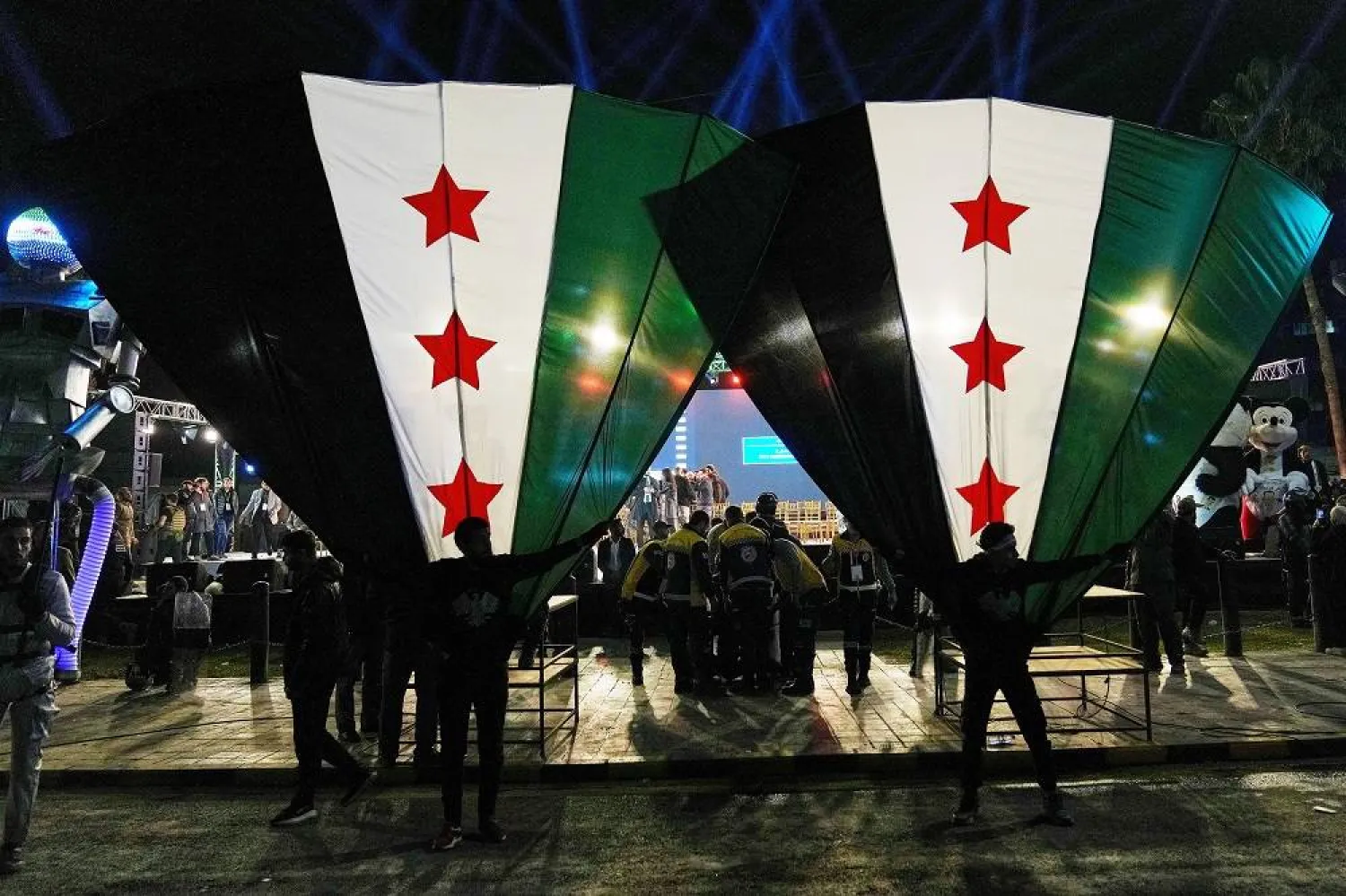

Trump Adds Seven Countries, Including Syria, to Full Travel Ban List 

Syrian citizens wave their national flags during celebrations marking the first anniversary of the ousting of former President Bashar al-Assad in Damascus, Syria, Monday, Dec. 8, 2025. (AP)
TT

Trump Adds Seven Countries, Including Syria, to Full Travel Ban List 

Syrian citizens wave their national flags during celebrations marking the first anniversary of the ousting of former President Bashar al-Assad in Damascus, Syria, Monday, Dec. 8, 2025. (AP)

US President Donald Trump on Tuesday expanded a list of countries subject to a full travel ban, prohibiting citizens from an additional seven countries, including Syria, from entering the United States.

The White House said in a statement that Trump signed a proclamation "expanding and strengthening entry restrictions on nationals from countries with demonstrated, persistent, and severe deficiencies in screening, vetting, and information-sharing to protect the Nation from national security and public safety threats."

Tuesday's move banned citizens from Burkina Faso, Mali, Niger, South Sudan, Syria and those holding Palestinian Authority-issued travel documents. The action also imposes a full ban on Laos and Sierra Leone, which had previously only been subject to partial restrictions.

The White House said the expanded ban goes into effect on January 1.

The action comes despite Trump's vow to do everything he could to make Syria successful after landmark talks in November with Syrian President Ahmed al-Sharaa.

Trump has backed Sharaa, whose visit capped a stunning year for the opposition fighter-turned-ruler who toppled longtime autocratic leader Bashar al-Assad and has since traveled the world as a leader who wants to unify his war-ravaged nation and end its decades of international isolation.

But in a post on his Truth Social platform on Saturday, Trump vowed "very serious retaliation" after the US military said two US Army soldiers and a civilian interpreter were killed in Syria by a suspected ISIS attacker who targeted a convoy of American and Syrian forces before being shot dead. He described the incident in remarks to reporters as a "terrible" attack.

The White House cited visa overstay rates for Syria in its justification for the ban.

"Syria is emerging from a protracted period of civil unrest and internal strife. While the country is working to address its security challenges in close coordination with the United States, Syria still lacks an adequate central authority for issuing passports or civil documents and does not have appropriate screening and vetting measures," the White House said.

US ADDS MORE NATIONS TO PARTIAL RESTRICTIONS LIST

Trump signed a proclamation in June banning the citizens of 12 countries from entering the United States and restricting those from seven others, saying it was needed to protect against "foreign terrorists" and other security threats. The bans apply to both immigrants and non-immigrants, such as tourists, students and business travelers.

The travel ban remains on those twelve countries, the White House said.

Trump also added partial restrictions and entry limitations on an additional 15 countries, including Nigeria, which is under scrutiny from Trump, who in early November threatened military action over the treatment of Christians in the country.

Since returning to office in January, Trump has aggressively prioritized immigration enforcement, sending federal agents to major US cities and turning away asylum seekers at the US-Mexico border.

The expansion of the countries subject to entry restrictions marks a further escalation of immigration measures the administration has taken since the shooting of two National Guard members in Washington, DC, last month.

Investigators say the shooting was carried out by an Afghan national who entered the US in 2021 through a resettlement program under which Trump administration officials have argued there was insufficient vetting.

Days after the shooting, Trump vowed to "permanently pause" migration from all "Third World Countries," although he did not identify any by name or define the term.



EU Ready to ‘Enhance’ Operations Protecting Middle East Shipping

Greek Prime Minister Kyriakos Mitsotakis speaks during a joint press conference with Cyprus' and France's presidents at Paphos military airport, in Paphos, Cyprus, 09 March 2026, (EPA)
TT

EU Ready to ‘Enhance’ Operations Protecting Middle East Shipping

Greek Prime Minister Kyriakos Mitsotakis speaks during a joint press conference with Cyprus' and France's presidents at Paphos military airport, in Paphos, Cyprus, 09 March 2026, (EPA)

The European Union said on Monday it was ready to bolster its maritime operations in the Middle East to protect shipping routes, after holding talks with regional leaders.

The EU has been discussing reinforcing its naval mission in the Red Sea after US-Israeli attacks on Iran triggered a broader regional war, causing maritime traffic in the Strait of Hormuz to all but halt.

European Council President Antonio Costa and European Commission President Ursula von der Leyen "expressed their openness to further tailor and enhance these operations in order to better respond to the situation", the bloc said in a statement.

They held video talks with leaders from countries in the region including Saudi Arabia, Bahrain, Iraq, Jordan, Lebanon, Qatar, Syria, Türkiye and the United Arab Emirates.

A fifth of global crude passes through the Strait of Hormuz.

The EU has two maritime defensive operations in the region -- anti-piracy naval force Atalanta and Aspides.

The latter was launched in the Red Sea in 2024 to prevent attacks on trade vessels by Iran-backed Houthi militants.

Aspides is based in Greece but under Italy's operational military command. It currently has three warships -- one French, one Greek and one Italian.

Operation Atalanta has two ships, one in Oman and the other in Djibouti.

Greek Prime Minister Kyriakos Mitsotakis urged his European counterparts "to strengthen this operation (Aspides) with more naval assets".

"Few of us are participating at present but we must demonstrate European solidarity on a concrete level," he said.

He was speaking alongside French President Emmanuel Macron during a visit to Cyprus on Monday.

Macron said France would contribute to Aspides "over the long term" with two additional frigates.


Israel Says Iran’s New Supreme Leader a ‘Tyrant’ Who Will Continue ‘Regime’s Brutality’

A person holds a picture of the new Iranian Supreme Leader Mojtaba Khamenei during a gathering in support of him in Tehran, Iran, 09 March 2026. (EPA)
TT

Israel Says Iran’s New Supreme Leader a ‘Tyrant’ Who Will Continue ‘Regime’s Brutality’

A person holds a picture of the new Iranian Supreme Leader Mojtaba Khamenei during a gathering in support of him in Tehran, Iran, 09 March 2026. (EPA)

Israel's foreign ministry said Monday that Iran's new supreme leader Mojtaba Khamenei was a "tyrant" like his slain father, and would continue what it described as the Iranian "regime's brutality". 

In a post on X featuring a picture of Mojtaba Khamenei and his father Ali Khamenei, holding guns, the ministry wrote: "Mojtaba Khamenei. Like Father Like Son". 

"Mojtaba Khamenei's hands are already stained with the bloodshed that defined his father's rule. Another tyrant to continue the Iranian regime's brutality," the ministry said, in Israel's first reaction to Mojtaba Khamenei's selection as supreme leader following the killing of his father on February 28 in Israeli strikes. 

Earlier, Israel's UN ambassador Danny Danon said Mojtaba Khamenei has the same radical ideas as in the past and Israel will target anyone who promotes radical ideas against it.

"Changing the man at the top does not change the regime," Danon told reporters at the United Nations when asked about Iran's naming of Khamenei to replace his ‌father.

"The new leader, unfortunately, is more of the same ideology, the same radical ideas, and ... anyone who will promote those radical ideas against us, we will target them, we will ⁠find them," Danon said.

He said the ‌people of Iran ‌should rise up to choose their next leader and added: "We ‌will have to create the conditions for them, ‌and that is what we are doing now."

Asked about the threat to crucial energy traffic in the Strait of Hormuz and Iran's attacks against neighboring countries, Danon ‌said Israel and the US were hunting Iran's missile launchers and degrading its ⁠capabilities.

"So it's ⁠going to be harder for them to attack vessels in the Strait of Hormuz. It doesn't mean it will be 100% guaranteed, but it will be harder for them to do that.

"So I'm optimistic about that. Every day we see the numbers of attacks, going down," Danon said.

The war has effectively shut the Strait of Hormuz, where a fifth of global oil and liquefied natural gas is shipped along Iran's coast.


Türkiye Says NATO Defenses Shot Down Second Incoming Iranian Missile

This handout photograph taken and released on March 9, 2026, by Turkish news agency DHA (Demiroren News Agency) shows part of a second Iranian ballistic missile destroyed by NATO in Turkish airspace. (Photo by Handout / DHA (Demiroren News Agency) / AFP)
TT

Türkiye Says NATO Defenses Shot Down Second Incoming Iranian Missile

This handout photograph taken and released on March 9, 2026, by Turkish news agency DHA (Demiroren News Agency) shows part of a second Iranian ballistic missile destroyed by NATO in Turkish airspace. (Photo by Handout / DHA (Demiroren News Agency) / AFP)

Türkiye said on Monday that NATO air defenses shot down a second Iranian ballistic missile that had entered its airspace and warned that it would move against any such threats, which increasingly pose a test for Ankara and the alliance.

The incident in southern Türkiye marks the second intercepted missile from Iran in the last week.

Türkiye, NATO's second-largest army and Iran's neighbor, had warned Tehran on Saturday against attacking again, but it has not suggested it wants to formally call on bloc members for further protection.

A NATO spokesperson confirmed that the alliance had intercepted a missile heading to Türkiye, and that it stood firm in its readiness to defend allies.

Unlike last ‌week's incoming ‌missile, which was downed outside Türkiye, the latest missile entered Turkish airspace. ‌Its fragments ⁠fell in a ⁠region sitting between a critical airbase to the west and a radar base to the east, both of which are used by the United States and NATO.

"We once again emphasize that all necessary measures will be taken decisively and without hesitation against any threat directed at our country's territory and airspace," the Turkish Defense Ministry said, adding there had been no casualties in the incident.

"We also reiterate that it is in everyone's interest to heed Türkiye’s warnings in this regard," it said.

President Recep Tayyip Erdogan said Türkiye had delivered the necessary warnings ⁠to Iran after the missile incident.

"Iran continues to take wrong and ‌provocative steps," Erdogan said after a cabinet meeting in Ankara.

He ‌said that Türkiye would continue to take additional measures after deploying six F-16 fighter jets to northern Cyprus earlier on ‌Monday, adding that Türkiye’s main goal was to keep the country out of the "blaze" of ‌the Iran war.

RELIANCE ON NATO DEFENSES

Türkiye, an emerging leader in the global defense industry, lacks its own fully fledged air defenses despite development efforts, and has relied on NATO air defenses stationed in the eastern Mediterranean Sea in both incidents in the last week.

Türkiye did not immediately comment on any formal steps within NATO. It had previously said ‌it had no intention of invoking the bloc's Article 4 that would call allies to consult if a member is threatened. That could lead ⁠to Article 5, which ⁠would call NATO to defend its attacked ally.

Erdogan's office said Ankara was strongly reiterating its warning to all parties, namely Iran, to avoid endangering regional stability and civilians.

It was unclear where the missile was headed.

US air forces are stationed at Türkiye’s Incirlik base, and there is a NATO radar base in Malatya province to the northeast that provides vital protection for the alliance.

Ankara said the missile debris fell in empty fields in Gaziantep, which sits roughly between the two.

The US embassy in Türkiye ordered non-emergency government employees and families to leave its southern Adana consulate, where service was suspended, and it strongly encouraged Americans to leave southeast Türkiye.

Ankara says that Washington has not used Incirlik in its air assault, alongside Israel, on Iran, which triggered Tehran's missile and drone attacks.

Iran did not immediately comment on the incident, but it has said repeatedly that it is not at war with regional countries and is not explicitly targeting Türkiye.

Türkiye had sought to mediate US-Iran talks before the air war that began 10 days ago.