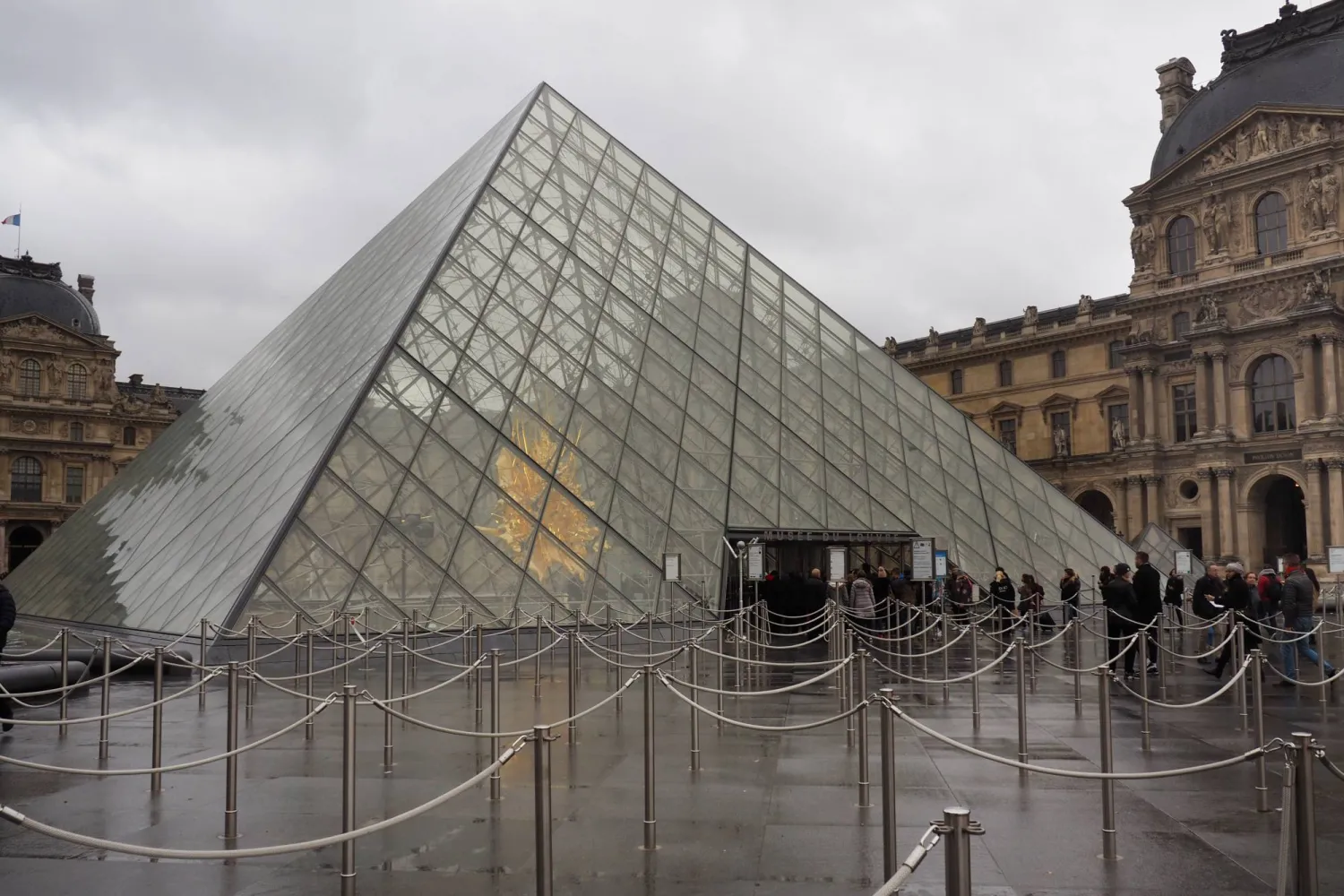
France's Louvre Museum Remains Shut as Workers Extend Strike

FILED - 07 December 2018, France, Paris: A View of the inner courtyard with the glass pyramid of the Louvre Museum in Paris. Photo: Christian Böhmer/dpa
TT

France's Louvre Museum Remains Shut as Workers Extend Strike

FILED - 07 December 2018, France, Paris: A View of the inner courtyard with the glass pyramid of the Louvre Museum in Paris. Photo: Christian Böhmer/dpa

Staff at France's Louvre museum in Paris on Wednesday unanimously voted in favor of extending a strike over pay and working conditions that began on Monday, leaving the world's most visited museum closed until further notice.

The museum is routinely closed on Tuesdays.

The strike comes after a spectacular jewel heist in October, as well as recent infrastructure problems, including a water leak that damaged ancient books, which have exposed glaring security gaps and revealed the museum's deteriorating state.

Unions have said that staff at the Louvre are overworked and mismanaged, and they are calling for more hiring, pay increases and a redirection of spending.

Louvre director Laurence des Cars, who has faced intense criticism since burglars in October made off with crown jewels worth 88 million euros ($103.14 million), is due to answer questions from the French Senate on Wednesday afternoon. 

Des Cars has acknowledged an “institutional failure” following the heist but has come under renewed scrutiny after admitting she only learned of a critical 2019 security audit after the robbery.

France’s Court of Auditors and a separate administrative inquiry have since criticized delays in implementing a long-promised security overhaul.

The Culture Ministry announced emergency anti-intrusion measures last month and assigned Philippe Jost, who oversaw the Notre Dame restoration, to help reorganize the museum. The move was widely seen as a sign of mounting pressure on Louvre leadership.


Heritage Commission Revives Al-Nasb Heritage District as Abha Cultural Tourism Destination

The district’s significance lies in its unique architectural composition - SPA
TT

Heritage Commission Revives Al-Nasb Heritage District as Abha Cultural Tourism Destination

The district’s significance lies in its unique architectural composition - SPA

Al-Nasb Heritage District in Abha is one of the most prominent living examples of traditional architecture in Aseer Region, preserving its long history and architectural details that embody people’s connection to their local environment and document the social and cultural patterns that have shaped the identity of the place across generations.

The district’s significance lies in its unique architectural composition, where mud and stone buildings stand side by side in visual harmony. They were built using local materials such as stone, clay, and juniper trunks, while the narrow alleyways and closely set buildings give the district a cohesive social character that reflects the spirit of past communities in the region and the close relationship between people and place.

The Heritage Commission has revived the district through an integrated restoration and rehabilitation project aimed at preserving its original elements and enhancing its sustainability, as part of national efforts to protect urban heritage and highlight it as a cultural and tourism asset, SPA reported.

The site is also distinguished by its natural setting, as the district overlooks the banks of Abha Valley and surrounding farms, giving it a distinctive visual and aesthetic dimension. Its narrow passageways and closely set buildings illustrate a traditional urban pattern that strengthens ties among residents and captures the nature of social life in that era.

The district is now a growing destination for culture and tourism in Abha, attracting visitors and heritage enthusiasts who come to explore the details of authentic architecture and learn about the traditional ways of life that have shaped Aseer Region’s identity across generations. The project helps raise awareness of the importance of preserving archaeological sites as a key pillar in forming national memory.

The project is part of the Kingdom’s efforts to protect and effectively manage cultural heritage, in line with the targets of Saudi Vision 2030, which gives special attention to the cultural sector. It seeks to turn heritage sites into vibrant spaces that support cultural tourism and sustainable development while reconnecting society with its historical roots.


Saudi Heritage Commission Enforces Strict Penalties Against Antiquities Violators

The fines varied according to the nature and circumstances of each violation
TT

Saudi Heritage Commission Enforces Strict Penalties Against Antiquities Violators

The fines varied according to the nature and circumstances of each violation

The Saudi Heritage Commission announced financial fines against 11 violators for dealing in portable antiquities without obtaining the required regulatory licenses, as part of its ongoing efforts to protect cultural heritage in the Kingdom and enhance compliance with regulations governing the sector.

The commission clarified that the violations involved displaying and selling antiquities on online platforms without registering or documenting them with the Heritage Commission or obtaining the necessary licenses, in explicit violation of the provisions of the Law of Antiquities, Museums and Urban Heritage.

The fines varied according to the nature and circumstances of each violation, reaching up to SAR15,000 in some cases.

The commission reaffirmed its commitment to monitoring violations related to heritage sites and collections across the Kingdom and taking the necessary legal and regulatory actions against all those proven to have contravened the regulations.

The Heritage Commission called on all citizens and residents to report any violations or non-compliant practices related to heritage sites or collections through its social media channels, by visiting its branches across the Kingdom, through the Archaeological Site Reporting platform, or by contacting the unified security operations center at 911.


Holy Quran Museum Showcases Rare 18th-Century Brass-Engraved Copy of the Quran

Among the museum’s distinctive exhibits is a copy of the Quran engraved on brass plates dating back to the 12th century AH - SPA
TT

Holy Quran Museum Showcases Rare 18th-Century Brass-Engraved Copy of the Quran

Among the museum’s distinctive exhibits is a copy of the Quran engraved on brass plates dating back to the 12th century AH - SPA

The Holy Quran Museum in the Hira Cultural District in Makkah offers a rich cultural and knowledge experience, enabling visitors to explore the history of the Holy Quran and its sciences, and view rare manuscripts and artifacts documenting the journey of its transcription through the ages, reflecting the care Muslims have given to the Holy Quran since the dawn of Islam to the present day, SPA reported.

Among the museum’s distinctive exhibits is a copy of the Quran engraved on brass plates dating back to the 12th century AH (18th century CE), showcasing the precision and mastery achieved in Islamic arts and the special attention given to Quranic transcription, combining beauty and scholarly accuracy.

This artwork embodies a continuation of deep-rooted traditions in Islamic calligraphy and decorative arts, utilizing various materials and techniques from parchment and paper to metals, highlighting Muslims’ profound connection to the Holy Quran and their commitment to preserving it in artistic forms that combine creativity and reverence.