


Syria, Kurdish Forces Race to Save Integration Deal ahead of Deadline

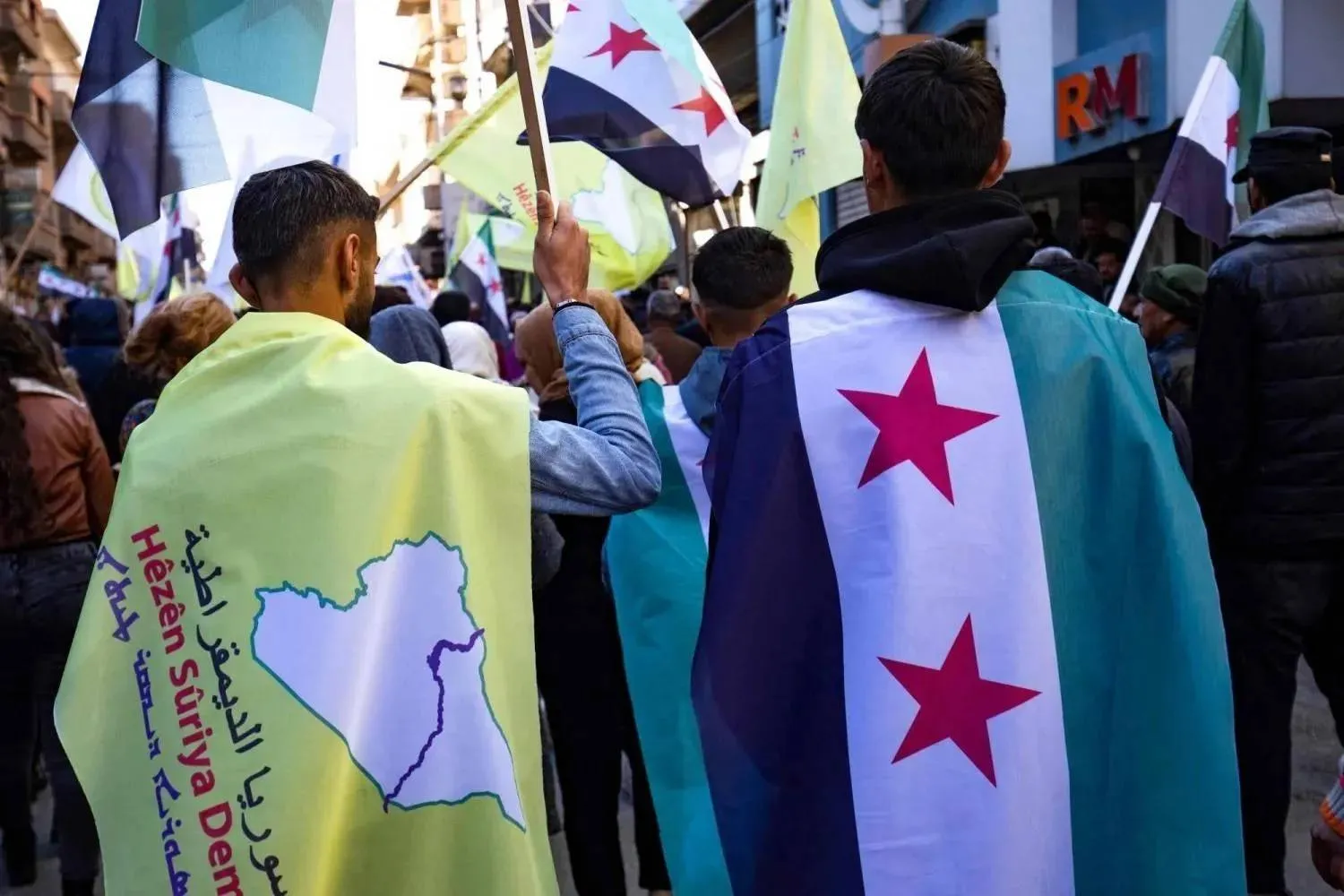
Kurds wave the flags of the SDF and the new Syrian regime during a celebration in the city of Qamishli in northeastern Syria (AFP).
TT

Syria, Kurdish Forces Race to Save Integration Deal ahead of Deadline

Kurds wave the flags of the SDF and the new Syrian regime during a celebration in the city of Qamishli in northeastern Syria (AFP).

Syrian, Kurdish and US officials are scrambling ahead of a year-end deadline to show some progress in a stalled deal to merge Kurdish forces with the Syrian state, according to several people involved in or familiar with the talks.

Discussions have accelerated in recent days despite growing frustrations over delays, according to the Syrian, Kurdish and Western sources who spoke to Reuters, some of whom cautioned that a major breakthrough was unlikely, Reuters said.

The interim Syrian government has sent a proposal to the Kurdish-led Syrian Democratic Forces (SDF) that controls the country's northeast, according to five of the sources.

In it, Damascus expressed openness to the SDF reorganizing its roughly 50,000 fighters into three main divisions and smaller brigades as long as it cedes some chains of command and opens its territory to other Syrian army units, according to one Syrian, one ‌Western and three Kurdish ‌officials.

'SAVE FACE' AND EXTEND TALKS ON INTEGRATION

It was unclear whether the idea would ‌move ⁠forward, and several sources downplayed ‌prospects of a comprehensive eleventh-hour deal, saying more talks are needed. Still, one SDF official said: "We are closer to a deal than ever before".

A second Western official said that any announcement in coming days would be meant in part to "save face", extend the deadline and maintain stability in a nation that remains fragile a year after the fall of former President Bashar al-Assad.

Whatever emerges was expected to fall short of the SDF's full integration into the military and other state institutions by year-end, as was called for in a landmark March 10 agreement between the sides, most of the sources said.

Failure to mend Syria's deepest remaining fracture risks an armed clash that could derail its emergence from 14 years of war, and ⁠potentially draw in neighboring Türkiye that has threatened an incursion against Kurdish fighters it views as terrorists.

Both sides have accused the other of stalling and acting in bad faith. The SDF ‌is reluctant to give up autonomy it won as the main US ally during ‍the war, after which it controlled ISIS prisons and rich ‍oil resources.

The US, which backs Syrian President Ahmed al-Sharaa and has urged global support for his interim government, has relayed messages between ‍the SDF and Damascus, facilitated talks and urged a deal, several sources said.

A US State Department spokesperson said Tom Barrack, the US ambassador to Türkiye and special envoy to Syria, continued to support and facilitate dialogue between the Syrian government and the SDF, saying the aim was to maintain momentum towards integration of the forces.

SDF DOWNPLAYS DEADLINE; TURKIYE SAYS PATIENCE THIN

Since a major round of talks in the summer between the sides failed to produce results, frictions have mounted including frequent skirmishes along several front lines across the north.

The SDF took control of much of northeast Syria, where most of the nation's oil and wheat production is, after defeating ISIS militants in 2019.

It said ⁠it was ending decades of repression against the Kurdish minority but resentment against its rule has grown among the predominantly Arab population, including against compulsory conscription of young men.

A Syrian official said the year-end deadline for integration is firm and only "irreversible steps" by the SDF could bring an extension.

Türkiye’s foreign minister, Hakan Fidan, said on Thursday it does not want to resort to military means but warned that patience with the SDF is "running out".

Kurdish officials have downplayed the deadline and said they are committed to talks toward a just integration.

"The most reliable guarantee for the agreement's continued validity lies in its content, not timeframe," said Sihanouk Dibo, a Syrian autonomous administration official, suggesting it could take until mid-2026 to address all points in the deal.

The SDF had in October floated the idea of reorganizing into three geographical divisions as well as the brigades. It is unclear whether that concession, in the proposal from Damascus in recent days, would be enough to convince it to give up territorial control.

Abdel Karim Omar, representative of the Kurdish-led northeastern administration in Damascus, said the proposal, which has not been made public, included "logistical and administrative details that could cause disagreement and ‌lead to delays".

A senior Syrian official told Reuters the response "has flexibility to facilitate reaching an agreement that implements the March accord".



Hamas Official Says Miami Talks Must End Israel's Gaza Truce 'Violations'

12 February 2025, Palestinian Territories, Khan Younis: Palestinians shop in a market in the middle of the destruction in Khan Younis, after the Israeli Forces withdrew as part of the ceasefire agreement with Hamas. Photo: Abed Rahim Khatib/dpa
TT

Hamas Official Says Miami Talks Must End Israel's Gaza Truce 'Violations'

12 February 2025, Palestinian Territories, Khan Younis: Palestinians shop in a market in the middle of the destruction in Khan Younis, after the Israeli Forces withdrew as part of the ceasefire agreement with Hamas. Photo: Abed Rahim Khatib/dpa

A top Hamas official said that talks in Miami on Friday to advance the next phase of the Gaza ceasefire must aim to end Israeli truce "violations" in the Palestinian territory.

"Our people expect these talks to result in an agreement to put an end to ongoing Israeli lawlessness, halt all violations and compel the occupation to abide by the Sharm el-Sheikh agreement," Hamas political bureau member, Bassem Naim, told AFP.

The United States is hosting the discussions, with President Donald Trump's special envoy, Steve Witkoff, expected to meet senior officials from mediator countries Qatar, Egypt and Türkiye in Florida to push for the second stage of the ceasefire deal.


Egypt Signals Possible Activation of Joint Defense Pact to Safeguard Sudan’s Unity

Abdel Fattah el-Sisi during the reception of Abdel Fattah al-Burhan in Cairo on Thursday (Egyptian Presidency)
TT

Egypt Signals Possible Activation of Joint Defense Pact to Safeguard Sudan’s Unity

Abdel Fattah el-Sisi during the reception of Abdel Fattah al-Burhan in Cairo on Thursday (Egyptian Presidency)

Egypt has drawn explicit “red lines” regarding the conflict in Sudan, warning that any attempt to cross them would directly threaten Egyptian national security.

Cairo signaled it is prepared to take all measures permitted under the Joint Defense Agreement between the two countries, a position analysts describe as Cairo’s most forceful since the outbreak of war in Sudan in 2023.

The statement coincided with President Abdel Fattah el-Sisi receiving on Thursday Lt. Gen. Abdel Fattah al-Burhan, Chairman of Sudan’s Transitional Sovereignty Council.

El-Sisi reaffirmed Egypt’s “full support for the Sudanese people in overcoming the current critical phase,” stressing Cairo’s unwavering commitment to Sudan’s unity, sovereignty, security, and stability, according to presidential spokesman Mohamed El-Shennawy.

During the visit, Egypt also renewed its support for US President Donald Trump’s vision for achieving peace and stability in Sudan, aligning with Washington’s broader approach to de-escalation and conflict resolution.

For the first time since the conflict began, Cairo publicly articulated non-negotiable red lines, stressing that Sudan’s unity and territorial integrity are inseparable from Egypt’s own national security. These red lines include preventing the partition of Sudan, protecting the country’s resources, and preserving its state institutions.

The Egyptian presidency underscored that safeguarding Sudan’s institutions is highly important and affirmed Egypt’s “full right to take all necessary measures under international law,” including the possible activation of the Joint Defense Agreement to prevent any violations.

Egypt and Sudan signed a military cooperation agreement in March 2021 covering training, border security, and countering shared threats, building on a Joint Defense Agreement concluded in 1976 to confront external dangers.

Maj. Gen. Yahya Kadwani, a member of Egypt’s parliamentary Committee on Defense and National Security, warned that efforts to divide Sudan necessitate firm red lines to protect Sudanese state assets and Egypt’s own security.

He told Asharq Al-Awsat that invoking the joint defense pact signals strong coordination within international legitimacy and existing bilateral agreements.

The presidency said Egypt is deeply concerned by ongoing escalation in Sudan and the resulting “horrific massacres and flagrant violations of basic human rights,” particularly in El Fasher.

Cairo categorically rejected the creation or recognition of any parallel political or military entities, warning that such moves would undermine Sudan’s unity and territorial integrity.

Ambassador Salah Halima, a member of the Egyptian Council for Foreign Affairs, said Egyptian-Sudanese coordination aims to protect Egyptian, Sudanese, and Arab national security, noting that both countries are members of the Council of Red Sea Coastal States, which plays a strategic role in defense and development.

He added that Egypt’s stance aligns with the International Quartet initiative and a proposal advanced by Saudi Crown Prince and Prime Minister Mohammed bin Salman during his visit to the United States.

The roadmap calls for a three-month humanitarian truce, integration of the Rapid Support Forces into the Sudanese Armed Forces, and preservation of military cohesion.

The Quartet, which includes Saudi Arabia, Egypt, the United Arab Emirates, and the United States, proposed last August a plan for a three-month humanitarian ceasefire, followed by a permanent cessation of hostilities and a political process leading to an independent civilian government within nine months.

Al-Burhan’s visit to Cairo followed talks in Saudi Arabia, where he affirmed Sudan’s readiness to work with Trump, US Secretary of State Marco Rubio, and US envoy Massad Boulos to end the war.

Amani Al-Tawil, Director of the Africa Program at the Al-Ahram Center for Political and Strategic Studies, said Egypt’s position represents its strongest stance yet and aligns with Saudi and US calls to preserve Sudan’s unity, halt the war, reject parallel entities, and protect state institutions.


Israel Considers Special Military Court to Seek Death Penalty for Hamas Fighters

A fighter from the Izz ad-Din al-Qassam Brigades, affiliated with Hamas, oversees the search for the bodies of Israeli hostages, with the participation of Red Cross personnel, in the Jabalia refugee camp in northern Gaza, Dec. 1, 2025. (EPA) 
TT

Israel Considers Special Military Court to Seek Death Penalty for Hamas Fighters

A fighter from the Izz ad-Din al-Qassam Brigades, affiliated with Hamas, oversees the search for the bodies of Israeli hostages, with the participation of Red Cross personnel, in the Jabalia refugee camp in northern Gaza, Dec. 1, 2025. (EPA) 

Israel is weighing extraordinary legal measures that could result in the execution of up to 100 Hamas fighters accused of taking part in the Oct. 7, 2023 attack.

Defense Minister Israel Katz and Justice Minister Yariv Levin have discussed the creation of a dedicated military court to try hundreds of members of Hamas’ elite “Nukhba” unit, part of the Izz ad-Din al-Qassam Brigades, according to Israeli media reports.

Officials familiar with the deliberations said the proposed court would have the authority to impose the death penalty, with military prosecutors expected to seek capital punishment for about 100 defendants facing the gravest charges.

Senior figures from the Israeli army and the Justice Ministry attended the talks, including Itai Ofir, the chief military prosecutor, the Times of Israel reported. Katz said Israel was determined to punish those responsible for the attack “in a way that leaves no ambiguity,” adding that anyone who harms Israeli civilians “will be held fully accountable.”

The discussions come shortly after the far-right Otzma Yehudit party, led by National Security Minister Itamar Ben-Gvir, released updated principles for controversial legislation that would mandate the death penalty for those involved in the October 7 assault.

The bill, which passed an initial Knesset vote in November and is now being debated in the National Security Committee, would allow military courts to impose capital punishment on Palestinians by a simple majority of judges.

Military sources said Israel is holding about 450 Palestinian prisoners classified as Hamas “elite” fighters, far fewer than the thousands initially cited at the start of the war.

According to Israeli officials, prosecutors intend to seek death sentences, most likely by firing squad, after the Israeli Medical Association reportedly declined to take part in executions by lethal injection.

Channel 14 said the detainees are being held at a special military facility under heavy guard, in conditions that have drawn criticism from international human rights organizations.

Officials have spent nearly two years debating how to prosecute the suspects in a way that would ensure execution.

The preferred option, according to the report, is to conduct trials outside the regular judicial system in highly public proceedings, likened to the trial of Nazi official Adolf Eichmann, who was abducted by the Mossad in Argentina in 1960, tried by a special tribunal in Jerusalem, and executed in 1962.

Critics warned that such high-profile trials could become a platform for putting Israel itself on trial over events preceding Oct. 7 and the subsequent war in Gaza.

Israeli authorities said they have compiled extensive evidence, including documents seized in Gaza, interrogations of detainees, and video footage recorded by Hamas and Palestinian Islamic Jihad fighters during the attack.

The move comes amid rising tensions in Israeli prisons. Prison Service Commissioner Kobi Yaakobi recently warned of a possible inmate uprising due to harsh conditions.

The Prison Service later said his comments were taken out of context, insisting its policies, which are overseen by Ben-Gvir, are effective and that it is prepared for “any scenario.”

More than 9,500 Palestinians are currently held in Israeli prisons, including 3,360 in administrative detention without charge or trial. Palestinian prisoner groups say at least 110 detainees have died in custody since the war began, including 50 from Gaza.