

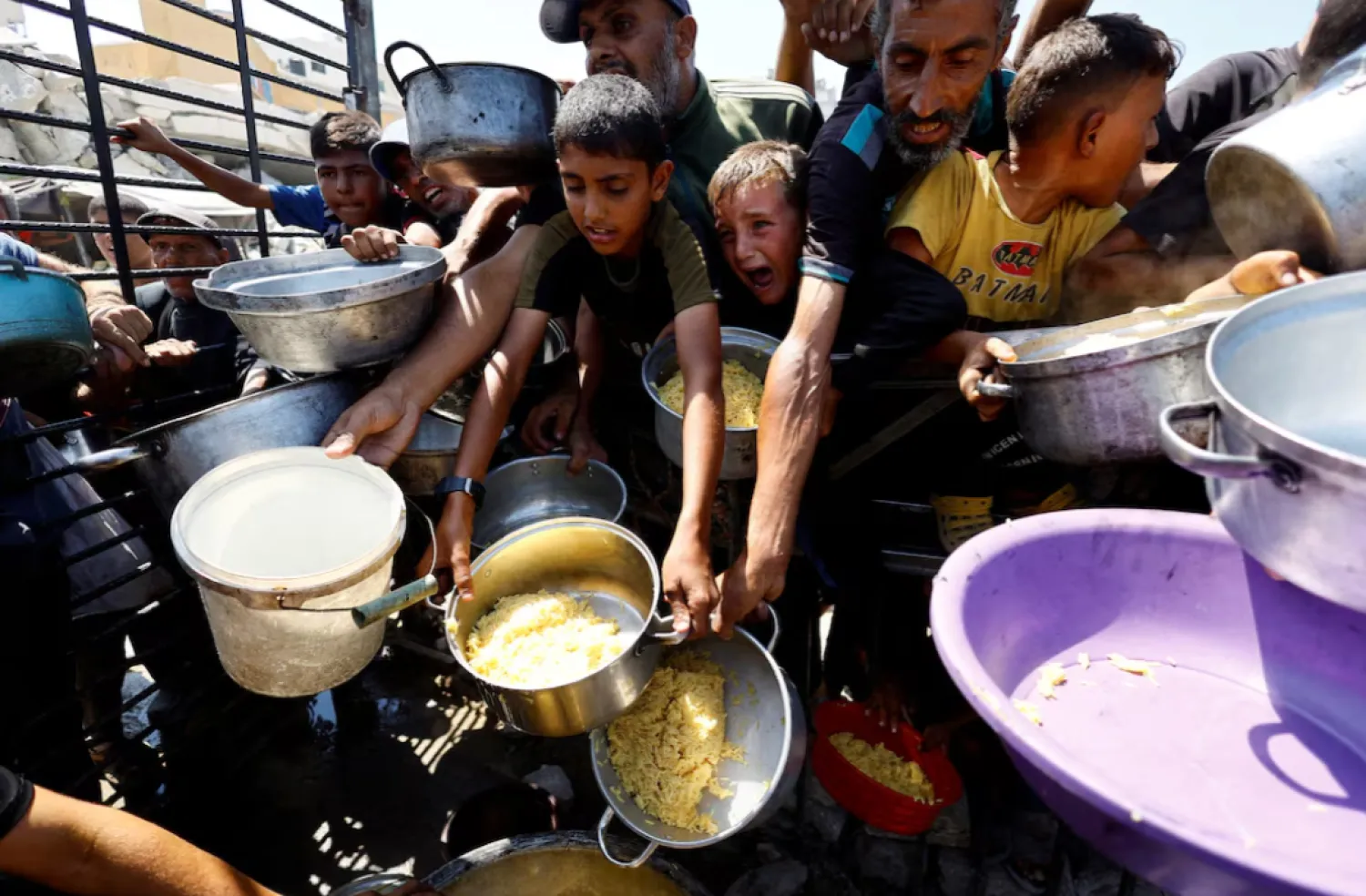

Gaza No Longer in Famine After Aid Access Improves, Hunger Monitor Says

Palestinians wait to receive food from a charity kitchen after the global hunger monitor, in Gaza City, August 28, 2025. REUTERS/Mahmoud Issa/File Photo
TT

Gaza No Longer in Famine After Aid Access Improves, Hunger Monitor Says

Palestinians wait to receive food from a charity kitchen after the global hunger monitor, in Gaza City, August 28, 2025. REUTERS/Mahmoud Issa/File Photo

There is no longer famine in Gaza, a global hunger monitor said on Friday, after access for humanitarian and commercial ​food deliveries improved following a fragile October 10 ceasefire in the war between Israel and Palestinian Hamas militants.

The latest assessment by the Integrated Food Security Phase Classification comes four months after it reported that 514,000 people - nearly a quarter of Palestinians in the Gaza Strip - were experiencing famine. The IPC warned on Friday that the situation in the enclave remained critical, Reuters reported.

"Under a worst-case scenario, which would include renewed hostilities and a halt in humanitarian and commercial inflows, the entire Gaza Strip (would be) at risk of famine through mid-April 2026. This underscores the severe and ongoing humanitarian crisis," the IPC said in the report.

Israel controls all access to the coastal enclave. COGAT, the Israeli military agency that coordinates aid, in August disputed that there was famine in Gaza. COGAT says 600-800 trucks have entered Gaza daily since the start of the truce in October, ‌and that food made ‌up 70% of all those supplies.

COGAT rejected the report's findings.

"The report relies on ‌severe ⁠gaps in ​data collection ‌and on sources that do not reflect the full scope of humanitarian assistance. As such, it misleads the international community, fuels disinformation and presents a false depiction of the reality on the ground."

Israel's Foreign Ministry said that far more aid was going into Gaza than what was reflected in the report and that food prices there had dropped sharply since July.

Hamas disputes Israel's aid figures, saying far fewer than 600 trucks a day have made it into Gaza. Aid agencies have repeatedly said far more aid needs to get into the small, crowded territory and have said Israel is blocking needed items from entering, which Israel denies.

NO FAMINE, BUT STILL CATASTROPHIC CONDITIONS

The IPC said five famines have been confirmed in the past 15 years: in Somalia ⁠in 2011, South Sudan in 2017 and 2020, Sudan in 2024, and most recently in Gaza in August.

For a region to be classified as in famine at least 20% of people ‌must be suffering extreme food shortages, with one in three children acutely malnourished and ‍two people out of every 10,000 dying daily from starvation or malnutrition ‍and disease.

"No areas are classified in famine," the IPC said of Gaza on Friday. "The situation remains highly fragile and is contingent on ‍sustained, expanded and consistent humanitarian and commercial access."

Even if a region has not been classified as in famine because those thresholds have not been met, the IPC can determine households are suffering catastrophic conditions, which it describes as an extreme lack of food, starvation and significantly increased risks of acute malnutrition and death.

The IPC said on Friday that more than 100,000 people in Gaza were experiencing catastrophic conditions, but projected that figure to decline to around 1,900 people by ​April 2026. It said the entire Gaza Strip was classified in an emergency phase, one step below catastrophic conditions.

"Over the next 12 months, across the entire Gaza Strip, nearly 101,000 children aged 6–59 months are expected to suffer from acute ⁠malnutrition and require treatment, with more than 31,000 severe cases," the IPC said.

"During the same period, 37,000 pregnant and breastfeeding women will also face acute malnutrition and require treatment," it said.

AID CHALLENGES REMAIN

Antoine Renard, the top UN World Food Programme official in Gaza and the West Bank, said there were signs of improvement in the dire hunger situation in Gaza.

"The fact that most of the population is having two meals per day is actually a clear sign that we are actually having a bit of reversal," he told reporters on Thursday.

However, he said it was "a constant struggle" to get streamlined access to Gaza at scale and speed with humanitarian and commercial trucks facing congestion at the border crossings.

The United Nations and aid groups also warned on Wednesday that humanitarian operations in Gaza were at risk of collapse if Israel does not lift impediments that include a "vague, arbitrary, and highly politicized" registration process.

The International Rescue Committee’s Zoe Daniels said high food prices meant it was hard for many people in Gaza to obtain enough high-quality food even when it was available in the market, while Jolien Veldwijk of CARE said the situation in Gaza had not improved as much as it ‌should have.

"People are relying on canned food that is pre-cooked or community kitchens, and they don’t hold the nutritional value that is needed for people to recover from malnutrition.”




EU Condemns Israel's West Bank Control Measures

The Israeli settlement of Har Homa, seen from the West Bank city of Bethlehem, Tuesday, Dec. 17, 2024. (AP)
TT

EU Condemns Israel's West Bank Control Measures

The Israeli settlement of Har Homa, seen from the West Bank city of Bethlehem, Tuesday, Dec. 17, 2024. (AP)

The European Union on Monday condemned new Israeli measures to tighten control of the West Bank and pave the way for more settlements in the occupied Palestinian territory, AFP reported.

"The European Union condemns recent decisions by Israel's security cabinet to expand Israeli control in the West Bank. This move is another step in the wrong direction," EU spokesman Anouar El Anouni told journalists.


Atrocities in Sudan's El-Fasher Were 'Preventable Human Rights Catastrophe'

Sudanese displaced people who left El Fasher after its fall, sit in the shade in Tawila at the Rwanda camp reception point on December 17, 2025. (Photo by AFP)
TT

Atrocities in Sudan's El-Fasher Were 'Preventable Human Rights Catastrophe'

Sudanese displaced people who left El Fasher after its fall, sit in the shade in Tawila at the Rwanda camp reception point on December 17, 2025. (Photo by AFP)

The atrocities unleashed on El-Fasher in Sudan's Darfur region last October were a "preventable human rights catastrophe", the United Nations said Monday, warning they now risked being repeated in the neighbouring Kordofan region.


"My office sounded the alarm about the risk of mass atrocities in the besieged city of El-Fasher for more than a year ... but our warnings were ignored," UN rights chief Volker Turk told the Human Rights Council in Geneva.


He added that he was now "extremely concerned that these violations and abuses may be repeated in the Kordofan region".


Arab League Condemns Israel's Decisions to Alter Legal, Administrative Status of West Bank

A general view shows the opening session of the meeting of Arab foreign ministers at the Arab League Headquarters (Reuters)
TT

Arab League Condemns Israel's Decisions to Alter Legal, Administrative Status of West Bank

A general view shows the opening session of the meeting of Arab foreign ministers at the Arab League Headquarters (Reuters)

The General Secretariat of the Arab League strongly condemned decisions by Israeli occupation authorities to impose fundamental changes on the legal and administrative status of the occupied Palestinian territories, particularly in the West Bank, describing them as a dangerous escalation and a flagrant violation of international law, international legitimacy resolutions, and signed agreements, SPA reported.

In a statement, the Arab League said the measures include facilitating the confiscation of private Palestinian property and transferring planning and licensing authorities in the city of Hebron and the area surrounding the Ibrahimi Mosque to occupation authorities.

It warned of the serious repercussions of these actions on the rights of the Palestinian people and on Islamic and Christian holy sites.

The statement reaffirmed the Arab League’s firm support for the legitimate rights of the Palestinian people, foremost among them the establishment of their independent state on the June 4, 1967 borders, with East Jerusalem as its capital.