

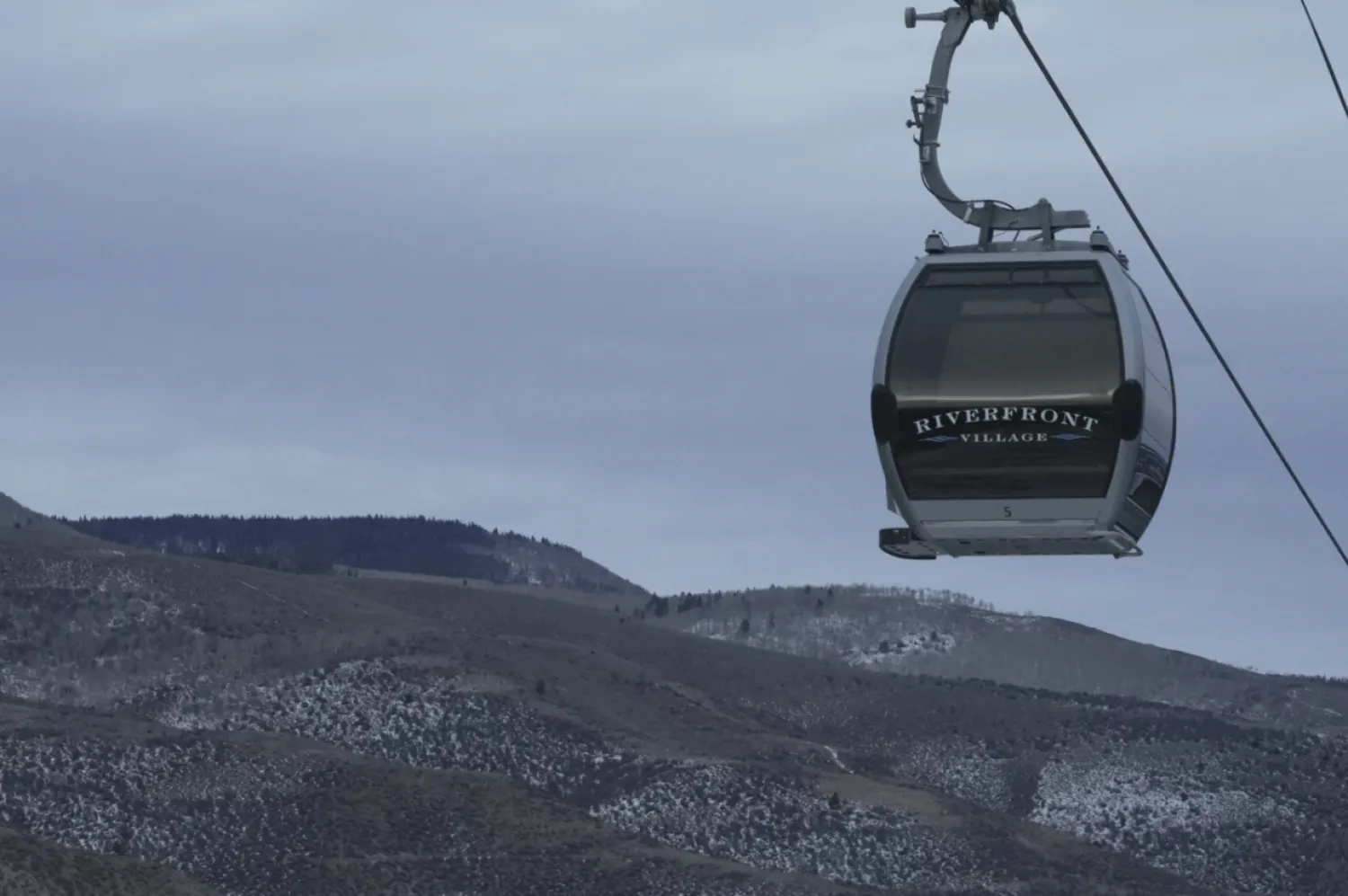

Warm Weather and Low Snowpack Bedevil Western Ski Resorts

Only a small percentage of lifts were open and snow depths were well below average at Lake Tahoe resorts, just one example of warm weather causing well-below-average snowpack in almost all of the West. -File Photo/The AP news
TT

Warm Weather and Low Snowpack Bedevil Western Ski Resorts

Only a small percentage of lifts were open and snow depths were well below average at Lake Tahoe resorts, just one example of warm weather causing well-below-average snowpack in almost all of the West. -File Photo/The AP news

Ski resorts are struggling to open runs, walk-through ice palaces can’t be built, and the owner of a horse stable hopes that her customers will be satisfied with riding wagons instead of sleighs under majestic Rocky Mountain peaks. It’s just been too warm in the West with not enough snow.

Meanwhile, the Midwest and Northeast have been blanketed by record snow this December, a payday for skiers who usually covet conditions out West, The AP news reported.

In the Western mountains where snow is crucial for ski tourism — not to mention water for millions of acres (hectares) of crops and the daily needs of tens of millions of people — much less snow than usual has piled up.

“Mother Nature has been dealing a really hard deck,” said Kevin Cooper, president of the Kirkwood Ski Education Foundation, a ski racing organization at Lake Tahoe on the California-Nevada line.

Only a small percentage of lifts were open and snow depths were well below average at Lake Tahoe resorts, just one example of warm weather causing well-below-average snowpack in almost all of the West.

In Utah, warmth has indefinitely postponed this winter’s Midway Ice Castles, an attraction 45 minutes east of Salt Lake City that requires cold temperatures to freeze water into building-size, palatial features. Temperatures in the area that will host part of the 2034 Winter Olympics have averaged 7-10 degrees (3-5 degrees Celsius) above normal in recent weeks, according to the National Weather Service.

Near Vail, Colorado, Bearcat Stables owner Nicole Godley hopes wagons will be a good-enough substitute for sleighs for rides through mountain scenery.

“It’s the same experience, the same ride, the same horses,” Godley said. “It’s more about, you know, just these giant horses and the Western rustic feel.”

In the Northwest, torrential rain has washed out roads and bridges and flooded homes. Heavy mountain snow finally arrived late this week in Washington state but flood-damaged roads that might not be fixed for months now block access to some ski resorts.

In Oregon, the Upper Deschutes Basin has had the slowest start to snow accumulation in records dating to 1981. Oregon, Idaho and western Colorado had their warmest Novembers on record, with temperatures ranging from 6-8.5 degrees (2-4 degrees Celsius) warmer than average, according to the National Oceanic and Atmospheric Administration.

Continued warmth could bring yet another year of drought and wildfires to the West. Most of the region except large parts of Colorado and Oregon has seen decent precipitation but as rain instead of snow, pointed out NOAA drought information coordinator Jason Gerlich.

That not only doesn’t help skiers but farmers, ranchers and people from Denver to Los Angeles who rely on snowpack water for their daily existence. Rain runs off all at once at times when it's not necessarily needed.

“That snowpack is one of our largest reservoirs for water supply across the West,” Gerlich said.

Climate scientists agree that limiting global warming is critical to staving off the snow-to-rain trend.

In the northeastern U.S., meanwhile, below-normal temperatures have meant snow instead of rain. Parts of Vermont have almost triple and Ohio double the snowfall they had this time last year.

Vermont’s Killington Resort and Pico Mountain, had about 100 trails open for “by far the best conditions I have ever seen for this time of year,” said Josh Reed, resort spokesman who has lived in Killington for a decade.

New Hampshire ski areas opening early include Cannon Mountain, with over 50 inches (127 centimeters) to date. In northern Vermont, Elena Veatch, 31, already has cross-country skied more this fall than she has over the past two years.

“I don’t take a good New England winter for granted with our warming climate,” Veatch said.

Out West, it's still far too early to rule out hope for snow. A single big storm can “turn things around rather quickly,” pointed out Gerlich, the NOAA coordinator.

Lake Tahoe's snow forecast over Thanksgiving week didn't pan out but Cooper with the ski racing group is eyeing possibly several feet (1-2 meters) in the long-term forecast.

“That would be so cool!” Cooper said.


Trump Ballroom Approved by Panel, Remains Stalled by Judge

Donald Trump has cited the need for the ballroom to host state dinners for visiting dignitaries. Mandel NGAN / AFP/File
TT

Trump Ballroom Approved by Panel, Remains Stalled by Judge

Donald Trump has cited the need for the ballroom to host state dinners for visiting dignitaries. Mandel NGAN / AFP/File

US President Donald Trump's White House ballroom won final planning approval on Thursday, but construction remains in limbo following a court order that he needs congressional approval.

The National Capital Planning Commission (NCPC), which has several Trump appointees on its board, greenlit the plans in an 8-1 vote, said AFP.

The project aims to construct a massive ballroom on the site of the White House's East Wing -- previously best known for housing the First Lady's offices. It was demolished in September.

Trump expressed his thanks in a post on his Truth social media platform, saying, "when completed, it will be the greatest and most beautiful ballroom of its kind anywhere in the world."

Planning approval does not, however, mean construction can go ahead unchecked.

On Tuesday, a federal judge ordered a halt to construction, saying Trump needed congressional approval. The president is "steward" of the White House, Judge Richard Leon wrote. "He is not, however, the owner!"

Will Scharf, the commission's chairman and a political ally of Trump, addressed the lawsuit before the vote, saying, "That order really does not impact our action here today.

"From my perspective, we have a project before us. We've been asked to review it, and that's really our job here today."

He noted that Judge Leon had placed a two-week delay on his stop-work order to allow the Trump administration to appeal.

The ballroom has become a passion project for Trump during his second term: the president often discusses the plan in public appearances, press conferences and meetings.

Trump has repeatedly said that a large ballroom is needed to host, among other key events, state dinners for visiting dignitaries.

"For more than 150 years, every president has dreamt about having a ballroom at the White House to accommodate people for grand parties, state visits, and even, in the modern day, inaugurations," Trump wrote on Truth. "I am honored to be the first president to finally get this much-needed project, which is on time and under budget, underway."

He has promised to meet the costs -- estimated to be upwards of $400 million -- with private donations, not tax payer money.


Waste Water to Clean Energy: Japanese Engineers Harness the Power of Osmosis

Engineers in the city of Fukuoka and their private partners have opened what is only the world's second osmotic power plant. Philip FONG / AFP
TT

Waste Water to Clean Energy: Japanese Engineers Harness the Power of Osmosis

Engineers in the city of Fukuoka and their private partners have opened what is only the world's second osmotic power plant. Philip FONG / AFP

A Japanese water plant is harnessing the natural process of osmosis to generate renewable energy that could one day become a common power source.

The possibility of generating power from osmosis -- when water molecules pass from a less salty solution to a more salty one -- has long been known.

But actually, generating energy from that has proved more complicated, in part due the difficulty of designing the membrane through which the molecules pass, said AFP.

Engineers in the city of Fukuoka and their private partners think they might have cracked it, and have opened what is only the world's second osmotic power plant.

It generates power from the transfer of molecules between treated sewage water and concentrated seawater, a waste product from a desalination plant in the city.

"If osmotic power generation technology advances to the point where it can be practically used with ordinary seawater... this, in turn, would represent a major contribution to efforts against global warming," said Kenji Hirokawa, manager at Sea Water Desalination Plant.

Osmosis is familiar to most people. It is the process that, for example, causes water to seep out of a cucumber or eggplant when sprinkled with salt.

Water molecules move across membranes from an area of low solution concentration to an area of higher concentrated solution.

At scale, that movement can be significant enough to turn a turbine and thereby generate electricity.

Desalination solution

Fukuoka is particularly well-placed to benefit from the technology because it has a readily available source of extremely salty water -- the brine leftover from desalination.

With no major rivers to sufficiently source its water, the city and wider Fukuoka region of 2.6 million people have relied on a major desalination plant to produce drinking water since 2005.

That left the city with large quantities of concentrated saline wastewater to deal with.

Ordinarily it is diluted and released back to the sea. Previous attempts to find alternatives, including salt making, failed to gain traction.

Then engineering firm Kyowakiden Industry approached the city about harnessing the salty wastewater for osmotic power.

"When our company rolls this out as a business, we aim to build plants roughly five to 10 times the scale of this current facility," said Tetsuro Ueyama, research and development manager at the Nagasaki-based company.

In Fukuoka's system, a generator is attached to a local desalination plant located near a sewage treatment facility.

It draws in highly saline wastewater from the desalination plant and receives treated sewage.

The two separate streams of liquid go through a number of chambers separated by semi-permeable membranes through which water molecules travel from the treated sewage toward the salty water.

That process increases the volume, pressure and speed of the saline water flow, spinning a turbine that generates electricity before the now-diluted mixture is discharged to sea.

The 700-million-yen ($4.4 million) power generation system came online last August, and once running at full capacity, it should generate up to 880,000 kilowatts annually, equivalent to the electricity consumption of 300 households.

However, it will remain devoted to supplying the power-thirsty facility, although it covers just a tiny fraction of its energy needs.

Not 'a pipe dream'

The engineers involved, however, are dreaming big.

The system will go through a five-year test to monitor its performance, including costs and maintenance, particularly for the membrane and other parts exposed to salt.

Financial details of the project have not been disclosed, but engineers admitted that for now the system's power costs "a lot more" than either fossil fuel or renewable energy.

Pumping the water into the system also uses energy itself, and scaling up osmotic power for grid-level energy production has not yet been done anywhere in the world.

Still, officials and experts believe the power source has a future, noting that unlike solar and wind, it is not dependent on weather or light.

And the current high costs are partly because the company had to build a one-of-a-kind power plant, Ueyama said.

Osmotic power has often been seen as primarily useful for estuary areas, where freshwater river flows meet the salty ocean.

But Ueyama said the technique being used in Japan could be useful for countries with large desalination facilities like Saudi Arabia and other Middle Eastern nations.

Kyowakiden is also working on technology that could generate similar power levels from less salty regular seawater.

"First we want to popularize this technology from Fukuoka to the rest of Japan. In order for us to do that, we want to further upgrade our technology to create osmotic power generation that can use ordinary ocean water to generate electricity," he said.

"We don't think this is a pipe dream."


North Korea’s Kim Pets Puppies, Kittens at Pyongyang Pet Shop

North Korean leader Kim Jong Un visits the Hwasong Pet Shop as he inspects service facilities in the Fourth-Stage District of the Hwasong area, accompanied by his daughter Kim Ju Ae, in Pyongyang, North Korea, in this picture released by North Korea's official Korean Central News Agency on April 3, 2026. (KCNA via Reuters)
TT

North Korea’s Kim Pets Puppies, Kittens at Pyongyang Pet Shop

North Korean leader Kim Jong Un visits the Hwasong Pet Shop as he inspects service facilities in the Fourth-Stage District of the Hwasong area, accompanied by his daughter Kim Ju Ae, in Pyongyang, North Korea, in this picture released by North Korea's official Korean Central News Agency on April 3, 2026. (KCNA via Reuters)

North Korean leader Kim Jong Un petted puppies and kittens with his delighted daughter as they toured a new Pyongyang housing district, state media said Friday.

The Hwasong area, formerly mostly farmland, is a newly developed residential district with about 40,000 housing units built through a series of projects launched in 2022 under Kim's orders.

It is part of a broader construction push in the capital and across the diplomatically isolated, poor country aimed at improving living standards after years of Western sanctions and state-controlled economic policies.

Streets of the district were "brimming with the joy and excitement of citizens who greeted the auspicious event of moving into new houses", Pyongyang's official Korean Central News Agency (KCNA) said.

Accordingly, "various service bases to contribute to improving the wellbeing of the inhabitants are stepping up the preparations for inauguration," it said.

Kim, with his teenage daughter Ju Ae, visited a pet shop in the district, where he said: "Households rearing pets are increasing in the capital city and local areas nowadays.

"I saw to it that a new shop was built to sell pets and various accessories and offer the specialized service."

Images released by state media showed a visibly delighted Ju Ae watching cats with her father and petting one perched on a tower while Kim sat just behind her.

In another photo, Kim cradled a white puppy as officials looked on with broad smiles, while Ju Ae sat beside him watching.

"Referring to the production of various kinds of pet-care tools, feed and veterinary medicines, he (Kim) stressed the need to take measures to increase production in the future," KCNA said.

Kim and his daughter also visited a musical instrument store, with state media images showing the duo looking at guitars and saxophones.

Properly managing and operating the leisure facilities would "serve as a valuable foundation for the development of socialist civilization," Kim said, according to KCNA.

The North Korean leader and his daughter also visited a hair salon, and said welfare amenities were "essential" for "ensuring a cultured and hygienic environment and highly civilized living space in the formation of urban districts."

He called for "steadily improving the quality of service on the principle of fully meeting the aesthetic tastes," and "creating a new Korean-style service culture".

In February, South Korea's national intelligence service said that Pyongyang appears to have started the process of designating Ju Ae as leader Kim's successor.

This perception has been stoked by a string of recent high-profile outings including watching a test of nuclear-capable rocket launchers, firing a pistol and trying out the country's new battle tank in large-scale military drills.

Kim ordered the shops to open for the Day of the Sun, the April 15 birth anniversary of his grandfather and national founder Kim Il Sung, KCNA said.
