
Some Animals Have Evolved Extreme Ways to Sleep in Precarious Environments

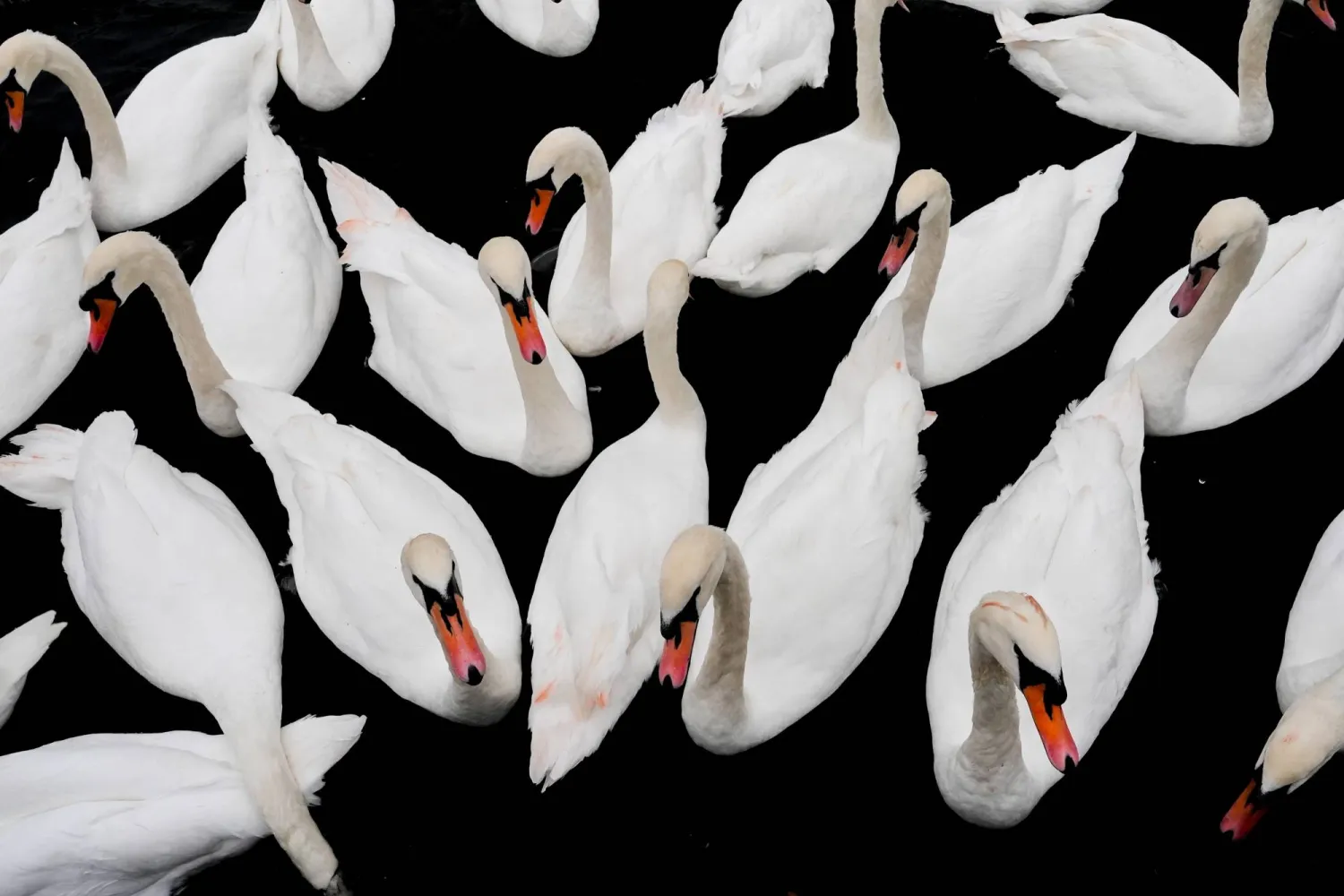
 Mute swans float on the River Thames, Oct. 10, 2025, in Windsor, England. (AP Photo/Julia Demaree Nikhinson, File)
Mute swans float on the River Thames, Oct. 10, 2025, in Windsor, England. (AP Photo/Julia Demaree Nikhinson, File)
TT

Some Animals Have Evolved Extreme Ways to Sleep in Precarious Environments

 Mute swans float on the River Thames, Oct. 10, 2025, in Windsor, England. (AP Photo/Julia Demaree Nikhinson, File)
Mute swans float on the River Thames, Oct. 10, 2025, in Windsor, England. (AP Photo/Julia Demaree Nikhinson, File)

Every animal with a brain needs sleep — and even a few without a brain do, too. Humans sleep, birds sleep, whales sleep and even jellyfish sleep.

Sleep is universal “even though it’s actually very risky,” said Paul-Antoine Libourel, a researcher at the Neuroscience Research Center of Lyon in France, The AP news reported.

When animals nod off, they're most vulnerable to sneaky predators. But despite the risks, the need for sleep is so strong that no creature can skip it altogether, even when it's highly inconvenient.

Animals that navigate extreme conditions and environments have evolved to sleep in extreme ways — for example, stealing seconds at a time during around-the-clock parenting, getting winks on the wing during long migrations and even dozing while swimming.

For a long time, scientists could only make educated guesses about when wild animals were sleeping, observing when they lay still and closed their eyes. But in recent years, tiny trackers and helmets that measure brain waves — miniaturized versions of equipment in human sleep labs — have allowed researchers to glimpse for the first time the varied and sometimes spectacular ways that wild animals snooze.

“We’re finding that sleep is really flexible in response to ecological demands,” said Niels Rattenborg, an animal sleep research specialist at the Max Planck Institute for Biological Intelligence in Germany.

Call it the emerging science of “extreme sleep.”

Chinstrap penguins and their ‘microsleeps’ Take chinstrap penguins in Antarctica that Libourel studies.

These penguins mate for life and share parenting duties — with one bird babysitting the egg or tiny gray fluffy chick to keep it warm and safe while the other swims off to fish for a family meal. Then they switch roles — keeping up this nonstop labor for weeks.

Penguin parents face a common challenge: getting enough sleep while keeping a close eye on their newborns.

They survive by taking thousands of catnaps a day — each averaging just 4 seconds long.

These short “microsleeps," as Korea Polar Research Institute biologist Won Young Lee calls them, appear to be enough to allow penguin parents to carry out their caregiving duties for weeks within their crowded, noisy colonies.

When a clumsy neighbor passes by or predatory seabirds are near, the penguin parent blinks to alert attention and soon dozes off again, its chin nodding against its chest, like a drowsy driver.

The naps add up. Each penguin sleeps for a total of 11 hours per day, as scientists found by measuring the brain activity of 14 adults over 11 days on Antarctica's King George Island.

To remain mostly alert, yet also sneak in sufficient winks, the penguins have evolved an enviable ability to function on extremely fractured sleep — at least during the breeding season.

Researchers can now see when either hemisphere of the brain — or both at once — are asleep.

Frigatebirds snooze half their brains in flight Poets, sailors and birdwatchers have long wondered whether birds that fly for months at a time actually get any winks on the wing.

In some cases, the answer is yes — as scientists discovered when they attached devices that measure brain-wave activity to the heads of large seabirds nesting in the Galapagos Islands called great frigatebirds.

While flying, frigatebirds can sleep with one half of the brain at a time. The other half remains semialert so that one eye is still watching for obstacles in their flight path.

This allows the birds to soar for weeks at a time, without touching land or water, which would damage their delicate, non-water repellent feathers.

Frigatebirds can't do tricky maneuvers — flapping, foraging or diving — with just one half of their brain. When they dive for prey, they must be fully awake. But in flight, they have evolved to sleep when gliding and circling upward on massive drafts of warm rising air that keep them aloft with minimal effort.

Back at the nest in trees or bushes, frigatebirds change up their nap routine — they are more likely to sleep with their whole brain at once and for much longer bouts. This suggests their in-flight sleeping is a specific adaptation for extended flying, Rattenborg said.

A few other animals have similar sleeping hacks. Dolphins can sleep with one half of the brain at a time while swimming. Some other birds, including swifts and albatrosses, can sleep in flight, scientists say.

Frigatebirds can fly 255 miles (410 kilometers) a day for more than 40 days, before touching land, other researchers found — a feat that wouldn’t be possible without being able to sleep on the wing.

Elephant seals slumber while diving deep On land, life is easy for a 5,000-pound (2,268-kilogram) northern elephant seal. But at sea, sleep is dangerous — sharks and killer whales that prey on seals are lurking.

These seals go on extended foraging trips, for up to eight months, repeatedly diving to depths of several hundred feet (meters) to catch fish, squid, rays and other sea snacks.

Each deep dive may last around 30 minutes. And for around a third of that time, the seals may be asleep, as research led by Jessica Kendall-Bar of Scripps Institution of Oceanography revealed.

Kendall-Bar's team devised a neoprene headcap similar to a swimming cap with equipment to detect motion and seal brain activity during dives, and retrieved the caps with logged data when seals returned to beaches in Northern California.

The 13 female seals studied tended to sleep during the deepest portions of their dives, when they were below the depths that predators usually patrol.

That sleep consisted of both slow-wave sleep and REM sleep. During REM, or rapid eye movement sleep, the seals were temporarily paralyzed — just like humans during this deep-sleep stage — and their dive motion changed. Instead of a controlled downward glide motion, they sometimes turned upside down and spun in what the researchers called a “sleep spiral” during REM sleep.

In the span of 24 hours, the seals at sea slept for around two hours total. (Back on the beach, they averaged around 10 hours.)

The winding evolution of sleep Scientists are still learning about all the reasons we sleep — and just how much we really need.

It's unlikely that any tired human can try these extreme animal sleep hacks. But learning more about how varied napping may be in the wild shows the flexibility of some species. Nature has evolved to make shut-eye possible in even the most precarious situations.


'Large-scale' Avalanche Kills Two Skiers in French Alps

Members of the CRS Alpes Grenoble mountain rescue team prepare to board a Securite Civile helicopter (emergency management) after after an avalanche emergency response rescue mission in an off-piste area of the Ecrins massif, French Alps on January 29, 2026. (Photo by JEFF PACHOUD / AFP)
TT

'Large-scale' Avalanche Kills Two Skiers in French Alps

Members of the CRS Alpes Grenoble mountain rescue team prepare to board a Securite Civile helicopter (emergency management) after after an avalanche emergency response rescue mission in an off-piste area of the Ecrins massif, French Alps on January 29, 2026. (Photo by JEFF PACHOUD / AFP)

An avalanche has killed two off-piste ski tourers in the French Alps, a local prosecutor said on Sunday.

According to local rescue services, the two men died when an avalanche was triggered on Saturday afternoon near the village of Saint-Veran, known as the highest village in the French Alps.

The two victims-- one born in 1997 and the other in 1991 -- were part of a group of four unguided skiers when a "large-scale" avalanche swept down the north side of the Tete de Longet mountain peak, Gap prosecutor Marion Lozac'hmeur told AFP.

The other two skiers were unharmed, Lozac'hmeur added.

An autopsy has been ordered as part of an investigation into the cause of death, according to the prosecutor.

Avalanches have already claimed the lives of more than 20 skiers across the French, Swiss and Austrian Alps so far this season.


Olympic Tourists in Cortina Can Explore the Dolomites with the New ‘Uber Snowmobile’ Service

 The peaks of the Dolomites are seen from the Cortina Sliding Centre during the Milano Cortina 2026 Winter Olympic Games in Cortina d'Ampezzo on February 5, 2026. (AFP)
The peaks of the Dolomites are seen from the Cortina Sliding Centre during the Milano Cortina 2026 Winter Olympic Games in Cortina d'Ampezzo on February 5, 2026. (AFP)
TT

Olympic Tourists in Cortina Can Explore the Dolomites with the New ‘Uber Snowmobile’ Service

 The peaks of the Dolomites are seen from the Cortina Sliding Centre during the Milano Cortina 2026 Winter Olympic Games in Cortina d'Ampezzo on February 5, 2026. (AFP)
The peaks of the Dolomites are seen from the Cortina Sliding Centre during the Milano Cortina 2026 Winter Olympic Games in Cortina d'Ampezzo on February 5, 2026. (AFP)

The peaks of the Dolomites are seen from the Cortina Sliding Centre during the Milano Cortina 2026 Winter Olympic Games in Cortina d'Ampezzo on February 5, 2026. (AFP)

For one month starting on Saturday, Olympic spectators keen for a side trip to a UNESCO World Heritage Site can use Uber to reserve a ride on a snowmobile along the snow-covered road to the base of the Three Peaks of Lavaredo.

The dramatic, jagged limestone pinnacles stand just 23 kilometers (14.3 miles) from the Cortina venues where athletes are competing in the 2026 Winter Olympics and Paralympics.

One of the Olympic torchbearers, Giulia Baffetti, runs snowmobiling tours through Cortina-based winter activities outfit Snowdreamers. The company partnered with Uber, the official ride-hailing sponsor for the Games, to offer free tours on the weekends in February to people in town.

"Uber Snowmobile" tours, which can only be booked through Uber, include a ride in an Uber transfer bus for up to eight people from Cortina to the spot where riders mount their snowmobiles for departure. Tourgoers then follow the instructor, who leads the line of snowmobiles.

The first slots offered went fast, but Uber spokesperson Caspar Nixon said Friday that it planned to add more.

The three peaks are a magical place, Baffetti said, and this is a way for more people to experience it. Hikers and climbers flock there in the warmer months. In the winter, it’s a prime spot for cross-country skiing, snowshoeing and sledding. Snowmobiling is allowed in a limited area in order to protect the environment.

"We want to give an experience to the tourists, so they can feel the mountains in a different way," she said.

The Associated Press took the one-hour tour on Thursday, ahead of the Saturday launch, along with one other person. Helmets are essential, while heated handgrips are a most welcome feature. And that red button? Passengers can push it to stop the snowmobile if it veers off course or they feel unsafe.

The adrenaline-filled ride reaches speeds up to 40 kph (25 mph) when zooming past snow-covered trees, and drivers are instructed to slow when coming upon cross-country skiers and sledders. Deer and wolves are sometimes seen along the 7-kilometer (4.3-mile) route up to the base of the peaks.

Also visible on Thursday was the southernmost of the three Lavaredo peaks, rising sharply out of the fog. While the Dolomites are breathtaking from Cortina — and on Friday, the sun shone and the view was clear from town — they are even more impressive up close.

The route back includes a short loop around Lake Antorno. Before traversing all the ups and downs, the snowmobile instructor leading the tour offers a reminder about that red button.

Saher Deeb, an Israeli tourist, was along for the ride Thursday, one day after his 29th birthday. It was his first time on a snowmobile, and he was all smiles as he climbed off at the end.

"It was perfect," he said.


French Duo Finish Walking from France to Shanghai After 1.5 Years

 Performers throw molten iron to create sparks during a performance on the Bund promenade along the Huangpu river, ahead of the upcoming Lunar New Year of the Horse in Shanghai on February 2, 2026. (AFP)
Performers throw molten iron to create sparks during a performance on the Bund promenade along the Huangpu river, ahead of the upcoming Lunar New Year of the Horse in Shanghai on February 2, 2026. (AFP)
TT

French Duo Finish Walking from France to Shanghai After 1.5 Years

 Performers throw molten iron to create sparks during a performance on the Bund promenade along the Huangpu river, ahead of the upcoming Lunar New Year of the Horse in Shanghai on February 2, 2026. (AFP)
Performers throw molten iron to create sparks during a performance on the Bund promenade along the Huangpu river, ahead of the upcoming Lunar New Year of the Horse in Shanghai on February 2, 2026. (AFP)

Two French adventurers reached the end of an epic walk from France to Shanghai on Saturday, after nearly a year and a half crossing 16 countries almost entirely on foot.

Loic Voisot and Benjamin Humblot embraced as they stood by the river on the Bund promenade, the financial hub's distinctive skyline glittering in the background.

Voisot and Humblot set off from Annecy in September 2024.

"We were thinking about this moment almost every day for more than a year now, so it's a really strong feeling," Humblot said of reaching their destination.

Hanging out after work one day, the two friends realized they both yearned for a "great adventure".

They wanted to visit China -- but without flying, which they believe is too harmful to the environment.

A plan to set out on foot was hatched, and except for a stretch in Russia which was done by bus for safety reasons, 518 days and around 12,850 kilometers (7,980 miles) later they took the last steps to completing it.

Around 50 people gathered at the start point for the last 10km stretch of their odyssey, many local people who have been following them on social media.

Along the way their numbers swelled, as media, French residents of Shanghai and others joined.

"If your dreams are crazy, just take it step by step and sometimes you will not succeed, but sometimes you will," said Voisot.

Asked what he would do first now the walk was over, he joked: "Sleep a lot!"