
Alleged Bondi Shooters Conducted ‘Tactical’ Training in Countryside, Police Say 

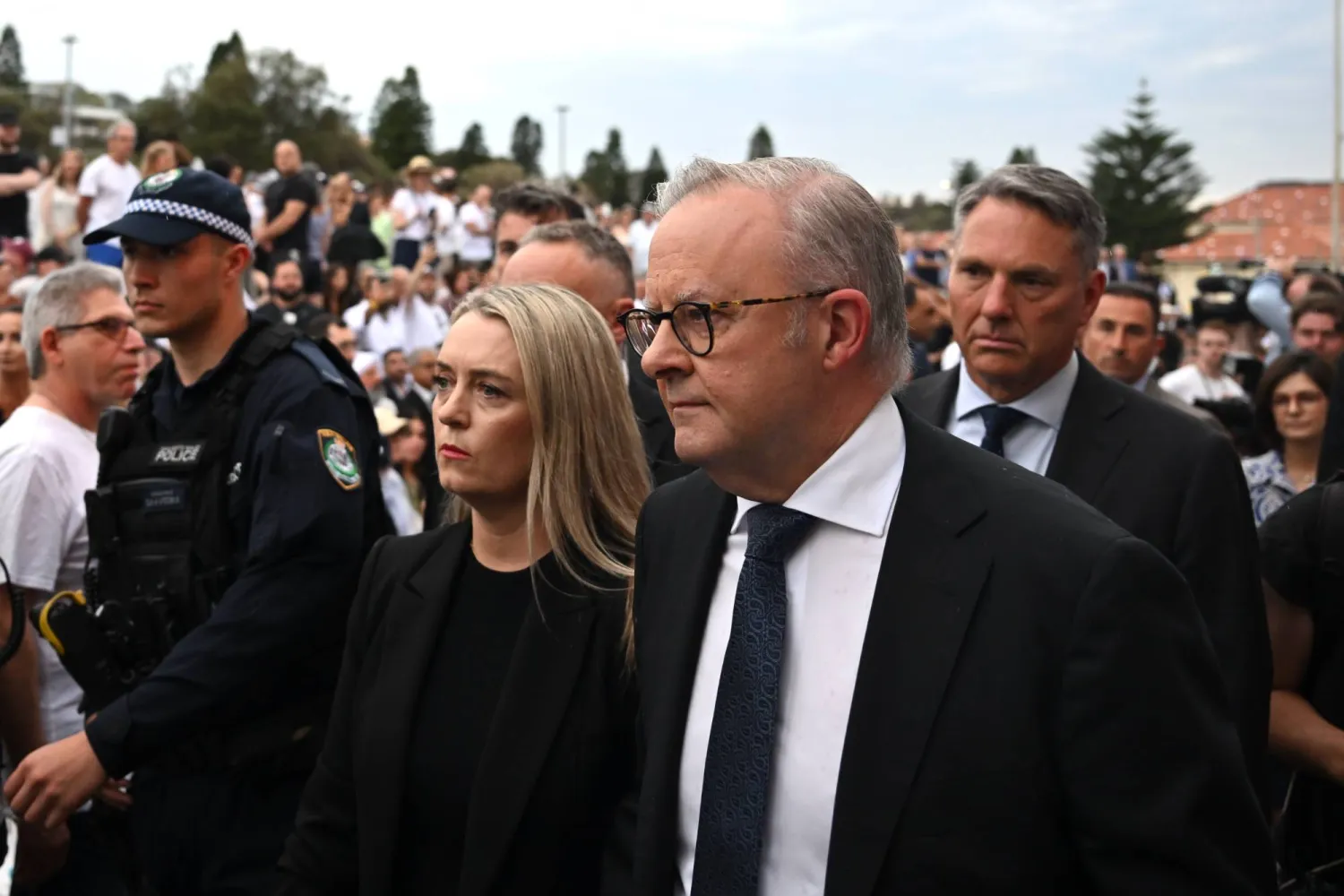
21 December 2025, Australia, Sydney: Australian Prime Minister Anthony Albanese (R) and his wife Jodie Haydon attend a National Day of Reflection vigil and commemoration for the victims and survivors of the Bondi Massacre at Bondi Beach in Sydney. (Dean Lewins/AAP/dpa)
TT

Alleged Bondi Shooters Conducted ‘Tactical’ Training in Countryside, Police Say 

21 December 2025, Australia, Sydney: Australian Prime Minister Anthony Albanese (R) and his wife Jodie Haydon attend a National Day of Reflection vigil and commemoration for the victims and survivors of the Bondi Massacre at Bondi Beach in Sydney. (Dean Lewins/AAP/dpa)

Two suspects in last week's deadly mass shooting at Australia's Bondi Beach trained for the attack in the countryside, police alleged in court documents Monday, as Prime Minister Anthony Albanese vowed tougher laws against hate speech and extremism.

Father and son Sajid Akram and Naveed are accused of targeting a Hanukkah event on Bondi Beach, killing 15 people in the nation's deadliest mass shooting in almost three decades.

Police documents released Monday said the two had carried out "firearms training" in what was believed to be the New South Wales countryside prior to the shooting.

Pictures were released showing the accused firing shotguns and moving in what authorities described as a "tactical manner".

The pair also recorded a video in October railing against "Zionists" while sitting in front of a flag of the ISIS group and detailing their motivations for the attack, police said.

And they made a nighttime "reconnaissance" trip to Bondi Beach just days before the killings, documents showed.

Australia observed a minute's silence at 6:47 pm (0747 GMT) on Sunday -- exactly a week since the first reports of gunfire.

On Monday, Albanese said he would push for tough new laws creating "an aggravated offense for hate preaching".

"We're not going to let the ISIS inspired terrorists win. We won't let them divide our society, and we'll get through this together," Albanese told reporters.

"As Prime Minister, I feel the weight of responsibility for an atrocity that happened whilst I'm Prime Minister, and I'm sorry for what the Jewish community and our nation as a whole has experienced," he said.

"The government will work every day to protect Jewish Australians, to protect the fundamental right as Australians that they have to be proud of who they are, to practice their faith, to educate their children and to engage in Australian society in the fullest way possible," he added.

- Crackdown on guns, 'terrorist symbols' -

Australia's federal government has flagged a suite of reforms to gun ownership and hate speech laws, as well as a review of police and intelligence services.

Albanese also announced last week a sweeping buyback scheme to "get guns off our streets".

It is the largest gun buyback since 1996, when Australia cracked down on firearms in the wake of a mass shooting that killed 35 people at Port Arthur.

And the government of New South Wales -- where the shooting took place -- recalled its parliament for two days on Monday to introduce what it called the "toughest firearm reforms in the country".

"We can't pretend that the world is the same as it was before that terrorist incident on Sunday," New South Wales Premier Chris Minns told reporters.

"I'd give anything to go back a week, a month, two years, to ensure that didn't happen, but we need to make sure that we take steps so that it never happens again."

The new rules will cap the number of guns an individual can own to four, or ten for exempted individuals like farmers.

There are more than 1.1 million firearms in the state, officials said.

The legislation would also ban the display of "terrorist symbols", including the flag of the ISIS, which was found in a car linked to one of the alleged shooters.

Authorities will also be able to prohibit protests for up to three months following a terrorism incident.

One of the alleged gunmen, Sajid Akram, 50, was shot and killed by police during the attack. An Indian national, he entered Australia on a visa in 1998.

His 24-year-old son Naveed, an Australian-born citizen, was moved from hospital to jail on Monday, police said.

Minns said Monday he would also look into stricter hate speech legislation next year.


US Vice President Vance Heads to Armenia, Azerbaijan to Push Peace, Trade

US Vice President JD Vance speaks during the Critical Minerals Ministerial at the State Department in Washington, DC, US, February 4, 2026. (Reuters)
TT

US Vice President Vance Heads to Armenia, Azerbaijan to Push Peace, Trade

US Vice President JD Vance speaks during the Critical Minerals Ministerial at the State Department in Washington, DC, US, February 4, 2026. (Reuters)

US Vice President JD Vance will visit Armenia and Azerbaijan this week to push a Washington-brokered peace agreement that could transform energy and trade routes in the strategic South Caucasus region.

His two-day trip to Armenia, which begins later on Monday, comes just six months after the Armenian and Azerbaijani leaders signed an agreement at the White House seen as the first step towards peace after nearly 40 years of war.

Vance, the first US vice president to visit Armenia, is seeking to advance the Trump Route for International Peace and Prosperity (TRIPP), a proposed 43-kilometre (27-mile) corridor that would run across southern Armenia and give Azerbaijan a direct route to its exclave ‌of Nakhchivan ‌and in turn to Türkiye, Baku's close ally.

"Vance's visit should ‌serve ⁠to reaffirm the ‌US's commitment to seeing the Trump Route through," said Joshua Kucera, a senior South Caucasus analyst at Crisis Group.

"In a region like the Caucasus, even a small amount of attention from the US can make a significant impact."

The Armenian government said on Monday that Vance would hold talks with Prime Minister Nikol Pashinyan and that both men would then make statements, without elaborating.

Vance will then visit Azerbaijan on Wednesday and Thursday, the White House has said.

Under the agreement signed last year, ⁠a private US firm, the TRIPP Development Company, has been granted exclusive rights to develop the proposed corridor, with Yerevan ‌retaining full sovereignty over its borders, customs, taxation and security.

The ‍route would better connect Asia to Europe ‍while - crucially for Washington - bypassing Russia and Iran at a time when Western countries are ‍keen on diversifying energy and trade routes away from Russia due to its war in Ukraine.

Russia has traditionally viewed the South Caucasus as part of its sphere of influence but has seen its clout there diminish as it is distracted by the war in Ukraine.

Securing US access to supplies of critical minerals is also likely to be a key focus of Vance's visit.

TRIPP could prove a key transit corridor for the vast mineral wealth of ⁠Central Asia - including uranium, copper, gold and rare earths - to Western markets.

CLOSED BORDERS, BITTER RIVALS

In Soviet times the South Caucasus was criss-crossed by railways and oil pipelines until a series of wars beginning in the 1980s disrupted energy routes and shuttered the border between Armenia and Türkiye, Azerbaijan's key regional ally.

Armenia and Azerbaijan were locked in bitter conflict for nearly four decades, primarily over the mountainous region of Nagorno-Karabakh, an internationally recognized part of Azerbaijan that broke away from Baku's control as the Soviet Union fell apart in 1991.

Azerbaijan and Armenia fought two wars over Karabakh before Baku finally took it back in 2023. Karabakh's entire ethnic Armenian population of around 100,000 people fled to Armenia. The two neighbors have made progress in recent months on normalizing relations, including restarting ‌some energy shipments.

But major hurdles remain to full and lasting peace, including a demand by Azerbaijan that Armenia change its constitution to remove what Baku says contains implicit claims on Azerbaijani territory.


Adviser to Iran's Supreme Leader to Visit Oman on Tuesday

FILED - 06 February 2009, Bavaria, Munich: Ali Larijani, then chairman of the Iranian parliament, speaks at the 45th Munich Security Conference in Munich. Photo: Andreas Gebert/dpa
TT

Adviser to Iran's Supreme Leader to Visit Oman on Tuesday

FILED - 06 February 2009, Bavaria, Munich: Ali Larijani, then chairman of the Iranian parliament, speaks at the 45th Munich Security Conference in Munich. Photo: Andreas Gebert/dpa

Ali Larijani, an adviser to Iran's Supreme Leader Ali Khamenei, will visit Oman accompanied by a delegation on Tuesday, the ‌semi-official Tasnim news ‌agency reported ‌on ⁠Monday.

American and ‌Iranian diplomats held indirect talks in Oman last week, aimed at reviving diplomacy amid a US ⁠naval buildup near Iran and ‌Tehran's vows ‍of a ‍harsh response if ‍attacked.

"During this trip, (Larijani) will meet with high-ranking officials of the Sultanate of Oman and discuss the latest regional ⁠and international developments and bilateral cooperation at various levels," Tasnim said.

The date and venue of the next round of talks are yet to be announced.


Russia’s Lavrov Sees No ‘Bright Future’ for Economic Ties with US

06 February 2026, Russia, Moscow: Russian Foreign Minister Sergei Lavrov gives a press conference following a meeting with Organization for Security and Cooperation in Europe (OSCE) Chairperson-in-Office Ignazio Cassis, head of Switzerland's Federal Department of Foreign Affairs, Federal Councilor of the Swiss Confederation, and OSCE Secretary General Feridun Sinirlioglu at the Russian Foreign Ministry's Reception House. (Sofya Sandurskaya/TASS via ZUMA Press/dpa)
TT

Russia’s Lavrov Sees No ‘Bright Future’ for Economic Ties with US

06 February 2026, Russia, Moscow: Russian Foreign Minister Sergei Lavrov gives a press conference following a meeting with Organization for Security and Cooperation in Europe (OSCE) Chairperson-in-Office Ignazio Cassis, head of Switzerland's Federal Department of Foreign Affairs, Federal Councilor of the Swiss Confederation, and OSCE Secretary General Feridun Sinirlioglu at the Russian Foreign Ministry's Reception House. (Sofya Sandurskaya/TASS via ZUMA Press/dpa)

Russia remains open for cooperation with the United States but is not hopeful about economic ties despite Washington's ongoing efforts to end the Ukraine war, Russian Foreign Minister Sergei Lavrov said in an interview published on Monday.

Speaking to Russia-based media outlet TV BRICS, ‌Lavrov cited what ‌he called the ‌United ⁠States' declared ‌aim of "economic dominance".

"We also don't see any bright future in the economic sphere," Lavrov said.

Russian officials, including envoy Kirill Dmitriev, have previously spoken of the prospects for a major restoration ⁠of economic relations with the United States as ‌part of any eventual Ukraine ‍peace settlement.

But although ‍President Donald Trump has also ‍spoken of reviving economic cooperation with Moscow and has hosted his Russian counterpart Vladimir Putin on US soil since returning to the White House, he has imposed further onerous sanctions on Russia's vital ⁠energy sector.

Lavrov also cited Trump's hostility to the BRICS bloc, which includes Russia, China, India, Brazil and other major developing economies.

"The Americans themselves create artificial obstacles along this path (towards BRICS integration)," he said.

"We are simply forced to seek additional, protected ways to develop our financial, economic, logistical and ‌other projects with the BRICS countries."