

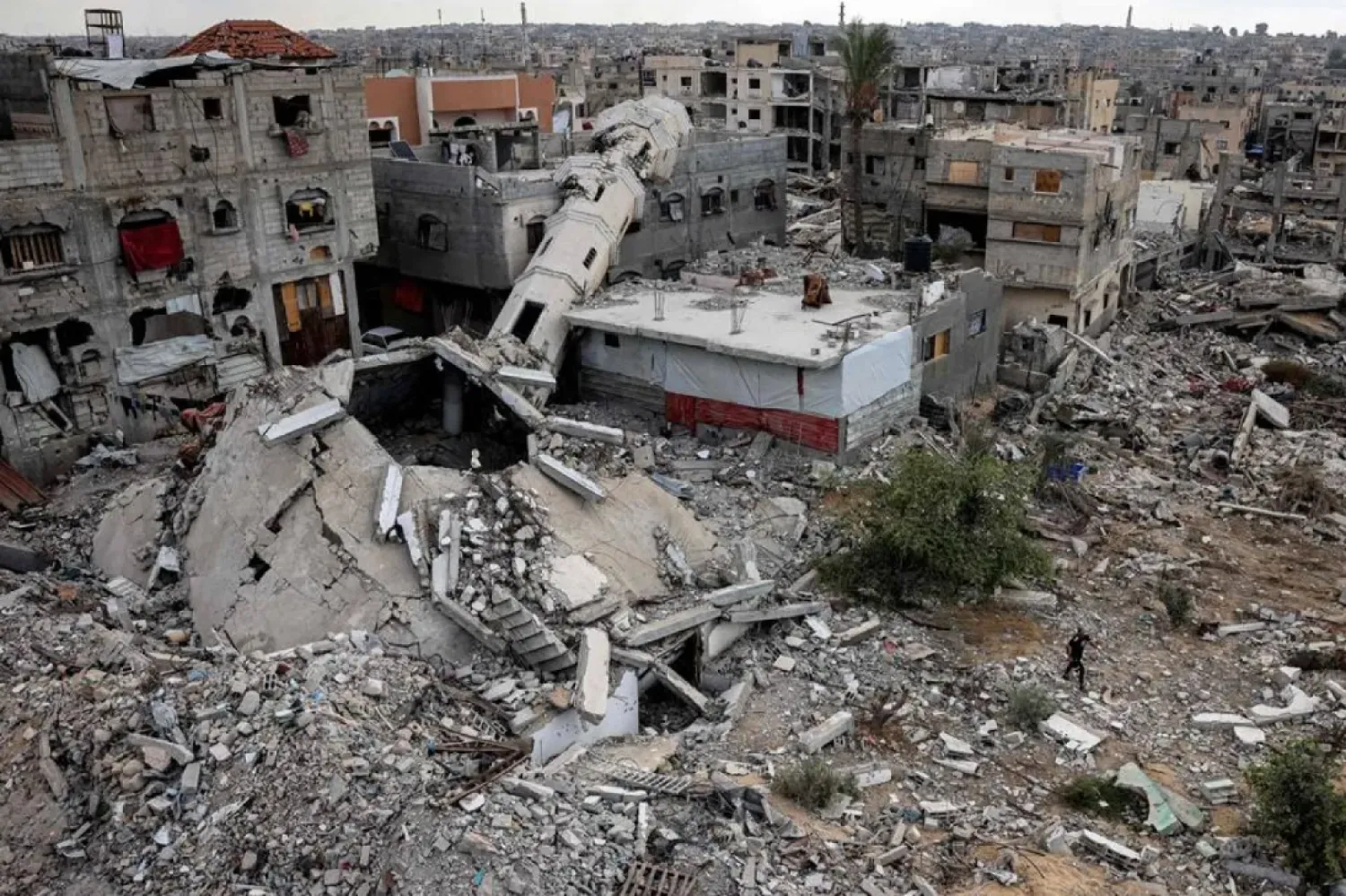

Gazans Fear Renewed Displacement after Israeli Strikes

This overview shows a destroyed mosque and other buildings in Khan Younis in the southern Gaza Strip on October 7, 2024 on the first anniversary of the ongoing war in the Palestinian territory between Israel and Hamas. (AFP)
TT

Gazans Fear Renewed Displacement after Israeli Strikes

This overview shows a destroyed mosque and other buildings in Khan Younis in the southern Gaza Strip on October 7, 2024 on the first anniversary of the ongoing war in the Palestinian territory between Israel and Hamas. (AFP)

When her children, trembling with fear, ask where the family can go to escape Israel's continued bombardment in southern Gaza's Khan Yunis area, Umm Ahmed has no answer.

In her small, devastated village near Khan Yunis city, recent Israeli drone and artillery strikes shattered the tenuous sense of peace delivered by a ceasefire that has largely held since October 10, AFP said.

Residents say the strikes have targeted neighborhoods east of the so-called Yellow Line -- a demarcation established under the truce between Israel and Hamas.

The Israeli military says its troops are deployed in the area in accordance with the ceasefire framework, accusing Hamas militants of "crossing the Yellow Line and carrying out terrorist activities".

More than two years after Hamas's October 7 attack on Israel sparked a devastating war, tens of thousands of Gazans still live in tents or damaged homes in these areas, where the Israeli army maintains control and operates checkpoints.

Now, many fear being forced from their homes, compelled to move west of the Yellow Line.

"We don't sleep at night because of fear. The bombardments in the east are relentless," said Umm Ahmed, 40.

"My children tremble at every explosion and ask me, 'Where can we go?' And I have no answer."

Her home in Bani Suheila has been completely destroyed, yet the family has stayed, pitching a tent beside the ruins.

"Staying close to our destroyed home is easier than facing the unknown," Umm Ahmed said.

Crossing the Yellow Line to Al-Mawasi, west of Khan Yunis, is not an option for them.

There, makeshift camps stretch as far as the eye can see, housing tens of thousands of Palestinians who fled the fighting.

"There is no place left for anyone there, and not enough food or water," Umm Ahmed said, as Gaza remains trapped in a catastrophic humanitarian crisis.

- 'We will not leave' -

The Israeli military blames continued threats from the Hamas group for its actions in the area.

The Israeli military said in a statement to AFP that the army’s “current operations in Gaza, and their deployment in the Yellow Line area in particular, are carried out to address direct threats from terrorist organizations in Gaza.”

The war in Gaza began with Hamas's attack on Israel on October 7, 2023 that resulted in the deaths of 1,221 people, mostly civilians, according to an AFP tally based on official Israeli figures.

Since the war began, more than 70,000 people have been killed in Gaza, according to the Hamas-run territory's health ministry.

The vast majority of Gaza's more than two million residents were displaced during the war, many multiple times.

A fragile ceasefire has been in place since October 10, though both sides regularly accuse each other of violations.

Under the truce, Israeli forces withdrew to positions east of the Yellow Line.

Earlier this month, Israeli army chief Lieutenant General Eyal Zamir described the Yellow Line as the "new border line" with Israel.

"The Yellow Line is a new border line -- serving as a forward defensive line for our communities and a line of operational activity," he said to reserve soldiers in Gaza.

For Palestinian officials, the line is seen as a tool for permanent displacement.

"The objective is to frighten residents, expel them from their areas, and force them west," said Alaa al-Batta, mayor of Khan Yunis, denouncing the bombardments as "violations of the ceasefire agreement".

Mahmud Baraka, 45, from Khuzaa, east of Khan Yunis, described constant artillery fire and home demolitions in the area.

"It feels like we are still living in a war zone," he said.

"Explosions happen as if they are right next to us. The objective of the occupation is clear: to intimidate us and drive us out, so the region is emptied."

For now, residents feel trapped between bombardment and displacement, uncertain how long they can endure.

Despite the danger, Abdel Hamid, 70, refuses to leave his home located north of Khan Yunis, where he lives with his five children.

"We will not leave... this is our land," he said.

"Moving would not be a solution, but yet another tragedy."


Germany Deports Man to Syria for First Time Since 2011

People attend a protest against reelection of Syria's president Bashar al-Assad, near Syria's embassy, Berlin, Germany May 26, 2021. (Reuters)
TT

Germany Deports Man to Syria for First Time Since 2011

People attend a protest against reelection of Syria's president Bashar al-Assad, near Syria's embassy, Berlin, Germany May 26, 2021. (Reuters)

Germany deported a man to Syria for the first time since the civil war began in that country in 2011, the interior ministry in Berlin announced on Tuesday.

A Syrian immigrant previously convicted of criminal offences in Germany was flown to Damascus and handed over to Syrian authorities on Tuesday morning, the ministry said.


Army: Lebanese Soldier among Those Killed in Monday Israeli Strike

Lebanese soldiers secure the site of an Israeli drone strike that targeted a truck in the village of Sibline, south of Beirut, on December 16, 2025. (Photo by Mahmoud ZAYYAT / AFP)
TT

Army: Lebanese Soldier among Those Killed in Monday Israeli Strike

Lebanese soldiers secure the site of an Israeli drone strike that targeted a truck in the village of Sibline, south of Beirut, on December 16, 2025. (Photo by Mahmoud ZAYYAT / AFP)

A Lebanese soldier was among three people killed in an Israeli air strike on a car in the country's south, the army said Tuesday, denying Israeli claims that he was also a Hezbollah operative.

Israel has kept up regular strikes on Lebanon, usually saying it is targeting Hezbollah, despite a November 2024 ceasefire that sought to end more than a year of hostilities with the Iran-backed militant group, which it accuses of rearming.

Lebanon's state-run National News Agency said Monday's strike on a vehicle was carried out by an Israeli drone around 10 kilometers (six miles) from the southern coastal city of Sidon and "killed three people who were inside".

The Lebanese army said on Tuesday that Sergeant Major Ali Abdullah had been killed the previous day "in an Israeli airstrike that targeted a car he was in" near the city of Sidon.

The Israeli army said it had killed three Hezbollah operatives in the strike, adding in a statement on Tuesday that "one of the terrorists eliminated during the strike simultaneously served in the Lebanese intelligence unit".

A Lebanese army official told AFP it was "not true" that the soldier was a Hezbollah member, calling Israel's claim "a pretext" to justify the attack.

Under heavy US pressure and amid fears of expanded Israeli strikes, Lebanon has committed to disarming Hezbollah, starting with the south.

The Lebanese army plans to complete the group's disarmament south of the Litani River -- about 30 kilometers from the border with Israel -- by year's end.

The latest strike came after Lebanese and Israeli civilian representatives on Friday took part in a meeting of the ceasefire monitoring committee for a second time, after holding their first direct talks in decades earlier this month.

The committee comprises representatives from Lebanon, Israel, the United States, France and the United Nations Interim Force in Lebanon (UNIFIL).

More than 340 people have been killed by Israeli fire in Lebanon since the ceasefire, according to an AFP tally of Lebanese health ministry reports.


Israel Defense Minister Vows to Stay in Gaza, Establish Outposts

Palestinians amid rubble of destroyed buildings in Jabalia, northern Gaza Strip (AFP)
TT

Israel Defense Minister Vows to Stay in Gaza, Establish Outposts

Palestinians amid rubble of destroyed buildings in Jabalia, northern Gaza Strip (AFP)

Defense Minister Israel Katz on Tuesday vowed Israel will remain in Gaza and pledged to establish outposts in the north of the Palestinian territory, according to a video of a speech published by Israeli media. 

His remarks, reported across Israeli media, come as a fragile US-brokered ceasefire between Israel and Hamas holds in Gaza, said AFP. 

Mediators are pressing for the implementation of the next phases of the truce, which would involve an Israeli withdrawal from the territory. 

Speaking at an event in the Israeli settlement of Beit El in the occupied West Bank, Katz said: "We are deep inside Gaza, and we will never leave Gaza -- there will be no such thing." 

"We are there to protect, to prevent what happened (from happening again)," he added, according to a video published by Israeli news site Ynet. 

Katz also vowed to establish outposts in the north of Gaza in place of settlements that had been evacuated during Israel's unilateral disengagement from the territory in 2005. 

"When the time comes, God willing, we will establish in northern Gaza, Nahal outposts in place of the communities that were uprooted," Katz said, referring to military-agricultural settlements set up by Israeli soldiers. 

"We will do this in the right way and at the appropriate time." 

Katz's remarks were slammed by former minister and chief of staff Gadi Eisenkot, who accused the government of "acting against the broad national consensus, during a critical period for Israel's national security." 

"While the government votes with one hand in favor of the Trump plan, with the other hand it sells fables about isolated settlement nuclei in the (Gaza) Strip," he wrote on X, referring to the Gaza peace plan brokered by US President Donald Trump. 

The next phases of Trump's plan would involve an Israeli withdrawal from Gaza, the establishment of an interim authority to govern the territory in place of Hamas and the deployment of an international stabilization force. 

It also envisages the demilitarization of Gaza, including the disarmament of Hamas, which the group has refused. 

On Thursday, several Israelis entered the Gaza Strip in defiance of army orders and held a symbolic flag-raising ceremony to call for the reoccupation and resettlement of the Palestinian territory.
