
Shanghai's Elderly Waltz Back to the Past at Lunchtime Dance Halls

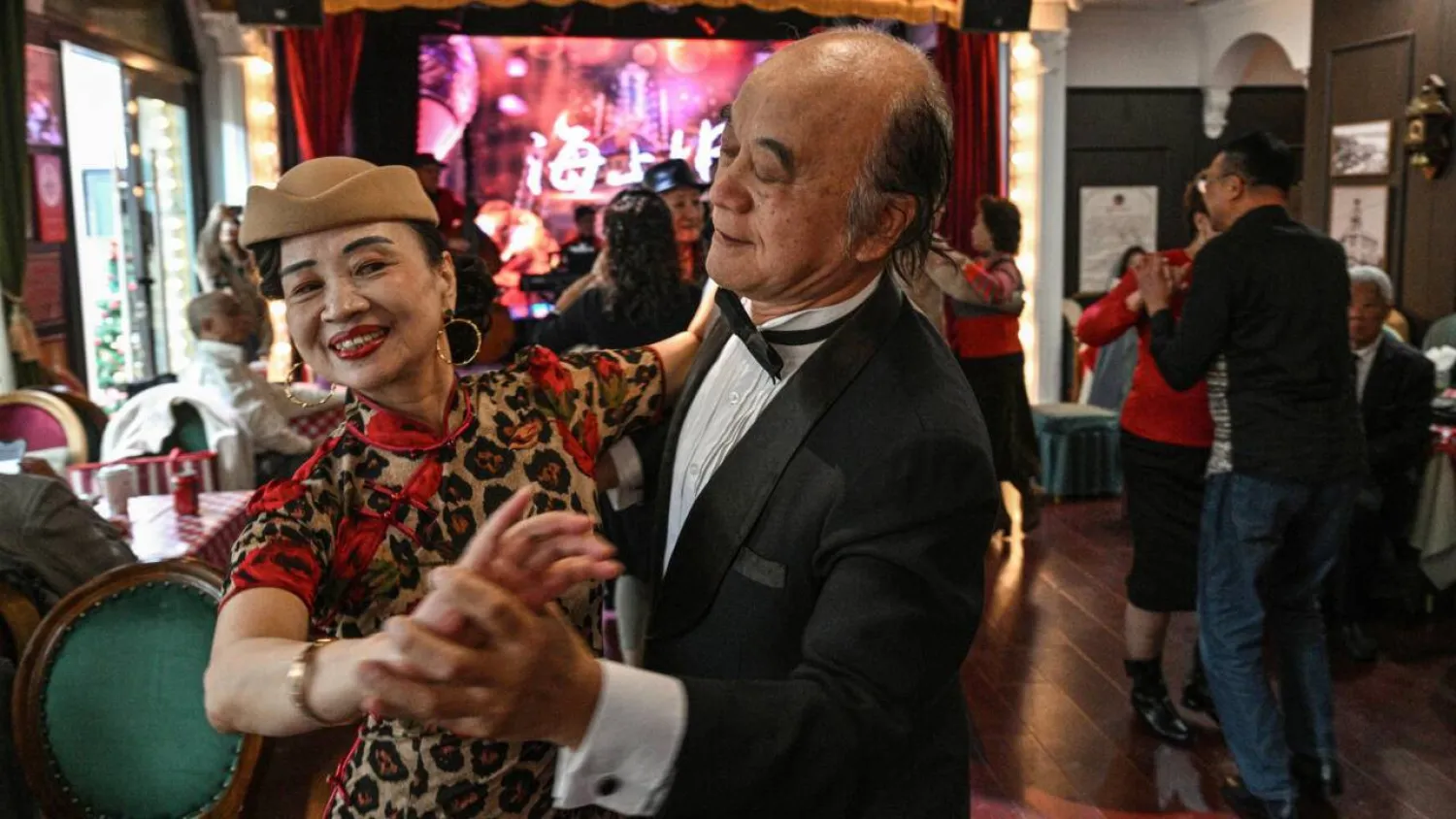
On any given day, multiple venues in Shanghai host hours-long dance sessions, a phenomenon born of the city's deeply of ballroom culture. Hector RETAMAL / AFP
TT

Shanghai's Elderly Waltz Back to the Past at Lunchtime Dance Halls

On any given day, multiple venues in Shanghai host hours-long dance sessions, a phenomenon born of the city's deeply of ballroom culture. Hector RETAMAL / AFP

A group of retirees cheered under disco lights as 60-year-old Xu Li leapt into her partner's arms, her legs spread akimbo in perfect splits.

It was just a regular Wednesday at one of Shanghai's many lunchtime dance clubs, a phenomenon born of the city's deeply rooted love of ballroom culture from its jazz-age heyday.

On any given day, multiple venues host hours-long daytime sessions across the finance hub, some starting as early as 6 am.

Establishments such as the historic Paramount Ballroom are time capsules from the 1930s, while others flash with neon pink and green rave lights in the early afternoon.

All are important spaces for their mostly elderly clientele to socialize and reclaim the past through the medium of foxtrot, rumba and polka.

"I was quite lonely at home," 66-year-old Lin Guang told AFP at a dance hall called Old Dreams Of Shanghai in December, explaining he had felt lost after retiring.

"Coming here to dance makes me feel young again. Now, I seem to have endless energy."

Wine-red velvet curtains and cabaret lights framed the sprung wooden floor as a live band played Shanghai jazz classics.

Women, some dressed in vintage gowns or sleek traditional qipao dresses, took out elegant dance shoes, while the men's footwear was meticulously polished and their hair neatly combed.

"We want to recreate a bit of old Shanghai culture," said 69-year-old bandleader Jin Zhiping.

For him and his similarly aged bandmates, the lunchtime sessions, priced at 60 yuan ($8.5), are a source of purpose.

"It lifts our spirits, and makes us feel we still have value," said Jin.

For Xu, the athletic sexagenarian, the benefits of exercising are "tremendous".

"I feel beautiful, and I'm becoming more and more beautiful as time goes on," she said.

'Like my home'

In 1930s Shanghai, ballroom dancing symbolized modernity and sophistication.

"Shanghai is a port city," said Chen Yiming, the entrepreneur behind Old Dreams Of Shanghai. "We absorbed foreign cultures and blended them with our own."

The art deco Paramount Ballroom was a must-visit destination, counting warlords, poets and actor Charlie Chaplin among its visitors.

These days, it still opens its heavy brass doors daily, an elevator transporting a steady stream of guests back almost a century in time for 180 yuan each.

Wei Xiaomeng, 90, comes to the Paramount Ballroom five times a week.

"This ballroom is like my home," she told AFP.

She first snuck into a dance hall as a curious middle school student.

"I thought it was luxurious, and I loved it," she said.

As a waltz began, couples swept across the floor, hands clasped and feet moving in perfect synchronization under the gilded cornices and glittering chandeliers.

"That feeling of loneliness? It's completely gone here," smiled 75-year-old Yuan Yingjie. "It's a familiar, homely feeling."

Fafa, a 70-year-old who visits the venue three times a week, put it simply: "Here, it's all joy."

'Just old, not dead'

Old Dreams Of Shanghai's Chen said for elderly clientele, dance halls are gyms, entertainment venues and social clubs rolled into one.

"An elderly person is just old, not dead. They have the same social and entertainment needs as anyone," she said.

But there are concerns the average age of the dancers could see this quintessential Shanghai phenomenon slowly die out.

It is unclear how many of these dance halls still exist. AFP found around a dozen online, while a recent local media report suggested around 20 still operate.

"Promoting dance culture to a younger generation is actually very necessary," said the Paramount's executive director, 33-year-old Stella Zheng.

In-person contact was especially important in China's hyper-digitalized society, she said.

"The exchange of glances, body language... you can listen to music, make friends through dance."

The Paramount hosts parties for young people in collaboration with other dance institutions, and plans to offer classes in styles like modern and Latin.

Chen said she had observed a growing retro trend.

"More and more young people are starting to join in to dance modern or swing," she said.

Older dancers are excited to share the floor.

"We truly hope young people come," said Wang Li, 65.

"Young people have an energy, a bright liveliness. Being with them makes us feel younger too."


Thousands of Authors Publish ‘Empty’ Book to Protest AI Using their Work

Thousands of authors published an “empty” book to protest AI (Shutterstock)
TT

Thousands of Authors Publish ‘Empty’ Book to Protest AI Using their Work

Thousands of authors published an “empty” book to protest AI (Shutterstock)

Thousands of authors including Kazuo Ishiguro, Philippa Gregory and Richard Osman have published an “empty” book to protest against AI firms using their work without permission.

About 10,000 writers have contributed to Don’t Steal This Book, in which the only content is a list of their names.

Copies of the work were distributed to attenders at the London book fair on Tuesday, a week before the UK government is due to issue an assessment on the economic cost of proposed changes in copyright law.

By March 18, ministers must deliver an economic impact assessment as well as a progress update on a consultation about the legal overhaul, against a backdrop of anger among creative professionals about how their work is being used by AI firms.

The organizer of the book, Ed Newton-Rex, a composer and campaigner for protecting artists’ copyright, said the AI industry was “built on stolen work ... taken without permission or payment.”

He added: “This is not a victimless crime – generative AI competes with the people whose work it is trained on, robbing them of their livelihoods. The government must protect the UK’s creatives, and refuse to legalize the theft of creative work by AI companies.”

Other authors who have contributed their names to the book include the Slow Horses author, Mick Herron; the author Marian Keyes; the historian David Olusoga; and Malorie Blackman, the writer of Noughts and Crosses.

“It is not in any way unreasonable to expect AI companies to pay for the use of authors’ books,” said Blackman.


Wildlife to Replace Humans on Next Series of UK Banknotes

Banknotes and coins that feature an image of Britain's King Charles III are pictured on display during a photocall for "The Future of Money" exhibition, at the Bank of England Museum, City of London, UK, Feb. 27, 2024. (AFP)
TT

Wildlife to Replace Humans on Next Series of UK Banknotes

Banknotes and coins that feature an image of Britain's King Charles III are pictured on display during a photocall for "The Future of Money" exhibition, at the Bank of England Museum, City of London, UK, Feb. 27, 2024. (AFP)

Images of ‌animals will feature on the next series of banknotes from the Bank of England, as the central bank shifts away from historical figures such as William Shakespeare, Winston Churchill and Jane Austen over the coming years.

"Nature is a great choice from a banknote authentication perspective and means we can showcase the UK's rich and varied wildlife on the next series of ‌banknotes," Victoria ‌Cleland, the BoE's chief cashier, said.

Bank ‌of ⁠England banknotes have ⁠featured monarchs since Queen Elizabeth first appeared on one in 1960, while Shakespeare was the first historic figure to appear in 1970.

King Charles' portrait will continue to appear on the next series of notes as well, the ⁠BoE said.

The BoE held a ‌consultation on a change ‌to the design of banknotes in July 2025, ‌inviting views from the public.

The theme of ‌nature was supported by 60% of the 44,000 responses, narrowly beating the category of "architecture and landmarks" on 56% and "notable historical figures" on 38%. Other categories included "arts, ‌culture and sport", "innovation" and "noteworthy milestones".

The new notes will feature wildlife native ⁠to ⁠the United Kingdom and will not include household pets, the BoE said. It plans to run a second consultation in the coming months asking for the public's views on specific animals to feature on the notes taken from a list created by British wildlife experts.

The BoE is not the only producer of banknotes in the United Kingdom. Notes are also produced by seven commercial banks in Scotland and Northern Ireland.


North Korea and China to Resume Passenger Train Service After Six-Year Gap

A North Korean flag flutters from a train believed to be carrying North Korean leader Kim Jong Un, as it arrives in Beijing, China, September 2, 2025. (Reuters)
TT

North Korea and China to Resume Passenger Train Service After Six-Year Gap

A North Korean flag flutters from a train believed to be carrying North Korean leader Kim Jong Un, as it arrives in Beijing, China, September 2, 2025. (Reuters)

South ‌Korea's Unification Ministry said on Tuesday that passenger train services between Pyongyang and Beijing are set to resume this week, marking the end of a six-year suspension caused by the COVID-19 pandemic.

The resumption restores a critical transport link between North Korea and its primary economic ally, after ‌years of ‌strict border closures that began ‌in ⁠early 2020.

China's state ⁠railway told the Yonhap News Agency that the Pyongyang–Beijing train will begin the round-trip service on March 12, operating four times a week.

Only the last two carriages will ⁠initially carry passengers, mainly diplomats or ‌others on ‌official business, with ticket sales to the general ‌public possible if seats are ‌available, Yonhap quoted a railway official as saying.

North Korea remains closed to most foreign tourism, with limited exceptions largely for ‌Russian tour groups under restricted arrangements, according to travel agencies organizing trips ⁠to ⁠the country.

Before the pandemic, Chinese visitors made up the largest share of foreign tourists to North Korea, the agencies said.

Tour organizers said on Monday that North Korea had cancelled next month's Pyongyang Marathon for unspecified reasons. The race is one of the few events that has been open to international participants in the isolated state.