


Hawaii’s Big Island Bans Feeding Feral Cats in an Effort to Help Endangered Native Species

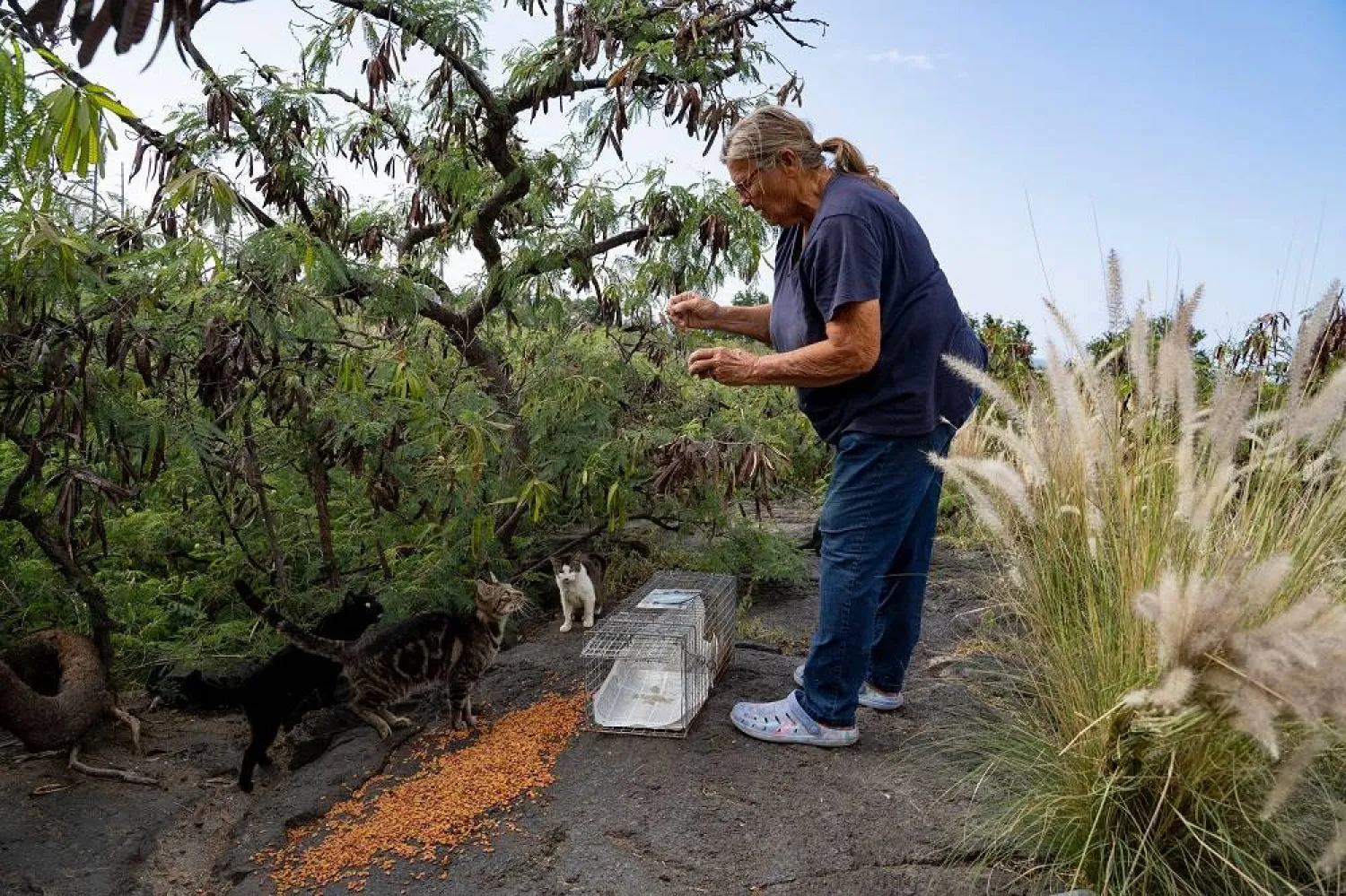
Liz Swan sets up food and a trap for stray cats near the Kealakehe Transfer Station and Recycling Center, Tuesday, Dec. 2, 2025, in Kailua-Kona, Hawaii. (AP)
TT

Hawaii’s Big Island Bans Feeding Feral Cats in an Effort to Help Endangered Native Species

Liz Swan sets up food and a trap for stray cats near the Kealakehe Transfer Station and Recycling Center, Tuesday, Dec. 2, 2025, in Kailua-Kona, Hawaii. (AP)

Throngs of feral cats emerge from the shade of parked trucks and bushes as soon as the familiar Subaru Forester pulls into a dump on Hawaii's Big Island. They run after the vehicle to a certain meal — a gravy train that might not be around much longer.

A Hawaii County law set to take effect at the start of the new year bans feeding feral animals on county property. It's an effort to protect native species, such as an endangered goose called the nene, from a super predator introduced to the islands by Europeans in the 18th century.

But the measure doesn't sit well with many cat lovers, including the driver of the Subaru, Liz Swan, who has been feeding feral felines on the Big Island for 33 years.

“I don’t believe the cats should be exterminated at the expense of the nene,” Swan said. “They’re both living creatures.”

It's unclear how many feral cats — abandoned pets and their descendants — live on the Big Island. Estimates range well into the tens of thousands, with pockets of dense colonies supported by people. Opponents of the ban say it will hamper their efforts to contain the population by trapping and neutering the animals and that hungry cats will then have to hunt for food.

A variety of threats

About 200 cats live at the Kealakehe Transfer Station and Recycling Center, not far from the bustling tourist district of Kona.

Swan shows up every late afternoon with water and kibble, and says she's never seen a nene anywhere near the dump. Despite living amid trash, the cats there generally appear robust, most of them missing the tip of an ear, indicating they’ve been spayed or neutered.

The cats threaten the native species directly — by killing them — and indirectly, biologists say. Food left out for the cats can attract native animals, bringing them into closer contact with humans. Cat feces can also spread a parasite that causes toxoplasmosis, a disease that has killed endangered Hawaiian monk seals and native birds.

Last year, a male nene — pronounced “neh-neh” — was struck and killed by a car as it crossed a road in Hilo, on the eastern side of the island, to reach a cat feeding station. The goose's surviving mate, which also had a gosling die of toxoplasmosis in 2024, has recently taken on another partner and is nesting in a Hilo park, the state Department of Land and Natural Resources announced this month.
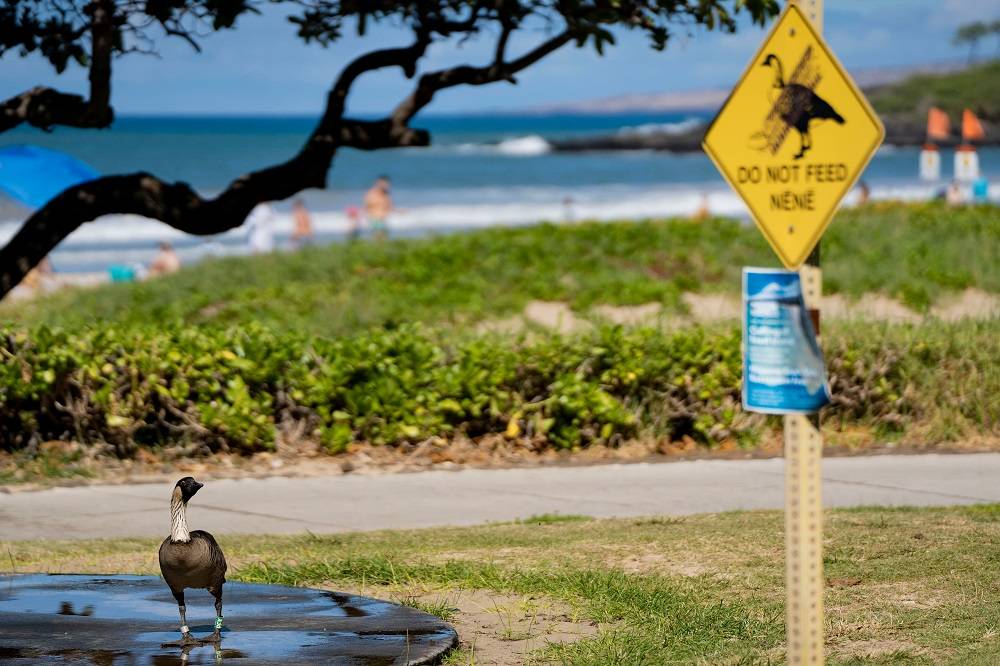
A nene stands near a sign reading "DO NOT FEED NENE" at Hapuna Beach, Tuesday, Dec. 2, 2025, in Kamuela, Hawaii. (AP)

The county's feeding ban will help protect them, the department said.

A Hawaiian biologist's view State wildlife biologist Raymond McGuire recently checked for nene nesting sites among the barren black-rock fields near a shopping center at the Waikoloa resort. It's not their traditional habitat, but he has seen the geese fly in to grab food — risking getting hit by cars — and last year some nested there.

As he approached, a pair of feline eyes peered out of a crack in the lava rock. Cats emerged from their nooks, perhaps mistaking him for someone who might offer food.

McGuire was relieved to see there were no nene nearby, but frustrated with evidence the cats are being fed: empty water bowls and aluminum pans.

He's a cat owner — "my favorite animal is a cat" — but as a Hawaiian whose love of nature inspired him to pursue conservation work, he believes there is no room for them where native species are struggling to survive.

“There's so many birds that my kids will never see, that I got to see,” he said, referring to native forest birds. “I think about my ancestors and I do wonder: Are we honoring them well in what we do? Because they did take steps to protect them.”

Feral cats are a problem in many places, but Hawaii's sensitive ecosystem is full of species that evolved without mammalian predators, making them especially vulnerable, McGuire said.

'I felt bad for the cats'

Hawaiian culture is closely tied to Hawaii’s animals; aumakua, or ancestral spirit guides, can take animal form, noted Big Island Mayor Kimo Alameda. His family's aumakua is the shark, he said.

After the county council passed the measure with a veto-proof 6-2 vote, Alameda decided to let it take effect without his signature. Opponents persuaded him it would harm the cats.

“I had a soft spot for that,” he said. “I felt bad for the cats.”

The debate was so contentious that some opponents sent him hate messages, Alameda said.

The mayor said he hopes police consider enforcement a low priority. Violations carry fines of up to $50 for a first offense and up to $500 for subsequent offenses.

Will the ban prompt feeders to work in secret? The answer is simple to Makaʻala Kaʻaumoana, a cultural practitioner — someone who works to preserve Hawaiian cultural traditions — on the island of Kauai.

Trapping, neutering and releasing cats makes no difference because they can still hunt, she said.

“The cats have to be removed," she said.

Debbie Cravatta, who feeds cats in her West Hawaii neighborhood, questioned why.

“It’s a native species — why does that reign over a domestic cat that somebody dumped out pregnant and that had six kittens out in the wild?" Cravatta said. "Why is that life more valuable than this life?”

Opponents also argue the ban might only push feeding efforts underground.

“I'm not going to let them starve,” Swan said.


AlUla Announces Exceptional Ramadan Experiences

These programs come as part of efforts to enhance AlUla’s tourism experience - SPA
TT

AlUla Announces Exceptional Ramadan Experiences

These programs come as part of efforts to enhance AlUla’s tourism experience - SPA

AlUla Governorate is welcoming the holy month of Ramadan this year with a wide range of diverse tourism experiences that reflect the area’s distinctive character and rich cultural heritage, reinforcing its position as one of the Kingdom’s most prominent destinations to visit during the holy month.

During Ramadan, AlUla offers an integrated experience catering to different visitor preferences, including guided stargazing experiences, cultural events, and night markets, in addition to traditional dining experiences for Iftar and Suhoor, embodying the depth of AlUla’s cultural heritage and local identity.

The Ramadan programs in AlUla include a variety of standout events, such as Ramadan experiences at Maraya Hall, a cultural market, and live performances in the atmosphere of Ashar Valley, alongside heritage tours in AlUla Old Town that narrate stories of AlUla and its Ramadan customs, including the award-winning Incense Road Experience, SPA reported.

The programs also feature seasonal art exhibitions hosted across multiple cultural venues, including Design Space AlUla, the fourth edition of Desert X AlUla, and the Arduna exhibition at AlUla Oasis, in addition to experiences combining art, nature, and stargazing at Daimumah Oasis in collaboration with AlUla Manara.

Visitors are also offered tours to prominent archaeological sites, including Hegra, Dadan, and Jabal Ikmah, to explore ancient sites dating back centuries BCE and view unique rock inscriptions, as well as adventure experiences ranging from dinner and stargazing in Sharaan, hot-air balloon rides, mountain hiking trails, and safari tours.

These programs come as part of efforts to enhance AlUla’s tourism experience during the holy month of Ramadan and provide diverse options that meet visitor expectations, contributing to the growth of tourism activity and showcasing the governorate’s natural and cultural assets.


NCW Releases over 10,000 Animals under Reintroduction Programs

The releases carried out by the center over the past years included more than 80 priority wildlife species - SPA
TT

NCW Releases over 10,000 Animals under Reintroduction Programs

The releases carried out by the center over the past years included more than 80 priority wildlife species - SPA

The National Center for Wildlife (NCW) announced that the total number of wildlife animals released under its breeding and reintroduction programs for locally threatened species has exceeded 10,000 animals, an achievement reflecting the scale of the center’s sustained efforts to develop wildlife, restore ecosystems, and enhance biodiversity across various regions of the Kingdom.

The releases carried out by the center over the past years included more than 80 priority wildlife species, including reem gazelles (sand gazelles), Arabian oryx, Idmi gazelles, mountain ibex, houbara bustards, ostriches, and sandgrouse, as part of efforts aimed at supporting the recovery of natural populations of these species and enhancing their sustainability within their environmental and historical ranges, SPA reported.

CEO of NCW Dr. Mohammad Qurban noted that release operations are among the key tools for restoring ecosystems and reducing ecological imbalance, as the return of wildlife to their natural habitats contributes to protecting biodiversity and improving environmental quality, which in turn supports habitat integrity, the continuity of plant and animal components, and the enhancement of ecosystem functions over the long term.

NCW continues to implement its strategic plans to develop wildlife, protect endangered species, and enhance the efficiency of natural habitat management through expanding breeding programs, enhancing applied scientific research, building national capacities, and applying the best international practices in biodiversity management, in addition to raising environmental awareness, engaging local communities, and supporting eco-tourism, thereby contributing to achieving the objectives of the Saudi Green Initiative and Saudi Vision 2030, and the National Environment Strategy, toward thriving and sustainable wildlife, biodiversity, and ecosystems.


Somalia Welcomes Its First Bowling Alley as the Middle Class and Diaspora Returnees Grow

 People bowl at the Feynuus Bowling Center in Mogadishu, Somalia, on Jan. 15, 2026. (AP)
People bowl at the Feynuus Bowling Center in Mogadishu, Somalia, on Jan. 15, 2026. (AP)
TT

Somalia Welcomes Its First Bowling Alley as the Middle Class and Diaspora Returnees Grow

 People bowl at the Feynuus Bowling Center in Mogadishu, Somalia, on Jan. 15, 2026. (AP)
People bowl at the Feynuus Bowling Center in Mogadishu, Somalia, on Jan. 15, 2026. (AP)

In a city long defined by conflict, Somalia ’s capital of Mogadishu now echoes with the crash of pins at the country's first modern bowling alley.

It's the latest sign of revival in the once-thriving Indian Ocean port shaped by 35 years of civil war and militant bombings. Millions of people were forced to flee what became one of the world’s most dangerous cities. Those who remained avoided public spaces as the al-Qaeda-linked group al-Shabab waged an insurgency against the Somali state.

In recent years, improved security measures against al-Shabab, an expanded government presence and growing private investment have allowed daily life to re-emerge. Cafes line newly reopened streets, beaches draw evening crowds and traffic congestion, once unimaginable, now clogs key intersections.

The Feynuus Bowling Center opened last year and draws many locals and Somalis returning from the diaspora, who bring investment and business ideas after years of sending billions of dollars in remittances from abroad.

On a recent evening, young Somalis gathered in groups, laughing and filming each other on their phones while music played. Many from the diaspora are visiting Mogadishu for the first time in years, or the first time ever.

“I couldn’t believe Mogadishu has this place,” said Hudoon Abdi, a Somali-Canadian on holiday, as she prepared to take her turn to bowl.

“I’m enjoying it. Mogadishu is actually safe,” she said, urging others to visit.

Mogadishu remains vulnerable to militant attacks, however, with security measures like checkpoints and heavily guarded zones part of daily life. Non-Somalis remain largely confined to a compound at the international airport.

But residents say the ability to gather for recreation signals an important psychological shift. Such venues provide a welcoming environment for a younger generation eager for safe spaces to socialize.

Abukar Hajji returned from the United Kingdom on holiday after many years away and found the difference between what he imagined and what he experienced eye-opening.

“When I was flying from the UK, I believed it was a scary place, like a war-torn country,” he said. “Everyone told me, ‘Good luck,’ but when I came and saw it with my own eyes, I didn’t want to leave.”

Sadaq Abdurahman, the manager of the bowling center, said the idea for the business emerged from a growing demand among young people for recreational facilities.

“It has created employment opportunities for at least 40 youths,” he said.

According to the Somali National Bureau of Statistics, Somalia’s unemployment rate stands at 21.4%.

The bowling alley has private security guards, bag checks and surveillance cameras, reflecting the precautions common at public venues in Mogadishu.

Urban planners and economists say businesses like the bowling alley signal a broader shift in Mogadishu’s recovery, as private sector growth increasingly complements international aid and government-led rebuilding efforts.

Ahmed Khadar Abdi Jama, a lecturer in economics at the University of Somalia, said innovative businesses are responding to the needs of diaspora returnees and the growing middle class, “which in turn adds to the expected increase in Somalia’s GDP.”

Outside the bowling alley, traffic hummed and neon signs flickered, other reminders of Mogadishu’s fragile transformation.
