




With Donald Trump back in the Oval Office in early 2025, it took less than a year for his revamped “maximum pressure” campaign to set the pace for Iran.
What began as an argument over reviving the nuclear deal quickly gave way to a far starker reality: war on Iranian soil, for only the second time since the founding of the Islamic Republic, nearly four decades after a conflict whose scars still weigh heavily on the country’s collective memory.
In fact, the clouds of war had been gathering over Tehran well before Trump began his path back to the White House.
Hopes of reviving the nuclear agreement faded, while Iran’s uranium enrichment accelerated, a trajectory that culminated in the 12-day war and exposed the limits of Iranian deterrence in the face of Israeli preemptive strikes later joined by the United States, followed by the reimposition of UN sanctions under the snapback mechanism.
Yet this trajectory did not begin in Washington but in Tehran itself. Months before the US elections, the ruling establishment bet on a “tactical pause” by electing Masoud Pezeshkian, who took office in August 2024 as a reformist president with a less confrontational tone toward the West, presenting himself as a manager of an “economic war,” not a missile adventure.
He selected a foreign policy team seasoned in negotiating rooms, led by Foreign Minister Abbas Araghchi, a signal interpreted in the West as early preparation for a new phase of talks and an attempt to lower tensions and recalibrate the nuclear file for two contradictory scenarios: either a Democratic administration under Kamala Harris seeking to carry on the legacy of Obama and Biden, or Trump’s return in a harsher version of “maximum pressure” to close the Iran file on his own terms.
Donald Trump returned to the presidency with familiar charisma to an American scene marked by greater international tension and an open war between Israel and Iran’s proxies, scrambling calculations in Tehran.
The man whose record includes the decision to assassinate Qasem Soleimani was not an unknown figure to the ruling elite, but a tested adversary returning with a full record of withdrawing from the nuclear deal and escalating sanctions.
The assessment, therefore, settled on the view that he would not change his core approach but would seek to expand it: maximum pressure in the economy and finance, accompanied by a clear political message that any Iranian retreat must be tangible across the nuclear, missile and regional files alike.
Under this assessment, Tehran’s room for maneuver appeared to be narrowing, even before indirect negotiation rounds began.
The return of “maximum pressure”
Less than two weeks after taking the oath of office, Donald Trump signed a National Security Presidential Memorandum on Feb. 4, 2025, relaunching the “maximum pressure” policy in a tougher and more detailed form.
The memorandum laid out three main objectives: denying Iran any pathway to a nuclear weapon or intercontinental ballistic missiles, dismantling its networks and proxies designated on Western terrorism lists, and curbing the development of its ballistic missile arsenal and asymmetric capabilities.
At the executive level, the Treasury Department was tasked with applying maximum economic pressure by tightening sanctions enforcement and issuing guidance warning the shipping, insurance and port sectors against dealing with Tehran or its proxies.
The State Department was tasked with amending or revoking previous waivers, collaborating with allies to implement the reimposition of UN sanctions under the snapback mechanism, and reducing Iranian oil exports to zero.
In parallel, the Justice Department was charged with pursuing Iranian-linked financial and logistical networks and front companies operating inside the United States.
In this way, Trump’s long-standing slogan on not allowing Iran to have a nuclear weapon was turned into a comprehensive framework that fused economic pressure, domestic security and diplomacy into a single track aimed at Tehran.
On the Iranian side, the initial response was a mix of denial and caution. Supreme Leader Ali Khamenei did not shut the door on negotiations, but neither did he throw it wide open.
He allowed an indirect negotiating channel to proceed, beginning with a message from Donald Trump delivered by a special envoy, to which Tehran replied with a brief note.
From that channel emerged five rounds of indirect talks between Trump’s team, led by Steve Witkoff, and the Iranian team, headed by Abbas Araghchi, with European and regional mediators participating.
Publicly, Araghchi spoke of a “readiness for responsible talks if Washington honors its commitments,” and of the possibility of reaching a “balanced agreement” that would reintegrate Iran into the global economy.
Behind the scenes, the Iranian team sought to widen its room for maneuver by playing on differences between Washington and some European capitals, and by probing sensitivities within Trump’s own camp, particularly toward its more hardline figures, in the hope that these contradictions could translate into greater flexibility in the terms of a deal.
Five rounds of talks
Despite the diplomatic choreography, the fault lines were clear from the outset and they barely shifted across all five rounds of talks. Each session returned to the same central dispute, underscoring how far apart Washington and Tehran remained beneath the incremental gains recorded on paper.
Washington insisted that Iran be stripped of its stockpile of uranium enriched to 60 percent, near the nuclear threshold, that the International Atomic Energy Agency be restored to a full monitoring role at all sensitive sites, and that any subsequent track include a clear timetable to address the range of Iran’s ballistic missiles and key elements of its regional activity.
Tehran, for its part, clung to familiar priorities: the lifting of oil and financial sanctions as a precondition, guarantees that no future US administration would withdraw from a new agreement, the exclusion of the missile file from any binding text, and rejection of labeling its ties with regional allies as “destabilizing behavior.”
Each round, therefore, ended with much the same outcome: technical progress at the margins of draft texts, and political deadlock at their core.
In the background, Iran’s relationship with the International Atomic Energy Agency was steadily sliding into a more confrontational zone.
For years, the agency has sought explanations for uranium traces found at undeclared sites, as well as the restoration of monitoring cameras and measuring devices that were gradually disabled or removed after Washington withdrew from the 2015 accord.
By 2025, Iran’s stockpile of uranium enriched to 60 percent had reached a level that agency experts said significantly shortens the technical time needed to reach the nuclear threshold, should there be political will.
From the perspective of Western capitals, the program had become a mix of material advances and political opacity. From Tehran’s vantage point, the agency file had become an extension of the “maximum pressure” campaign, this time waged through legal and technical means.
The 12-day war
Along a parallel track, the entire region was still absorbing the aftershocks of Oct. 7, 2023. Hamas’s Al-Aqsa Flood opened the door to nearly two years of high-intensity shadow warfare between Israel and Iran’s proxies, stretching from the Lebanese border to the Red Sea.
With each Israeli strike on convoys or sites linked to the Iranian Revolutionary Guard Corps in Syria, the traditional deterrence equation lost some of the ambiguity that had long been part of its strength.
Tehran, however, clung to managing the confrontation through proxies and avoiding direct engagement from its own territory until a moment that upended that calculus entirely, the 12-day war.
For the first time on this scale, fire was exchanged directly between Iran and Israel over Iranian soil itself.
This struck the heart of the doctrine entrenched by Qasem Soleimani, which stipulates taking the battle beyond Iran’s borders and keeping proxy fronts alight so that war would not reach the country’s interior.
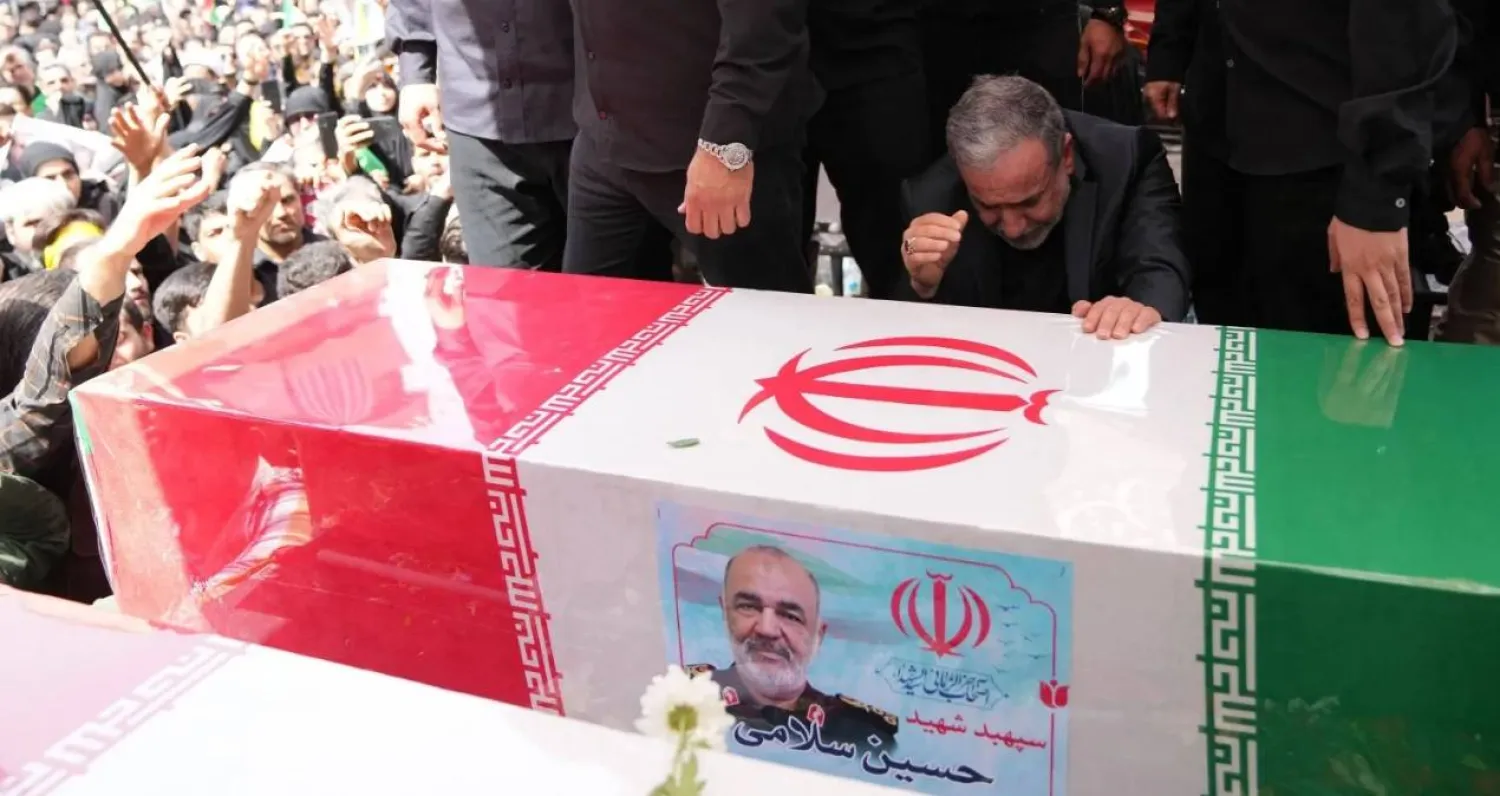
In the opening days of the 12-day war, Israel carried out a series of focused strikes inside Iran, targeting missile bases and key command centers, along with facilities tied to the enrichment chain and some research and development sites.
In that initial round, the IRGC lost a number of senior field commanders, along with what officials described as “brains” of the nuclear program, physicists, engineers and technical officials, in a blow that hit the military and technical leadership more than the physical infrastructure alone.
Days later, the confrontation escalated further with the launch of an operation dubbed Midnight Hammer, involving stealth bombers and cyber operations that disrupted parts of Iran’s early warning and surveillance systems.
The operation targeted pivotal sites in the enrichment cycle, centers for manufacturing and assembling centrifuges, and sensitive units within the nuclear infrastructure, forcing Iran to suspend some activities for technical and security reasons.
Official rhetoric focused on missiles that struck targets inside Israel and on the “imposition of a ceasefire,” but calmer assessments within decision-making circles were more restrained.
The nuclear program was not erased, but it underwent a severe stress test that showed Iran’s current deterrence posture does not prevent a focused strike on the core of the nuclear project when political and military conditions align.
The military shock accelerated the exposure of fault lines within the ruling elite.
Pezeshkian publicly warned of the “risk of a second war on Iranian soil,” hinting that “the other side has shown its readiness to strike nuclear facilities themselves,” an indirect signal that ignoring the negotiation track now carries rising security costs.
Hardliners, by contrast, argued that any reassessment after the war would amount to “rewarding the enemy” and casting doubt on the value of “resistance” as a strategic choice, rejecting any link between battlefield losses and a return to the negotiating table.
Internal divisions
Against this backdrop, Supreme Leader Ali Khamenei chose to respond to the shock of war by reshuffling advisory circles rather than changing course. He appointed Ali Larijani, a close confidant and former parliament speaker, to head the Supreme National Security Council, and approved the creation of a new “Defense Council” under its umbrella.
The body brings together military commanders and senior government and security officials to provide more integrated assessments of the war, the nuclear program and the negotiating track.
On the surface, the move aimed to broaden consultation after the 12-day war. In practice, it reflected a mix of acknowledgment that earlier calculations had fallen short and insistence on keeping final decisions within a narrow circle that manages both deterrence and diplomacy.
That circle operates within limits set externally by “maximum pressure” and internally by the imperative of preserving regime cohesion.
Postwar differences were not confined to assessing military performance. They spilled into a deeper question: what to do with the nuclear file after Midnight Hammer. In Tehran, one line of thinking began to take shape around deepening what officials describe as “managed nuclear ambiguity.”
The idea stops short of a formal withdrawal from the Non-Proliferation Treaty and instead seeks a gray-zone posture, a large stockpile of enriched uranium, reduced oversight by the International Atomic Energy Agency, and deliberately vague signals about “capability” without an explicit declaration of intent to build a weapon.
Another camp warned that ambiguity without a clear negotiating path could turn from a deterrent into an invitation for further preemptive strikes and the normalization of attacks on nuclear facilities.
Between the two logics, the working position settled into a narrow formula: no readiness for “zero enrichment” concessions demanded by Donald Trump, but no decision to burn bridges entirely.
Instead, a temporary management of the crisis while awaiting shifts in the balance of power.
Return of UN sanctions
Amid this debate, European powers moved to activate the snapback mechanism and restore UN sanctions on Iran, citing noncompliance with its nuclear commitments.
Britain, France and Germany pushed the file to the Security Council, reviving six previous resolutions.
The result left Tehran in an ambiguous position. Legally, international restrictions on arms, missiles and asset freezes returned.
In practice, Iran, along with Beijing and Moscow, continued to treat the landscape as largely unchanged. In Iran’s domestic discourse, the paradox was summed up in a terse phrase: UN sanctions are “present and absent at the same time.”
For banks and investors, however, they were present enough to freeze risk appetite.
By the end of 2025, the toll of Trump’s return weighed heavily on Tehran. Five rounds of indirect talks produced no real breakthrough. The 12-day war exposed gaps in the deterrence system.
UN sanctions returned to the fore. The rial slid to record lows, translating daily into market prices, fuel costs and the food basket.
At the same time, the Iranian leadership held to two fixed points: an explicit rejection of “zero enrichment” as demanded by the Trump administration, and a calibrated refusal to open a full-scale confrontation with the United States and its allies.
In that sense, what Tehran calls “strategic patience” increasingly resembled a state of strategic paralysis.
Between mounting external pressure and a shrinking internal margin for maneuver, Iran entered 2026 unable to return to the negotiating table from a position of strength and unwilling to acknowledge that the cost of staying the course is rising politically, economically and in security terms.
The 12-day war and snapback did not bring the two sides closer so much as reveal a shared belief that time favors each of them. Washington is betting that a battered economy and collapsing currency will eventually force Tehran to accept a harsh deal.
Part of Iran’s elite, meanwhile, is wagering that no US administration will bear the cost of another full-scale war, and that waiting out Trump’s term is cheaper than submitting to his terms.
Reading the year ahead thus becomes an exercise in mapping the boundaries of this paralysis and weighing the open scenarios facing Tehran, between a second war, a managed truce, and a coerced deal imposed under the ceiling of “maximum pressure.”
Three possible paths
From this point, Iran faces three main trajectories in 2026. They are not necessarily mutually exclusive and could overlap over time.
The first is a slow slide toward a second confrontation if efforts to rebuild missile and nuclear capabilities continue under pressure and frictions recur in the Strait of Hormuz, under pretexts such as refusing ship inspections or responding to new sanctions.
In such a scenario, Washington and Tel Aviv could conclude that acting now is less costly than waiting, with any future strike extending beyond facilities and bases to target higher levels of power, in an attempt to strike at the center of decision-making rather than its periphery.
The second path is a renewed wave of protests and social and economic unrest, fueled by a vicious cycle of currency collapse, rising food and fuel prices, and the erosion of a middle class that has historically been the main reservoir for gradual reform.
In this scenario, “maximum pressure” shifts from an external lever to an internal detonator.
The system would face a fraught equation: further hardening on the nuclear and missile files would mean deeper contraction in daily life and broader public anger, while a sudden retreat under Trump’s terms would be read on the street as a belated admission of the failure of the previous course, opening the door to a new protest cycle that is harder to contain and more directly tied to the cost of Iran’s regional project.
The third path, and the most likely in the short term, is an attempt to buy time through an unwritten “mutual freeze.”
That would mean an effective but undeclared slowdown in high-level enrichment, limited windows of technical cooperation with the International Atomic Energy Agency, and tighter control over the tempo of the “axis” to avoid shocks on the scale of the 12-day war. In return, the United States would accept managing the situation on a basis of containment rather than settlement, while keeping US and UN sanctions in place.
This path resolves nothing fundamentally, but allows each side to claim it has not crossed its red lines, even as Iran’s economic attrition continues, deterrence remains incomplete, and the risk of escalation lingers in the background.
Looking back at the year 2025, it can be seen as the moment when Trump’s policies transitioned from a theoretical threat to a concrete reality across Iran’s geography and economy. A joint military strike narrowed the margin of the nuclear program. UN sanctions returned through snapback. Pressure tightened on oil exports and financing networks.
Washington sought to redefine Iran’s place in US strategy as a constrained adversary rather than a rising power. Tehran responded with a mix of nuclear ambiguity, calibrated management of the “axis,” and a bet on time.
Iran thus enters 2026 trapped in a formula set by the “maximum pressure” memorandum: a system that cannot afford a full-scale war, yet cannot easily enter a settlement on its adversary’s terms.
The real challenge is no longer how Tehran emerges from Trump’s shadow, but whether it can, under this tightening vise, produce a third strategy that moves beyond the twin options of slow-motion escalation or passive waiting, before time itself, rather than negotiations or strikes, imposes the shape of the ending.


