China Launches Military Drills Simulating Blockade of Taiwan Ports

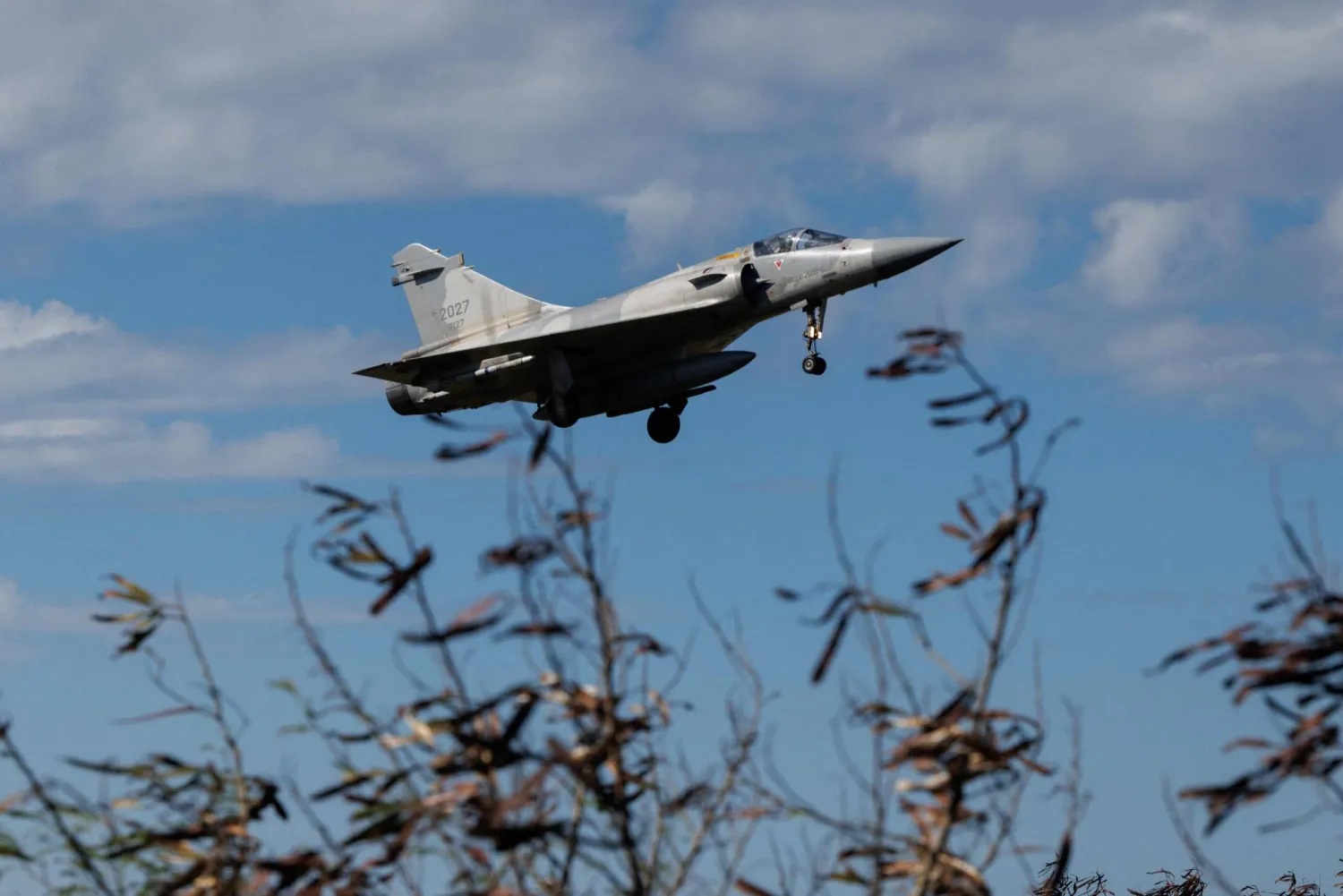
A Taiwan Air Force Mirage 2000 fighter jet takes off at Hsinchu Air Base in Hsinchu on December 29, 2025. (AFP)
TT

China Launches Military Drills Simulating Blockade of Taiwan Ports

A Taiwan Air Force Mirage 2000 fighter jet takes off at Hsinchu Air Base in Hsinchu on December 29, 2025. (AFP)

China launched live-fire drills around Taiwan on Monday that it said would simulate a blockade of the self-ruled island's key ports, prompting Taipei to condemn Beijing's "military intimidation".

Beijing claims Taiwan as part of its sovereign territory and has refused to rule out using military action to seize the island democracy.

The latest show of force follows a bumper round of arms sales to Taipei by the United States, Taiwan's main security backer.

Beijing warned on Monday that "external forces" arming Taipei would "push the Taiwan Strait into a perilous situation of imminent war", but did not mention any countries by name.

Any attempts to stop China's unification with Taiwan were "doomed to fail", foreign ministry spokesman Lin Jian said.

China said earlier it was conducting "live-fire training on maritime targets to the north and southwest of Taiwan" in large-scale exercises involving destroyers, frigates, fighters, bombers and drones.

A military spokesman said Beijing would send army, navy, air force and rocket force troops for "major military drills" code-named "Justice Mission 2025".

The activities will focus on "sea-air combat readiness patrol, joint seizure of comprehensive superiority, blockade on key ports and areas, as well as all-dimensional deterrence outside the island chain", said Senior Colonel Shi Yi of the People's Liberation Army's Eastern Theater Command.

Chinese authorities also published a map of five large zones around Taiwan where further live-fire activities would take place from 8:00 am to 6:00 pm (0000 to 1000 GMT) on Tuesday.

"For the sake of safety, any irrelevant vessel or aircraft is advised not to enter the afore-mentioned waters and airspace," the statement said.

- 'Rapid response' -

Taiwan condemned China's "disregard for international norms and the use of military intimidation to threaten neighboring countries", Presidential Office spokeswoman Karen Kuo said.

Taipei said Monday it had detected four Chinese coastguard ships sailing off its northern and eastern coasts.

Its coastguard said it "immediately deployed large vessels to pre-position responses in relevant areas" and "sent additional support units".

Taiwan's military said it had established a response center, deployed "appropriate forces" and "carried out a rapid response exercise".

The drills by China's ruling Communist Party "further confirm its nature as an aggressor, making it the greatest destroyer of peace", Taipei's defense ministry said.

- 'Stern warning' -

Shi, the Chinese military spokesman, said the drills were "a stern warning against 'Taiwan Independence' separatist forces, and... a legitimate and necessary action to safeguard China's sovereignty and national unity".

Beijing's military released a poster about the drills showing "arrows of justice" -- one engulfed in flames -- raining down on what appeared to be green worms on a geographical outline of Taiwan.

Chinese state broadcaster CCTV reported that a core theme of the exercises was a "blockade" of key Taiwanese ports including Keelung in the north and Kaohsiung in the south.

China's military last held large-scale drills involving live firing around Taiwan in April -- surprise maneuvers condemned by Taipei.

China said this month it would take "resolute and forceful measures" to safeguard its territory after Taiwan said the United States had approved a major $11 billion arms sale.

Beijing announced fresh sanctions on 20 American defense companies last week, though they appeared to have little or no business in China.

Last month, Japan's Prime Minister Sanae Takaichi triggered a backlash from Beijing when she said the use of force against Taiwan could warrant a military response from Tokyo.


Israeli Opposition Bloc Gathers to See How to Oust Netanyahu

Former military chief Gadi Eisenkot, leader of the Yashar party, speaks following the exit poll at his party headquarters, on the evening of Israel's national election, in Tel Aviv, Israel October 28, 2026. (Reuters)
TT

Israeli Opposition Bloc Gathers to See How to Oust Netanyahu

Former military chief Gadi Eisenkot, leader of the Yashar party, speaks following the exit poll at his party headquarters, on the evening of Israel's national election, in Tel Aviv, Israel October 28, 2026. (Reuters)

The Israeli opposition bloc led by Gadi Eisenkot gathered on Tuesday for the first time since elections as they strategize how to oust Prime Minister Benjamin Netanyahu, with divisions on whether to ally with Arab lawmakers.

Opposition party heads gathered in Herzliya, the tech industry hub north of Tel Aviv where former military chief Eisenkot lives, a week after the election produced an inconclusive result.

Yair Lapid, a centrist former prime minister who headed the opposition in the outgoing parliament, said as he entered that Netanyahu was backing an "extreme and dangerous attempt to invalidate the elections".

"What we need to do now is go and form a government, because the conduct of recent days is just a reminder that we must remove Netanyahu and his people from the Prime Minister's Office," Lapid told reporters.

"They have already caused enough damage to the State of Israel and to the people of Israel," he said.

Netanyahu and his allies have repeatedly alleged major fraud or malfeasance by Arab-majority parties which made historic gains last week, winning 19 seats in the 120-member parliament on the back of anger over the hard-right government's rhetoric towards Arab citizens of Israel.

No side won a majority. Eisenkot's diverse opposition bloc won 48 seats while Netanyahu's camp secured 53, of which 27 are from his Likud party.

The Arab parties could bring Eisenkot to a majority but the opposition is divided on whether to ally with them, and Arab politicians did not join the talks in Herzliya.

Despite their diverging views on various issues, including the role of Arab lawmakers, all the party leaders in Eisenkot's bloc have said they would back him to form the next government.

Public opinion polls conducted before the election showed that Jewish Israeli opposition supporters are divided over including Arab parties in government while right-wing Israelis are adamantly opposed.

- 'Political reality' -

Yousef Jabareen, the head of the largest Arab-majority party in the next parliament, told AFP that the opposition needed to accept "political reality" and team up to remove Netanyahu.

Arab-Israelis are descendants of Palestinians who remained after Israel's creation in 1948 and account for around 20 percent of the population today.

On the campaign trail, most of the main Jewish opposition parties rejected partnering with the Arab-majority lists citing a lack of common values, particularly around security and national identity.

The notable exception was Yair Golan, head of the left-wing party The Democrats, who said it was racist to exclude working with the Arab minority.

Netanyahu spent the campaign painting Arab parties as untrustworthy and stoking fears of a Palestinian state.

Avigdor Liberman, a right-wing member of Eisenkot's bloc who heads the Yisrael Beiteinu party, on Tuesday stressed that another election must be avoided but said that the Arab lists should not be included in the government.

"Given the political situation that has emerged, there is enough room to maneuver, and with proper navigation it is possible to quickly establish a functioning and stable government without Raam and the Joint List," he wrote on X, referring to the two Arab-majority lists.

On Monday, Netanyahu called for a "broad national government" without the Arab parties and said that as his Likud was the largest single party, he should lead the next coalition.

No opposition leader has voiced any openness to a unity government with Netanyahu, Israel's longest-serving prime minister, pointing to his divisiveness, the corruption charges against him and his failure to prevent the October 7, 2023 attack by Hamas.

"We seek to establish a broad government with our partners and with any party that wishes to join and does not support terrorism," Netanyahu said in a Telegram post.

He ruled out a coalition with Arab-majority lists, alleging that the parties "support terrorism and deny the existence of the Jewish state".

Leaders of Arab-Israeli parties have unanimously condemned the October 7 attack by Hamas without describing the Palestinian movement as a terror group.

Although the leader of the Raam party has recognized Israel as a "Jewish state", other leaders have rejected that definition.


Qatar Says Remains ‘Hopeful’ of a US-Iran Deal

Vessels at the Strait of Hormuz, as seen from Musandam, Oman, November 3, 2026. (Reuters)
TT

Qatar Says Remains ‘Hopeful’ of a US-Iran Deal

Vessels at the Strait of Hormuz, as seen from Musandam, Oman, November 3, 2026. (Reuters)

Qatar said on Tuesday it remained hopeful that an interim deal could be reached between the United States and Iran as both sides review proposals put forward by mediators including Doha.

In recent days, diplomatic efforts have been underway to prevent renewed fighting after the United States threatened major new strikes -- though US President Donald Trump signaled diplomatic progress with Iran.

Early on Tuesday, US media reported that Washington had launched limited strikes on an Iranian island in the Strait of Hormuz as Iranian media reported five explosions in quick succession.

"Both parties remain committed to the negotiation process; as we mentioned, we are facilitating the real-time exchange of proposals between them," foreign ministry spokesman Majed Al Ansari told reporters.

Both sides "are currently reviewing the ideas and proposals we have presented," he added.

"We remain hopeful that there is still a chance for a deal to take place," he said, adding Doha was working "towards an interim deal".

On Monday, Iranian Foreign Minister Abbas Araghchi said that "very intensive" talks were underway with the United States via mediators.

That same day Qatari negotiators returned to Doha after a meeting in Tehran that lasted more than three hours, Al Ansari said.

He warned that any escalation could complicate the talks.

The US and Israel increased their threats towards Iran in the run-up to the midterms and last week's general elections in Israel, where Prime Minister Benjamin Netanyahu failed to secure a majority.


Russian Defense Minister Hails ‘Unprecedented’ Beijing Ties on China Visit

A Russian and Chinese national flag flutter near Tiananmen Gate, in Beijing, China, May 16, 2024. (AP)
TT

Russian Defense Minister Hails ‘Unprecedented’ Beijing Ties on China Visit

A Russian and Chinese national flag flutter near Tiananmen Gate, in Beijing, China, May 16, 2024. (AP)

Russian Defense Minister Andrei Belousov said Moscow's strategic partnership with Beijing has reached "an unprecedentedly high level" as he visited China for talks, his ministry said Tuesday.

Russia has sought closer ties with China since its assault on Ukraine launched in 2022 that Beijing, insisting it is a neutral party, has never denounced, calling for peace talks instead.

The Chinese and Russian militaries have held regular joint exercises in recent years, a partnership that Western and some other governments view with suspicion as Moscow's war on Ukraine grinds on.

Belousov, during his China visit, said that "the strategic partnership between the Russian Federation and the People's Republic of China has reached an unprecedentedly high level," according to a statement by his ministry.

He also said the partnership was "grounded in the personal contacts" between Russian President Vladimir Putin and China's President Xi Jinping.

In China, Belousov met with Zhang Shengmin, vice-chairman of the Central Military Commission (CMC), the body headed by Xi that directs the armed forces.

The meeting comes before the Asia-Pacific Economic Cooperation (APEC) summit in the Chinese city of Shenzhen on November 18-19.

Putin has said he intends to be at the summit, which US President Donald Trump has also said he will try to attend.

The Kremlin said in September that Putin and Trump had discussed the idea of holding a trilateral meeting with Xi at the summit.