


Kolkata’s Iconic Trams Face Final Stop as Modernization Rolls in

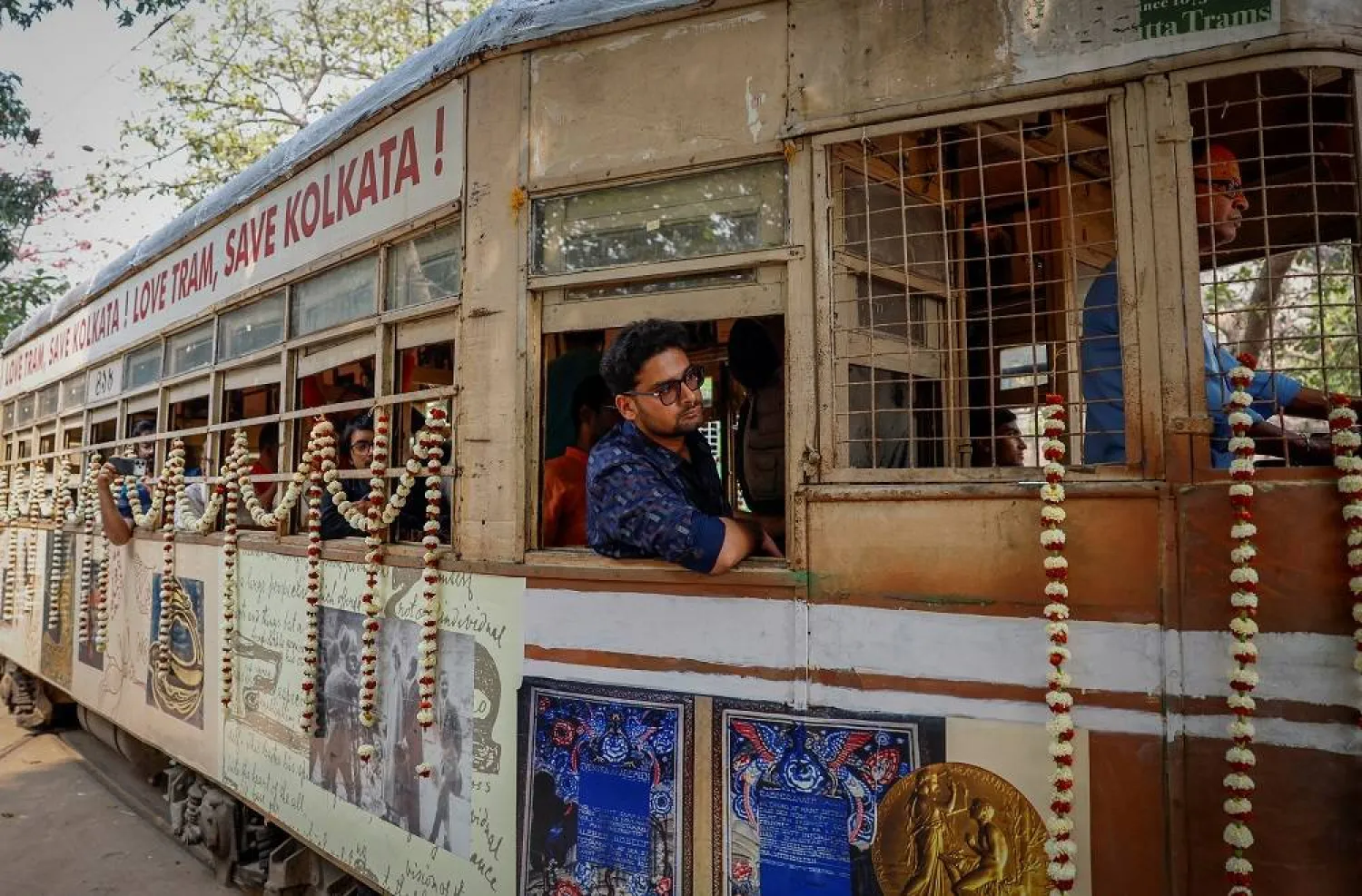
Passengers sit inside a decorated tram during the 152nd anniversary celebrations of trams in Kolkata, India, February 24, 2025. (Reuters)
TT

Kolkata’s Iconic Trams Face Final Stop as Modernization Rolls in

Passengers sit inside a decorated tram during the 152nd anniversary celebrations of trams in Kolkata, India, February 24, 2025. (Reuters)

For more than a century, trams have rumbled past Kolkata's crumbling colonial facades, with their chiming bells contributing to the city's soundtrack as they ferried generations of ​commuters.

Now, Asia's oldest tram network is on the brink of disappearing as authorities consider pulling the plug on a mode of transport that has become more nostalgia than necessity.

The West Bengal government plans to shut down the 152-year-old system, keeping only a short heritage route. The decision has sparked a court battle as residents and heritage advocates fight to keep ‌the trams ‌rolling.

"As children, we would take the ‌trams ⁠for ​fun, ‌but as I grew older it became a necessity," said Abha Maity, 44, recalling rides to school and college. "I can’t imagine Kolkata without them."

Once a highlight of the city's streets, the wobbly trams now struggle for space amid traffic jams - competing with buses and yellow taxis - as Kolkata builds modern infrastructure and seeks faster transport.

Kolkata introduced ⁠horse-drawn trams in 1873 and electrified them in 1902. At its peak, the ‌network boasted more than 340 trams and ‍covered the entire city. Today, ‍only two routes remain, with a fleet of about 10.

"When ‍I joined, more than 340 trams were running. Now it's down to seven or eight," said Bacchu Sidda, a conductor for 36 years who still checks his duty roster pinned on a board ​at the last functioning depot in Gariahat.

The government began selling depots and scrapping cars years ago, prompting a citizens' ⁠group called Calcutta Tram Users Association (CTUA) to take the fight to court. CTUA has campaigned since 2016 to save what remains of the system.

"I love my trams more than myself," said Deep Das, 19, a journalism student and CTUA member. "If they disappear, it will be like a part of my body has left me."

Despite resistance, authorities are pouring billions into upgrading Kolkata's infrastructure, focusing on metro expansion, wider roads and new highways to ease congestion.

For now, the fate of Kolkata's aging trams awaits a ‌court review, as they continue carrying some passengers who view them as living memories of the city's past.



Riyadh Art Unveils Tuwaiq Sculpture 2026

The exhibition site on Tahlia Street was strategically chosen for its historical legacy of innovation to provide a conceptual framework for the works. SPA
TT

Riyadh Art Unveils Tuwaiq Sculpture 2026

The exhibition site on Tahlia Street was strategically chosen for its historical legacy of innovation to provide a conceptual framework for the works. SPA

The Royal Commission for Riyadh City, via its Riyadh Art program, has launched the Tuwaiq Sculpture 2026 exhibition on Prince Mohammed bin Abdulaziz Street (Tahlia).

Open to the public from February 9 to 22, the exhibition showcases 25 new artworks themed "Traces of What Will Be," exploring transformation and urban renewal.

The sculptures were crafted during a live phase from January 10 to February 5, during which artists from 18 countries used local stone and recycled metals, allowing the public to witness the creative process firsthand.

The exhibition site on Tahlia Street was strategically chosen for its historical legacy of innovation to provide a conceptual framework for the works.

Overseen by a panel of international experts, the exhibition serves as an interactive cultural platform featuring workshops and panel discussions to foster community engagement.

All 2026 pieces will join Riyadh Art's permanent collection, which has hosted over 170 artists since 2019 and already installed more than 60 sculptures across the city to integrate contemporary art into Riyadh's urban fabric.


Syrian Culture Minister Applauds Saudi Pavilion at Damascus Book Fair

The 2026 Damascus International Book Fair is held from February 6 to 16 - SPA
TT

Syrian Culture Minister Applauds Saudi Pavilion at Damascus Book Fair

The 2026 Damascus International Book Fair is held from February 6 to 16 - SPA

Syrian Minister of Culture Mohammed Yassin Saleh visited the Kingdom’s pavilion at the 2026 Damascus International Book Fair, held from February 6 to 16, where the Kingdom is serving as the Guest of Honor.

He commended the efforts of the Literature, Publishing and Translation Commission in showcasing the rich diversity of the Saudi cultural and literary scene. The pavilion features exhibitions of manuscripts, a Saudi fashion corner, and archaeological replicas, SPA reported.

The minister reviewed the commission's Tarjim translation initiative and Saudi literature comics.

This participation at the 2026 Damascus International Book Fair showcases Saudi creativity and fosters cultural dialogue, supporting Saudi Vision 2030’s goals of knowledge exchange and cultural leadership.


Saudi Arabia, Syria Underline Depth of their Cultural Ties

Syrian President al-Sharaa receives the Saudi minister of culture and the accompanying delegation at the Conference Palace in Damascus on Thursday. (SPA)
TT

Saudi Arabia, Syria Underline Depth of their Cultural Ties

Syrian President al-Sharaa receives the Saudi minister of culture and the accompanying delegation at the Conference Palace in Damascus on Thursday. (SPA)

Saudi Arabia and Syria underlined the strength of their cultural relationship during high-level meetings held in Damascus on Thursday, on the sidelines of the opening of the Damascus International Book Fair 2026, where the Kingdom is participating as guest of honor.

Syrian President Ahmad al-Sharaa received Saudi Minister of Culture Prince Badr bin Abdullah bin Farhan at the Conference Palace in the capital.

Earlier the same day, Prince Badr met with his Syrian counterpart, Minister of Culture Mohammad Yassin Saleh, during an official visit to attend the fair. T

he Saudi minister congratulated Syria on hosting the exhibition and expressed his wishes for continued prosperity, progress, and stability for the Syrian government and people.

Both meetings highlighted the depth of cultural relations between the two countries, the importance of expanding joint cultural cooperation across various fields, and the alignment of positions on issues of mutual interest in a way that serves both nations.

The Saudi delegation included senior officials and advisers, among them representatives from the Royal Court, the Ministry of Culture, and the King Abdulaziz Public Library, reflecting broad institutional engagement in the visit.

In the evening, Prince Badr attended the opening ceremony of the fair’s special session, held under the patronage and in the presence of al-Sharaa. The event drew wide official and cultural participation, including Arab ministers, political and intellectual figures, and a distinguished group of writers and cultural figures.

In a post on the X platform, Prince Badr thanked “our brothers in Syria for their generous hospitality and their efforts in organizing the Damascus International Book Fair.”

The minister also inaugurated the Kingdom’s pavilion at the fair in the presence of the Syrian minister of culture and the Qatari minister of culture.

Saudi Arabia’s guest-of-honor participation continues until Feb. 16 and reflects its growing prominence and leadership in the Arab and global cultural landscape.

This participation aligns with Saudi Vision 2030, which places culture at the heart of national development, viewing it as a space for dialogue, a bridge for civilizational communication, and a tool for strengthening ties among Arab peoples.

The Saudi Literature, Publishing and Translation Commission is leading the Kingdom’s participation, highlighting the development of the cultural sector and reaffirming the central role of books as carriers of knowledge and awareness.

The Saudi pavilion boasts a comprehensive cultural program featuring intellectual seminars, poetry evenings, a manuscript exhibition, traditional Saudi fashion displays, hospitality corners, archaeological replicas, and performing arts that express the depth of the Kingdom’s cultural heritage.

On the sidelines of the visit, Prince Badr, accompanied by Minister Saleh, toured the National Museum of Damascus, which houses rare artifacts spanning prehistoric eras, ancient Syrian civilizations, classical and Islamic periods, as well as traditional and modern art.