

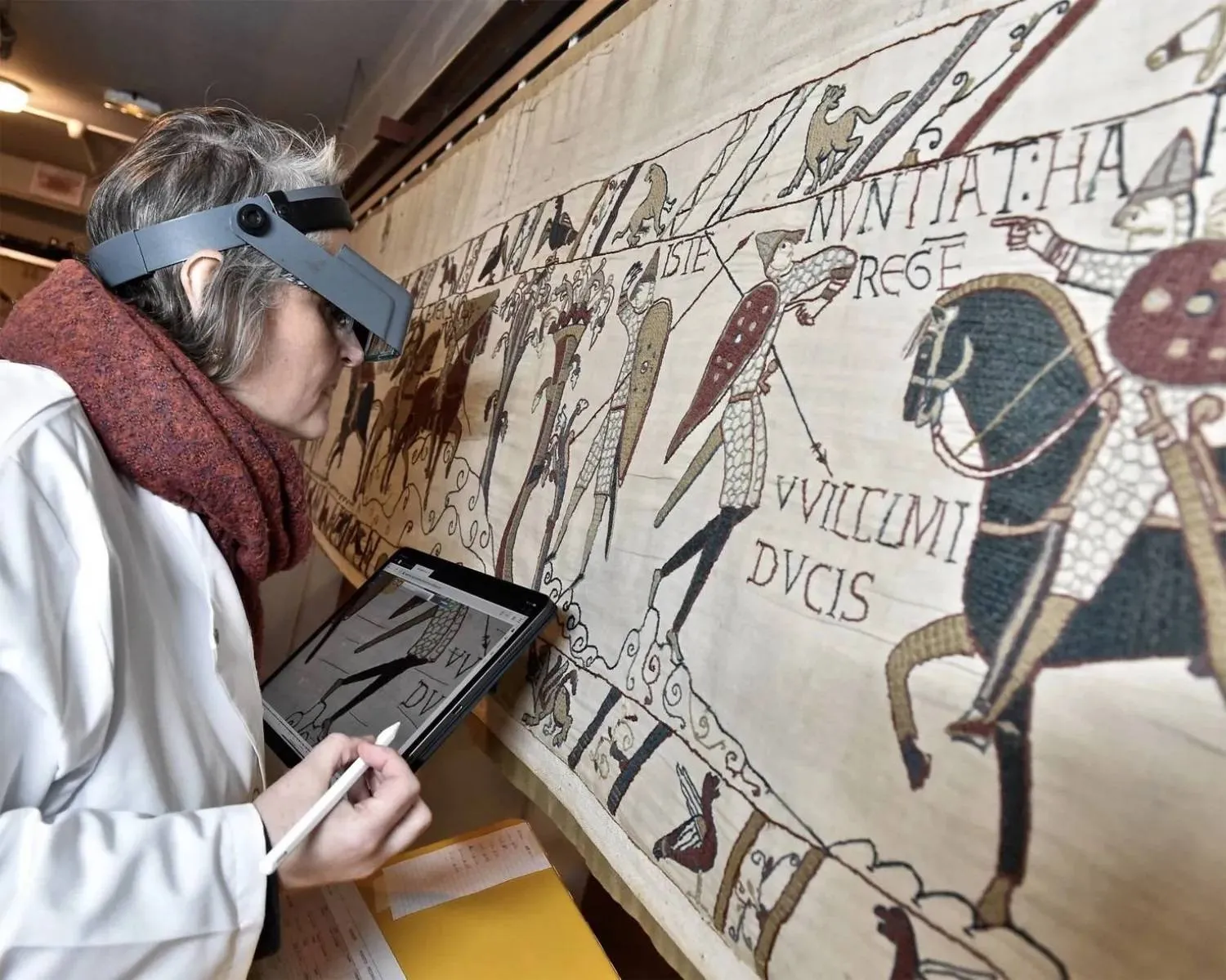

British Treasury to Cover Bayeux Tapestry for Estimated £800 Million

This photo provided by Bayeux townhall shows a technician inspecting the famed Bayeux tapestry in Bayeux, Normandy, in 8th January, 2020. (Ville de Bayeux via AP/File photo)
TT

British Treasury to Cover Bayeux Tapestry for Estimated £800 Million

This photo provided by Bayeux townhall shows a technician inspecting the famed Bayeux tapestry in Bayeux, Normandy, in 8th January, 2020. (Ville de Bayeux via AP/File photo)

The British Treasury is set to insure the Bayeux Tapestry against damage for an estimated £800 million while it is on loan to the British Museum next year, reported the BBC.

The 70m-long embroidery depicting the Battle of Hastings in 1066 will travel from France to London as part of a deal between the two nations' governments.

The artifact's transit and its time in storage and on display will be covered under the Government Indemnity Scheme (GIS). Indemnity insurance covers situations like loss or damage.

The Treasury said without the long-standing scheme, “public museums and galleries would face a substantial commercial insurance premium, which would be significantly less cost effective.”

There are concerns about the move, as some French art experts have suggested the nearly 1,000-year-old work was in far too a delicate state to be transported - something French officials have denied.

It is understood the Treasury has received an initial valuation for covering the Bayeux Tapestry that has been provisionally approved. The loan will not be formally confirmed until it receives the final valuation.

That final valuation is estimated to be around £800 million.

The Bayeux Tapestry will be displayed in the Sainsbury Exhibitions Gallery of the British Museum from next September until July 2027 while its current home, the Bayeux Museum, undergoes renovations.

Comprising 58 scenes, 626 characters and 202 horses, the huge masterpiece charts a contested time in Anglo-French relations when William The Conqueror took the English throne from Harold Godwinson, becoming the first Norman king of England.

The government's indemnity scheme allows art and cultural objects to be shown publicly in the UK which "might not have been otherwise because the cost of insurance would have been too high".

The scheme - first set up in 1980 - has facilitated numerous high-value loans, including Vincent van Gogh's 1888 work "The Bedroom" to the National Gallery.

In exchange for the Bayeux Tapestry, the British Museum will loan items to France, including the 7th Century Anglo-Saxon artifacts discovered at the Sutton Hoo burial site in Suffolk and the 12th Century Lewis chess pieces.




Danish Warship Sunk by Nelson’s British Fleet Discovered After 225 Years

 Morten Johansen, head of maritime archaeology at Denmark's Viking Ship Museum, shows a metal insignia recovered from the wreck of Danish flagship "Dannebroge" that sank during the Battle of Copenhagen in 1801, in Copenhagen, Denmark, Tuesday, March 31, 2026. (AP)
Morten Johansen, head of maritime archaeology at Denmark's Viking Ship Museum, shows a metal insignia recovered from the wreck of Danish flagship "Dannebroge" that sank during the Battle of Copenhagen in 1801, in Copenhagen, Denmark, Tuesday, March 31, 2026. (AP)
TT

Danish Warship Sunk by Nelson’s British Fleet Discovered After 225 Years

 Morten Johansen, head of maritime archaeology at Denmark's Viking Ship Museum, shows a metal insignia recovered from the wreck of Danish flagship "Dannebroge" that sank during the Battle of Copenhagen in 1801, in Copenhagen, Denmark, Tuesday, March 31, 2026. (AP)
Morten Johansen, head of maritime archaeology at Denmark's Viking Ship Museum, shows a metal insignia recovered from the wreck of Danish flagship "Dannebroge" that sank during the Battle of Copenhagen in 1801, in Copenhagen, Denmark, Tuesday, March 31, 2026. (AP)

More than 200 years after being sunk by Adm. Horatio Nelson and the British fleet, a Danish warship has been discovered on the seabed of Copenhagen Harbor by marine archaeologists.

Working in thick sediment and almost zero visibility 15 meters (49 feet) beneath the waves, divers are in a race against time to unearth the 19th-century wreck of the "Dannebroge" before it becomes a construction site in a new housing district being built off the Danish coast.

Denmark’s Viking Ship Museum, which is leading the monthslong underwater excavations, announced its findings on Thursday, 225 years to the day since the Battle of Copenhagen in 1801.

“It’s a big part of the Danish national feeling,” said Morten Johansen, the museum’s head of maritime archaeology.

A great deal has been written about the battle “by very enthusiastic spectators, but we actually don’t know how it was to be onboard a ship being shot to pieces by English warships and some of that story we can probably learn from seeing the wreck,” Johansen said. The Associated Press was the only international outlet given access to the site.

In the Battle of Copenhagen, Nelson and the British fleet attacked and defeated Denmark’s navy as it formed a protective blockade outside the harbor.

Thousands were killed and wounded during the brutal hourslong naval clash, considered one of Nelson’s “great battles.” The intention was to force Denmark out of an alliance of Northern European powers, including Russia, Prussia and Sweden.

At the center of the fighting was the Danish flagship, the Dannebroge, commanded by Commodore Olfert Fischer.

The 48-meter (157-foot) Dannebroge was Nelson’s main target. Cannon fire tore through its upper deck before incendiary shells sparked a fire aboard.

“(It was) a nightmare to be on board one of these ships,” Johansen said. “When a cannonball hits a ship, it’s not the cannonball that does the most damage to the crew, it’s wooden splinters flying everywhere, very much like grenade debris.”

The battle also is believed to have inspired the phrase “to turn a blind eye.” After deciding to ignore a superior’s signal, Nelson, who had lost sight in his right eye, reportedly remarked: “I have only one eye, I have a right to be blind sometimes.”

Nelson eventually offered a truce and a ceasefire was later agreed with Denmark’s Crown Prince Frederik.

The stricken Dannebroge slowly drifted northward and exploded. Records say the sound created a deafening roar across Copenhagen.

Marine archaeologists have discovered two cannons, uniforms, insignia, shoes, bottles and even part of a sailor’s lower jaw, perhaps one of the 19 unaccounted-for crew members who likely lost their lives that day.

The dig site will soon be enveloped by construction work for Lynetteholm, a megaproject to build a new housing district in the middle of Copenhagen Harbor that is expected to be completed by 2070.

Marine archaeologists began surveying the area late last year, targeting a spot thought to match the flagship’s final position.

Experts say the sizes of the wooden parts found match old drawings. Dendrochronological dating, the method of using tree rings to establish the age of wood, match the year the ship was built. They also say the darkened dig site is full of cannonballs, a hazard for divers navigating waters darkened by clouds of silt stirred up from the seabed.

“Sometimes you can’t see anything, and then you really have to just feel your way, look with your fingers instead of with your eyes,” diver and maritime archaeologist Marie Jonsson said.

Chronicled in books and painted on canvases, the 1801 battle is deeply embedded in Denmark’s national story.

Archaeologists hope their discoveries may help reexamine the event that shaped the Scandinavian country and perhaps uncover personal stories of those who went into battle on that day 225 years ago.

“There are bottles, there are ceramics, and even pieces of basketry,” Jonsson said. “You get closer to the people onboard.”


Priceless Ancient Golden Helmet Stolen from Dutch Museum Is Recovered

A police officer stands by a stolen artifact from Romania, the 2,500-year-old Cotofenesti helmet, recovered in Netherlands, is shown during a press conference in Assen, Netherlands, Thursday, April 2, 2026. (AP Photo/Aleksandar Furtula)
TT

Priceless Ancient Golden Helmet Stolen from Dutch Museum Is Recovered

A police officer stands by a stolen artifact from Romania, the 2,500-year-old Cotofenesti helmet, recovered in Netherlands, is shown during a press conference in Assen, Netherlands, Thursday, April 2, 2026. (AP Photo/Aleksandar Furtula)

A priceless ancient golden helmet from Romania stolen last year from a museum in the Netherlands has been recovered, Dutch authorities announced Thursday.

Under the guard of heavily armed, balaclava-clad police, prosecutors unveiled the 2,500-year-old Cotofenesti helmet, one of Romania’s most revered national treasures from the Dacia civilization, during a news conference in the eastern Dutch city of Assen.

“We are incredibly pleased,” Corien Fahner of the prosecution service told reporters. “It has been a roller-coaster. Especially for Romania, but also for employees of the Drents Museum.”

The helmet was on display at the small museum in January 2025, the last weekend of a six-month-long exhibition, when thieves broke in and grabbed it, along with three golden wristbands.

There were fears the helmet may have been melted down because its fame and dramatic studded appearance made it virtually unsellable.

Two of three missing armbands were also recovered as part of a deal prosecutors reached with three men arrested for the heist shortly after it occurred. Their trial will begin later in April.

Fahner said the search for the remaining armband would continue.

The helmet did not return unscathed.

“The helmet is slightly dented, but there will be no permanent damage,” Drents Museum director Robert van Langh said during the news conference. “The armbands are in perfect condition.”

Thieves used a homemade firework bomb and sledgehammer to break into the museum. Grainy security video distributed by police after the raid appeared to show three people opening a museum door with a large crowbar, followed by an explosion.

The theft put a strain on relations between the Netherlands and Romania

Romanian Justice Minister Radu Marinescu last year called the incident a “crime against our state” and said recovering the artifacts “is an absolute priority.”


Traditional Arts Festival Reinforces National Identity, Highlights Performance Traditions

The Traditional Arts Festival 2026 is drawing strong crowds of visitors and tourists in Diriyah. (SPA)
TT

Traditional Arts Festival Reinforces National Identity, Highlights Performance Traditions

The Traditional Arts Festival 2026 is drawing strong crowds of visitors and tourists in Diriyah. (SPA)

The Traditional Arts Festival 2026, organized by the Ministry of Culture, is drawing strong crowds of visitors and tourists in Diriyah amid pleasant spring weather.

The festival, held from March 26 to April 8 and from 4 p.m. to 11 p.m., features a range of performing arts from across the Kingdom, the Saudi Press Agency reported on Thursday.

Live shows in a dedicated traditional performance arena allow visitors to explore those traditions and their varied forms, reflecting the depth and diversity of Saudi cultural heritage.

The event is part of the Ministry of Culture’s ongoing efforts to support the national cultural scene and highlight traditional performing arts as a core element of the Kingdom’s cultural identity. It also presents those arts as a form of expression tied to the occasions and events of Saudi society.