Russia Urges Restraint as Trump Warns Iran of Possible Strike

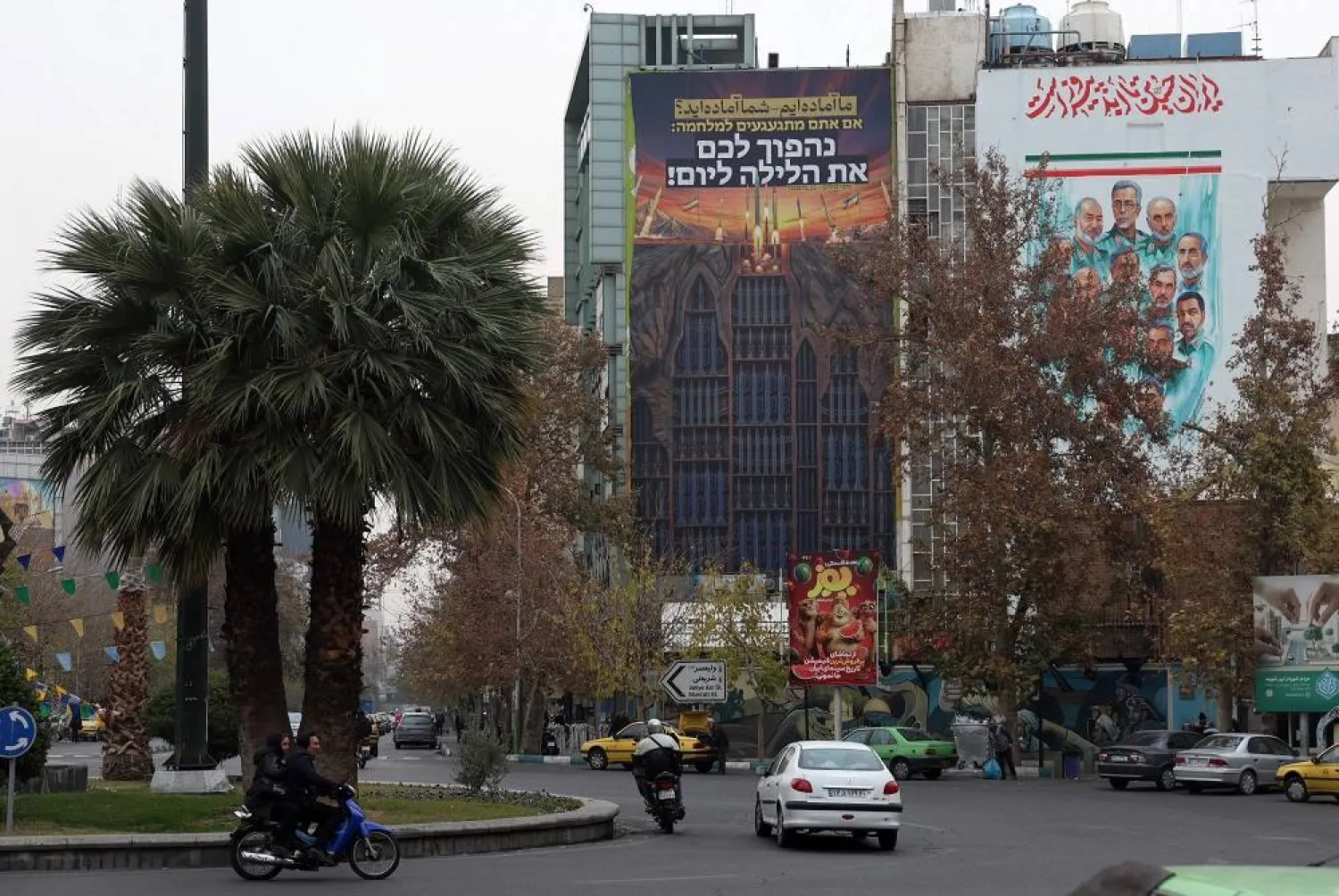
Iranians drive past an anti-Israeli billboard carrying a sentence in Persian reading "We are ready, are you ready?" hanging at Palestine Square in Tehran, Iran, 24 December 2025. (EPA)
TT

Russia Urges Restraint as Trump Warns Iran of Possible Strike

Iranians drive past an anti-Israeli billboard carrying a sentence in Persian reading "We are ready, are you ready?" hanging at Palestine Square in Tehran, Iran, 24 December 2025. (EPA)

The Kremlin on Tuesday said it was ​necessary to develop a dialogue with Iran and urged all parties to refrain from escalation after ‌US President ‌Donald Trump ‌said ⁠Washington ​would ‌support another massive strike on Iran.

Flanked by Israeli Prime Minister Benjamin Netanyahu, Trump suggested on Monday ⁠that Tehran may be ‌working to ‍restore ‍its weapons programs after ‍a US strike in June. Iran denies it has a nuclear ​weapons program.

Moscow has cultivated closer ties ⁠with Tehran since the start of its war in Ukraine, and this year signed a strategic partnership treaty with Iran.


Report: Macron Warns Belarus Against Involvement in Ukraine War

France's President Emmanuel Macron (C) speaks with Lens' French head coach Pierre Sage (L) ahead of the French Cup final football match between RC Lens and OGC Nice at the Stade de France stadium, in Saint-Denis, on the outskirts of Paris, on May 22, 2026. (AFP)
TT

Report: Macron Warns Belarus Against Involvement in Ukraine War

France's President Emmanuel Macron (C) speaks with Lens' French head coach Pierre Sage (L) ahead of the French Cup final football match between RC Lens and OGC Nice at the Stade de France stadium, in Saint-Denis, on the outskirts of Paris, on May 22, 2026. (AFP)

French President Emmanuel Macron on Sunday warned Belarusian leader Alexander Lukashenko, a key Russian ally, against an involvement in Moscow's war against Ukraine, a source close to Macron said.

The warning was made during the first reported phone call between the two leaders since the early days of Russia's invasion in February 2022, partly launched from Belarusian territory.

Macron "stressed the risks for Belarus of allowing itself to be drawn into Russia's war of aggression against Ukraine," the source, who spoke on condition of anonymity, said.

"He also urged Alexander Lukashenko to take the necessary steps to improve relations between Belarus and Europe," the source added.

A brief readout on the Belarusian presidency's website said that "the heads of state discussed regional issues and Belarus' relations with the EU and with France in particular."

The conversation took place "at the initiative of the French side", the readout added.

Earlier in May, Ukrainian President Volodymyr Zelensky ordered troops to reinforce the border with Belarus in the north, claiming Moscow was preparing a new offensive from there. The Kremlin denied that.

Russia and its smaller ally Belarus held nuclear drills days ago, on May 18, as Kyiv escalated its drone attacks on Russia.

Belarus, which borders NATO's eastern flank, hosts Russia's latest nuclear-capable missile, the Oreshnik.

On Sunday, Russia used the ballistic hypersonic missile for the third time in the war against Ukraine, as part of a massive drone and missile barrage that caused widespread destruction across Kyiv.


Trump Says No Rush for Iran Deal, US Blockade Stays

Vessels are seen anchored in the Strait of Hormuz, off the port city of Khasab on Oman's northern Musandam Peninsula on May 17, 2026. (AFP)
TT

Trump Says No Rush for Iran Deal, US Blockade Stays

Vessels are seen anchored in the Strait of Hormuz, off the port city of Khasab on Oman's northern Musandam Peninsula on May 17, 2026. (AFP)

US President Donald Trump said on Sunday he had told his representatives not to rush into any deal with Iran, appearing to dampen hopes of an imminent breakthrough in the three-month-old war that had been raised by both sides a day earlier.

The US blockade on Iranian ships on the Strait of Hormuz would "remain in full force and effect until an agreement is reached, certified, and signed", Trump wrote on Truth Social.

Negotiations were progressing and the US relationship with Iran had become more professional and productive, he said. But he added: "Both sides must take their time and get it right. There can be no mistakes!"

A day earlier, Trump said Washington and Iran had "largely negotiated" a memorandum of understanding on a peace deal that would reopen the Strait of Hormuz, which before the conflict carried one-fifth of global oil and liquefied natural gas shipments.

Trump has repeatedly played up the prospect of an agreement to end the war that the US and Israel started on February 28, so far without success.

It was not clear whether the agreement he was ‌referring to on Sunday ‌was the initial memorandum of understanding that has been under discussion, or a much more challenging broad ‌peace settlement, ⁠likely to take ⁠much longer.

The two sides remain at odds over numerous difficult issues, such as Iran's nuclear ambitions and Tehran's demands for the lifting of sanctions and the release of tens of billions of dollars of Iranian oil revenues frozen in foreign banks.

Various media in the US and Iran had said the memorandum setting out a framework for ending months of fighting would, if concluded, lift a US blockade on Iranian shipping and reopen the waterway, which Iran has shut with threats to attack shipping.

HOPE FOR RELIEF IN GLOBAL ENERGY CRISIS

A senior Iranian source earlier told Reuters that if Iran's Supreme National Security Council approved the memorandum, it would be sent to Supreme Leader Mojtaba Khamenei for final approval.

But Iran's Tasnim news agency said differences remained over one or two clauses. Tasnim cited ⁠a source as saying there would be no final understanding if the US continued to create obstacles.

In another ‌potential stumbling block, a military adviser to Khamenei said Tehran had the legal right to manage ‌the Strait of Hormuz, though it was not clear if that meant continuing to decide which ships can go through.

Any deal cementing the current fragile ceasefire ‌would bring relief to markets but not immediately quell a global energy crisis, which has driven up costs of fuel, fertilizer and food.

Even if ‌the war ends now, full flows through the strait will not return before the first or second quarter of 2027, the head of the Abu Dhabi National Oil Company said last week.

Iran's Revolutionary Guards said 33 vessels had passed through the strait over the past 24 hours after getting permission from Tehran, still far short of the 140 on a typical day before the war.

Trump, while offering various war aims during the conflict, has repeatedly said the US struck Iran to prevent ‌it from obtaining nuclear weapons.

Iran "must understand, however, that they cannot develop or procure a Nuclear Weapon or Bomb", he reiterated in his post on Sunday.

Iran has long denied it is pursuing such weapons and ⁠says it has a right to enrich ⁠uranium for civilian purposes, although the purity it has achieved far exceeds that needed for power generation.

'ISSUES STILL NEED TO BE DISCUSSED,' IRAN SAYS

Sources have told Reuters the proposed framework, when it emerges, will unfold in three stages: formally ending the war, resolving the crisis in the Strait of Hormuz and launching a 30-day window for negotiations on a broader agreement, which can be extended.

Trump, whose approval ratings have been hit by the war's impact on US energy prices, said on Friday he would not attend his son's wedding this weekend, citing Iran among the reasons for staying in Washington.

He spoke on Saturday with leaders from Saudi Arabia, Qatar, the United Arab Emirates, Jordan, Egypt, Türkiye and Pakistan, who encouraged Trump to agree to the emerging framework, Axios reported.

Iranian Foreign Ministry spokesperson Esmail Baghaei said on Saturday that "the trend this week has been towards a reduction in disputes, but there are still issues that need to be discussed through mediators".

Baghaei said the issue of the US blockade on Iran's shipping was important, but that its priority was ending the threat of new US attacks and the parallel conflict in Lebanon.

The US-Israeli bombing of Iran killed thousands of people in Iran before it was suspended in a ceasefire in early April.

Israel has also killed thousands more and driven hundreds of thousands from their homes in Lebanon, which it invaded in pursuit of the Iran-backed Hezbollah.

Iranian strikes on Israel and neighboring Gulf states have killed dozens of people.


Iran and US Closing in on Deal to End War

Vessels in the Strait of Hormuz, Iran, May 22, 2026. Majid Asgaripour/WANA (West Asia News Agency) via REUTERS
TT

Iran and US Closing in on Deal to End War

Vessels in the Strait of Hormuz, Iran, May 22, 2026. Majid Asgaripour/WANA (West Asia News Agency) via REUTERS

The United States and Iran could strike a deal to end the Middle East war as early as Sunday, Washington's top diplomat said, while Tehran insisted the agreement would do nothing to limit its nuclear program.

Washington and Tehran have observed a ceasefire since April 8 while mediators push for a negotiated settlement, although Iran has imposed controls on shipping and the US has blockaded Iran's ports.

On Sunday, during a visit to India, US Secretary of State Marco Rubio told reporters: "I do think perhaps there is the possibility that in the next few hours the world will get some good news."

This came after US President Donald Trump posted on social media that the deal "has been largely negotiated, subject to finalization between the United States of America, the Islamic Republic of Iran, and the various other Countries".

Rubio said the agreement would start a "process that can ultimately leave us where the president wants us to be, and that is a world that no longer has to fear or worry about an Iranian nuclear weapon".

Trump's post stressed that the Strait of Hormuz would be re-opened, a development that would bring relief to energy markets after a long Iranian blockade of a crucial waterway that in peacetime carries a fifth of world oil exports.

Iranian officials confirmed the existence of a draft agreement but stressed that -- contrary to earlier long-standing US demands -- talks on the issue of Iran's contested nuclear program have been deferred for 60 days after any deal.

- 'Lasting peace' -

According to Iran's Fars news agency, Washington has agreed to release part of Tehran's funds frozen abroad under international economic sanctions and to end its naval blockade of ships travelling to and from Iranian ports.

In exchange, "according to this draft, passage through the Strait of Hormuz would return to pre-war levels under Iranian management".

And, Fars said, "sanctions on oil, gas, petrochemicals and their derivatives would be temporarily lifted during the negotiation period so that Iran can freely sell its products".

Leaders from Saudi Arabia, the United Arab Emirates, Qatar, Egypt, Jordan and Bahrain, as well as representatives from Türkiye and Pakistan, joined a call with Trump to discuss the deal on Saturday.

Pakistan, which mediated historic face-to-face negotiations between US and Iranian delegations in April, hopes to host another round of talks "very soon", Prime Minister Shehbaz Sharif said.

He said Pakistan's powerful army chief Asim Munir, who visited Tehran on Friday and Saturday, also joined the call, which "provided a useful opportunity... to move the ongoing peace efforts forward to bring lasting peace in the region".

- Lebanese front -

Trump said a separate call with Israeli Prime Minister Benjamin Netanyahu "went very well". US strikes on Iran have been carried out together with Israel since the war began on February 28.

Iran's chief negotiator Mohammad Bagher Ghalibaf had warned earlier that Washington would face a tough response if it resumed hostilities, as Trump has often threatened.

"Our armed forces have rebuilt themselves during the ceasefire period in such a way that if Trump commits another act of folly and restarts the war, it will certainly be more crushing and bitter for the United States than on the first day of the war," Ghalibaf said.

On the war's other main front in Lebanon, state media reported that Israel struck the country's south on Saturday, where fighting has continued despite an April 17 ceasefire.

Lebanon's military said a strike targeted an army barracks and wounded a soldier, while Israel said one of its soldiers was killed on Friday near the border.

On Sunday, Lebanon's civil defense agency said its regional facility in the city of Nabatieh had been destroyed by an Israeli strike.