


Sudan: How One Hospital Saved Thousands of Lives Amid War

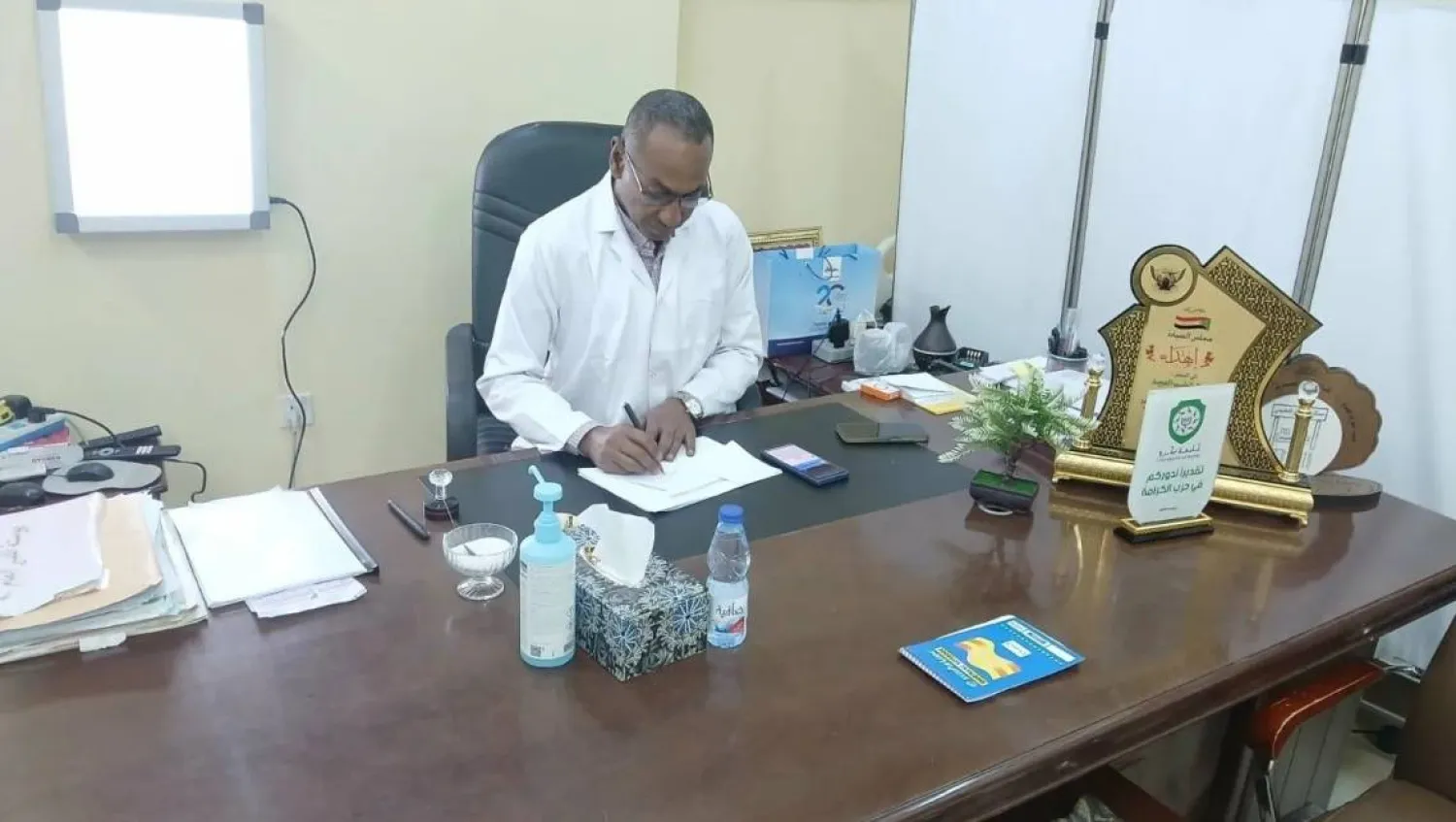
Al Nao Hospital Director Dr. Jamal Eltaeb (Asharq Al-Awsat)
TT

Sudan: How One Hospital Saved Thousands of Lives Amid War

Al Nao Hospital Director Dr. Jamal Eltaeb (Asharq Al-Awsat)

As Sudan’s war dragged on and fighting engulfed the capital Khartoum, the health system collapsed almost entirely. Hospitals shut their doors one after another, until only a single facility remained in operation in the city of Omdurman.

Al Nao Hospital, perched west of the city on the front line of fierce military confrontations, became the capital’s last functioning emergency hospital, receiving the wounded, responding to urgent cases, and saving thousands of lives under relentless fire.

Despite severe security and psychological pressure, a small group of doctors, health workers, volunteers, and technicians held out to keep the hospital running amid indiscriminate shelling, falling rockets and artillery rounds, severe shortages of supplies, power and water outages, the collapse of communications, and an ever-increasing flow of emergency cases.

Throughout the siege and restrictions imposed on the hospital, doctors, medical staff, and volunteers treated the wounded using just three worn-out ambulances.

Their meals were limited to beans and lentils for breakfast and dinner, as no restaurants were operating in the surrounding area, which was saturated with the smell of blood and gunpowder.

Their efforts earned them the Aurora Prize for Awakening Humanity, which is awarded to individuals who risk their lives, freedom, or health to save others.

Harsh days

The field hospital demonstrated its ability to function in the darkest of times.

“I was deeply affected by the deaths of children, and they were in large numbers,” hospital director Dr. Jamal Eltaeb told Asharq Al-Awsat.

“We were receiving more than 100 cases a day, sometimes within a single hour, around 4,000 a month, with injuries ranging from severe to minor, and we treated large numbers of wounded.”

Eltaeb said the hospital began operating on April 17, 2023, just days after the outbreak of the war, through an initiative launched by young volunteers and with extremely limited capabilities to treat the wounded.

“The injuries caused by indiscriminate shelling shook me deeply, especially among children and women,” he said.

“The deaths of young children were the most painful. Even if you are a doctor, you never get used to seeing children with amputated limbs or their abdomens torn open.”

Drowning in chaos

While the streets of Omdurman sank into chaos, the hospital remained alive with activity.

“We worked with the medical staff available and the limited medicines we had,” Eltaeb said. “The Dutch organization Doctors Without Borders provided us with major support.”

He added that after the war began, he moved from Khartoum to Omdurman as a volunteer, before Khartoum State’s health ministry personally asked him to formally manage the hospital in July 2023.

Alongside colleagues Dr. Amir Mohammed Al-Hassan, a specialist in internal medicine and cardiology, and Dr. Yasser Shamboul, a specialist in internal medicine, he began work with limited resources.

“Ministries and institutions were absent,” Eltaeb said.

“The wounded, the sick, the elderly, and children accept no excuses. They just want someone to treat them.”

Painful scenes

In February 2025, a powerful explosion rocked a popular market in Omdurman, quickly flooding the hospital’s emergency room with bodies and injured victims. “That was one of the most difficult days,” Eltaeb said.

“Sabreen Market was crowded with shoppers. We received around 170 injured people in less than two hours, transported by trucks because there was no ambulance service.”

Those who attempted to help were not doctors or health workers, he said, leading to chaotic transport that mixed the dead with the wounded.

Hospital staff sorted the bodies from the living inside the trucks and confirmed 48 deaths, alongside patients with varying injuries, some of whom lost limbs or were left with permanent disabilities.

“But thank God, we saved the lives of the rest,” he said.

The hospital itself came under indiscriminate shelling, yet doctors and medical staff insisted on continuing their work.

Eltaeb said several hospital workers were killed by shelling and rockets, one volunteer died inside the adjacent mosque, two security guards were killed, and a soldier was wounded by a sniper’s bullet inside the hospital.

Aurora humanitarian prize

The Aurora Foundation for Awakening Humanity awarded its 2025 prize, worth $1 million, to Dr. Jamal Eltaeb in recognition of his efforts managing a hospital that served as a final medical line of defense in Khartoum during the armed conflict.

The prize is one of the world’s leading humanitarian awards, honoring those who risk their lives, freedom, or health to save others and alleviate suffering in situations of conflict, crimes against humanity, or human rights violations.

“I do not know who nominated me for this prize,” Eltaeb said. “I was selected from among 880 nominees without my knowledge. When the shortlist was reduced to 25 people, I learned that I had been nominated.”

He said the prize committee searched for him by sending inquiries to hospitals across Europe, looking for a doctor named Jamal Eltaeb. A colleague in anesthesia in London emailed a message to a fellow doctor at Al Nao Hospital, who forwarded it to him.

“When I read the message, I thought it was some kind of joke and did not reply,” he said. After being encouraged to respond, he shared his contact details and received a call the following day, as the shortlist narrowed to 15, then four, before he was named the final winner.

“The prize does not represent me personally,” Eltaeb said. “It represents the hospital family, the doctors, administrators, and workers. I was only leading them. I am no more deserving of this prize than they are.”



Israel Says Ban on Gaza Media Access Should Stay

A Palestinian woman holds her child beside piles of rubble while heading toward Gaza City on Friday. (AFP)
TT

Israel Says Ban on Gaza Media Access Should Stay

A Palestinian woman holds her child beside piles of rubble while heading toward Gaza City on Friday. (AFP)

Israeli authorities have told the Supreme Court that a ban on international media access to Gaza should remain in place, arguing it is necessary for security reasons, according to a government submission filed by the public prosecutor. 

Since the outbreak of the Gaza war in October 2023, triggered by an attack on Israel by the Palestinian group Hamas, Israeli authorities have barred foreign journalists from independently entering the devastated territory, said AFP. 

Instead, Israel has allowed only a limited number of reporters to enter Gaza on a case-by-case basis, embedded with its military forces inside the blockaded territory. 

The Foreign Press Association (FPA), which represents hundreds of foreign journalists working in Israel and the Palestinian territories, filed a petition with the Supreme Court in 2024 seeking immediate and unrestricted access for international media to the Gaza Strip. 

Since then the court has given several extensions to the Israeli authorities to come up with a plan, but at a hearing last month it set January 4 as a final deadline. 

Late on Sunday, the Israeli authorities filed their response with the court, a copy of which was obtained by AFP. 

In the submission, the government said the ban on media access to Gaza should continue, citing security risks in the territory. 

"Even at this time, entry of journalists into the Gaza Strip without escort, as requested in the petition, should not be permitted," said the government submission. 

"This is for security reasons, based on the position of the defense establishment, which maintains that a security risk associated with such entry still exists." 

The Israeli authorities said the ceasefire in Gaza, which came into effect on October 10, continues to face regular threats. 

At least 420 Palestinians have been killed in Gaza by Israeli forces since the ceasefire took effect, according to Gaza's health ministry. 

The Israeli military said three of its soldiers have also been killed by militants during the same period. 

The Israeli authorities said in their submission that the search for the remains of the last hostage held in Gaza is ongoing, suggesting that allowing journalists into the territory at this stage could hinder the operation. 

The remains of Ran Gvili, whose body was taken to Gaza after he was killed during the Hamas attack on October 7, 2023, have still not been recovered despite the ceasefire. 

All other 250 hostages seized on that day - both the living and the deceased - have been returned to Israel. 

The Supreme Court is expected to issue a ruling on the matter, though it is unclear when a decision will be handed down. 


Calls in Lebanon for Immediate Action Against ‘Remnants’ of Assad Regime

The Masnaa border crossing between Lebanon and Syria. (AFP)
TT

Calls in Lebanon for Immediate Action Against ‘Remnants’ of Assad Regime

The Masnaa border crossing between Lebanon and Syria. (AFP)

Reports about the presence of “remnants of the former Syrian regime” in Lebanon have raised concerns that they could destabilize internal security or turn Lebanese territory into a platform for targeting Syria’s security and stability.

Authorities and security agencies have launched a broad campaign to verify these reports as voices across Lebanon warned of the presence of former Syrian officers in certain regions, particularly in the North and Bekaa Valley in the east.

The Lebanese Army Command regularly announces raids and security operations against suspects. The latest such operation was announced on Sunday, when dozens were detained, mostly Syrians, in northern Lebanon and the Bekaa.

In a statement, the Army Command said it carried out operations against wanted suspects, arresting nine Lebanese citizens and 35 Syrians in the regions of Akkar, Tripoli, Batroun, Baalbek and Hermel on charges including opening fire, possession of weapons, drug use, and human smuggling.

The army added that weapons, ammunition, drugs and military equipment were seized, and that investigations had begun under the supervision of the relevant judiciary.

Previously, a number of municipalities in northern Lebanon had issued statements urging security agencies to tighten measures in their areas, saying several former regime members have sought safety in their towns. They also spoke of the daily movement of suspicious vehicles.

Similar warnings have since emerged from the Bekaa. Dar al-Fatwa in Rashaya issued a statement on Sunday calling on the state to take “immediate, swift and decisive action to arrest the remnants of the Syrian regime in Lebanon and return them to Syria for trial.”

MP Wael Abou Faour, a member of the Democratic Gathering bloc, called on “the Lebanese security agencies to fulfill their duties with regard to the large number of officers from the remnants of the regime of former Syrian president Bashar al-Assad who are present in Lebanon.”

He stressed that despite the fall of the regime, “Lebanese-Syrian relations are governed by the Taif Agreement, which clearly stipulates that Lebanon must not be a base or a transit point for any attack on Syria’s security, and vice versa.”

“The Lebanese state must therefore act to uncover the truth and arrest officers from the remnants of the regime who are hiding in Lebanon.”


First Direct Clashes Erupt Between Hamas, Armed Gangs in Gaza

 Palestinians carry the remains of a victim of a fire that broke out in displacement tents in Gaza City (AFP). 
 Palestinians carry the remains of a victim of a fire that broke out in displacement tents in Gaza City (AFP). 
TT

First Direct Clashes Erupt Between Hamas, Armed Gangs in Gaza

 Palestinians carry the remains of a victim of a fire that broke out in displacement tents in Gaza City (AFP). 
 Palestinians carry the remains of a victim of a fire that broke out in displacement tents in Gaza City (AFP). 

The al-Tuffah neighborhood, east of Gaza City, witnessed on Sunday morning the first direct, face-to-face clashes between fighters from Hamas and members of an armed gang operating in the area, marking a new and dangerous escalation in Gaza’s internal security landscape.

Field sources said the clashes involved a group led by Palestinian Rami Halas, which calls itself the “Popular Defense Forces.” The group is reportedly active in areas under Israel’s control and has stepped up attacks against Palestinians over the past 10 days, killing at least two people and wounding several others.

According to the sources, members of the Halas gang advanced toward al-Sanafour junction in al-Tuffah, an area west of the so-called “Yellow Line,” designated as an initial withdrawal line under the Gaza ceasefire agreement.

As the gunmen entered residential neighborhoods, they were met with immediate gunfire from Hamas fighters and members of other armed factions. The exchange of fire lasted more than 20 minutes before the gang withdrew toward the Yellow Line, which remains under Israeli control.

The clashes coincided with the presence of Israeli surveillance drones overhead. Sources said that shortly after the fighting subsided, the drones carried out strikes on homes in al-Tuffah and surrounding areas. This was followed by the use of booby-trapped vehicles loaded with tons of explosives, detonated in stages to destroy what remained of houses in those zones.

The sources also revised earlier accounts of a killing on Saturday at the main junction in al-Shuja’iyya, east of Gaza City. A Palestinian initially believed to have been shot by Israeli forces was, in fact, killed by gunmen from the same armed gang, they said. He was at least the second person killed by the group in the area within roughly 10 days.

In recent weeks, the Halas gang has intensified its attacks in eastern Gaza City, allegedly operating under Israeli cover. About two weeks ago, it forced residents of a residential block in al-Tuffah to evacuate their homes.

Armed gangs in Gaza have become more active and increasingly sophisticated, carrying out assassinations — such as the killing of Internal Security officer Ahmed Zamzam —and opening fire on civilians in areas west of the Yellow Line. Sunday’s incident marked the first direct clash between such gangs and established armed factions.

Meanwhile, Hamas has expanded executions and crackdowns against armed gangs and individuals accused of collaborating with Israel since the ceasefire took effect on Oct. 10. Hamas sources said several alleged collaborators linked to the assassinations of senior leaders, including former Qassam Brigades commander Mohammed Deif, have been executed, while others have been arrested and remain under investigation.

Separately, Israeli fire killed three Palestinians in Khan Younis on Sunday, including a 15-year-old boy and a young man, while a fisherman was shot dead off the city’s coast. Since the ceasefire, more than 423 Palestinians have been killed in what are described as Israeli violations across Gaza.