

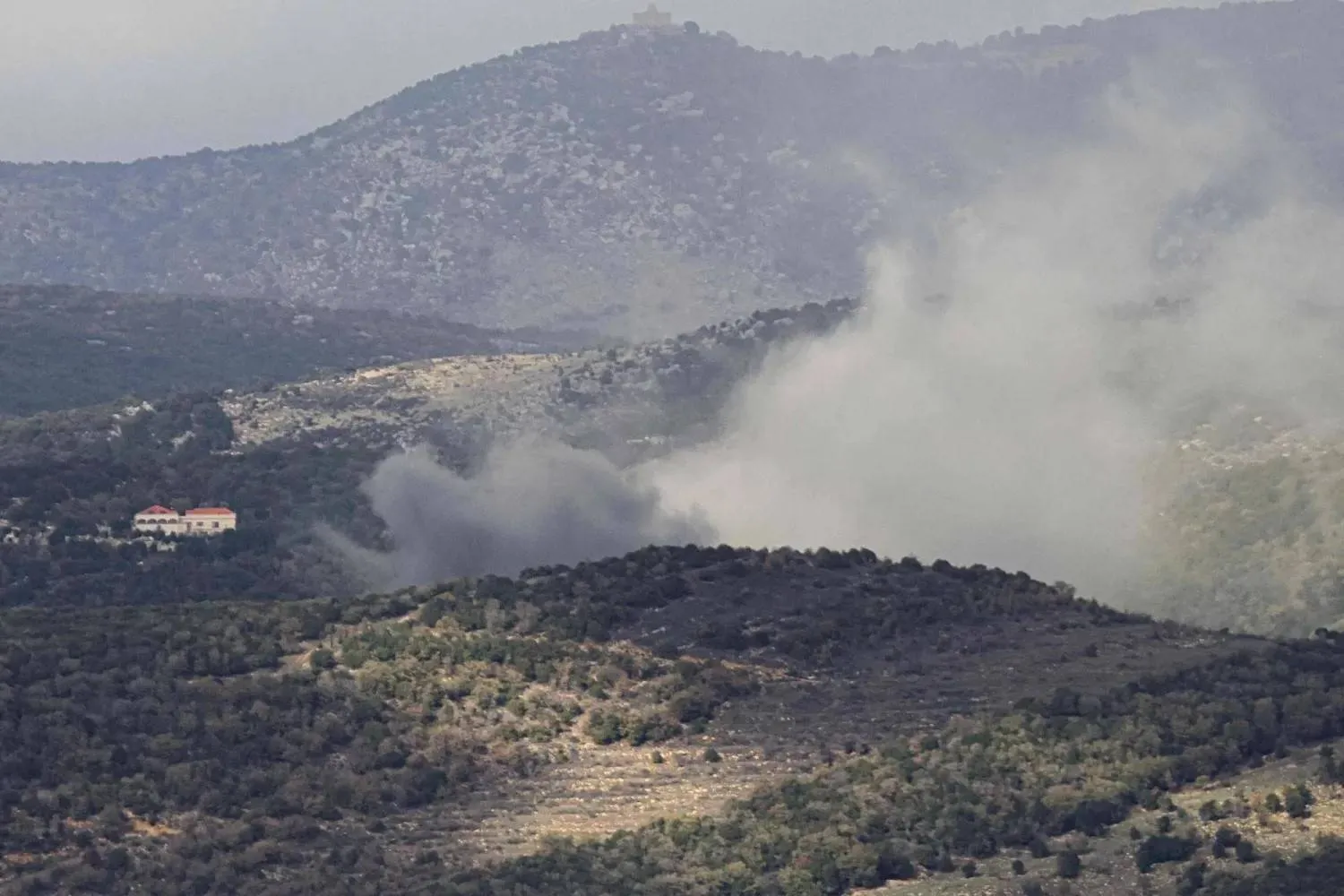

Israel Resumes South Lebanon Strikes after Netanyahu-Trump Talks

Smoke rises after Israeli airstrikes hit the Jabal al Rihan heights in southern Lebanon (AFP)
TT

Israel Resumes South Lebanon Strikes after Netanyahu-Trump Talks

Smoke rises after Israeli airstrikes hit the Jabal al Rihan heights in southern Lebanon (AFP)

Israel resumed airstrikes in southern Lebanon on Friday shortly after Prime Minister Benjamin Netanyahu returned from a visit to the United States, where he met US President Donald Trump, as Israeli officials signaled possible military action if Beirut fails to advance to the next phase of a plan to confine Hezbollah’s weapons north of the Litani River.

The ceasefire monitoring committee, also known as the mechanism, is tracking Lebanon’s political and diplomatic efforts, as well as local measures, aimed at preventing a renewed war.

The mechanism is expected to hold a military-level meeting next week to review developments.

Meanwhile, the Lebanese government is also due to receive a briefing next week from Lebanese Army Commander General Rodolphe Haykal on progress in implementing the state’s decision to contain the proliferation of weapons in stages.

Airstrikes resume

Israeli bombardment in Lebanon had eased after Netanyahu departed for the United States, with no intense airstrikes recorded as had been occurring on a weekly and repeated basis.

That situation changed following the end of the visit and Netanyahu’s return to Israel, where he is expected to meet Israeli officials on Saturday to brief them on his trip.

Lebanon’s state-run National News Agency reported that Israeli warplanes carried out airstrikes deep inside Lebanon, hitting the Louaizeh heights, the Mrouj Aqmata area in the Iqlim al Tuffah highlands, the Wadi Aazze Zefta area, the outskirts of Ansar in Nabatieh district, the Tabna area on the outskirts of Bissariyeh in the Zahrani region, and Mount Mashghara in the western Bekaa in eastern Lebanon.

The strikes totaled ten air raids, all within a contiguous geographic belt stretching from the coast to eastern Lebanon, north of the Litani.

Israeli army spokesman Avichay Adraee said on Friday that Israeli forces had carried out strikes on Hezbollah sites in several areas of southern Lebanon.

Writing on X, he said the army targeted what he described as terrorist infrastructure belonging to the group, including a training complex used by the Radwan Force, Hezbollah’s elite unit, and military buildings that he said were used to store weapons.

He said the presence of the targeted infrastructure and the conduct of military training constituted a violation of understandings between Israel and Lebanon.

North of the Litani

All the strikes hit deep valleys and uninhabited areas that have been repeatedly bombed since the ceasefire came into force in November 2024. The locations lie between about 20 kilometers east and 40 kilometers west of the border with Israel.

Earlier on Friday, an Israeli drone struck an excavator in the border town of Aita al Shaab.

Israeli warplanes also violated Lebanese airspace, flying at low altitude over villages in the Tyre district, while two Israeli aircraft breached the airspace over the city of Baalbek and surrounding villages in eastern Lebanon.

Israel has launched a new phase of military strikes since last month, focused on areas north of the Litani, after the Lebanese government announced the completion of the first phase of its plan to confine weapons to official military and security forces south of the river, and preparations to begin the second phase north of the Litani, extending to the Awali River, about 50 kilometers from the southern border.

Netanyahu’s deadline

The strikes followed the end of Netanyahu’s five-day visit to the United States.

Israel’s public broadcaster had reported earlier this week that Netanyahu instructed the military to suspend operations until his return, in order to avoid what it described as an unwanted entanglement during his meeting with Trump.

Israeli media reported on Friday that, upon Netanyahu’s return, security chiefs would be briefed on understandings and agreements reached with Trump.

Israeli media also suggested that Israel could act on its own if Lebanon fails to meet its commitments to implement weapons exclusivity north of the Litani, amid Hezbollah’s refusal to cooperate.

Hezbollah officials have said the priority should be for Israel to meet its obligations under the ceasefire, including withdrawing from occupied Lebanese points, halting attacks, releasing detainees, and launching reconstruction.

Hezbollah’s priorities

Hezbollah lawmaker Hassan Ezzedine said at a memorial event in southern Lebanon that the United States was trying, through politics, pressure and conspiracies, to achieve what Israel failed to accomplish militarily.

He said Lebanon and the resistance had fulfilled all obligations under the agreements, while Israel continued to evade any commitment.

He called on the Lebanese state and the sponsors of the agreement to compel Israel to stop its attacks, paving the way for an internal national dialogue on strategies to safeguard Lebanon’s strength and sovereignty, without foreign interference.

Ezzedine said the government had clear responsibilities outlined in its ministerial statement, foremost liberating land, stopping attacks, securing the release of detainees, and launching reconstruction.

He said inaction was unjustified, arguing the state could raise its voice in international forums, expose Israeli violations, issue a clear political decision mandating the Lebanese army to take all necessary measures to protect sovereignty, and ensure the return of citizens to their villages and properties, particularly in frontline areas.



EU Chief von der Leyen to Visit Syria, Lebanon This Week

European Commission President Ursula von der Leyen, addresses journalists during a visit to Sarajevo, Bosnia and Herzegovina, January 23, 2024. (Reuters)
TT

EU Chief von der Leyen to Visit Syria, Lebanon This Week

European Commission President Ursula von der Leyen, addresses journalists during a visit to Sarajevo, Bosnia and Herzegovina, January 23, 2024. (Reuters)

EU chief Ursula von der Leyen will visit Syria later this week on a first trip to the country since the fall of Bashar al-Assad, a spokeswoman said Monday.

Von der Leyen will head to Syria as part of a tour of the Middle East that will also see her visit Jordan and Lebanon, spokeswoman Paula Pinho said.


Israel Says Ban on Gaza Media Access Should Stay

A Palestinian woman holds her child beside piles of rubble while heading toward Gaza City on Friday. (AFP)
TT

Israel Says Ban on Gaza Media Access Should Stay

A Palestinian woman holds her child beside piles of rubble while heading toward Gaza City on Friday. (AFP)

Israeli authorities have told the Supreme Court that a ban on international media access to Gaza should remain in place, arguing it is necessary for security reasons, according to a government submission filed by the public prosecutor. 

Since the outbreak of the Gaza war in October 2023, triggered by an attack on Israel by the Palestinian group Hamas, Israeli authorities have barred foreign journalists from independently entering the devastated territory, said AFP. 

Instead, Israel has allowed only a limited number of reporters to enter Gaza on a case-by-case basis, embedded with its military forces inside the blockaded territory. 

The Foreign Press Association (FPA), which represents hundreds of foreign journalists working in Israel and the Palestinian territories, filed a petition with the Supreme Court in 2024 seeking immediate and unrestricted access for international media to the Gaza Strip. 

Since then the court has given several extensions to the Israeli authorities to come up with a plan, but at a hearing last month it set January 4 as a final deadline. 

Late on Sunday, the Israeli authorities filed their response with the court, a copy of which was obtained by AFP. 

In the submission, the government said the ban on media access to Gaza should continue, citing security risks in the territory. 

"Even at this time, entry of journalists into the Gaza Strip without escort, as requested in the petition, should not be permitted," said the government submission. 

"This is for security reasons, based on the position of the defense establishment, which maintains that a security risk associated with such entry still exists." 

The Israeli authorities said the ceasefire in Gaza, which came into effect on October 10, continues to face regular threats. 

At least 420 Palestinians have been killed in Gaza by Israeli forces since the ceasefire took effect, according to Gaza's health ministry. 

The Israeli military said three of its soldiers have also been killed by militants during the same period. 

The Israeli authorities said in their submission that the search for the remains of the last hostage held in Gaza is ongoing, suggesting that allowing journalists into the territory at this stage could hinder the operation. 

The remains of Ran Gvili, whose body was taken to Gaza after he was killed during the Hamas attack on October 7, 2023, have still not been recovered despite the ceasefire. 

All other 250 hostages seized on that day - both the living and the deceased - have been returned to Israel. 

The Supreme Court is expected to issue a ruling on the matter, though it is unclear when a decision will be handed down. 


Calls in Lebanon for Immediate Action Against ‘Remnants’ of Assad Regime

The Masnaa border crossing between Lebanon and Syria. (AFP)
TT

Calls in Lebanon for Immediate Action Against ‘Remnants’ of Assad Regime

The Masnaa border crossing between Lebanon and Syria. (AFP)

Reports about the presence of “remnants of the former Syrian regime” in Lebanon have raised concerns that they could destabilize internal security or turn Lebanese territory into a platform for targeting Syria’s security and stability.

Authorities and security agencies have launched a broad campaign to verify these reports as voices across Lebanon warned of the presence of former Syrian officers in certain regions, particularly in the North and Bekaa Valley in the east.

The Lebanese Army Command regularly announces raids and security operations against suspects. The latest such operation was announced on Sunday, when dozens were detained, mostly Syrians, in northern Lebanon and the Bekaa.

In a statement, the Army Command said it carried out operations against wanted suspects, arresting nine Lebanese citizens and 35 Syrians in the regions of Akkar, Tripoli, Batroun, Baalbek and Hermel on charges including opening fire, possession of weapons, drug use, and human smuggling.

The army added that weapons, ammunition, drugs and military equipment were seized, and that investigations had begun under the supervision of the relevant judiciary.

Previously, a number of municipalities in northern Lebanon had issued statements urging security agencies to tighten measures in their areas, saying several former regime members have sought safety in their towns. They also spoke of the daily movement of suspicious vehicles.

Similar warnings have since emerged from the Bekaa. Dar al-Fatwa in Rashaya issued a statement on Sunday calling on the state to take “immediate, swift and decisive action to arrest the remnants of the Syrian regime in Lebanon and return them to Syria for trial.”

MP Wael Abou Faour, a member of the Democratic Gathering bloc, called on “the Lebanese security agencies to fulfill their duties with regard to the large number of officers from the remnants of the regime of former Syrian president Bashar al-Assad who are present in Lebanon.”

He stressed that despite the fall of the regime, “Lebanese-Syrian relations are governed by the Taif Agreement, which clearly stipulates that Lebanon must not be a base or a transit point for any attack on Syria’s security, and vice versa.”

“The Lebanese state must therefore act to uncover the truth and arrest officers from the remnants of the regime who are hiding in Lebanon.”