


Maduro's Ouster Sparks Celebrations among Venezuelans in South Florida

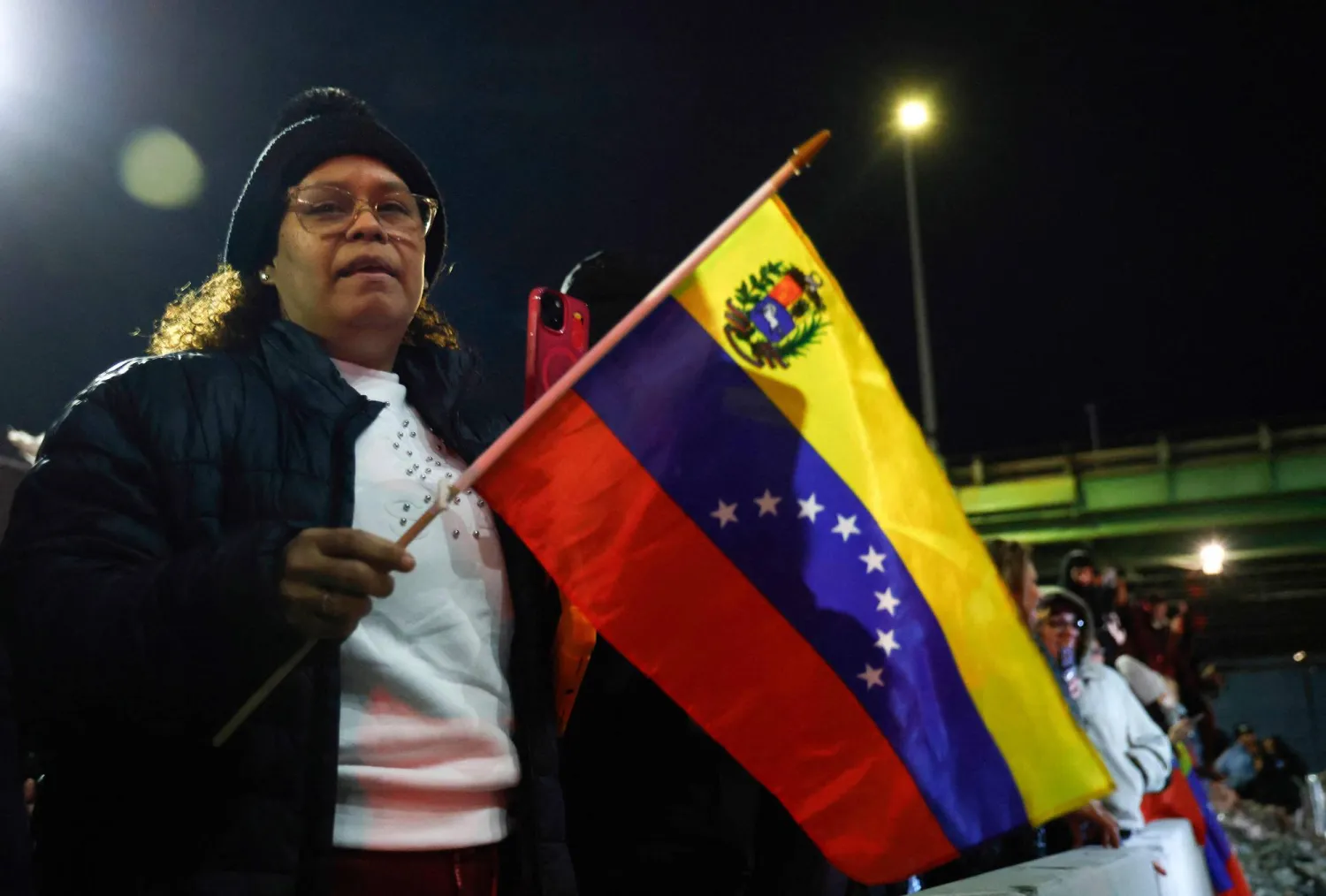
People hold the Venezuelan flag as they celebrate outside the Metropolitan Detention facility in the Brooklyn borough of New York, where ousted president Nicolas Maduro is expected to be held, on January 3, 2026 in New York City.  (Photo by John Lamparski / AFP)
People hold the Venezuelan flag as they celebrate outside the Metropolitan Detention facility in the Brooklyn borough of New York, where ousted president Nicolas Maduro is expected to be held, on January 3, 2026 in New York City. (Photo by John Lamparski / AFP)
TT

Maduro's Ouster Sparks Celebrations among Venezuelans in South Florida

People hold the Venezuelan flag as they celebrate outside the Metropolitan Detention facility in the Brooklyn borough of New York, where ousted president Nicolas Maduro is expected to be held, on January 3, 2026 in New York City.  (Photo by John Lamparski / AFP)
People hold the Venezuelan flag as they celebrate outside the Metropolitan Detention facility in the Brooklyn borough of New York, where ousted president Nicolas Maduro is expected to be held, on January 3, 2026 in New York City. (Photo by John Lamparski / AFP)

Revelers chanted “liberty” and draped Venezuelan flags over their shoulders in South Florida on Saturday to celebrate the US military operation to capture Nicolás Maduro and remove him from the country — a stunning outcome they had longed for but left them wondering what comes next in their troubled homeland.

For some Venezuelan natives, the military action — culminating months of stepped-up US pressure — brought their dreams of reuniting with loved ones closer to reality after years of heartbreaking separations, The Associated Press said.

People gathered for a rally in Doral — the Miami suburb where President Donald Trump has a golf resort and where roughly half the population is of Venezuelan descent — as word spread that Venezuela's now-deposed president had been captured and flown out of the country.

Outside El Arepazo restaurant, a hub of the Venezuelan culture of Doral, one man held a piece of cardboard with “Libertad” scrawled with a black marker. It was a sentiment expressed by other native Venezuelans hoping for a new beginning for their home country as they chanted “Liberty! Liberty! Liberty!"

"We’re like everybody — it’s a combination of feelings, of course," said Alejandra Arrieta, who came to the US in 1997. "There’s fears. There’s excitement. There’s so many years that we’ve been waiting for this. Something had to happen in Venezuela. We all need the freedom.”

Some Venezuelan exiles feel hopeful after US actions

For David Nuñez, the regime change offered hope for a long-awaited reunion with loved ones.

Nuñez said he fled to the United States six years ago after being persecuted in Venezuela for his political activism and has not seen his daughters — ages 8 and 17 — since then.

“The most important thing is that we’re going to be able to be with our families soon,” Nuñez said. “At least for me, I haven’t seen my daughters in six years so I have a lot of mixed feelings. I’ve cried a lot. I’m really happy because I know that I’m going to be able to return to Venezuela very soon.”

Trump insisted Saturday that the US government would run the country at least temporarily and was already doing so. The action marked the culmination of an escalating Trump administration pressure campaign on the oil-rich South American nation as well as weeks of planning that tracked Maduro’s behavioral habits.

After Trump’s press conference about US actions in Venezuela, people still gathered outside of the Doral restaurant sang, danced and waved flags. A percussionist drummed along with the singing crowd.

People started gathering outside the restaurant once the news broke. Cooks were told to stay and prepare more food for anticipated high demand. Hundreds showed up, and the crowd kept growing as the day went on.

Some say Maduro's ouster was long awaited Alexa Perez said she has waited year for this moment.

“Thanks, President Trump. This is our second liberty. This our independence day from today on,” Perez said.

She married a week ago and said the news was the “best wedding gift” possible.

Her husband, Aldo Amenta, said they were scared, excited and confused at first and felt better when they learned their family members were safe.

“We’re really happy and excited that the doors are open for Venezuela, for all of our people who deserve a chance,” Amenta said.

Perez responded positively to apparent US plans to run Venezuela at least temporarily and tap its vast oil reserves to sell to other nations, saying her homeland has not received anything from Russia, Iran and China.

“We are very poor, we have no hospital, we have no rights for our people,” Perez said. “So I think this is going to be a great transition. Because once you know how the US works, you know that everything can work better.”

The Venezuelan diaspora grew over decades

About 8 million people have fled the country since 2014, settling first in neighboring countries in Latin America and the Caribbean. After the COVID-19 pandemic, they increasingly set their sights on the United States, walking through the jungle in Colombia and Panama or flying to the US on humanitarian parole with a financial sponsor.

In South Florida, deep-seated concerns in the Venezuelan community about Trump's tough immigration policies gave way to celebrations after Maduro was deposed in the American military operation early Saturday.

In Doral, upper-middle-class professionals and entrepreneurs came to invest in property and businesses when socialist Hugo Chávez won the presidency in the late 1990s. They were followed by political opponents and entrepreneurs who set up small businesses. In recent years, more lower-income Venezuelans have come for work in service industries.

They are doctors, lawyers, beauticians, construction workers and house cleaners. Some are naturalized US citizens or live in the country illegally with US-born children. Others overstay tourist visas, seek asylum or have some form of temporary status.

‘Not a guarantee, but a possibility, for recovery’

Niurka Meléndez, who fled from Venezuela in 2015, said Saturday she’s hopeful that Maduro’s ouster will improve life in her homeland. Meléndez immigrated to New York City, where she co-founded the group Venezuelans and Immigrants Aid, which strives to empower the lives of immigrants. She became a steadfast advocate for change in her home country, where she said her countrymen faced a humanitarian crisis.

Now, she hopes those hardships will fade away.

“For us, it’s just the start of the justice we need to see,” Meléndez said in a phone interview.

Her homeland had reached a “breaking point” due to forced displacements, repression, hunger and fear, she said. Now there's a need for international humanitarian support to help in Venezuela's recovery.

“Removing an authoritarian system responsible for these crimes creates the possibility, not a guarantee, but a possibility, for recovery,” she said. “A future without criminal control over institutions is the minimum condition for rebuilding a country based on justice, rule of law, and democratic safeguards.”



UN Chief Calls on Iran to Respect Demonstrators' Right to 'Protest Peacefully'

 People walk on a street as protests erupt over the collapse of the currency's value in Tehran, Iran, January 2, 2026. Majid Asgaripour/WANA (West Asia News Agency) via Reuters
People walk on a street as protests erupt over the collapse of the currency's value in Tehran, Iran, January 2, 2026. Majid Asgaripour/WANA (West Asia News Agency) via Reuters
TT

UN Chief Calls on Iran to Respect Demonstrators' Right to 'Protest Peacefully'

 People walk on a street as protests erupt over the collapse of the currency's value in Tehran, Iran, January 2, 2026. Majid Asgaripour/WANA (West Asia News Agency) via Reuters
People walk on a street as protests erupt over the collapse of the currency's value in Tehran, Iran, January 2, 2026. Majid Asgaripour/WANA (West Asia News Agency) via Reuters

UN Secretary-General Antonio Guterres on Monday called on Iran to respect demonstrators' right to "protest peacefully," with the country in the grip of unrest over high prices and economic stagnation.

The Secretary-General "underscores the need to prevent any further casualties," his spokesman Stephane Dujarric said.

"He also calls on the authorities to uphold the right of freedom of expression, association and peaceful assembly" and that "all individuals must be allowed to protest peacefully and express their grievances."


Netanyahu Says Israel Won’t Let Iran Restore Ballistic Missile Program

Israeli Prime Minister Benjamin Netanyahu attends a debate initiated by the opposition as part of a plenary session in the Knesset, the Israeli parliament, in Jerusalem, 05 January 2026. (EP)A
TT

Netanyahu Says Israel Won’t Let Iran Restore Ballistic Missile Program

Israeli Prime Minister Benjamin Netanyahu attends a debate initiated by the opposition as part of a plenary session in the Knesset, the Israeli parliament, in Jerusalem, 05 January 2026. (EP)A

Prime Minister Benjamin Netanyahu said Monday that Israel would not allow arch-foe Iran to restore its ballistic missile program, just days after US President Donald Trump issued a similar threat.

"We will not allow Iran to restore its ballistic missile industry, and certainly we will not allow it renew the nuclear program that we significantly damaged," Netanyahu told lawmakers.

"If we are attacked, the consequences for Iran will be very severe," he said.

Netanyahu's threat comes days after Trump threatened to "eradicate" Iran's nuclear and ballistic missile program, after the two leaders met in Washington last week.

Israeli officials and media have expressed concern in recent months that Iran is rebuilding its ballistic missile arsenal after it was damaged during the 12-day war with Israel in June.

Trump said Iran "may be behaving badly" and was looking at new nuclear sites to replace those targeted by US strikes during the same conflict, as well as restoring its missile stockpiles.

"I hope they're not trying to build up again because if they are, we're going have no choice but very quickly to eradicate that buildup," Trump said, adding that the US response "may be more powerful than the last time."

But Trump said he believed Iran was still interested in a deal with Washington on its nuclear and missile programs. Tehran denies that it is seeking nuclear weapons.

Netanyahu, meanwhile, said the protests in Iran had "expanded greatly".

"It is very possible that we are at a decisive moment -- a moment when the Iranian people will take their destiny into their own hands," he said in parliament.

Protests erupted in Iran on December 28 when shopkeepers in the capital Tehran staged a strike over high prices and economic stagnation.

They have since spread to other cities and expanded to include political demands.

On Sunday, Netanyahu said that Israel stood in solidarity with the Iranian people during the ongoing demonstrations.

"We stand in solidarity with the struggle of the Iranian people and with their aspirations for freedom, liberty and justice," Netanyahu said at the weekly cabinet meeting.


Iran’s Leaders Struggle to End Protests, US Action in Venezuela Stokes Fears

 People walk on a street, as protests erupt over the collapse of the currency's value, in Tehran, Iran, January 5, 2026. Majid Asgaripour/WANA (West Asia News Agency) via Reuters
People walk on a street, as protests erupt over the collapse of the currency's value, in Tehran, Iran, January 5, 2026. Majid Asgaripour/WANA (West Asia News Agency) via Reuters
TT

Iran’s Leaders Struggle to End Protests, US Action in Venezuela Stokes Fears

 People walk on a street, as protests erupt over the collapse of the currency's value, in Tehran, Iran, January 5, 2026. Majid Asgaripour/WANA (West Asia News Agency) via Reuters
People walk on a street, as protests erupt over the collapse of the currency's value, in Tehran, Iran, January 5, 2026. Majid Asgaripour/WANA (West Asia News Agency) via Reuters

Iran's efforts to quell a wave of anti-government protests have been complicated by Donald Trump's threat to intervene on their side, a warning firmly underlined by the subsequent US capture of Venezuela's Nicolas Maduro, officials and insiders said on Monday.

A day before US special forces seized Maduro and his wife on January 3 and whisked them off to New York, the US president warned in a social media post that if Iran's leadership killed protesters who have taken to the streets since December 28 the US "will come to their rescue". At least 17 people have died so far.

Tehran's options have been limited by Trump's threats and a long-running economic crisis that deepened after Israel, joined by the US, launched strikes on the country in June in a 12-day war that pummeled several of Iran's nuclear sites.

SOME FEAR IRAN MAY BE 'NEXT VICTIM', OFFICIAL SAYS

"These twin pressures have narrowed Tehran's room for maneuver, leaving leaders caught between public anger on the streets and hardening demands and threats from Washington, with few viable options and high risks on every path," one Iranian official told Reuters.

The view was echoed by two other officials and a former Iranian official who remains close to Iran's decision makers. All of them asked not to be identified due to the sensitivity of the situation.

A second official said that, ‌after US action in ‌Venezuela, some of the authorities feared Iran could be "the next victim of Trump's aggressive foreign policy".

Iran's economy has ‌been ⁠hammered by years of ‌US sanctions, but its rial has been in freefall since last year's Israeli-US strikes that mainly targeted nuclear sites, where the West says Tehran has been working on nuclear arms. Iran denies this.

The protests that erupted in Tehran and which have spread to some cities in western and southern Iran do not match the scale of unrest that swept the nation in 2022-23 over the death of Mahsa Amini, who died in the custody of Iran's morality police for allegedly violating the hijab law.

But, even if smaller, these protests have quickly expanded from an economic focus to broader frustrations, with some protesters chanting "Down with the Islamic Republic" or "Death to the dictator" - a reference to Supreme Leader Ali Khamenei who has the final say in all state matters.

That presents a challenge for the authorities which have been trying to maintain and nurture the spirit of national ⁠unity that emerged during and after the Israeli-US strikes.

A third official said worries were growing in Tehran that "Trump or Israel might take military action against Iran, like what they did in June."

IRAN IS LONGTIME ALLY ‌OF VENEZUELA

Iran, which has for years allied itself with fellow oil producer Venezuela, which like Iran has ‍suffered under years of US sanctions, has condemned Washington's action in Caracas. ‍It has also condemned Trump's statements about Iran.

Iran's Foreign Ministry spokesperson Esmaeil Baghaei said such statements about "Iran's internal affairs amount, under international norms, to nothing more than ‍incitement to violence, incitement to terrorism, and incitement to killing".

On Friday, Trump threatened to intervene if protesters faced violence, declaring, "We are locked and loaded and ready to go," though he offered no details on what actions he might take.

The protests threaten what has long been Khamenei's defining priority: preserving the republic at any cost. In a sign of the leadership's concern, Khamenei on Saturday accused "enemies of the republic" of fomenting unrest and warned that "rioters should be put in their place".

WORST UNREST IN THE PAST THREE YEARS

Authorities have attempted to maintain a dual approach to the unrest, saying protests over the economy are legitimate and will be met by dialogue, while meeting some demonstrations with tear gas amid violent street confrontations.

However, at least 17 people have been killed in a week, rights groups said ⁠on Sunday. Authorities have said at least two members of the security services had died and more than a dozen were injured in the unrest.

The country's clerical establishment is still coming to terms with the 2025 Israeli and US strikes on Iranian nuclear and military targets. The attacks, which killed top Revolutionary Guard commanders and nuclear scientists, were launched just a day before a planned sixth round of talks with Washington over Tehran's disputed nuclear program.

Negotiations have stalled since the June conflict, even as both sides insist they remain open to a deal.

Washington and its allies accuse Iran of using its nuclear program as cover to develop weapons capability, a charge Tehran denies, saying its ambitions are purely peaceful.

DEEPENING ECONOMIC HARDSHIP, LACK OF TANGIBLE SOLUTION

Economic grievances remain at the heart of latest unrest.

Widening disparities between ordinary Iranians and a privileged clerical and security elite, compounded by mismanagement, runaway inflation and corruption — factors even acknowledged by state media — have fueled public anger.

Witnesses in Tehran, Mashhad and Tabriz reported a heavy security presence in main squares. "You can feel the tense atmosphere in Tehran, but life continues as normal," said Amir Reza, 47, a carpet shop owner in Tehran's Grand Bazaar.

President Masoud Pezeshkian has urged dialogue and promised reforms to stabilize the monetary and banking systems and protect purchasing power.

Starting January 10, the government will provide a monthly stipend of 10,000,000 rials per person (about $7) in non-cashable ‌electronic credit for use in select grocery stores, the semi-official Tasnim news agency reported.

For lower-income households, whose monthly salaries barely exceed $150, the measure represents a modest but meaningful boost. The rial lost roughly half its value against the dollar in 2025, while official inflation reached 42.5% in December.