
Stuck in Afghanistan, Pakistanis Want Border to Finally Reopen

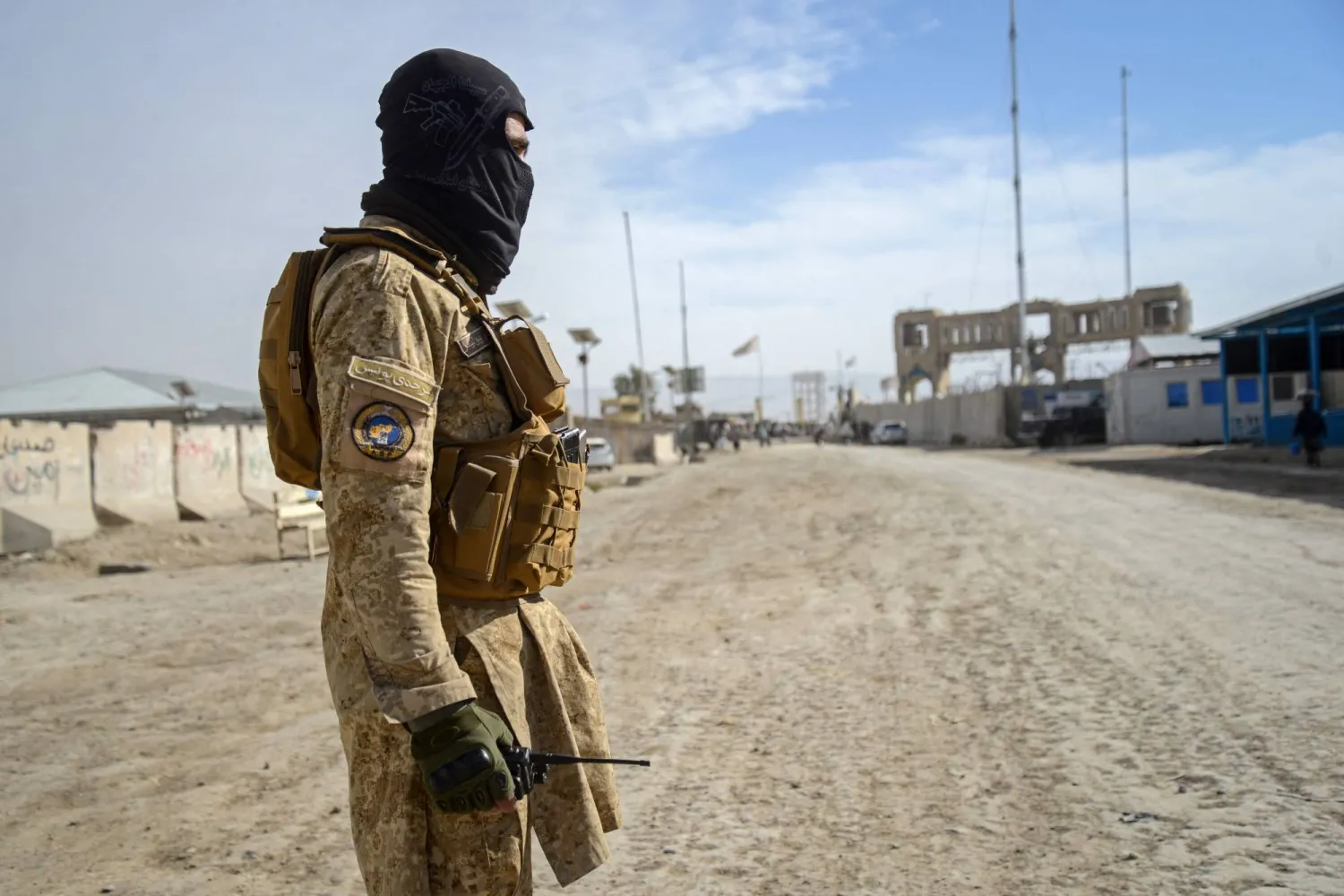
This photograph taken on December 29, 2025 shows a Taliban security personnel standing guard near the zero-point border crossing between Afghanistan and Pakistan at the Spin Boldak district of Kandahar province. (Photo by Sanaullah SEIAM / AFP)
TT

Stuck in Afghanistan, Pakistanis Want Border to Finally Reopen

This photograph taken on December 29, 2025 shows a Taliban security personnel standing guard near the zero-point border crossing between Afghanistan and Pakistan at the Spin Boldak district of Kandahar province. (Photo by Sanaullah SEIAM / AFP)

Nearly three months since border clashes prompted the closure of land crossings between Pakistan and Afghanistan, university students, merchants and families are left hanging with no way of getting back.

"We miss our parents and relatives," said Shah Faisal, 25, who studies medicine in an Afghan university and was hoping to visit his family back in Pakistan during winter break.

But the border has been shut since October 12, leaving many like him with no viable option of making it home, reported AFP.

Flights are prohibitively expensive, and smuggling routes come at too great a risk.

A student representative said there were around 500 to 600 Pakistanis at universities in one Afghan province alone, Nangarhar, who were looking for a way back.

Shah Fahad Amjad, 22, who attends medical school in the provincial capital Jalalabad, called on "both countries to open the road" and let students visit their families.

As the border closure drags on, some are also concerned about their visa status or financial situation.

The crisis has caused problems "for us, who are students in Afghanistan, but also for Afghans who are students in Pakistan", said 23-year-old Barkat Ullah Wazir, who studies in Jalalabad.

The colonial-era border between the South Asian neighbors stretches more than 2,600 kilometers (1,600 miles) across mountainous terrain.

Known as the Durand Line, it is normally a conduit between the Pakistanis and Afghans who live near it and share deep cultural, economic and even family ties.

It also divides Pashtun communities who live on either side -- the ethnic group from which the Taliban, which returned to power in Kabul in 2021, draws much of its support.

- 'We are displaced' -

The border has remained largely closed since the October clashes that killed more than 70 people, with the exception of Afghan refugees and migrants Pakistan has expelled.

Islamabad accused Kabul of harboring militant groups that launch attacks on Pakistani soil, allegations that the Afghan Taliban denies.

Mediation efforts have failed to produce a lasting agreement, and both sides have warned fighting could still resume.

Pakistani shopkeeper Ehsanullah Himmat, 21, had travelled to the southern Afghan city of Kandahar with his family to attend a relative's wedding, but "now we cannot go back to our home", he said.

"Fighting broke out, the road was closed," he told AFP, turning the planned two-day trip into a lengthy ordeal with no end in sight.

"We cannot go via smuggling routes, and other routes exist but they are very long and cost a lot of money" that the family cannot afford, he said.

Now "it is cold, it's winter, and we are displaced with our children", Himmat said.

Relatives in Afghanistan have hosted the family, but he said he felt a sense of "embarrassment" for overstaying their welcome.

- 'Standstill' -

Pakistan's foreign ministry said on Thursday that nearly 1,200 people had approached its embassy in Kabul requesting assistance to return home, including 549 students.

Just over 300 people had flown back by the end of December, according to the ministry.

Neither government has given any clear signal about when or under what conditions the border could reopen.

At the Spin Boldak crossing point, the road leading into Pakistan is blocked.

Truck driver Khan Muhammad, 39, has been there for weeks on end, unable to work or return to his city of Quetta, about 100 kilometers (62 miles) from the border.

"In these two-and-a-half months I haven't loaded even a single kilo of cargo. Work has come to a standstill," he said.

"All our livelihoods depend on this gate," he said, hoping the border would reopen soon.

When it does, "everyone will be able to return to their homes", he said.



Pakistan Warns That Afghanistan Is Becoming ‘Hub for Terrorists’ and Poses Regional Threat

This photograph taken on December 29, 2025 shows a Taliban security personnel standing guard near the zero-point border crossing between Afghanistan and Pakistan at the Spin Boldak district of Kandahar province. (AFP)
TT

Pakistan Warns That Afghanistan Is Becoming ‘Hub for Terrorists’ and Poses Regional Threat

This photograph taken on December 29, 2025 shows a Taliban security personnel standing guard near the zero-point border crossing between Afghanistan and Pakistan at the Spin Boldak district of Kandahar province. (AFP)

Pakistan’s military on Tuesday warned that Afghanistan is becoming a “hub for terrorists and non-state actors,” widening its allegations to assert that its Taliban government is patronizing al-Qaeda, the ISIS group and the Pakistani Taliban.

Military spokesman Lt. Gen. Ahmad Sharif Chaudhry also told a news conference, without offering evidence, that about 2,500 foreign militants recently entered Afghanistan from Syria following the ouster there of former President Bashar al-Assad. Chaudhry asserted that the militants were invited to Afghanistan.

“These terrorists are neither Pakistanis nor Afghan citizens and belong to other nationalities,” Chaudhry said, adding that the reemergence of international militant groups could pose security risks beyond neighboring Afghanistan’s borders.

There was no immediate comment from Kabul to Chaudhry's claim. Syria’s nearly 14-year civil war ended with Assad's ouster in December 2024, but left behind a patchwork of armed groups on all sides of the conflict, shaped by years of foreign intervention.

Fighters from Syria have since taken part in other wars in the region and beyond, including Turkish-backed combatants sent to Libya and militants recruited by Russia to fight in Ukraine. Foreign fighters have joined Syrian opposition factions, pro-government forces and extremist groups such as the ISIS group.

Chaudhry's remarks came a day after Pakistan and China called for more “visible and verifiable” measures to eliminate militant organizations operating from Afghan territory and to prevent it from being used for attacks against other countries.

Relations between Pakistan and Afghanistan have deteriorated in recent months, with tensions occasionally spilling into violence. In October, the countries came close to a wider conflict after Pakistan carried out airstrikes on what it described as Pakistani Taliban hideouts inside Afghanistan. Kabul retaliated by targeting Pakistani military posts. The fighting ended after Qatar brokered a ceasefire.

Pakistan has long accused Afghanistan and India of backing the Pakistani Taliban, known as Tehrik-e-Taliban Pakistan, and the outlawed Baloch National Army. Both Kabul and New Delhi deny the allegations.

Chaudhry also said Pakistan killed 2,597 militants in 2025, up from 1,053 a year earlier. The country recorded 5,397 militant attacks, up from 3,014 in 2024.

“Yes, this is a big number,” he said of the 2025 attacks. “Why? Because we are engaging them everywhere.” He added that Afghan nationals were involved in almost all major attacks inside Pakistan last year.


Danish Prime Minister Says a US Takeover of Greenland Would Mark the End of NATO

File photo: Denmark's Prime Minister Mette Frederiksen speaks to the media after a meeting of the so-called "coalition of the willing" in London, Friday, October 24, 2025. Kirsty Wigglesworth, AP
TT

Danish Prime Minister Says a US Takeover of Greenland Would Mark the End of NATO

File photo: Denmark's Prime Minister Mette Frederiksen speaks to the media after a meeting of the so-called "coalition of the willing" in London, Friday, October 24, 2025. Kirsty Wigglesworth, AP

Danish Prime Minister Mette Frederiksen said Monday an American takeover of Greenland would amount to the end of the NATO military alliance. Her comments came in response to US President Donald Trump's renewed call for the strategic, mineral-rich Arctic island to come under US control in the aftermath of the weekend military operation in Venezuela.

The dead-of-night operation by US forces in Caracas to capture leader Nicolás Maduro and his wife early Saturday left the world stunned, and heightened concerns in Denmark and Greenland, which is a semiautonomous territory of the Danish kingdom and thus part of NATO, The Associated Press said.

Frederiksen and her Greenlandic counterpart, Jens Frederik Nielsen, blasted the president's comments and warned of catastrophic consequences. Numerous European leaders expressed solidarity with them.

“If the United States chooses to attack another NATO country militarily, then everything stops,” Frederiksen told Danish broadcaster TV2 on Monday. “That is, including our NATO and thus the security that has been provided since the end of the Second World War.”

20-day timeline deepens fears Trump called repeatedly during his presidential transition and the early months of his second term for US jurisdiction over Greenland, and has not ruled out military force to take control of the island. His comments Sunday, including telling reporters “let’s talk about Greenland in 20 days,” further deepened fears that the US was planning an intervention in Greenland in the near future.

Frederiksen also said Trump “should be taken seriously” when he says he wants Greenland. “We will not accept a situation where we and Greenland are threatened in this way,” she added.

Nielsen, in a news conference Monday, said Greenland cannot be compared to Venezuela. He urged his constituents to stay calm and united.

“We are not in a situation where we think that there might be a takeover of the country overnight and that is why we are insisting that we want good cooperation,” he said.

Nielsen added: “The situation is not such that the United States can simply conquer Greenland.”

Ask Rostrup, a TV2 political journalist, wrote on the station's live blog Monday that Mette previously would have flatly rejected the idea of an American takeover of Greenland. But now, Rostrup wrote, the rhetoric has escalated so much that she has to acknowledge the possibility.

Trump slams Denmark's security efforts in Greenland

Trump on Sunday also mocked Denmark’s efforts at boosting Greenland’s national security posture, saying the Danes have added “one more dog sled” to the Arctic territory’s arsenal.

“It’s so strategic right now,” Trump had told reporters Sunday as he flew back to Washington from his home in Florida. “Greenland is covered with Russian and Chinese ships all over the place.”

He added: “We need Greenland from the standpoint of national security, and Denmark is not going to be able to do it."

But Ulrik Pram Gad, a global security expert from the Danish Institute for International Studies, wrote in a report last year that “there are indeed Russian and Chinese ships in the Arctic, but these vessels are too far away to see from Greenland with or without binoculars.”

US space base in northwestern Greenland

Greenlanders and Danes were further rankled this weekend by a social media post following the raid by a former Trump administration official turned podcaster, Katie Miller. The post shows an illustrated map of Greenland in the colors of the Stars and Stripes accompanied by the caption: “SOON.”

“And yes, we expect full respect for the territorial integrity of the Kingdom of Denmark,” Ambassador Jesper Møller Sørensen, Denmark’s chief envoy to Washington, said in a post responding to Miller, who is married to Trump’s influential deputy chief of staff Stephen Miller.

The US Department of Defense operates the remote Pituffik Space Base in northwestern Greenland. It was built following a 1951 defense agreement between Denmark and the United States. It supports missile warning, missile defense and space surveillance operations for the US and NATO.

On Denmark’s mainland, the partnership between the US and Denmark has been long-lasting. The Danes buy American F-35 fighter jets and just last year, Denmark’s parliament approved a bill to allow US military bases on Danish soil.

Critics say the vote ceded Danish sovereignty to the US

The legislation widens a previous military agreement, made in 2023 with the Biden administration, where US troops had broad access to Danish air bases in the Scandinavian country.


Gas Explosion Kills One in Western Russian City

Representation photo: Firefighters work at the site of car garages hit by a Russian missile strike, amid Russia's attack on Ukraine, in Chernihiv, Ukraine, January 5, 2026. REUTERS/Maksym Kishka
TT

Gas Explosion Kills One in Western Russian City

Representation photo: Firefighters work at the site of car garages hit by a Russian missile strike, amid Russia's attack on Ukraine, in Chernihiv, Ukraine, January 5, 2026. REUTERS/Maksym Kishka

A gas explosion in an apartment block in Russia's western city of Tver killed one person early Tuesday, regional authorities said, after earlier blaming a Ukrainian drone attack.

"The preliminary conclusion of experts is that the cause was a household gas explosion," Tver regional governor Vitaly Korolev said on Telegram.

"Initially, it was mistaken as the result of falling drone debris, since measures to repel an attack were indeed being taken in the region at that time," he added.

Household fires and gas incidents are not uncommon across Russia.

Moscow's defense ministry said Ukrainian drones were downed overnight in some 20 different regions, including six over Tver.

Last month, Ukrainian drone debris triggered a fire in an apartment block in Tver, a city some 180 kilometers (110 miles) from Moscow, wounding seven people.