Israeli Forces Kill Three Palestinians in Gaza, Local Authorities Say

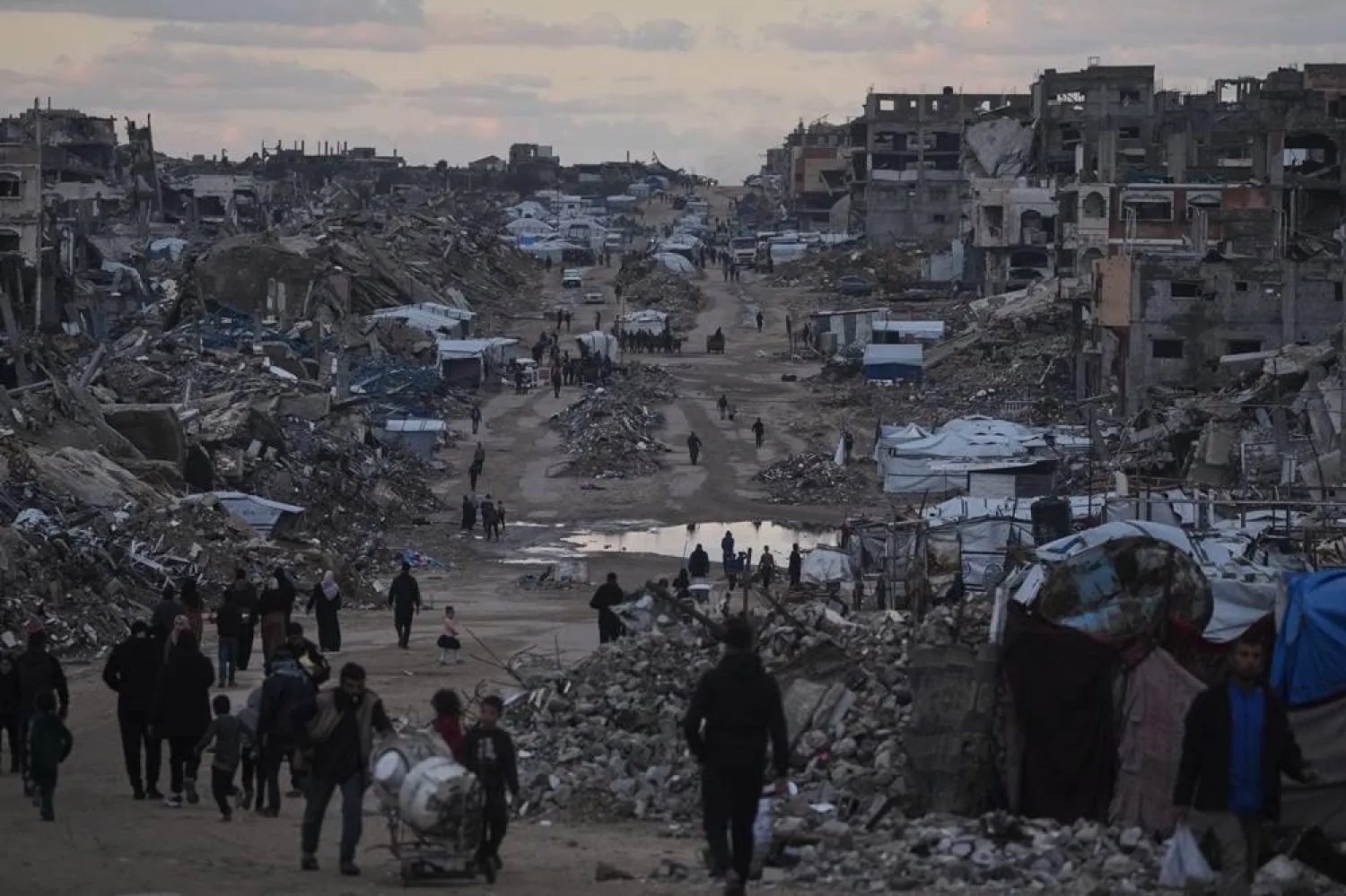
 Palestinians walk past destroyed buildings in the northern Gaza Strip, Friday, Jan. 2, 2026. (AP)
Palestinians walk past destroyed buildings in the northern Gaza Strip, Friday, Jan. 2, 2026. (AP)
TT

Israeli Forces Kill Three Palestinians in Gaza, Local Authorities Say

 Palestinians walk past destroyed buildings in the northern Gaza Strip, Friday, Jan. 2, 2026. (AP)
Palestinians walk past destroyed buildings in the northern Gaza Strip, Friday, Jan. 2, 2026. (AP)

Israeli forces shot and killed at least three Palestinians in separate incidents in the southern Gaza Strip city of Khan Younis on Sunday, local health authorities said.

Medics reported that the dead included a 15-year-old boy, a fisherman killed outside areas still occupied by Israel in the enclave, and a third man who was shot and killed east ‌of the city in ‌areas under Israeli ‌control.

The ⁠Israeli military ‌had no immediate comment on the reported incidents.

Israel has carried out repeated air strikes since a ceasefire took effect in October, saying they are aimed at preventing attacks or destroying militant infrastructure.

Gaza’s health ministry says 420 ⁠Palestinians have been killed since the ceasefire began, while ‌fighters have killed three Israeli soldiers.

Israel ‍and Hamas have ‍traded blame for violations of the ceasefire ‍agreement brokered under US President Donald Trump.

Israel retained control of 53% of Gaza under the first phase of Trump's plan, which involved the release of hostages held by gunmen in Gaza and of Palestinians detained ⁠by Israel.

The final hostage remains to be handed over are those of an Israeli police officer killed on October 7, 2023 - the day Gazan fighters invaded Israel, killing 1,200 and taking some 250 hostages, according to Israeli tallies.

Israel's military assault on Gaza has killed more than 71,000 Palestinians, according to the Gaza health ministry, and led ‌to accusations of genocide and war crimes that Israel denies.


Egypt Eyes Role for Its Companies in Angola’s Lobito Development Corridor

The Egyptian president during his meeting with his Angolan counterpart in Guinea last July (Egyptian Presidency).
TT

Egypt Eyes Role for Its Companies in Angola’s Lobito Development Corridor

The Egyptian president during his meeting with his Angolan counterpart in Guinea last July (Egyptian Presidency).

Cairo is seeking a role for Egyptian companies in projects to be implemented under Angola’s Lobito Development Corridor, while also coordinating to convene the next edition of the Egyptian–Angolan Business Forum at the earliest opportunity.

The move came during a phone call on Saturday between Egypt’s Minister of Foreign Affairs, Badr Abdelatty, and his Angolan counterpart, Tete António, in which the two ministers discussed ways to support and strengthen bilateral relations and coordinate positions on issues of mutual interest.

Abdelatty praised the “growing momentum in Egyptian–Angolan relations and the shared commitment to enhancing political understanding and consultation to push these ties to broader horizons.”

He stressed the importance of building on the outcomes of the Joint Committee meeting held in Angola last December, in a way that advances bilateral relations across political, economic, and investment fields. He also reiterated Egypt’s interest in cooperation in regional connectivity and transport, infrastructure, renewable energy, and the pharmaceutical industry.

The Egyptian foreign minister visited Angola’s capital, Luanda, last December, where he inaugurated the Egyptian–Angolan Business Forum on the sidelines of the first session of the Joint Committee between the two countries.

At the time, he said the forum reflected the strength of relations between Egypt and Angola and the shared political will of both leaderships to elevate economic cooperation into a cornerstone of the bilateral partnership. He underscored the need to boost trade volumes and mutual investments and to capitalize on available potential and opportunities.

Trade between Egypt and Angola rose in 2024 to $34.2 million, up from $21.3 million in 2023, according to figures released by Egypt’s Central Agency for Public Mobilization and Statistics (CAPMAS) in April 2025.

CAPMAS said in a report that Egyptian exports to Angola reached $34.1 million in 2024, compared with $21.3 million in 2023, while Egyptian imports from Angola amounted to $73,000 in 2024, up from $21,000 a year earlier.

Dr. Naglaa Marei, professor of political science and an expert on African affairs, stressed the importance of coordination between Egypt and Angola ahead of the upcoming African Union Summit, noting that the continent faces multiple challenges.

These include instability in the Horn of Africa and the Red Sea region against the backdrop of the Sudanese crisis, tensions between Ethiopia and Eritrea over access to the Red Sea, and the renewed violence and conflict in Ethiopia’s Tigray region.

Speaking to Asharq Al-Awsat, Marei said Egyptian–Angolan relations have recently seen numerous official visits and bilateral meetings, as well as the convening of the Joint Committee last December — developments that have contributed to advancing political, economic, and investment cooperation between the two countries.


Israel to Terminate MSF Work in Gaza for Failing to Provide Palestinian Staff List

A young boy sits overlooking destroyed buildings at Nuseirat camp for Palestinian refugees in the central Gaza Strip on January 31, 2026. (AFP)
TT

Israel to Terminate MSF Work in Gaza for Failing to Provide Palestinian Staff List

A young boy sits overlooking destroyed buildings at Nuseirat camp for Palestinian refugees in the central Gaza Strip on January 31, 2026. (AFP)

Israel said Sunday it was terminating the humanitarian operations of the international charity Doctors Without Borders in Gaza after the organization failed to provide a list of its Palestinian staff.

"The Ministry of Diaspora Affairs and Combating Antisemitism is moving to terminate the activities of Medecins Sans Frontieres (MSF) in the Gaza Strip," the ministry said.

The decision follows "MSF's failure to submit lists of local employees, a requirement applicable to all humanitarian organizations operating in the region", it added, stating that the group will cease its work and leave Gaza by February 28.

In December, the ministry announced it would prevent 37 aid organizations, including MSF, from operating in Gaza from March 1 for failing to provide detailed information about their Palestinian staff.

It had alleged that two MSF employees had links with Palestinian armed groups Hamas and Islamic Jihad, which the medical charity vehemently denies.

On Sunday, the ministry said MSF had committed in early January that it would share the staff list as required by the Israeli authorities.

"Despite its public commitment, the organization refrained from transferring the lists," the ministry said.

"Subsequently, MSF announced it does not intend to proceed with the registration process at all, contradicting its previous statements and the binding protocol.

"In accordance with the regulations, MSF will cease its operations and depart the Gaza Strip by February 28, 2026," the ministry added.

In a statement posted on its website on Friday, MSF acknowledged that it had, as an "exceptional measure", agreed to share a list of names of its Palestinian and international staff with the Israeli authorities.

"However, despite repeated efforts, it became evident that we were unable to build engagement with Israeli authorities on the concrete assurances required," the charity said.

"These included that any staff information would be used only for its stated administrative purpose and would not be colleagues at risk."

MSF said it had not received assurances on these fronts, so "concluded that we will not share staff information in the current circumstances".


How the United Nations’ Relationship with the Houthis Reached a Dead End

The Houthis claim that humanitarian workers are spying on them. (Reuters file)
TT

How the United Nations’ Relationship with the Houthis Reached a Dead End

The Houthis claim that humanitarian workers are spying on them. (Reuters file)

After more than a year of suspending most of its humanitarian activities in areas controlled by the Houthi movement, amid the arrest of dozens of local staff and the seizure of assets and property, the United Nations has declared that its relationship with the group has reached a dead end. The development raises serious concerns about the humanitarian consequences for millions of Yemenis who rely on food assistance.

Reflecting the depth of the crisis, the World Food Program has decided to halt its operations entirely in Houthi-held Sanaa and dismiss all its staff, after exhausting efforts to end repeated violations against humanitarian workers and to secure minimum conditions for safe operations.

Sources working with the United Nations and the aid sector told Asharq Al-Awsat that the decision to end the program’s presence in Houthi-controlled areas was driven by systematic practices aimed at undermining the independence of humanitarian work. These included direct interference in operations, tight restrictions on staff movement, the seizure of offices and warehouses, and repeated attempts to impose beneficiaries based on political and security considerations.

The program had suspended its activities in those areas several times over recent years in protest against Houthi interference in food aid distribution and attempts to divert assistance away from its humanitarian purpose.

Despite this, it maintained limited operations through local partners to deliver emergency aid to the most vulnerable, particularly during natural disasters and floods that struck several governorates over the past two years. This continued until security and administrative conditions deteriorated to unprecedented levels.

Arrests and asset seizures

Despite the flexibility shown by the United Nations in dealing with restrictions and its efforts to overcome violations of the rules governing UN missions, the Houthis responded with escalating measures.

These included raids on the offices of several UN agencies, including the World Food Program, the arrest of dozens of local employees, accusations that they were spying for the United States and Israel, and the seizure of assets and property belonging to UN agencies and other organizations.

According to the sources, the program continued for more than a year to pay salaries to its staff, including those detained or barred from work after Houthi intelligence services took control of UN premises.

It also maintained paying rent on buildings, while engaging in difficult negotiations aimed at securing the release of detained staff, ending the takeover of offices, and recovering confiscated assets.

Aid organizations later concluded that they had delayed too long in deciding to end their presence, citing what they described as deliberate stalling during negotiations.

While one wing overseeing what is referred to as the Houthi foreign ministry showed some understanding of UN demands and proposed solutions, another wing led by intelligence agencies pushed for further escalation.

Escalation without end

During negotiations led by the UN coordinator for Yemen over the past year, the Houthis proposed presenting what they claimed were “evidence” to support espionage charges against local staff. They later suggested trying the detainees and issuing a general amnesty after convictions.

The United Nations rejected claims, insisting on the unconditional release of all detained staff — around 73 people — as well as others held from international and local organizations and diplomatic missions.

The talks coincided with further Houthi escalatory steps, including raids on additional humanitarian offices, new arrests of local staff, and the referral of dozens to a specialized court for terrorism and state security cases. This deepened mistrust and closed off any prospects for compromise.

With around 12 million people living in Houthi-controlled areas, the UN has warned that these measures, most recently the raid on the offices of six UN agencies in Sanaa and the seizure of their assets, will lead to an unprecedented deterioration of the humanitarian situation, in the absence of acceptable arrangements to ensure aid reaches those in need.

The UN Security Council adopted resolutions in 2025 and this year calling on the Houthis to provide a safe working environment and to immediately and unconditionally release all detained staff from the United Nations, non-governmental organizations, and diplomatic missions.

The militants have ignored the calls and demanded a review of the UN presence agreement in Yemen, which dates back to the 1960s.