

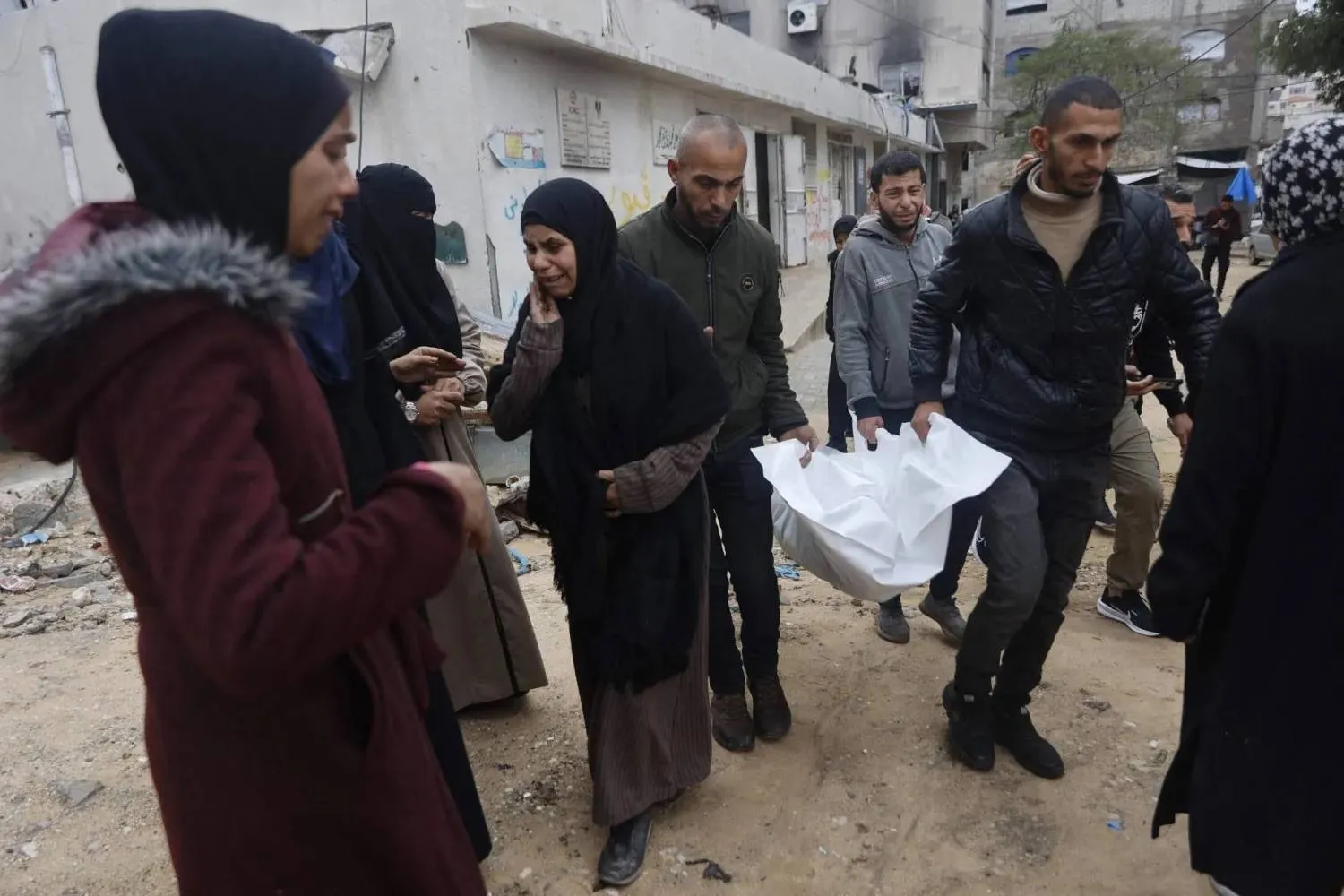

First Direct Clashes Erupt Between Hamas, Armed Gangs in Gaza

 Palestinians carry the remains of a victim of a fire that broke out in displacement tents in Gaza City (AFP). 
 Palestinians carry the remains of a victim of a fire that broke out in displacement tents in Gaza City (AFP). 
TT

First Direct Clashes Erupt Between Hamas, Armed Gangs in Gaza

 Palestinians carry the remains of a victim of a fire that broke out in displacement tents in Gaza City (AFP). 
 Palestinians carry the remains of a victim of a fire that broke out in displacement tents in Gaza City (AFP). 

The al-Tuffah neighborhood, east of Gaza City, witnessed on Sunday morning the first direct, face-to-face clashes between fighters from Hamas and members of an armed gang operating in the area, marking a new and dangerous escalation in Gaza’s internal security landscape.

Field sources said the clashes involved a group led by Palestinian Rami Halas, which calls itself the “Popular Defense Forces.” The group is reportedly active in areas under Israel’s control and has stepped up attacks against Palestinians over the past 10 days, killing at least two people and wounding several others.

According to the sources, members of the Halas gang advanced toward al-Sanafour junction in al-Tuffah, an area west of the so-called “Yellow Line,” designated as an initial withdrawal line under the Gaza ceasefire agreement.

As the gunmen entered residential neighborhoods, they were met with immediate gunfire from Hamas fighters and members of other armed factions. The exchange of fire lasted more than 20 minutes before the gang withdrew toward the Yellow Line, which remains under Israeli control.

The clashes coincided with the presence of Israeli surveillance drones overhead. Sources said that shortly after the fighting subsided, the drones carried out strikes on homes in al-Tuffah and surrounding areas. This was followed by the use of booby-trapped vehicles loaded with tons of explosives, detonated in stages to destroy what remained of houses in those zones.

The sources also revised earlier accounts of a killing on Saturday at the main junction in al-Shuja’iyya, east of Gaza City. A Palestinian initially believed to have been shot by Israeli forces was, in fact, killed by gunmen from the same armed gang, they said. He was at least the second person killed by the group in the area within roughly 10 days.

In recent weeks, the Halas gang has intensified its attacks in eastern Gaza City, allegedly operating under Israeli cover. About two weeks ago, it forced residents of a residential block in al-Tuffah to evacuate their homes.

Armed gangs in Gaza have become more active and increasingly sophisticated, carrying out assassinations — such as the killing of Internal Security officer Ahmed Zamzam —and opening fire on civilians in areas west of the Yellow Line. Sunday’s incident marked the first direct clash between such gangs and established armed factions.

Meanwhile, Hamas has expanded executions and crackdowns against armed gangs and individuals accused of collaborating with Israel since the ceasefire took effect on Oct. 10. Hamas sources said several alleged collaborators linked to the assassinations of senior leaders, including former Qassam Brigades commander Mohammed Deif, have been executed, while others have been arrested and remain under investigation.

Separately, Israeli fire killed three Palestinians in Khan Younis on Sunday, including a 15-year-old boy and a young man, while a fisherman was shot dead off the city’s coast. Since the ceasefire, more than 423 Palestinians have been killed in what are described as Israeli violations across Gaza.


Presidential Adviser to Asharq Al-Awsat: Security Stable in Yemen’s Aden

Presidential Leadership Council member Abdul Rahman Al-Mahrami Abou Zaraa during a previous meeting with the Hadhramaut governor, attended by adviser Jaber Mohammed. (Photo courtesy of Abu Zaraa’s office)
TT

Presidential Adviser to Asharq Al-Awsat: Security Stable in Yemen’s Aden

Presidential Leadership Council member Abdul Rahman Al-Mahrami Abou Zaraa during a previous meeting with the Hadhramaut governor, attended by adviser Jaber Mohammed. (Photo courtesy of Abu Zaraa’s office)

Security in Yemen’s interim capital, Aden, was stable on Wednesday, a senior official said, after security forces moved swiftly to deploy across the city and secure key government institutions.

Jaber Mohammed, a presidential adviser and director of the office of Presidential Leadership Council member Abdul Rahman Al-Mahrami, also known as Abou Zaraa, told Asharq Al-Awsat that the security plan had been implemented within hours.

Since the early morning, brigades of the Giants Forces have deployed across Aden’s main streets, securing vital government institutions. “The security situation is calm and stable,” Mohammed said.

Meanwhile, Mohammed al-Ghaithi, a member of the Southern Transitional Council delegation that arrived in Riyadh, said the atmosphere was positive and that preparations were underway to launch a series of meetings related to intra-Southern dialogue.

In a post on X, he stated that he arrived with colleagues from Aden in Riyadh.

“In a positive atmosphere, we will begin a series of meetings to prepare for intra-southern dialogue under the sponsorship of our brothers in the Kingdom of Saudi Arabia,” he added.

Earlier, Presidential Leadership Council member Abdullah al-Alimi said that developments in the south represented a restoration of the state's authority, its institutions, legitimacy, and reference frameworks.

Al-Alimi said this was aimed at preserving stability and public calm, and clarifying the truth, free from the logic of conflicts and illusory victories.

The Presidential Leadership Council had decided to revoke the membership of Aidarous al-Zubaidi and refer him to the public prosecutor over accusations including high treason, undermining Yemen’s political and economic standing, obstructing state efforts to confront the coup, and fueling internal strife.

In another post on X, al-Alimi stated that the responsibility for maintaining security and stability rested with state institutions, local authorities, and all loyal citizens, in a manner that ensured the rule of law and protected civilians.

“What is happening today in the southern governorates after the rebellion of Aidrous al-Zubaidi, despite all the sincere efforts made by our brothers in the Kingdom of Saudi Arabia and the Presidential Leadership Council to prevent reaching this stage, is not what we had hoped for, and we are not happy with what has happened,” he said.

The Saudi-led coalition backing Yemen’s legitimate government later announced new details surrounding the movements of al-Zubaidi, following military escalation by forces affiliated with the council in Hadhramaut and Al-Mahra.

Coalition spokesman Major General Turki al-Maliki stated that the coalition had informed al-Zubaidi on January 4 to travel to Saudi Arabia within 48 hours to meet with Presidential Leadership Council Chairman Rashad al-Alimi and coalition leaders to discuss the reasons behind the recent military escalation.

He said arrangements had been made for al-Zubaidi to travel on a Yemenia Airways flight, but the flight was delayed for several hours before being canceled, followed by heightened tensions and the appearance of gunmen and military vehicles near civilian facilities around the airport.

Al-Maliki added that forces affiliated with the Southern Transitional Council then moved to impose measures in Aden, including a military deployment, obstruction of movement inside the airport, the closure of some roads, and armed deployments across the city, which the coalition described as an “unjustified escalation” that threatened security and stability.


Cairo to Host Hamas Delegation Next Week to Advance Gaza Ceasefire Deal

Palestinians walk through the ruins of destroyed buildings in Gaza City, Sunday, Jan. 4, 2026. (AP)
TT

Cairo to Host Hamas Delegation Next Week to Advance Gaza Ceasefire Deal

Palestinians walk through the ruins of destroyed buildings in Gaza City, Sunday, Jan. 4, 2026. (AP)

A Palestinian source told Asharq Al-Awsat on Tuesday that Cairo will host a delegation from Hamas next week for talks aimed at advancing a ceasefire agreement in Gaza.

The source, who is close to Hamas, said the visit is expected to focus on the provisions of the second phase of the ceasefire deal, most notably finalizing the names of a technocratic committee to administer Gaza, in an effort to move forward with implementation of the agreement.

The talks will be led by senior Hamas figure and chief negotiator Khalil al-Hayya, though no exact date for the meeting has been announced.

Two Palestinian sources close to Fatah also stressed the importance of Egypt’s role in shaping arrangements for the second phase of the deal, particularly in the face of obstacles posed by Israeli Prime Minister Benjamin Netanyahu.

On Tuesday, Netanyahu said the Rafah border crossing would not be reopened until the return of the last remaining body.

Israel’s public broadcaster reported that the Israeli premier is insisting the crossing between Gaza and Egypt remain closed until the body of the final Israeli captive held in the enclave, Ran Gvili, is returned.

He was quoted as saying that agreements with the US administration underpin this position.

The move marks a reversal from earlier expectations that the crossing would reopen at the start of the first phase of the Gaza agreement on Oct. 10.

It follows a report published Sunday by the Israeli daily Haaretz, which cited informed sources as saying the Rafah crossing was set to reopen soon in both directions, with European forces playing a main role in running it.

Those forces had already arrived in Israel and were ready to deploy in the area, it revealed.


Report: Iran’s Foreign Minister to Visit Lebanon on Thursday

16 March 2018, Austria, Vienna: Abbas Araqchi, then Deputy Foreign Minister of Iran, gives an interview in Vienna. (dpa)
TT

Report: Iran’s Foreign Minister to Visit Lebanon on Thursday

16 March 2018, Austria, Vienna: Abbas Araqchi, then Deputy Foreign Minister of Iran, gives an interview in Vienna. (dpa)

Iran's Foreign Minister Abbas Araqchi told the Mehr news ​agency he will visit Lebanon on Thursday with an economic delegation.

A US-backed ceasefire agreed in November 2024 ended more than ‌a year ‌of ‌fighting ⁠between ​Israel ‌and Lebanon's Hezbollah, but it also required the disarmament of the Iran-aligned group.

Lebanon has sought to distance itself ⁠from Iran, with its Foreign ‌Minister Youssef Raji ‍last ‍month declining an ‍invitation to visit Tehran citing "current conditions" as not permitting the visit, and he instead ​invited Araqchi to visit Beirut for talks.
