


'That's Enough Now!' Greenland PM Says After Latest Trump Threat

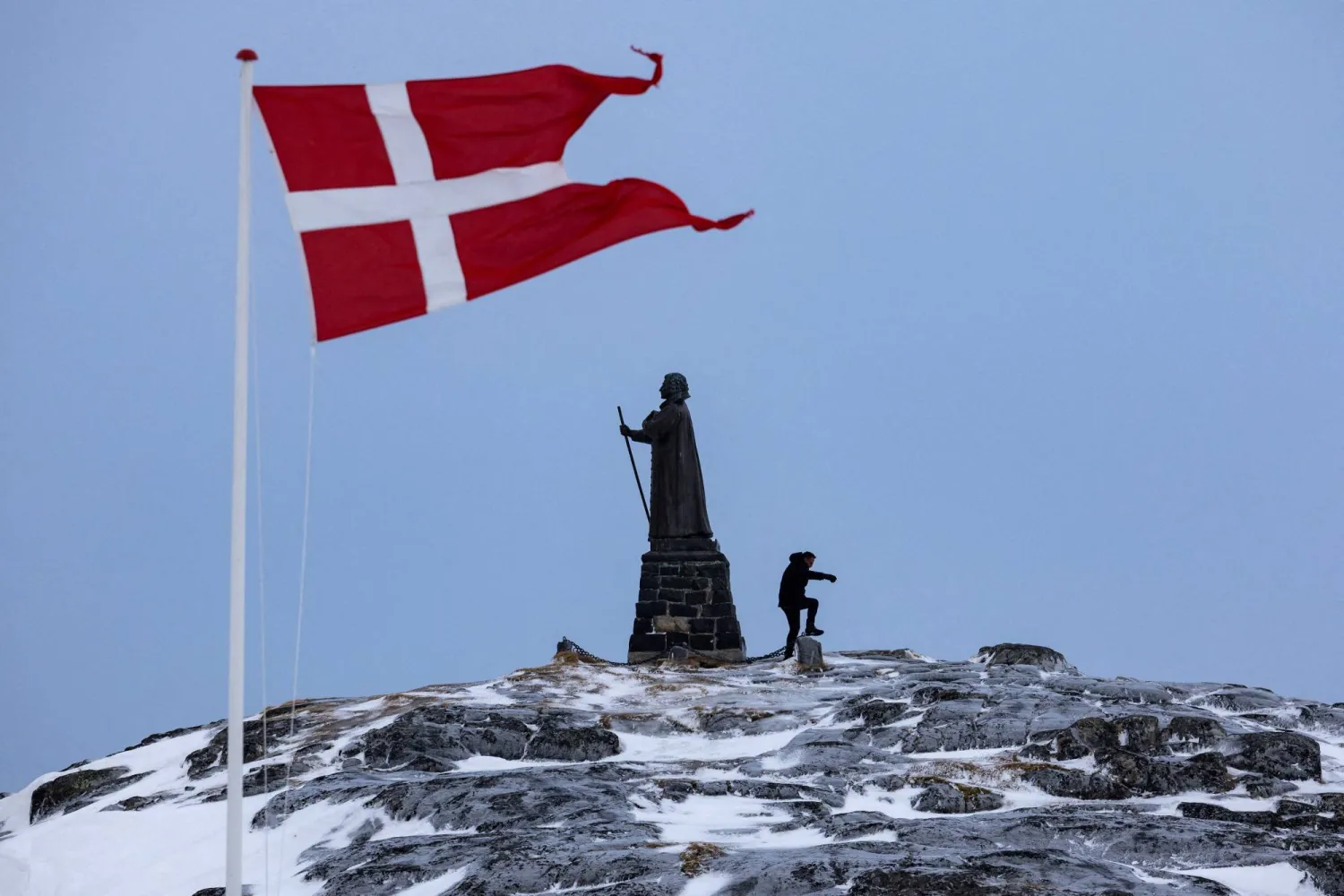
FILE PHOTO: A man walks as Danish flag flutters next to Hans Egede Statue ahead of a March 11 general election in Nuuk, Greenland, March 9, 2025. REUTERS/Marko Djurica/File Photo
TT

'That's Enough Now!' Greenland PM Says After Latest Trump Threat

FILE PHOTO: A man walks as Danish flag flutters next to Hans Egede Statue ahead of a March 11 general election in Nuuk, Greenland, March 9, 2025. REUTERS/Marko Djurica/File Photo

"That's enough now," Greenland's Prime Minister Jens Frederik Nielsen said after repeated threats from US President Donald Trump to annex the autonomous Danish territory.

"No more pressure. No more insinuations. No more fantasies of annexation. We are open to dialogue. We are open to discussions. But this must happen through the proper channels and with respect for international law," the head of Greenland's government wrote on Facebook late Sunday.

President Donald Trump doubled down Sunday on his claim that Greenland should become part of the United States, despite calls by Denmark's prime minister to stop "threatening" the territory.

Washington's military intervention in Venezuela has reignited fears for Greenland, which Trump has repeatedly said he wants to annex, given its strategic location in the Arctic.

While aboard Air Force One en route to Washington, Trump reiterated the goal.

"We need Greenland from the standpoint of national security, and Denmark is not going to be able to do it," he said in response to a reporter's question.

"We'll worry about Greenland in about two months... let's talk about Greenland in 20 days."

Over the weekend, the Danish prime minister called on Washington to stop "threatening its historical ally".

"I have to say this very clearly to the United States: it is absolutely absurd to say that the United States should take control of Greenland," Prime Minister Mette Frederiksen said in a statement.

She also noted that Denmark, "and thus Greenland", was a NATO member protected by the agreement's security guarantees.



Zelenskiy Seeks New Trump Meeting as Peace Negotiators Tackle Land Issue

 Ukraine's President Volodymyr Zelenskiy arrives for a meeting with his Cypriot counterpart Nikos Christodoulides at the presidential palace in Nicosia, , Cyprus, Wednesday, Jan. 7, 2026. (Petros Karadjias/Pool via Reuters)
Ukraine's President Volodymyr Zelenskiy arrives for a meeting with his Cypriot counterpart Nikos Christodoulides at the presidential palace in Nicosia, , Cyprus, Wednesday, Jan. 7, 2026. (Petros Karadjias/Pool via Reuters)
TT

Zelenskiy Seeks New Trump Meeting as Peace Negotiators Tackle Land Issue

 Ukraine's President Volodymyr Zelenskiy arrives for a meeting with his Cypriot counterpart Nikos Christodoulides at the presidential palace in Nicosia, , Cyprus, Wednesday, Jan. 7, 2026. (Petros Karadjias/Pool via Reuters)
Ukraine's President Volodymyr Zelenskiy arrives for a meeting with his Cypriot counterpart Nikos Christodoulides at the presidential palace in Nicosia, , Cyprus, Wednesday, Jan. 7, 2026. (Petros Karadjias/Pool via Reuters)

Ukraine's President Volodymyr Zelenskiy is seeking a new meeting with US President Donald Trump as their officials revisited the two most problematic issues in peace talks aimed at ending Russia's war in Ukraine.

Kyiv is under US pressure to secure peace quickly but wants security guarantees from allies and is pushing back on Russian demands to cede its eastern Donetsk region and give up control of the Zaporizhzhia nuclear power plant.

Speaking to reporters over WhatsApp on Wednesday, Zelenskiy said he wanted to meet Trump again soon to gauge his openness to a Ukrainian proposal that Washington provide security guarantees for more than 15 years in the event of ‌a ceasefire.

He ‌also urged Trump to step up pressure on Russia, which ‌has been ⁠cool on ‌the US-backed peace push and is continuing its massive air attacks on Ukrainian cities and the country's energy grid.

"The Americans, in my view, are being productive right now; we have good results... They need to put pressure on Russia. They have the tools, and they know how to use them," Zelenskiy said.

The White House did not immediately respond to a request for comment on the suggestion of a new meeting between Zelenskiy and Trump.

Citing the US operation to seize Venezuelan leader Nicolas Maduro, Zelenskiy suggested ⁠Washington could similarly move against Chechen leader Ramzan Kadyrov, a Vladimir Putin ally whose troops became known for their brutality in ‌Ukraine.

"Maybe then Putin would see it and think twice," he ‍said.

Talks in Paris this week produced ‍commitments from Kyiv's allies to back up a ceasefire with guarantees such as a multinational troop ‍presence.

But Zelenskiy said the expression of "political will" had yet to be translated into legally binding pledges backed by national parliaments.

MAJOR STUMBLING BLOCKS

Zelenskiy spoke as US and Ukrainian officials in Paris discussed the matter of territory and the fate of the Zaporizhzhia plant , Europe's largest nuclear facility, which he described as the two thorniest issues in the talks.

Kyiv has refused to pull out of the industrialized Donetsk region, which Russia has failed to seize entirely despite occupying wide swathes of it.

⁠Zelenskiy has said the US has floated the idea of a free economic zone there if Ukraine withdraws from the parts of the region that it still controls.

On Tuesday, US and Ukrainian officials had already talked through "some ideas" to address the issue of territory. White House special envoy Steve Witkoff said "land options" had been discussed and that he hoped for compromise to be reached.

Any compromises on land should be put to a referendum for Ukrainians, Zelenskiy has previously said. According to an opinion poll last month, around three-quarters of Ukrainians are prepared for a deal that would freeze the current front line, but oppose ceding territory.

The US has also proposed trilateral operation of the Zaporizhzhia plant, which Moscow captured in 2022 and connected to its own power grid, with an American chief manager, ‌Zelenskiy said last month.

Kyiv has instead proposed joint Ukrainian-American use of the plant, according to Zelenskiy, with the US itself determining how to use 50% of the energy produced.


US Needs to Control Venezuelan Oil Sales, Revenue to Drive Change, Says Energy Secretary

The city of Caracas, days after the US launched a strike on Venezuela and captured President Nicolas Maduro and his wife Cilia Flores, Venezuela January 7, 2026. (Reuters)
TT

US Needs to Control Venezuelan Oil Sales, Revenue to Drive Change, Says Energy Secretary

The city of Caracas, days after the US launched a strike on Venezuela and captured President Nicolas Maduro and his wife Cilia Flores, Venezuela January 7, 2026. (Reuters)

The United States needs to control Venezuela's oil sales and revenue to drive the changes it wants to see in the country, Energy Secretary Chris Wright said on Wednesday.

Wright said he was speaking to US oil companies to learn what conditions would enable them to enter the South American country and added that he wanted to sell Venezuelan oil to US refineries.

Over the weekend, President Donald Trump said the US would "take control" of Venezuela after US forces ousted Venezuelan President Nicolas Maduro, a step that could give US energy companies access to the country's vast oil reserves.

"Instead ‌of the oil ‌being blockaded as it is right now, we're ‌going ⁠to let the ‌oil flow," Wright said, adding that the government would sell it to buyers in the US and around the world.

The US would sell the production coming out of Venezuela indefinitely, he said. The sales would be controlled by the US government, Wright added, with revenues collected from them "deposited into accounts controlled by the US government."

On Tuesday, Caracas and Washington reached a deal to export up ⁠to $2 billion worth of Venezuelan crude to the United States, under which Venezuela will be "turning over" between ‌30 and 50 million barrels of "sanctioned oil" to ‍the US.

"If we control the ‍flow of oil, the sales of that oil, and the flow of ‍the cash that comes from those sales, we have large leverage. But without large leverage...you don't get change."

Wright was speaking at the Goldman Sachs Energy, CleanTech & Utilities Conference in Miami.

Shares of US refiners Marathon Petroleum, Phillips 66 and Valero Energy were up between 2.5% and 5%.

Raising crude output from Venezuela is a top objective for Trump. Venezuela was producing as much as 3.5 million ⁠barrels per day (bpd) in the 1970s. But mismanagement and limited foreign investment led to a huge drop in annual production, which averaged about 1.1 million bpd last year.

"We could get several hundred thousand barrels a day of additional production in the short to medium term if the conditions are there for just small capital deployments," Wright said.

The South American country sits atop the world's largest oil reserves but accounts only for about 1% of global supply.

US oil executives are expected to visit the White House later this week to discuss ways to revive Venezuela's tattered oil sector, Reuters reported on Tuesday.

Chevron has been invited to ‌the meeting, a source familiar with the matter said on Wednesday.


Netanyahu Tries to Calm Tensions After Israeli Bus Runs Over and Kills Ultra-Orthodox Teen

Israeli Prime Minister Benjamin Netanyahu (C) attends a debate initiated by the opposition as part of a plenary session in the Knesset, the Israeli parliament, in Jerusalem, 05 January 2026. (EPA)
TT

Netanyahu Tries to Calm Tensions After Israeli Bus Runs Over and Kills Ultra-Orthodox Teen

Israeli Prime Minister Benjamin Netanyahu (C) attends a debate initiated by the opposition as part of a plenary session in the Knesset, the Israeli parliament, in Jerusalem, 05 January 2026. (EPA)

Israel's Prime Minister Benjamin Netanyahu urged calm on Wednesday after a bus driver ran over and killed a teenage boy during a protest by thousands of ultra-Orthodox Jewish demonstrators against a law seeking to draft them into Israel’s military.

“I call for restraint to prevent the mood from becoming further inflamed so that, heaven forbid, we do not have additional tragedies,” Netanyahu said in a statement, adding that the death would be thoroughly investigated.

The incident on Tuesday evening killed yeshiva student Yosef Eisenthal, who police said was 14. Video from the protest obtained by The Associated Press showed the boy being trapped under the vehicle while the driver continued to drive on for several meters as onlookers jostled and screamed.

Police officers arrested and questioned the bus driver, who told investigators he was attacked by protesters before his vehicle hit the boy. Police said Wednesday that the driver's arrest had been extended until Jan. 15. He has not yet been charged.

Protesters had been blocking the road and acting violently toward police officers, throwing eggs and other objects at them, a police spokesperson said.

The violence reflected growing tensions between the Israeli authorities and the ultra-Orthodox, known as Haredim, as the government mulls plans to draft them into the military.

When Israel was founded in 1948, a small number of gifted ultra-Orthodox scholars were granted exemptions from the draft, which is compulsory for most Jews in the country. But with a push from politically powerful religious parties, those numbers have swelled over the decades.

There is support for rolling back the ultra-Orthodox exemption among many secular Israelis, especially those who have served multiple rounds of duty in the latest war between Israel and the Palestinian Hamas group in Gaza.

Measures to draft the ultra-Orthodox have been met with staunch opposition and occasional violence from religious protesters who claim serving in the military will destroy their way of life. The pushback has created a political problem for Netanyahu, who relies on the support of religious parties in the Israeli Parliament.