


AMD Shows off New Higher Performing AI Chip at CES Event

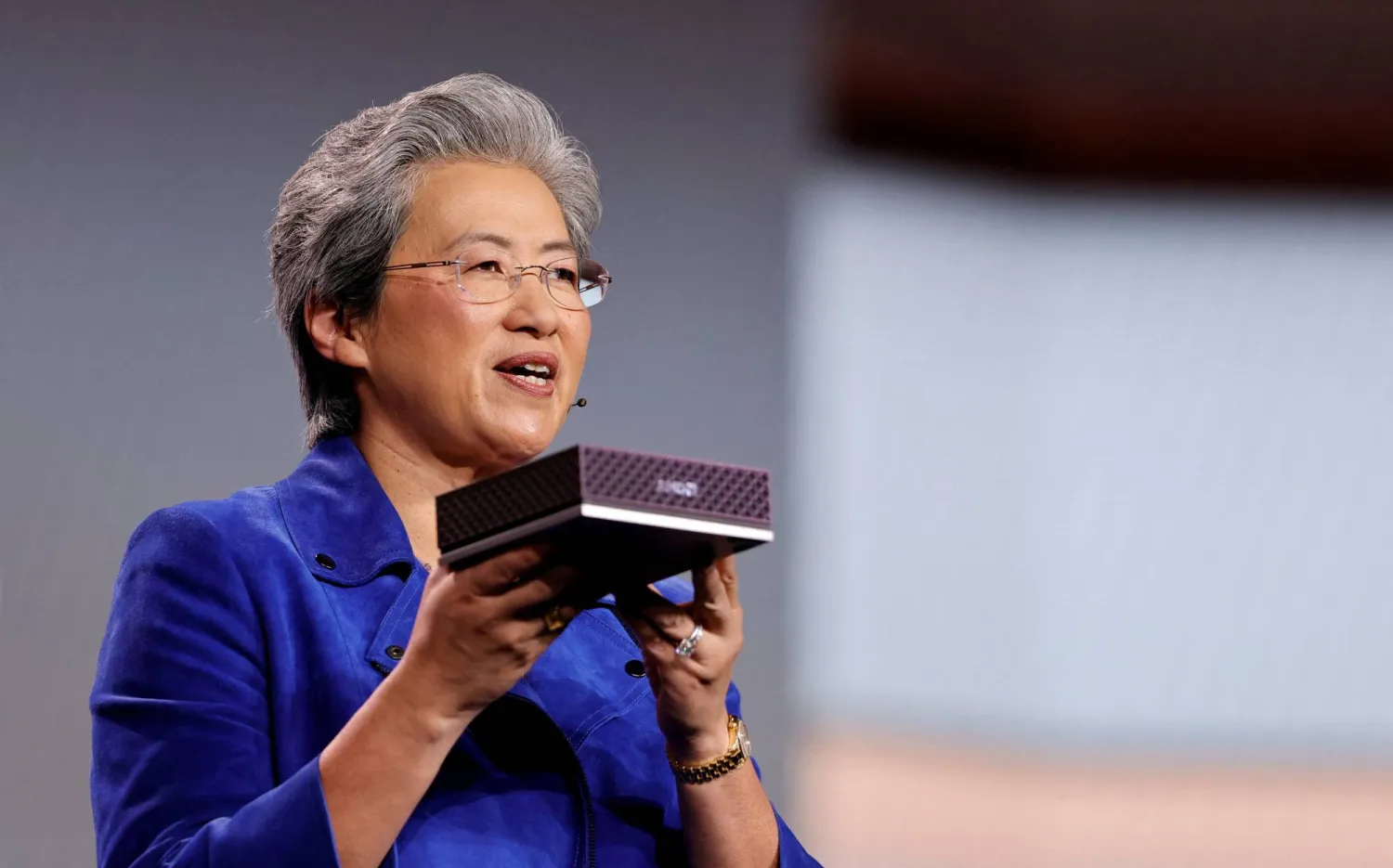
 Lisa Su, CEO of AMD, holds an AMD Ryzen AI Halo Developer Platform during an AMD keynote address at CES 2026, an annual consumer electronics trade show, in Las Vegas, Nevada, US, January 5, 2026. (Reuters)
Lisa Su, CEO of AMD, holds an AMD Ryzen AI Halo Developer Platform during an AMD keynote address at CES 2026, an annual consumer electronics trade show, in Las Vegas, Nevada, US, January 5, 2026. (Reuters)
TT

AMD Shows off New Higher Performing AI Chip at CES Event

 Lisa Su, CEO of AMD, holds an AMD Ryzen AI Halo Developer Platform during an AMD keynote address at CES 2026, an annual consumer electronics trade show, in Las Vegas, Nevada, US, January 5, 2026. (Reuters)
Lisa Su, CEO of AMD, holds an AMD Ryzen AI Halo Developer Platform during an AMD keynote address at CES 2026, an annual consumer electronics trade show, in Las Vegas, Nevada, US, January 5, 2026. (Reuters)

Advanced Micro Devices CEO Lisa Su showed off a number of the company's AI chips on Monday at the CES trade show in Las Vegas, including its advanced MI455 AI processors, which are components in the data center server racks that the company is selling to firms like ChatGPT maker OpenAI.

Su also unveiled the MI440X, a version of the MI400 series chip designed for on-premise use at businesses. The so-called enterprise version is designed to fit into infrastructure that is not specifically designed for AI clusters. The ‌MI440X is a version ‌of an earlier chip that the US plans ‌to ⁠use in a supercomputer.

AMD ‌is one of Nvidia's strongest rivals but has struggled to have as much success. In October, AMD signed a deal with OpenAI that, in addition to the financial upside, was a major vote of confidence in AMD's AI chips and software. But it is unlikely to dent Nvidia's dominance, as the market leader continues to sell every AI chip it can make, analysts said.

At the Monday event, OpenAI President Greg Brockman joined Su on ⁠stage and said chip advancements were critical to OpenAI's vast computing needs.

Looking to the future needs of ‌companies like OpenAI, Su previewed the MI500 and said it ‍offered 1,000 times the performance of an ‍older version of the processor. The company said the chips would launch in ‍2027.

At the event, Su hosted Daniele Pucci, CEO of Generative Bionics, an Italian AI developer, who unveiled GENE.01, a humanoid robot.

"Our first commercial humanoid robot will be manufactured in the second half of 2026," Pucci said at the event.

Earlier on Monday, Nvidia showed off its next-generation Vera Rubin platform, which is made up of six separate chips. CEO Jensen Huang said it was in full production. It is expected to debut ⁠later this year.

In October, AMD signed the deal with ChatGPT maker OpenAI that will add billions of dollars to the company’s annual revenue. The first deployment of AI chips that incorporate AMD’s MI400 series will roll out this year. Nvidia has generated tens of billions of dollars in quarterly revenue from its AI chip sales, a feat that AMD has struggled to achieve thus far.

OpenAI is a key customer of AMD and executives at the Santa Clara, California-based company expect the deal to lead to significant additional new sales.

Also on Monday, AMD launched its Ryzen AI 400 Series processors for AI PCs, alongside Ryzen AI Max+ chips for advanced local inference and gaming. Intel held a launch event ‌earlier for its Panther Lake chips that it said would be available for order on Tuesday.



Indonesia to Ban Social Media Access for Under-16s

 A YouTube logo hangs on the wall at the YouTube Podcast Awards ceremony, in Berlin, Wednesday, Feb. 25, 2026. (Christophe Gateau/dpa via AP)
A YouTube logo hangs on the wall at the YouTube Podcast Awards ceremony, in Berlin, Wednesday, Feb. 25, 2026. (Christophe Gateau/dpa via AP)
TT

Indonesia to Ban Social Media Access for Under-16s

 A YouTube logo hangs on the wall at the YouTube Podcast Awards ceremony, in Berlin, Wednesday, Feb. 25, 2026. (Christophe Gateau/dpa via AP)
A YouTube logo hangs on the wall at the YouTube Podcast Awards ceremony, in Berlin, Wednesday, Feb. 25, 2026. (Christophe Gateau/dpa via AP)

Indonesia said Friday it would ban social media access for children under 16, citing threats from online pornography, cyberbullying, online fraud and internet addiction.

"Accounts belonging to children under 16 on high-risk platforms will start to be deactivated, beginning with YouTube, TikTok, Facebook, Instagram, Threads, X, Bigo Live, and Roblox," Communications Minister Meutya Hafid said in a statement.

"The government is stepping in so that parents no longer have to fight alone against the giants of the algorithm. Implementation will begin on March 28, 2026," she added.

The ban will be introduced in stages "until all platforms fulfil their compliance obligations."

TikTok Indonesia and Google Indonesia did not immediately respond to requests for comment.

A European Union expert group began work this week on a similar social media ban for children after Australia in December required TikTok, YouTube, Snapchat and other sites to remove accounts held by under-16s.

Brussels is keeping a close eye on how successful the Australian ban proves to be, with legal challenges already filed against it.

France, along with Denmark, Greece and Spain, has been pushing for similar action at EU level, and India has been considering a teen social media ban of its own.

Meutya said the government understood the new regulation "may cause some initial inconvenience" for users in Indonesia, but "we believe that this is the best step the Government must take in the midst of a digital emergency."

She added: "We are taking this step to reclaim the sovereignty of our children's future. We want technology to humanize humans, not sacrifice our children's childhood."


Oracle Reportedly Plans Thousands of Job Cuts as Data Center Costs Rise

FILE PHOTO: Oracle logo is seen in this illustration created on September 9, 2025. REUTERS/Dado Ruvic/Illustration/File Photo
TT

Oracle Reportedly Plans Thousands of Job Cuts as Data Center Costs Rise

FILE PHOTO: Oracle logo is seen in this illustration created on September 9, 2025. REUTERS/Dado Ruvic/Illustration/File Photo

Enterprise software company Oracle is planning thousands of job cuts as it faces a cash crunch from a massive AI data center expansion effort, Bloomberg News reported on Thursday.

Long a smaller contender in the cloud market, over the past year Oracle has emerged as a major player in the business of renting computing power thanks, in part, to its $300 billion deal with OpenAI.

But investors have grown worried about ⁠how it would ⁠fund the data center expansion needed to serve OpenAI and other customers, including Elon Musk's xAI and Meta.

The software company, chaired by billionaire Larry Ellison, in February outlined plans to raise $45 billion to $50 billion this year in ⁠order to expand its cloud infrastructure, fueling investor concerns about its rising debt load.

The layoffs will impact divisions across Oracle and may be implemented as soon as this month, the Bloomberg report said, citing people familiar with the matter.

Some cuts will be aimed at job categories that the company expects will shrink due to AI.

The planned reductions are expected to be ⁠wider-reaching than Oracle's ⁠typical rolling job cuts, according to Bloomberg.

This week, Oracle announced internally that it would be reviewing many of the open job listings in its cloud division, effectively slowing down or freezing the hiring process, the report added.

Oracle declined to comment when contacted by Reuters.

The company had about 162,000 full-time employees as of May 31, 2025, according to its annual filing with the US Securities and Exchange Commission.


UK's Nothing Splashes Color on New Phones to Shake Up 'Boring' Tech

Carl Pei, CEO of Nothing, poses for pictures at Nothing headquarters in Kings Cross, in London, Britain, February 26, 2026. REUTERS/Jaimi Joy
TT

UK's Nothing Splashes Color on New Phones to Shake Up 'Boring' Tech

Carl Pei, CEO of Nothing, poses for pictures at Nothing headquarters in Kings Cross, in London, Britain, February 26, 2026. REUTERS/Jaimi Joy

Nothing, the smartphone maker founded in London by Carl Pei, launched new mid-tier handsets and headphones on Thursday, adding new colors to its white, black and grey palette to appeal to digitally adept younger customers.

Pei, a Swedish national who previously co-founded Chinese brand OnePlus, started Nothing in 2020 with the aim of making consumer technology less monotonous. He said smartphones had become "kind of boring", with only incremental improvements in batteries, screens and cameras.

The Phone (4a), available in pink and blue as well as black and white, and Phone (4a) Pro, ⁠available in pink, ⁠black and silver, will retail at 349 pounds or 349 euros, and 499 pounds or 479 euros, respectively.

Both phones feature improved cameras and the company's signature glyph interface, a system of LED lights on the back.

Headphone (a) has up to five days of battery life and integrated physical controls in the ear cups, the company said. It will be available in pink, ⁠yellow, black and white, priced at 149 pounds, $199 and 159 euros.

"We're giving our portfolio a splash of color and secondly we're advancing some of our AI initiatives," Reuters quoted Pei as saying.

"We started Nothing to break that monotony and make tech more fun," he said in an interview.

Nothing's first phone in 2022 stood out in a sea of similar Android devices with its transparent design and distinctive backlit glyph features.

Pei said the company was building scale and capability so it could launch more novel AI-focused products.

"We cannot just create audio products and smartphones because those are basically already solved problems," he ⁠said.

"I think ⁠we need to usher in a new wave of human-computer interaction. That will be the next step for us."

The company, which raised $200 million at a $1.3 billion valuation last year, plans to spin off its India-focused, budget-oriented devices brand called CMF.

Pei said Nothing was considering listing that business, but had not made a firm decision. "India has one of the most active capital markets in the world," he said.

He said Nothing itself would be IPO-ready by the end of 2028, though the target was "more like an internal call to arms to just get our act together, build all the structures we need".

"Whether we pull the trigger or not really depends on the market conditions and our plans at that time," he said.