Western Europe Braces for Another Wave of Snow and Ice

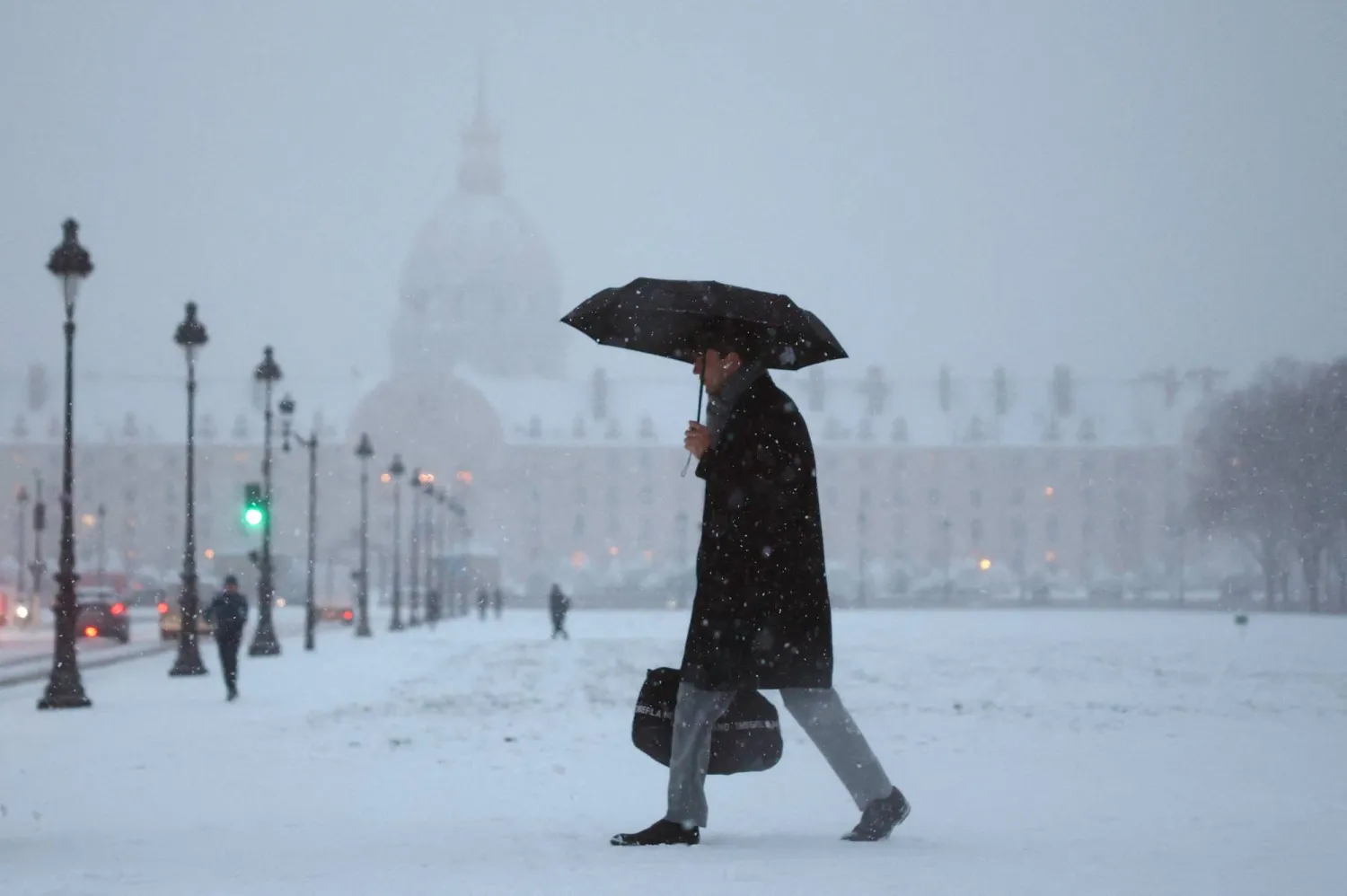
A man shelters from falling snow under an umbrella past as he walks on the snow-covered Esplanade des Invalides in Paris as winter weather with snow and cold temperatures hits a part of the country, France, January 7, 2026. (Reuters)
TT

Western Europe Braces for Another Wave of Snow and Ice

A man shelters from falling snow under an umbrella past as he walks on the snow-covered Esplanade des Invalides in Paris as winter weather with snow and cold temperatures hits a part of the country, France, January 7, 2026. (Reuters)

Western Europe braced for more snow and ice on Wednesday, with the first named storm of the year hitting the continent's Atlantic coast.

More flights were cancelled, train ​services disrupted and roads blocked as storm Goretti advanced across the region.

Heavy snow hit the Paris region as daylight broke, while the south of Britain is likely to be most heavily affected on Thursday and Friday. Cold weather warnings covered vast parts of France and Britain on Wednesday.

French weather agency Meteo France warned of snowfalls extending across the northern ‌half of ‌the country on Wednesday. Britain's Met Office ‌said ⁠ice ​warnings ‌would remain in Scotland but would be lifted later in the morning in most of England and Wales.

Paris bus services were suspended as shops geared up for the first day of the New Year sales.

Heavier snowfall than usual for the region has caused travel chaos this week. Dutch airline KLM cancelled 600 flights scheduled ⁠for Wednesday at Amsterdam's Schiphol airport, the sixth day of disruption in a ‌row at one of Europe's busiest hubs.

KLM ‍has warned it is ‍running out of de-icing fluid for its jets and that ‍delays to supplies had made it difficult to replenish stock. Its partner Air France said it was not aware of any shortages in France.

Schiphol airport said it still had ample supplies of a different ​type of de-icing fluid it uses to clear runways.

France's civil aviation authority asked airlines to cut 40% ⁠of flights at Paris' main international airport Roissy-Charles de Gaulle and 25% of flights out of the smaller Orly airport.

In Brussels, some flights were cancelled and the de-icing of runways and the wings of aircraft was causing delays.

Authorities in the Netherlands told people to plan to work from home if possible. French officials banned trucks and school buses from the roads in a third of all administrative departments, most in the northern half of the country.

Carrefour CEO Alexandre Bompard said the truck ban would ‌bring some disruption to supply chains, in particular fresh produce.


Saudi Arabia: NCW Marks World Wildlife Day with Strategic Plan for Biodiversity Protection

The NCW says it is focused on enhancing wildlife management efficiency. SPA
TT

Saudi Arabia: NCW Marks World Wildlife Day with Strategic Plan for Biodiversity Protection

The NCW says it is focused on enhancing wildlife management efficiency. SPA

The National Center for Wildlife (NCW) reaffirmed its commitment to protecting wildlife and preserving natural habitats, recognizing this responsibility as essential to nature conservation and ecosystem sustainability in Saudi Arabia. This observance aligns with World Wildlife Day, marked annually on March 3.

The center emphasized its efforts in wildlife development, which include breeding endangered species and reintroducing them into their natural habitats, developing and managing protected areas, and implementing environmental monitoring programs and scientific research.

This approach builds on a phased institutional effort, expanding breeding and reintroduction programs for wildlife species from seven to 21, with a strategic plan to reach 50 programs by 2030.

The NCW is also focused on enhancing wildlife management efficiency and advancing operational tools, thereby strengthening a national approach grounded in science and long-term planning.


Student Solves Mystery of Icy ‘Snowmen’ in Solar System’s Outer Reaches

Contact binaries are made up of two connected spheres, reminiscent of a snowman (Shutterstock)
TT

Student Solves Mystery of Icy ‘Snowmen’ in Solar System’s Outer Reaches

Contact binaries are made up of two connected spheres, reminiscent of a snowman (Shutterstock)

A student has unraveled a long-standing cosmic enigma concerning some of our solar system’s most peculiar objects: icy “snowmen” that populate its outer reaches, according to The Independent.

Astronomers have long debated the origins of these 'contact binaries' – objects comprising two connected spheres, reminiscent of a snowman.

Now, researchers at Michigan State University claim to have evidence.

These peculiar celestial “snowmen” are found in the Kuiper Belt, a vast expanse beyond Neptune, which is filled with icy remnants dating back to the solar system's formation. The region lies beyond the turbulent asteroid belt between Mars and Jupiter.

These ancient building blocks, known as planetesimals, have largely persisted untouched for billions of years. Roughly one in 10 of these objects are classified as ‘contact binaries.’

The enduring mystery has been how such delicate structures could have formed without being violently smashed together.

Jackson Barnes, a graduate student at the university, has developed the first computer simulation to show how such two-lobed shapes can arise naturally through gravitational collapse.

This is the process by which matter contracts under its own gravity, overpowering forces that would otherwise pull it apart.

The research has been published in Monthly Notices of the Royal Astronomical Society.

Earlier computer models treated colliding objects as fluid-like blobs that quickly merged into single spheres, making it impossible to recreate contact binaries.

Using high-performance computing facilities, Barnes’ simulations instead allow objects to retain their strength and settle gently against one another.

Other theories have suggested that rare events or exotic conditions might be required to produce these shapes, but researchers say such explanations are unlikely to account for their apparent abundance.

“If we think 10% of planetesimal objects are contact binaries, the process that forms them can’t be rare,” said Earth and Environmental Science assistant professor Seth Jacobson, the study’s senior author.

“Gravitational collapse fits nicely with what we’ve observed.”

Contact binaries were first seen in close detail in January 2019, when Nasa’s New Horizons spacecraft flew past a Kuiper Belt object later nicknamed Ultima Thule.

The images prompted scientists to re-examine other distant bodies, revealing that about 10% of planetesimals share the same distinctive shape.

In the sparsely populated Kuiper Belt, these objects drift largely undisturbed and are rarely hit by other debris.

In the early history of the Milky Way, the galaxy consisted of a disc of gas and dust. Remnants of that era persist in the Kuiper Belt today, including dwarf planets such as Pluto, along with comets and planetesimals.

Planetesimals are among the first solid bodies to form as dust and pebble-sized material clumps together under gravity. Much like snowflakes compressed into a snowball, they are loose aggregates pulled from clouds of tiny particles.

Barnes’ simulation shows that as one of these clouds rotates, it can collapse inward and split into two separate bodies that begin orbiting each other.

Such binary planetesimals are commonly observed in the Kuiper Belt. Over time, their orbits spiral closer until the pair gently touch and fuse, preserving their rounded shapes.

The reason these fragile-looking structures survive for billions of years, Barnes explained, is simple chance. In such a remote region, collisions are rare. Without a major impact, there is little to pull the two bodies apart, and many contact binaries show few, if any, impact craters.

Scientists have long suspected gravitational collapse was responsible, but until now they lacked models capable of testing the idea properly.

“We’re able to test this hypothesis for the first time in a legitimate way,” Barnes said. “That’s what’s so exciting about this paper.”

He believes the model could also help researchers understand more complex systems involving three or more bodies. The team is already working on simulations that better capture the details of the collapse process.

As future space missions venture deeper into the outer solar system, the researchers said the familiar snowman shape may turn out to be far more common than once thought.


80% of China’s Lanterns Are Made in One Little Town

80% of the country's lanterns are still made by hand (Getty images)
TT

80% of China’s Lanterns Are Made in One Little Town

80% of the country's lanterns are still made by hand (Getty images)

In China, red lanterns could guide a traveler to safety in cold winter alleyways, be symbols of power outside an imperial hall, or act as a call to religious devotion when hung in a temple.

They are also absolutely synonymous with lunar new year celebrations right across the vast country and link today's Chinese people with the culture of their ancestors, according to BBC.

To imagine how many lanterns would be hung here, at any given time, is like trying to count how many trees would be in the Amazon.

And yet it is claimed that a remarkable 80% of the country's lanterns are still made – by hand – in one small town in Hebei Province.

Walking around the dusty streets of Tuntou you see evidence of lantern making everywhere you go.

A view through an open door into a courtyard might reveal a small group of villagers sitting on stools and making lanterns while they chat, while down the main street, red lanterns are piled up one on top of the other.

Nobody seems to know just how many hundreds of years ago the craft started in this part of northern China but, if you're born in Tunou, you are immersed in lantern making from a very young age.

“When you see others in your family doing it every day, you get the hang of it quickly,” one woman told the BBC, adding that “kids here can pick it up at from around 10-years-old.”

It seems remarkable that, in an era of high-tech production lines, this town has been able to maintain a stranglehold on the lantern market, using production techniques from another era.

When asked about this, one elderly lantern maker said it was because they could easily fill diverse orders, no matter how small in scale, and do it more cheaply than factories could.

In the future, modern production may find a way to match what this village can do by hand, offering the same diversity of options at a competitive price, but it has not happened yet.

But a challenge for Tuntou is that many young people these days are not satisfied with a life of lantern making, instead opting for the lure of the city and the possibilities that urban existence can bring. This could mean a shortage of labor in the years to come.

However, for now, this is China's lantern town, and its residents are proud that it is known this way.