


Latest Israeli Escalation in Lebanon Raises Questions about All-out War

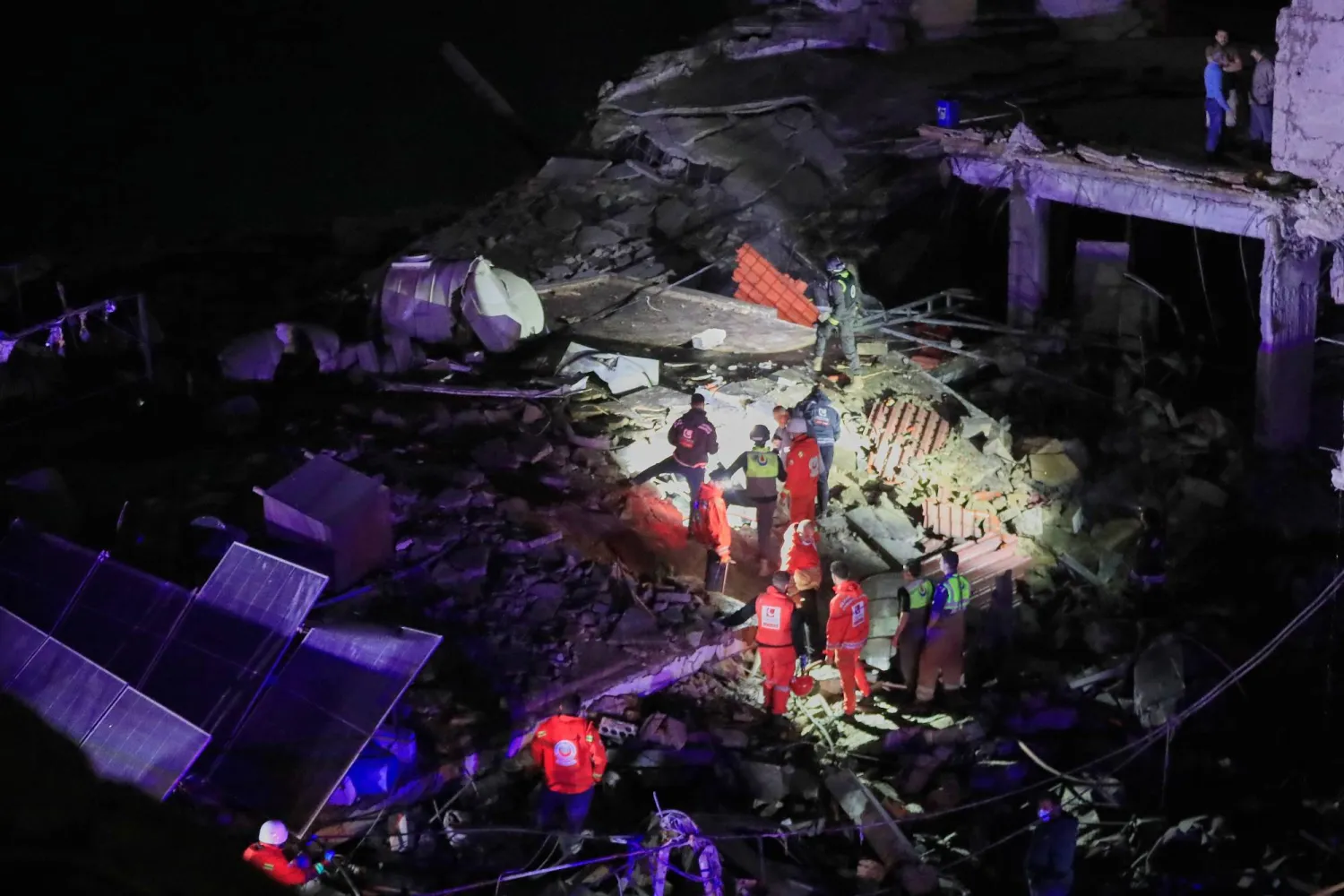
Rescue workers search for possible victims in a building destroyed by an Israeli strike in the southern port city of Sidon, Lebanon, early Tuesday, Jan. 6, 2026. (AP)
TT

Latest Israeli Escalation in Lebanon Raises Questions about All-out War

Rescue workers search for possible victims in a building destroyed by an Israeli strike in the southern port city of Sidon, Lebanon, early Tuesday, Jan. 6, 2026. (AP)

The Israeli airstrike that struck a three-storey building on Tuesday in the industrial zone of Sainiq, in the Sidon district in southern Lebanon, was part of a broader wave of attacks that on Monday targeted the western Bekaa Valley, Jezzine, and areas around Sidon.

With intensive drone flights over Baalbek and its outskirts, followed by surveillance over Tyre and Zahrani, the picture pointed to a new wave of escalation extending beyond the South that stretches from north of the Litani River to the Awali basin and parts of the Bekaa.

Timing

The escalation raises serious questions, Lebanese President Joseph Aoun said, particularly as the “Mechanism” committee is set to meet on Wednesday.

The committee is tasked with halting hostilities and identifying practical steps to restore security and stability in the South, including Israel’s withdrawal to the international border, the release of Lebanese detainees, and the completion of the Lebanese Army’s deployment in line with UN Security Council Resolution 1701.

In a statement, Aoun stressed that Israel’s continued attacks aim to derail local, regional, and international efforts to contain the escalation, despite Lebanon’s cooperation and the measures adopted by the government to extend state authority south of the Litani.

He added that these steps were implemented by the Lebanese Army “with professionalism, discipline, and precision.”

He renewed his call for effective international intervention to curb Israel’s actions and to enable the Mechanism committee to fulfill its mandate with the consensus of the parties concerned and sustained international support.

On Monday, Israel launched a series of strikes across eastern and southern Lebanon after issuing evacuation warnings to residents. Overnight, it continued air raids without warning on Zahrani and Sarafand.

At dawn on Tuesday, it struck a three-storey building in an industrial area in Ghazieh, near the coastal city of Sidon — about 40 kilometres south of Beirut — wounding one person, levelling the building, damaging nearby structures, and sparking a fire.

Later on Tuesday, an Israeli drone struck an area near a house in the village of Kfardounine, followed by another strike on a home in Khirbet Selm that killed two people, according to Lebanon’s National News Agency.

The Israeli army said it had targeted “multiple military infrastructures” belonging to Hezbollah and Hamas, including weapons depots and military facilities above and below ground.

The statement said Hezbollah used these sites to advance “terrorist plans” and rebuild its capabilities. It also cited strikes on Hamas weapons-production sites in southern Lebanon allegedly used to arm the Palestinian group and plan attacks against Israeli forces and Israel.

Signals on the ground

The latest strikes carry several overlapping signals: a clear return to escalation; an expansion of operations to include areas north of the Litani, the Awali basin, and parts of the Bekaa; and a shift beyond targeting Hezbollah’s military infrastructure alone, with attacks on sites Israel says belong to Hamas.

This has brought strikes into predominantly Sunni areas, such as Manara in the western Bekaa.

Beyond the South

Retired Brigadier Khalil Helou told Asharq Al-Awsat that the recent developments reflect a broader Israeli strategy aimed at increasing pressure on the Lebanese government and state institutions, particularly the army, to accelerate implementation of the second phase of the plan to impose state monopoly over arms, especially north of the Litani, effectively across all of Lebanon.

He said Israel’s approach in Lebanon cannot be separated from the situation in Gaza and Iran, arguing that these arenas are interconnected within a single strategic vision that also intersects with US policy.

“What we are witnessing today is the outcome of wider political and security understandings that emerged after the meeting between Benjamin Netanyahu and Donald Trump, even if the details were never made public,” he said. The leaders met in late December.

Intelligence-driven operations

Helou described Israel’s recent strikes as “limited military operations with an intelligence-driven character rather than open political signaling.”

The absence of prior warnings in some cases, he added, points to targeted assassinations or precision strikes on sites believed to have particular military importance.

Dahiyeh a possible target, war unlikely

On potential escalation scenarios, Helou said strikes on Beirut’s southern suburb of Dahiyeh have become more conceivable than before within Israel’s margin of maneuver.

He nonetheless ruled out a full-scale war, arguing that Hezbollah is currently unable to mount a response even if the scope of attacks widens.

Iran

Turning to Iran, Helou said internal developments and debates within the Iranian regime play a decisive role in shaping Tehran’s regional behavior.

Any major decision by Hezbollah remains directly tied to Iranian guidance, he added.

“The Lebanese scene cannot be read in isolation from what is unfolding daily in Iran, where the broader strategic picture is being drawn,” he remarked.

Meanwhile, Israel’s Walla news site reported that there is no intention to scale back Israeli military presence along the Lebanese border and that operations will continue as required, even if this entails expanding their geographic scope to include areas north of the Litani, the Awali basin, parts of the Bekaa, and Beirut’s southern suburbs.

The escalation comes ahead of a military meeting of the Mechanism committee and before a Cabinet session Thursday devoted to reviewing the Lebanese Army’s final report on arms control south of the Litani and preparations for a second phase north of the river.

Haaretz, meanwhile, reported that Trump told Netanyahu he was granting him limited leeway for any military operation against Hezbollah.

Helou said the next phase is likely to see intensified strikes and mounting pressure aimed at enforcing the second phase of disarmament across Lebanon without sliding into a comprehensive war, describing the current trajectory as a “calculated escalation serving broader political and military objectives.”



Syrian President Sharaa Meets with EU Chief von der Leyen

Syrian Minister of Foreign Affairs and Expatriates Asaad Al-Shaibani (R) receives European Council President Antonio Costa (C) and European Commission President Ursula von der Leyen, during an official visit to the People's Palace in the Syrian capital Damascus on January 9, 2026. (AFP)
TT

Syrian President Sharaa Meets with EU Chief von der Leyen

Syrian Minister of Foreign Affairs and Expatriates Asaad Al-Shaibani (R) receives European Council President Antonio Costa (C) and European Commission President Ursula von der Leyen, during an official visit to the People's Palace in the Syrian capital Damascus on January 9, 2026. (AFP)

Syria's President Ahmed al-Sharaa met with European Commission chief Ursula von der Leyen on Friday, state media said, as she became the highest ranking EU official to visit since longtime ruler Bashar al-Assad was ousted.

Von der Leyen is conducting a regional tour alongside Antonio Costa, who heads the European Council.

Their visit follows days of deadly clashes between government forces and Kurdish fighters in the north Syrian city of Aleppo.


Türkiye Calls on SDF to ‘Renounce Terrorism’, Abandon Separatism

Thick smoke rises from areas of fighting between the Syrian army and the SDF in Aleppo (EPA) 
TT

Türkiye Calls on SDF to ‘Renounce Terrorism’, Abandon Separatism

Thick smoke rises from areas of fighting between the Syrian army and the SDF in Aleppo (EPA) 

Türkiye has urged the Syrian Democratic Forces (SDF) to renounce terrorism and abandon what it described as separatist ambitions that threaten Syria’s unity, while signaling it is prepared to support the Syrian army in Aleppo should Damascus request assistance.

The call comes as fighting continues between Syrian government forces and the SDF in the Sheikh Maqsoud and Ashrafieh districts of Aleppo, where the Kurdish People’s Protection Units (YPG) form the core of the SDF.

Speaking in Ankara, Turkish Foreign Minister Hakan Fidan said the group must “abandon terrorism and give up efforts aimed at dividing Syria,” stressing that the region is in urgent need of peace and stability.

At a joint press conference with Omani Foreign Minister Badr bin Hamad Al Busaidi following talks on Thursday, Fidan said the SDF’s determination to hold on to its positions “at any cost” has become the single greatest obstacle to restoring stability in Syria. He argued that this rigid stance is detached from the political realities of Syria and the wider region, adding that the time has come for national unity.

Fidan also accused the SDF of aligning itself with Israel, warning that it risked becoming an instrument of Israel’s “divide and rule” strategy in the region. “Instead of contributing to unity, the SDF has chosen a path that undermines regional stability,” he stated.

Separately, a Turkish Defense Ministry official said Türkiye stands ready to assist the Syrian government in its counterterrorism efforts in Aleppo if formally requested. Speaking during the ministry’s weekly briefing, the official said the current operation is being carried out solely by the Syrian army but emphasized that Ankara would provide support if asked, in line with its commitment to Syria’s territorial integrity and unity.

The official added that Ankara is closely monitoring developments across Syria, noting that security in Syria directly affects Türkiye’s own national security. He remarked that the Aleppo operation was launched to restore public order following alleged SDF attacks on civilians and security personnel that resulted in casualties.

Political Divisions

The pro-Kurdish Democracy and Equality of Peoples Party (DEM) called on Türkiye to play a constructive role by encouraging dialogue, democratic integration, and coexistence among Syria’s diverse communities. Party spokesperson Ayşegül Doğan accused Ankara of indirectly fueling the fighting through allied armed factions operating in the area.

By contrast, opposition Victory Party leader Ümit Özdağ warned that the March 10 agreement amounted to a “political trap” for Türkiye, arguing that integrating the SDF into state institutions would legitimize the group, expand Israeli influence in Syria, and risk plunging the country back into civil war.

Meanwhile, the Syrian Kurdish Union urged Ankara to support Kurdish communities alongside Turkmen, saying attacks on Kurdish neighborhoods in Aleppo were aimed at sabotaging dialogue and a political settlement.


Gaza Civil Defense Says Israeli Attacks Kill 13 Including 5 Children

Rubble lies at the site of Thursday's Israeli strike on a house, in the central Gaza Strip, January 9, 2026. (Reuters)
TT

Gaza Civil Defense Says Israeli Attacks Kill 13 Including 5 Children

Rubble lies at the site of Thursday's Israeli strike on a house, in the central Gaza Strip, January 9, 2026. (Reuters)

Gaza's civil defense agency said Israeli attacks in the Palestinian territory on Thursday killed at least 13 people, including five children, despite a ceasefire that has largely halted the fighting.

Four people, including three children, were killed when a drone struck a tent sheltering displaced people in southern Gaza, agency spokesman Mahmud Bassal told AFP.

In the north of the Gaza Strip, an 11-year-old girl was killed near the Jabalia refugee camp and a strike on a school killed one person, while a drone near Khan Younis in the south killed a man, the agency added.

Two more Gazans, including a child, were killed in other attacks, reported the agency, which operates under Hamas authority.

Later on Thursday evening, four more people were killed in an Israeli air strike that targeted a house in an eastern area of Gaza City, Bassal said, adding that rescue work to search for several people who were missing had begun.

"The death toll has risen to 13 as a result of Israeli strikes on the Gaza Strip since this morning in a clear violation of the ceasefire agreement," Bassal said.

In a statement Friday morning, the Israeli military said it "precisely struck Hamas terrorists and terror infrastructure in the southern and northern Gaza Strip" in response to a "failed projectile" launch.

"The projectile that was launched from the Gaza Strip constitutes a violation of the ceasefire agreement," the statement added.

Since October 10, a fragile US-sponsored truce in Gaza has largely halted the fighting between Israeli forces and Hamas, but both sides have alleged frequent violations.

Hamas spokesman Hazem Qassem told AFP that the strikes in Gaza on Thursday "confirm the Israeli occupation's renunciation of its commitment to the ceasefire".

Israeli forces have killed at least 425 Palestinians in Gaza since the ceasefire took effect, according to Gaza's health ministry.

At least 21 people were killed on November 22 in Israeli strikes, making it one of the deadliest days in Gaza since the ceasefire came into effect.

The Israeli military said gunmen have killed three of its soldiers during the same period.