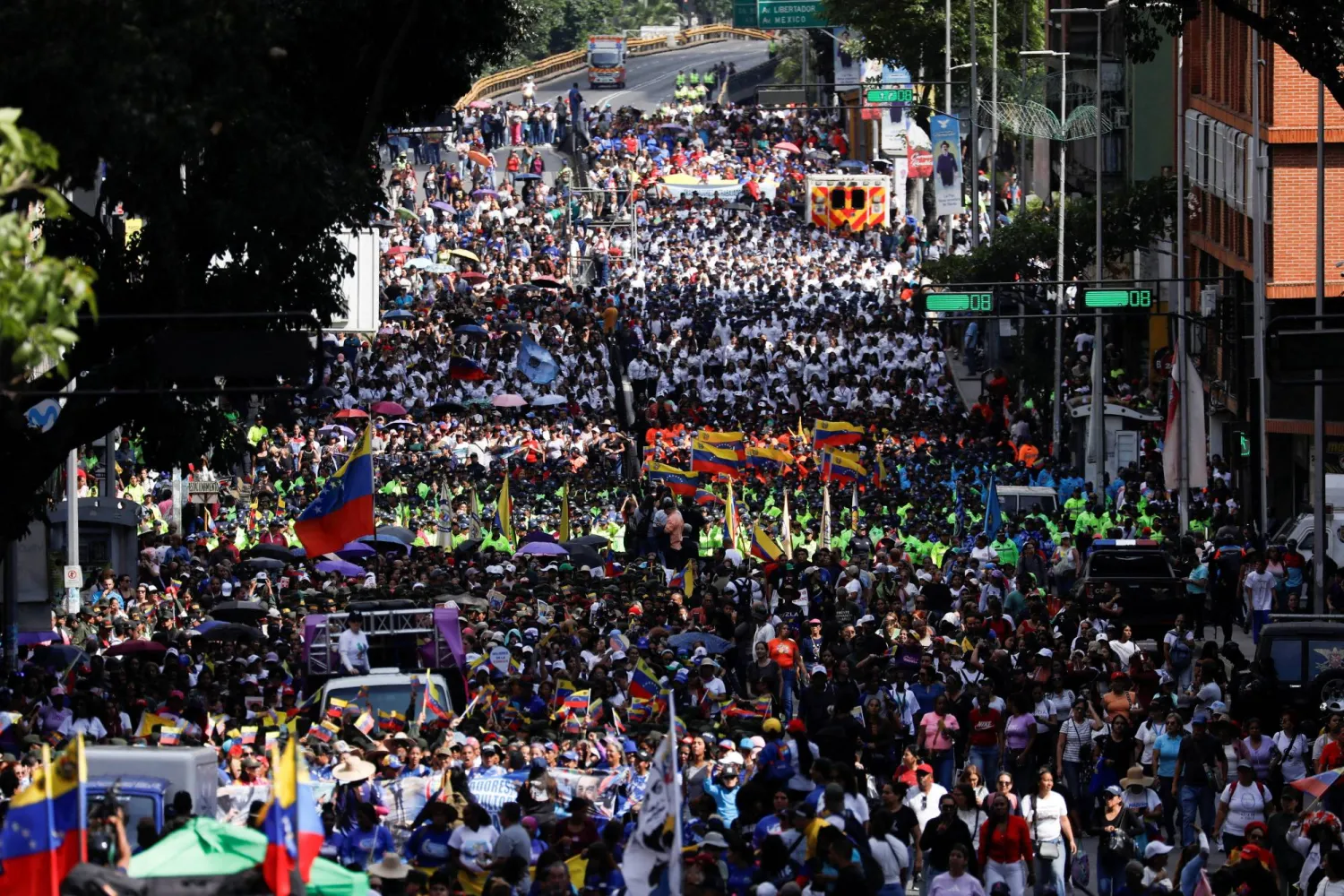
New Venezuela Leader Says ‘No Foreign Power’ Running Country

Government supporters participate in a women's march toward the office of interim President Delcy Rodriguez, days after the US launched a strike on Venezuela and captured President Nicolas Maduro and his wife Cilia Flores, in Caracas, Venezuela, January 6, 2026. (Reuters)
TT

New Venezuela Leader Says ‘No Foreign Power’ Running Country

Government supporters participate in a women's march toward the office of interim President Delcy Rodriguez, days after the US launched a strike on Venezuela and captured President Nicolas Maduro and his wife Cilia Flores, in Caracas, Venezuela, January 6, 2026. (Reuters)

Venezuela's interim leader Delcy Rodriguez insisted Tuesday no foreign power was governing her country, even as US President Donald Trump announced Caracas will be swiftly turning over millions of barrels of oil to the United States.

Rodriguez, who was vice president under toppled leader Nicolas Maduro, has given mixed signals about how much she is prepared to cooperate with Trump, at times sounding conciliatory, at others defiant.

Speaking three days after US special forces snatched Maduro and his wife in a stunning raid in Caracas, Rodriguez said: "The government of Venezuela is in charge in our country, and no-one else."

"There is no foreign agent governing Venezuela."

Trump insists Washington is now "in charge" of the Caribbean country but has said he is prepared to work with Rodriguez -- provided she submits to his demand for access to Venezuela's vast oil reserves.

The US leader was startlingly direct about his intent regarding the South American country's reserves, announcing on his Truth Social platform late Tuesday that Rodriguez "will be turning over between 30 and 50 MILLION Barrels of High Quality, Sanctioned Oil" to the United States.

"This oil will be sold at its market price, and that money will be controlled by me" as president, Trump said, adding that he has tasked Energy Secretary Chris Wright with "immediately" executing the plan.

- No surrender -

Rodriguez has offered an olive branch but also appeared anxious to keep on her side the hardliners who control the security forces and paramilitaries, which have patrolled the streets since Maduro's capture.

"We are a people that does not surrender, we are a people that does not give up," she declared, paying tribute to the "martyrs" of the US attacks.

She said the country is holding seven days of mourning for those killed.

In its first confirmation of losses, Venezuela's military on Tuesday published a list of 23 troops, including five generals, killed in the US strikes.

Top ally Havana separately issued a list of 32 dead Cuban military personnel, many of whom were members of Maduro's security detail.

Venezuela has not yet confirmed the number of civilian casualties in the operation in which US forces grabbed Maduro and Flores and took them to the United States to face trial.

Attorney General Tarek William Saab spoke Tuesday of "dozens" of civilian and military dead, without giving a breakdown.

- 'Trump, murderer' -

Thousands of supporters of the presidential couple, including powerful Interior Minister Diosdado Cabello, marched through Caracas demanding their release.

Fear of state repression has made it so the unpopular Maduro's many detractors loathe to celebrate his downfall.

Maduro and Flores appeared in court Monday in New York, where they pleaded not guilty to drug trafficking and other charges.

Mexican President Claudia Sheinbaum has called on the United States to ensure they receive a fair trial.

- Interim president's challenges -

Rodriguez has sought to project unity with Cabello and Defense Minister Vladimir Padrino Lopez, two hardliners seen as the main powerbrokers in the Maduro administration.

Opposition leader Maria Corina Machado, sidelined by Washington in the post-Maduro transition, warned in a Fox News interview that Rodriguez was not to be trusted.

"Delcy Rodriguez as you know is one of the main architects of torture, persecution, corruption, narcotrafficking," she said.

"She's the main ally and liaison with Russia, China, Iran, certainly not an individual that could be trusted by international investors."

In a sign that a repressive security apparatus remains in place, 16 journalists and media workers were detained in Venezuela on Monday, according to a journalists' union.

All were later released.

Trump has warned that Rodriguez will pay "a very big price, probably bigger than Maduro" if she does not comply with Washington's agenda.

A retired general who held high-ranking positions in the military predicted that Rodriguez would throw open Venezuela to US oil and mining companies and perhaps resume diplomatic ties, broken off by Maduro in 2019.

He also believed she would seek to appease criticism of Venezuela's dire rights record by releasing political prisoners.

Trump told Republican lawmakers Tuesday that Maduro was a "violent guy" who "killed millions of people" and claimed that Rodriguez's administration was "closing up" a torture chamber in Caracas.

The constitution says that after Maduro is formally declared absent -- which could happen after six months -- elections must then be held within 30 days.

Machado told Fox News she was confident the opposition, widely seen as the real victors of 2024 elections, would win "over 90 percent of the votes."


UN Chief Urges Drastic Emissions Cuts as COP31 Wrestles with Fossil Fuels

UN Secretary-General Antonio Guterres speaks at a press conference on the fifth day of the COP31 annual UN climate conference in Antalya, Türkiye, 13 November 2026. (EPA)
TT

UN Chief Urges Drastic Emissions Cuts as COP31 Wrestles with Fossil Fuels

UN Secretary-General Antonio Guterres speaks at a press conference on the fifth day of the COP31 annual UN climate conference in Antalya, Türkiye, 13 November 2026. (EPA)

UN Secretary-General Antonio Guterres on Friday called for an "immediate and drastic reduction" in greenhouse gas emissions, as divisions over fossil fuels dominated the first week of COP31 climate talks in Türkiye.

Big fossil fuel producers and consumers at the talks are resisting any deal that would specify firm new targets or a shift away from oil, gas and coal, observers said as the first week of talks drew to a close.

That poses a challenge for summit host Türkiye and lead negotiator Australia, which have another week to land the kind of ambitious agreement climate advocates such as Guterres say is needed.

"The central question is in the hands of member states, particularly the big emitters. They must recognize the need for an immediate and drastic reduction in emissions to keep the 1.5 goal still possible by the end of the century," he said, referring to the warming limit countries had agreed to ‌pursue under the 2015 ‌Paris Agreement.

A UN report last month found the world is on course to exceed ‌the 1.5 ⁠degrees Celsius (2.7 ⁠degrees Fahrenheit) warming threshold, a limit scientists say should prevent the worst effects of climate change.

As temperatures have risen, this year has been marked by extreme heatwaves across Western Europe and a glacier collapse in Nepal that triggered a flood that killed more than 1,450 people. Thousands more are still missing.

'DISPROPORTIONATE INFLUENCE'

Major oil producers have traditionally resisted language constraining fossil fuels, while large developing economies such as India have opposed measures they say could limit their development and energy choices, a dynamic that has compromised the outcomes of past deals.

The world’s biggest oil consumer, the United States, meanwhile, has skipped the talks for the second year ⁠in a row under President Donald Trump, who has called global warming a hoax and promoted ‌continued use of fossil fuels.

"We must confront the disproportionate influence of the fossil ‌fuel lobby. The future of our planet cannot be negotiated on the terms of those profiting from its destruction," said Guterres, who is leaving ‌his job at the end of December after two five-year terms.

"But I remain hopeful. I've also seen something extraordinary over ‌these 10 years. Renewable energy has moved from the margins to the mainstream. The economics have changed. The technology has advanced. A cleaner, safer, and more secure energy future is in our hands. The question is whether we have the courage and speed to reach for it."

ELECTRIFICATION AND NO FIRM TARGETS

COP31 host Türkiye is striving to place a proposal to expand global electrification at the center of an eventual deal, saying the ‌plan will lead to emissions cuts by speeding the shift away from fossil fuel-powered cars, boilers and other equipment.

The proposal does not require the increased electricity use to come ⁠from renewable sources, although some ⁠countries, including last year’s COP host Brazil, are advocating for progress on a plan to require countries to more clearly map out their transition away from fossil fuels.

Katrine Petersen, an observer for the non-governmental organization E3G, said whether those measures survive the talks depends on conversations in the days to come.

"We've also heard quite clearly from countries like India, the G77, that they don't want any firm targets. They don't want any kind of technology or fuel-specific language," she said. "(These are) the kind of consistent and ongoing divides that we've seen from those different parties before."

Diana Acconcia, head of the EU delegation, said Europe backed the electrification goal.

"Electrification is, in a way, an inclusive agenda because it is non-prescriptive in a way on how the electrification is achieved," she said. "Of course, for the European Union electrification is to be achieved by clean sources of energy."

The Australian team, which is leading negotiations under a split presidency arrangement, spent the first few days of the summit gathering views on what should be included in a political text agreed by consensus that will be followed by all the negotiated technical points.

Australia is taking further submissions from countries until Saturday night, with a view to formulating a draft text early next week.


Europe’s Security Cannot Be Part of Ukraine Peace Talks, EU Leaders Say

13 November 2026, Ireland, Dublin: German Chancellor Friedrich Merz speaks during a press conference on the sidelines of the EU summit at the Convention Centre in Dublin. (dpa)
TT

Europe’s Security Cannot Be Part of Ukraine Peace Talks, EU Leaders Say

13 November 2026, Ireland, Dublin: German Chancellor Friedrich Merz speaks during a press conference on the sidelines of the EU summit at the Convention Centre in Dublin. (dpa)

EU leaders said on Friday that Europe's security structure should not be a subject for Ukraine-Russia peace negotiations, but they did not answer the question of who should speak for Europe in any future talks.

The Kremlin said on Friday that Russia would be open to European countries taking part in Ukraine peace talks if it saw they were ready to contribute to the peace process.

German Chancellor Friedrich Merz described the Kremlin's comments as "the same old game" and said that Europe and the United States agreed on a clear message.

"There will be no discussions about ‌Ukraine without ‌Ukraine, and no discussions about Europe without Europe. Furthermore, there is no need ‌to ⁠talk about European ⁠security architecture. We have that already," Merz told reporters during a summit of European Union leaders in Dublin.

Russian officials have called for a broad agreement on Europe's security architecture to be reached before tackling the specifics of the war. Before its invasion of Ukraine in 2022, Russia demanded the withdrawal of NATO forces from countries that joined the alliance after 1997. NATO rejected the demand.

US negotiator Jared Kushner said in Moscow on Thursday that he had begun discussions with European partners on ⁠the continent's security architecture.

EUROPE PRIORITIZES CEASEFIRE IN RUSSIA-UKRAINE WAR

EU foreign policy chief ‌Kaja Kallas said Russian calls for discussions about Europe's ‌security architecture risked diverting attention from the need for a ceasefire. Latvian Prime Minister Andris Kulbergs called such ‌discussions "a trap".

During a meeting on Thursday, leaders from Poland, the Baltics and Nordic states warned ‌against brainstorming with the US or Russia about Europe’s security architecture, according to a European diplomat and a European official.

Forty European countries, meeting as a broader group in Dublin on Thursday, signed a declaration saying that any matter affecting European security should be decided with the involvement of Europeans.

EU leaders broadly agreed that Europe ‌needed to speak with one voice, but did not settle on a single individual to do so. Merz said discussions would continue.

"There are ⁠established institutional forms ⁠of (EU) representation — Kaja Kallas, for instance, is part of this — but the E3 format has also proven very effective," he said, in reference to an informal security grouping of France, Germany and Britain, which is no longer an EU member but a prominent NATO ally.

"Moreover, we always include Italy and Poland," Merz added.

Representatives from Britain, France, Germany, Italy and the EU attended Russia-Ukraine talks in Abu Dhabi earlier this week, where both Moscow and Kyiv cited some progress, though there was no sign of a breakthrough on key issues such as territory.

Swedish Prime Minister Ulf Kristersson said Britain, one of Europe's top three military powers, certainly had to be included in any future talks and that the five countries plus EU institutions would make sense.

"I'm quite flexible on that, so I think what we actually say is more important than the exact configuration of the people in the room," he said.


France Criticizes ‘Demagogic’ Move by Israel to Ban Hard-Left Leader Melenchon

 09 November 2026, France, Paris: France's Foreign Minister Jean-Noel Barrot, speaks during a G7 foreign ministers' meeting in Paris. (dpa)
09 November 2026, France, Paris: France's Foreign Minister Jean-Noel Barrot, speaks during a G7 foreign ministers' meeting in Paris. (dpa)
TT

France Criticizes ‘Demagogic’ Move by Israel to Ban Hard-Left Leader Melenchon

 09 November 2026, France, Paris: France's Foreign Minister Jean-Noel Barrot, speaks during a G7 foreign ministers' meeting in Paris. (dpa)
09 November 2026, France, Paris: France's Foreign Minister Jean-Noel Barrot, speaks during a G7 foreign ministers' meeting in Paris. (dpa)

France has ‌criticized as "demagogic" a decision by Israel to ban French hard-left presidential candidate Jean-Luc Melenchonand another leading figure in his France Unbowed (La France Insoumise) party from entering the country.

Israel's Foreign Ministry said on Thursday it would bar Melenchon and Mathilde Panot, the party’s parliamentary group chair, over "the extreme anti-Israel stance of La France Insoumise party and the outrageous statements made by ‌its leaders."

"This demagogic ‌decision, coming from a ‌government ⁠that has repeatedly violated international ⁠law, plays into the hands of those who, like La France Insoumise, thrive on exploiting the Israeli-Palestinian conflict," Foreign Minister Jean-Noel Barrot said on X.

"France will continue to work tirelessly toward a two-state solution and the ⁠peaceful coexistence of the Israeli and ‌Palestinian peoples,” he ‌said.

The Israeli Foreign Ministry said in a ‌statement on Thursday that both Melenchon and ‌Panot had made statements spreading "blood libels" against Israel, and that Melenchon had called for French ships to escort illegal flotillas to Gaza.

"Israel will respond ‌firmly to those who seek to harm it and will not allow ⁠individuals ⁠who act against Israel and incite against its citizens to enter the country," it said.

Melenchon told Franceinfo radio: "I am banned from entering a territory I did not ask to enter...I regret that the Israeli government is pursuing me like this."

In a campaign speech last Saturday, Melenchon made clear that, if he were elected president, French vessels would accompany activists hoping to force aid into the Gaza Strip.