
Kurdish Fighters Refuse to Leave Syria's Aleppo after Ceasefire

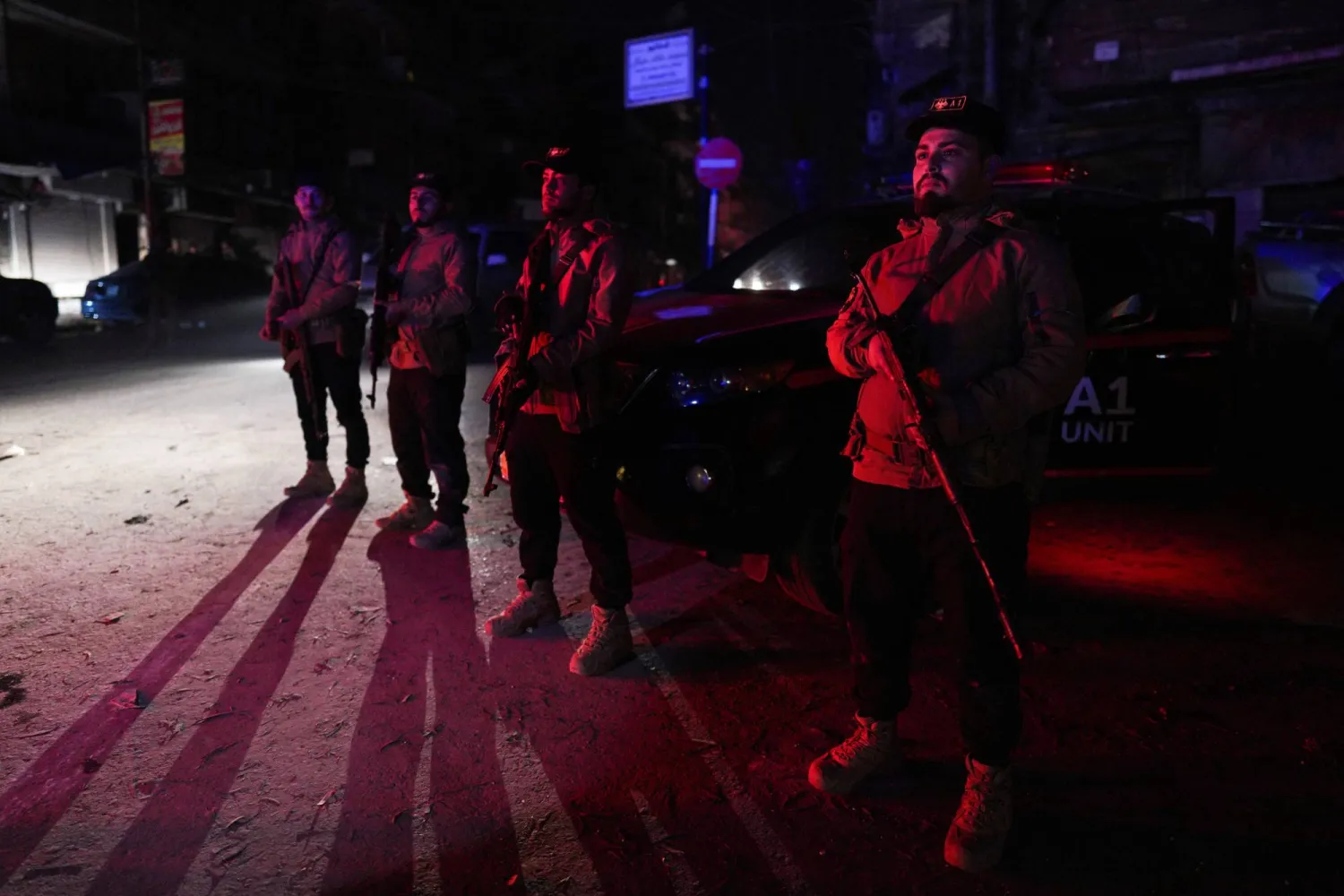
Security forces affiliated with the Ministry of the Interior stand guard in the Ashrafieh neighborhood, which they have taken control of, according to the Ministry of the Interior, following battles with the Syrian Democratic Forces, in Aleppo, Syria, January 9, 2026. (Reuters)
TT

Kurdish Fighters Refuse to Leave Syria's Aleppo after Ceasefire

Security forces affiliated with the Ministry of the Interior stand guard in the Ashrafieh neighborhood, which they have taken control of, according to the Ministry of the Interior, following battles with the Syrian Democratic Forces, in Aleppo, Syria, January 9, 2026. (Reuters)

Kurdish fighters rejected a call to leave Syria's Aleppo on Friday after the government announced a truce in deadly fighting that forced thousands of civilians to flee. 

Since Tuesday, government forces had been fighting the US-backed Kurdish-led Syrian Democratic Forces (SDF) in Aleppo, the country's second city, said AFP. 

The violence killed 21 people and was the latest challenge for a country still struggling to forge a new path after authorities ousted longtime ruler Bashar al-Assad just over a year ago. 

It also forced around 30,000 families to flee their homes, according to the UN. 

Both sides traded blame over who started the fighting, which came as they struggled to implement a deal to merge the Kurds' administration and military into the country's new government. 

On Friday, the defense ministry announced a ceasefire in the fighting with the SDF, which controls swathes of Syria's oil-rich north and northeast, and was key to the defeat of the ISIS group in 2019. 

"To prevent any slide towards a new military escalation within residential neighborhoods, the Ministry of Defense announces ... a ceasefire in the vicinity of the Sheikh Maqsud, Ashrafiyeh and Bani Zeid neighborhoods of Aleppo, effective from 3:00 am," the ministry wrote in a statement. 

Kurdish fighters were given until 9:00 am Friday (0600 GMT) to leave the three neighborhoods, while the Aleppo governorate said the fighters would be sent, along with their light weapons, to Kurdish areas further east. 

Hours later, the local councils of Sheikh Maqsud and Ashrafiyeh said the Kurdish fighters would not leave. 

"We have decided to remain in our districts and defend them," the statement said, rejecting any "surrender". 

An AFP photographer located on the edge of Ashrafiyeh saw members of the security forces enter the area, as well as vehicles that appeared to be preparing to evacuate Kurdish fighters. 

The United States welcomed the ceasefire in a post on X by its envoy Tom Barrack. 

He said Washington hoped for "a more enduring calm and deeper dialogue" and was "working intensively to extend this ceasefire and spirit of understanding". 

- 'Children were terrified' - 

An AFP correspondent reported fierce fighting across Ashrafiyeh and Sheikh Maqsud districts into Thursday night. On Friday morning, the truce appeared to be holding. 

Syria's military had instructed civilians in those neighborhoods to leave through humanitarian corridors ahead of launching the operation. 

State television reported that around 16,000 people had fled on Thursday alone. 

"We've gone through very difficult times... my children were terrified," said Rana Issa, 43, whose family left Ashrafiyeh on Thursday. 

"Many people want to leave", but are afraid of the snipers, she told AFP. 

Mazloum Abdi, who leads the SDF, said attacks on Kurdish areas "undermine the chances of reaching understandings", days after he visited Damascus for talks on the March integration deal. 

The agreement was meant to be implemented last year, but differences, including Kurdish demands for decentralized rule, have stymied progress. 

Sheikh Maqsud and Ashrafiyeh have remained under the control of Kurdish units linked to the SDF, despite Kurdish fighters agreeing to withdraw from the areas in April. 

Türkiye, which shares a 900-kilometer (550-mile) border with Syria, has launched successive offensives to push Kurdish forces from the frontier. 

Aron Lund, a fellow at the Century International research center, told AFP that "Aleppo is the SDF's most vulnerable area". 

"Both sides are still trying to put pressure on each other and rally international support," he said. 

He warned that if the hostilities spiral, "a full Damascus-SDF conflict across northern Syria, potentially with Turkish and Israeli involvement, could be devastating for Syria's stability". 

Israel and Türkiye have been vying for influence in Syria since Assad was toppled in December 2024. 

In Qamishli in the Kurdish-held northeast, hundreds of people have protested the Aleppo violence. 

"We call on the international community to intervene," said protester Salaheddin Sheikhmous, 61, while others held banners reading "no to war" and "no to ethnic cleansing". 


Head of Arab World Institute in Paris Resigns over Epstein-linked tax Fraud Probe

(FILES) France's former culture minister and president of Paris's famed Arab World Institute (AWI), Jack Lang, poses on January 28, 2013 in Paris. (Photo by Martin BUREAU / AFP)
TT

Head of Arab World Institute in Paris Resigns over Epstein-linked tax Fraud Probe

(FILES) France's former culture minister and president of Paris's famed Arab World Institute (AWI), Jack Lang, poses on January 28, 2013 in Paris. (Photo by Martin BUREAU / AFP)

France’s former Culture Minister Jack Lang has resigned as head of a Paris cultural center over alleged past financial links to convicted sex offender Jeffrey Epstein that prompted a tax investigation.

Lang was summoned to appear at the French Foreign Ministry, which oversees the Arab World Institute, on Sunday, but he submitted his resignation.

He is the highest-profile figure in France impacted by the release of Epstein files on Jan. 30 by the US Department of Justice, known for his role as a culture minister under Socialist President François Mitterrand in the 1980s and 1990s.

The Foreign Ministry confirmed his resignation Saturday evening.

The financial prosecutors' office said it had opened an investigation into Lang and his daughter, Caroline, over alleged “aggravated tax fraud laundering.”

French investigative news website Mediapart reported last week on alleged financial and business ties between the Lang family and Jeffrey Epstein through an offshore company based in the US Virgin Islands in the Caribbean Sea.

Jack Lang's name was mentioned more than 600 times in the Epstein files, showing intermittent correspondence between 2012 and 2019. His daughter was also in the released files.

Foreign Minister Jean-Noël Barrot has “taken note” of Lang's resignation and began the process to look for his successor, the foreign ministry said.
Lang headed the Arab World Institute since 2013.


Lebanon PM Pledges Reconstruction on Visit to Ruined Border Towns

This handout picture released by the Lebanese Government Press Office shows Lebanon's Prime Minister Nawaf Salam being showered with confetti as he is received by locals during a tour in the heavily-damaged southern village of Dhayra near the border with Israel on February 7, 2026. (Lebanese Government Press Office / AFP)
TT

Lebanon PM Pledges Reconstruction on Visit to Ruined Border Towns

This handout picture released by the Lebanese Government Press Office shows Lebanon's Prime Minister Nawaf Salam being showered with confetti as he is received by locals during a tour in the heavily-damaged southern village of Dhayra near the border with Israel on February 7, 2026. (Lebanese Government Press Office / AFP)

Lebanese Prime Minister Nawaf Salam visited heavily damaged towns near the Israeli border on Saturday, pledging reconstruction.

It was his first trip to the southern border area since the army said it finished disarming Hezbollah there, in January.

Swathes of south Lebanon's border areas remain in ruins and largely deserted more than a year after a US-brokered November 2024 ceasefire sought to end hostilities between Israel and the Iran-backed group.

Lebanon's government has committed to disarming Hezbollah, and the army last month said it had completed the first phase of its plan to do so, covering the area between the Litani River and the Israeli border about 30 kilometers (20 miles) further south.

Visiting Tayr Harfa, around three kilometers from the border, and nearby Yarine, Salam said frontier towns and villages had suffered "a true catastrophe".

He vowed authorities would begin key projects including restoring roads, communications networks and water in the two towns.

Locals gathered on the rubble of buildings to greet Salam and the delegation of accompanying officials in nearby Dhayra, some waving Lebanese flags.

In a meeting in Bint Jbeil, further east, with officials including lawmakers from Hezbollah and its ally the Amal movement, Salam said authorities would "rehabilitate 32 kilometers of roads, reconnect the severed communications network, repair water infrastructure" and power lines in the district.

Last year, the World Bank announced it had approved $250 million to support Lebanon's post-war reconstruction, after estimating that it would cost around $11 billion in total.

Salam said funds including from the World Bank would be used for the reconstruction and rehabilitation projects.

The second phase of the government's disarmament plan for Hezbollah concerns the area between the Litani and the Awali rivers, around 40 kilometers south of Beirut.

Israel, which accuses Hezbollah of rearming, has criticized the army's progress as insufficient, while Hezbollah has rejected calls to surrender its weapons.

Despite the truce, Israel has kept up regular strikes on what it usually says are Hezbollah targets and maintains troops in five south Lebanon areas.

Lebanese officials have accused Israel of seeking to prevent reconstruction in the heavily damaged south with repeated strikes on bulldozers, excavators and prefabricated houses.

Visiting French Foreign Minister Jean-Noel Barrot on Friday said the reform of Lebanon's banking system needed to precede international funding for reconstruction efforts.

The French diplomat met Lebanon's army chief Rodolphe Haykal on Saturday, the military said.


Over 2,200 ISIS Detainees Transferred to Iraq from Syria, Says Iraqi Official

 One of the American buses transporting ISIS fighters, according to a security source from the Syrian Democratic Forces, heads from Syria towards Iraq, in Qamishli, Syria, February 7, 2026. (Reuters)
One of the American buses transporting ISIS fighters, according to a security source from the Syrian Democratic Forces, heads from Syria towards Iraq, in Qamishli, Syria, February 7, 2026. (Reuters)
TT

Over 2,200 ISIS Detainees Transferred to Iraq from Syria, Says Iraqi Official

 One of the American buses transporting ISIS fighters, according to a security source from the Syrian Democratic Forces, heads from Syria towards Iraq, in Qamishli, Syria, February 7, 2026. (Reuters)
One of the American buses transporting ISIS fighters, according to a security source from the Syrian Democratic Forces, heads from Syria towards Iraq, in Qamishli, Syria, February 7, 2026. (Reuters)

Iraq has so far received 2,225 ISIS group detainees, whom the US military began transferring from Syria last month, an Iraqi official told AFP on Saturday.

They are among up to 7,000 ISIS detainees whose transfer from Syria to Iraq the US Central Command (CENTCOM) announced last month, in a move it said was aimed at "ensuring that the terrorists remain in secure detention facilities".

Previously, they had been held in prisons and camps administered by the Kurdish-led Syrian Democratic Forces (SDF) in northeast Syria.

The announcement of the transfer plan last month came after US envoy to Syria Tom Barrack declared that the SDF's role in confronting ISIS had come to an end.

Saad Maan, head of the security information cell attached to the Iraqi prime minister's office, told AFP on Saturday that "Iraq has received 2,225 terrorists from the Syrian side by land and air, in coordination with the international coalition", which Washington has led since 2014 to fight IS.

He said they are being held in "strict, regular detention centers".

A Kurdish military source confirmed to AFP the "continued transfer of ISIS detainees from Syria to Iraq under the protection of the international coalition".

On Saturday, an AFP photographer near the Kurdish-majority city of Qamishli in northeastern Syria saw a US military convoy and 11 buses with tinted windows.

- Iraq calls for repatriation -

ISIS seized swathes of northern and western Iraq starting in 2014, until Iraqi forces, backed by the international coalition, managed to defeat it in 2017.

Iraq is still recovering from the severe abuses committed by the extremists.

In recent years, Iraqi courts have issued death and life sentences against those convicted of terrorism offences.

Thousands of Iraqis and foreign nationals convicted of membership in the group are incarcerated in Iraqi prisons.

On Monday, the Iraqi judiciary announced it had begun investigative procedures involving 1,387 detainees it received as part of the US military's operation.

In a statement to the Iraqi News Agency on Saturday, Maan said "the established principle is to try all those involved in crimes against Iraqis and those belonging to the terrorist ISIS organization before the competent Iraqi courts".

Among the detainees being transferred to Iraq are Syrians, Iraqis, Europeans and holders of other nationalities, according to Iraqi security sources.

Iraq is calling on the concerned countries to repatriate their citizens and ensure their prosecution.

Maan noted that "the process of handing over the terrorists to their countries will begin once the legal requirements are completed".