


Hundreds of Thousands without Power as Storm Goretti Pummels Europe

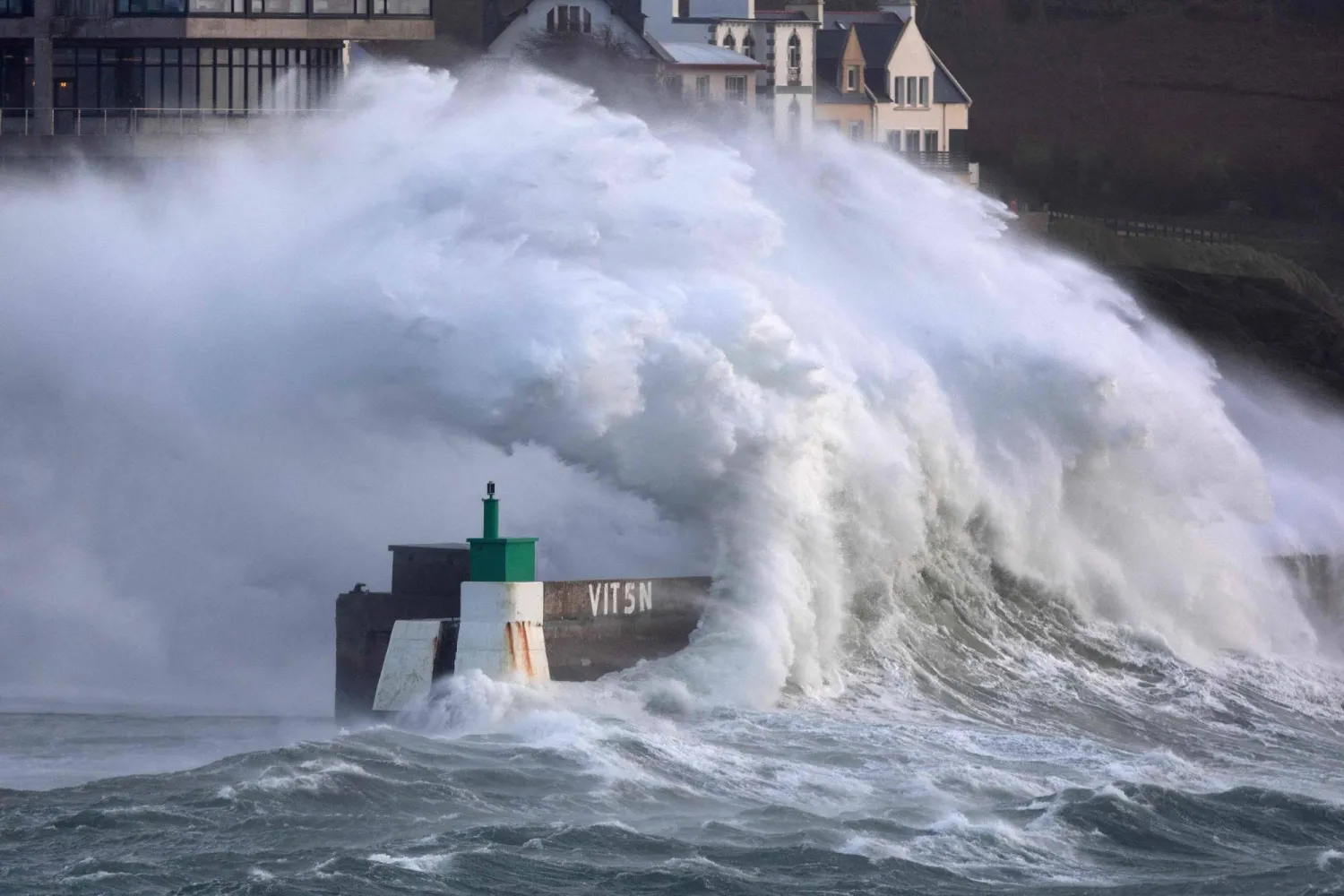
A huge wave crashes on the jetty of the harbor of Le Conquet, western France on January 8, 2026 as storm Goretti is announced to approach France's northern coasts. (Photo by Fred TANNEAU / AFP)
TT

Hundreds of Thousands without Power as Storm Goretti Pummels Europe

A huge wave crashes on the jetty of the harbor of Le Conquet, western France on January 8, 2026 as storm Goretti is announced to approach France's northern coasts. (Photo by Fred TANNEAU / AFP)

Fierce winds battered France and Britain on Friday as Storm Goretti barreled through northern Europe, cutting power to hundreds of thousands of households in plunging winter temperatures.

Forecasters from Britain to Germany urged people to stay inside as they issued weather warnings, including the rare, highest-level red wind alert for the British Isles of Scilly and Cornwall in southwestern England, AFP said.

In France, some 380,000 households lost power, the vast majority in the northern Normandy region, the Enedis power provider said, while the BBC said some 65,000 households lost electricity in Britain.

Overnight, wind gusts of 216 and 213 kilometers per hour (134 miles, 132 miles ) were registered in France's northwestern Manche region, authorities said.

The squalls felled trees in several regions, with at least one crashing on residential buildings in France's Seine-Maritime region, without injuries, authorities said.

Gusts of up to 160 kilometers (100 miles) per hour were expected in parts of Britain and "very large waves will bring dangerous conditions to coastal areas", Britain's Met Office said.

It also issued an amber snow warning in Wales, central England and parts of northern England, predicting snow of up to 30 centimeters (11 inches) in some areas.

The UK's National Rail has said train services will be affected over the next two days, and called on people to avoid travel unless necessary.

School cancelled, travel disruption

Schools remained shut in northern France, where weather alerts have been issued in 30 other regions.

"Take shelter and do not use your vehicle," the Manche prefecture warned on X on Thursday, urging residents to prepare emergency lighting and a drinking water supply.

Europe's current extreme weather conditions have caused at least eight deaths, and on Thursday police in the Albanian city of Durres pulled a man's body from floodwater following days of heavy snow and torrential rain across the Balkans.

In Germany, heavy snow and winds in the north were set to affect schools, hospitals and transport links.

Up to 15 centimeters of snow (six inches) could fall in the north, and there was a risk of icy conditions in the south, according to the German Weather Service (DWD).

Temperatures this weekend could plunge to as low as -20C in certain areas, DWD meteorologist Andreas Walter told AFP.

Some areas have announced schools will shut on Friday, including in the northern cities of Hamburg and Bremen.

In Hamburg, the weather had already caused delays and cancellations on the public transport network on Thursday.

The national rail company Deutsche Bahn warned of significant delays in the coming days and has mobilized more than 14,000 employees to clear snow from tracks and platforms.

'Consequence of climate change'

The DWD said the storm is expected to last until Saturday, with snowfall stopping on Monday.

Walter said the storm was an exception when compared to the last few years of milder winters, which were a "consequence of climate change".

"It's still possible to have a cold month with snow, even as temperatures rise due to climate change, but such events will become rarer in the future," he said.



Dinosaur Fossils in Brazil Reveal New Giant Species

An employee works at the excavation site where dinosaur bones were found in Davinopolis, Maranhao state, Brazil, April 28, 2021. Giovani de Toledo Viecili/Handout via REUTERS
TT

Dinosaur Fossils in Brazil Reveal New Giant Species

An employee works at the excavation site where dinosaur bones were found in Davinopolis, Maranhao state, Brazil, April 28, 2021. Giovani de Toledo Viecili/Handout via REUTERS

Brazilian scientists have identified a new species of giant dinosaur with ties to a similar animal found in Spain, reinforcing knowledge that land routes once connected parts of South America, Africa and Europe about 120 million years ago.

Named Dasosaurus tocantinensis, the species is one of the biggest found in the South American country and was described this month in the Journal of Systematic Palaeontology, Reuters reported.

The fossils were uncovered in 2021 at a site hosting infrastructure works near Davinopolis, in Brazil's northeastern state of Maranhao, and the research was led by Elver Mayer of the Federal University of the Sao Francisco Valley.

The remains include a femur measuring about 1.5 meters (59 inches), which helped researchers estimate the animal stretched roughly 20 meters long.

"As the excavation progressed over the days, we began to see the evidence of that huge bone, which is the femur," said Leonardo Kerber, a paleontologist at the Federal University of Santa Maria (UFSM) who contributed to the research.

"This indicates it was a very large dinosaur. Today we know Dasosaurus is among the biggest dinosaurs ever found in Brazil," he noted.

According to UFSM, analysis indicated the species is the closest known relative of Garumbatitan morellensis, a dinosaur described in Spain.

Their lineage was European and may have dispersed into what is now South America roughly 130 million years ago, likely via northern Africa, before the Atlantic fully opened, the university said.

Dasosaurus tocantinensis's name combines references to the region where the dinosaur was found, including the Tocantins River, a major waterway whose eastern margins lie near the fossil site.


German Philosopher Jurgen Habermas Dies Age 96

German philosopher Professor Juergen Habermas makes a speech during the awards ceremony for the "Understanding and Tolerance" prize at the Jewish museum in Berlin, November 13, 2010. REUTERS/Odd Andersen/Pool/File Photo
TT

German Philosopher Jurgen Habermas Dies Age 96

German philosopher Professor Juergen Habermas makes a speech during the awards ceremony for the "Understanding and Tolerance" prize at the Jewish museum in Berlin, November 13, 2010. REUTERS/Odd Andersen/Pool/File Photo

The German philosopher Jurgen Habermas has died, a spokesperson for his publishing house, Suhrkamp Verlag, told AFP on Saturday.

He died at the age of 96 in Starnberg, in southern Germany, she said, citing information from the family of the politically engaged theorist.

Habermas was considered the most influential German philosopher of his generation, involved in all the major postwar debates and seeing a united Europe, in his view, as the only remedy for the rise of nationalism, AFP reported.

In his later years, he devoted himself to promoting a federal European project and prevent the continent from falling, as it did in the 20th century, into nationalist rivalries.

Throughout his life, Habermas linked philosophy and politics, thought and action.

After serving as the voice of German student protest in the 1960s, he became its target thirty years later while warning of the risks of "left-wing fascism".

In 1989, he criticised the terms of German reunification, guided essentially by the demands of the market, and which made "the Deutsche mark its standard."

Born on June 18, 1929 in Duesseldorf, Habermas had been enrolled in the Hitler Youth, but he was too young to have taken an active part in the war. As a teenager, he was deeply marked by the collapse of Nazism.


Research Reveals Decades-Long Silverpit Crater Triggered by Tsunami 40 Million Years Ago

A massive asteroid struck the North Sea millions of years ago (Getty)
TT

Research Reveals Decades-Long Silverpit Crater Triggered by Tsunami 40 Million Years Ago

A massive asteroid struck the North Sea millions of years ago (Getty)

A long-running dispute about the origin of a North Sea crater has finally been settled, as new research finds a massive asteroid hit the water and triggered a towering tsunami millions of years ago.

Scientists have found that the Silverpit Crater – which lies around 700 meters beneath the southern North Sea seabed, roughly 80 miles off the coast of Yorkshire – was formed when an asteroid or comet struck the region roughly 43 to 46 million years ago, sparking a 330 feet tsunami.

Since geologists first identified the formation in 2002, the 3km-wide crater and its surrounding ring of circular faults spanning about 20 km have sparked intense debate, according to The Independent.

But researchers say their new study marks the clearest evidence yet that the structure is one of Earth’s rare impact craters.

This confirmation places it in the same category as well-known structures such as the Chicxulub Crater in Mexico, which is linked to the dinosaur mass extinction.

The team used computer modelling and analyzed newly available seismic imaging and microscopic geological samples taken from beneath the seabed.

Dr. Uisdean Nicholson, a sedimentologist in Heriot-Watt University’s School of Energy, Geoscience, Infrastructure and Society, who led the investigation, said: “New seismic imaging has given us an unprecedented look at the crater.”

He said samples from an oil well in the area also revealed rare ‘shocked’ quartz and feldspar crystals at the same depth as the crater floor.

“We were exceptionally lucky to find these – a real ‘needle-in-a-haystack’ effort. These prove the impact crater hypothesis beyond doubt, because they have a fabric that can only be created by extreme shock pressures,” said Nicholson.

The scientists say these microscopic minerals form only under the extreme pressures generated during asteroid impacts, providing strong confirmation of the event.

Early research proposed that the feature was created by a high-speed asteroid impact. Supporters of that idea pointed to its round shape, central peak, and surrounding concentric faults, which are often seen in known impact craters.

But other scientists suggested different explanations. Some proposed that underground salt movement distorted the rock layers and created the structure.

Others argued that volcanic activity may have caused the seabed to collapse.

In 2009, geologists even voted on the issue. According to a report in the December 2009 issue of Geoscientist magazine, most participants rejected the asteroid impact explanation at the time.

The latest findings, published in the journal Nature Communications and funded by the Natural Environment Research Council (NERC), now appear to overturn that conclusion.

Dr. Nicholson said: “Our evidence shows that a 160-meter-wide asteroid hit the seabed at a low angle from the west.”

“Within minutes, it created a 1.5 km high curtain of rock and water that then collapsed into the sea, creating a tsunami over 100 meters high.”

The impact would have produced a violent explosion at the seafloor and sent enormous waves spreading across the region.

Professor Gareth Collins, of Imperial College London, who attended the 2009 debate about the crater’s origin and contributed to the new research, said the researchers have “finally found the silver bullet” to end the debate.

He said: “I always thought that the impact hypothesis was the simplest explanation and most consistent with the observations.”

“It is very rewarding to have finally found the silver bullet. We can now get on with the exciting job of using the amazing new data to learn more about how impacts shape planets below the surface, which is really hard to do on other planets,” Collins added.

Dr. Nicholson also expressed his excitement about using the new findings for further research into asteroids.

“Silverpit is a rare and exceptionally preserved hypervelocity impact crater,” he said.

“These are rare because the Earth is such a dynamic planet – plate tectonics and erosion destroy almost all traces of most of these events.”