Experts Say Oceans Soaked up Record Heat Levels in 2025

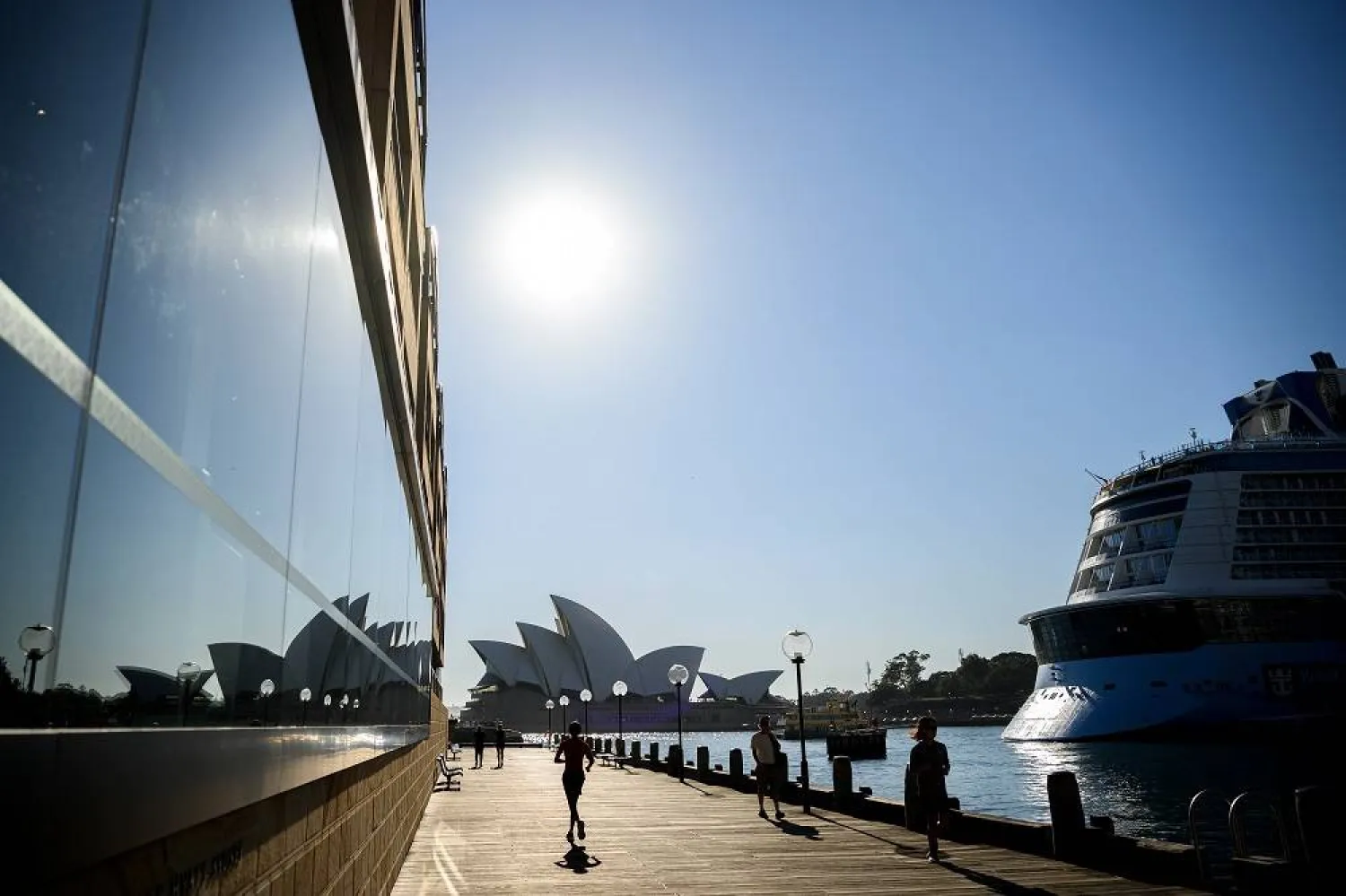
People exercise along Sydney Harbour, Australia, 08 January 2026. (EPA)
TT

Experts Say Oceans Soaked up Record Heat Levels in 2025

People exercise along Sydney Harbour, Australia, 08 January 2026. (EPA)

The world's oceans absorbed a record amount of heat in 2025, an international team of scientists said Friday, further priming conditions for sea level rise, violent storms, and coral death.

The heat that has accumulated in the oceans last year increased by approximately 23 zettajoules -- an amount equivalent to nearly four decades of global primary energy consumption.

This finding -- published in the journal Advances in Atmospheric Sciences -- was the highest reading of any year since modern record keeping began in the early 1950s, researchers said.

To derive these calculations, more than 50 scientists from 31 research institutions used multiple sources including a thousands-strong fleet of floating robots that track ocean changes to depths of 2,000 meters.

Peering into the depths, rather than fluctuations at the surface, provides a better indicator of how oceans are responding to "sustained pressure" from humanity's emissions, said study co-author Karina von Schuckmann.

"The picture is clear: results for 2025 confirm that the ocean continues to warm," von Schuckmann, an oceanographer from French research institute Mercator Ocean International, told AFP.

Oceans are a key regulator of Earth's climate because they soak up 90 percent of the excess heat in the atmosphere caused by humanity's release of greenhouse gases like carbon dioxide.

All that additional energy has a powerful knock-on effect. Warmer oceans increase moisture in the atmosphere, providing fuel for tropical cyclones and destructive rainfall.

Hotter seas also directly contribute to sea level rise -- water expands when it warms up -- and make conditions unbearable for tropical reefs, whose corals perish during prolonged marine heatwaves.

"As long as the Earth continues to accumulate heat, ocean heat content will keep rising, sea level will rise and new records will be set," said von Schuckmann.

- Humanity's choice -

Ocean warming is not uniform, with some areas warming faster than others.

The tropical oceans, the South Atlantic, the Mediterranean, the northern Indian Ocean, and the Southern Ocean were among waters that absorbed record amounts of heat in 2025.

This occurred even as average sea surface temperatures decreased slightly in 2025 -- yet still remained the third-highest value ever measured.

This decrease is explained by the shift from a powerful, warming El Nino event in 2023-2024 to La Nina-type conditions generally associated with a temporary cooling of the ocean surface.

In the long term, the rate of ocean warming is accelerating due to a sustained increase in greenhouse gas concentrations in the atmosphere caused mainly by burning fossil fuels.

As long as global warming is not addressed and the amount of heat trapped in the atmosphere keeps rising, oceans will keep breaking records, the researchers said.

"The greatest uncertainty in the climate system is no longer the physics, but the choices humanity makes," said von Schuckmann.

"Rapid emission reductions can still limit future impacts and help safeguard a climate in which societies and ecosystems can thrive."


Turkish Border Region Feels Economic Fallout from Iran

Turkiye shares 550km of border with Iran, including 300km in the province of Van alone and traditionally, Van, the capital of the province. (AFP)
TT

Turkish Border Region Feels Economic Fallout from Iran

Turkiye shares 550km of border with Iran, including 300km in the province of Van alone and traditionally, Van, the capital of the province. (AFP)

As vice-president of the chamber of commerce in the eastern Turkish city of Van, Fevzi Celiktas's job is to boost the local economy. But he has one major problem: his neighbors.

"We have some of the most feared countries in the world right on our doorstep: Iraq, Syria, and Iran," he told AFP.

"This greatly complicates our development."

Celiktas is not indifferent to the fate of Iranians who cross to the Turkish side of the border after the ruthless repression of protests in January.

But the collapse of their economy and currency, which sparked the popular uprising, is being felt acutely in the province.

Türkiye shares a 550-kilometer (342-mile) border with Iran, 300 of which flank Van province, with the main pedestrian border crossing of Kapikoy just a 90-minute drive from the provincial capital, also called Van.

The latest crisis is another blow to the struggling economy in this region of 1.1 million people which lies at the eastern end of Anatolia.

Perched on the eastern shores of Lake Van and surrounded by snow-capped mountains, the city of Van has traditionally offered escape and relaxation for Iranian tourists.

Visitors come to shop, enjoy the local bars or take out boats on Türkiye’s largest lake, which is also the second-largest in the Middle East.

"Iranian tourists are our main clientele," said Emre Deger, head of Van's tourism professionals association, whose own hotel has seen occupancy rates decline year after year.

Even though winter is the low season, a third of its rooms are usually occupied, he explained.

"But currently, all the hotels are empty or at 10 percent of capacity at best," he added.

- 'For the internet' -

For eight to 10 days after the crackdown on Iranian protesters when there was an internet blackout, the flow of visitors "completely dried up", Deger said.

"Those who came were just here for the internet," he added.

Every morning when the Kapikoy crossing opens, a few dozen travelers arrive in the cold, wearily boarding buses or taxis headed for Van.

Apart from a handful of students and the odd few with long-term plans outside of Iran, not many are prepared to speak, quickly scurrying off to discreet hotels where they keep to themselves.

"Most even hesitate to go out to get food," said Deger, who is waiting for March 21 when Iranians mark Nowruz, Persian New Year, to see if the tourists will return.

One Iranian woman in her 30s from the northwestern city of Tabriz said she understood the decline in visitors.

"There's no middle class left in Iran. We're all at the bottom, the very bottom," she said, without giving her name.

"Everyone is poor."

Back in Iran, she used to work in insurance, but now has a job at an elegant café in downtown Van.

"In the whole of January, I saw maybe two Iranians here," she said.

- 'Our money is worthless' -

"Two years ago, when you came to Türkiye with 5 or 10 million rials ($4-$8), you were fine. Now you need at least 40 or 50 million rials. Hotels, food, everything has become more expensive for us.

"Our money is worthless now."

The monthly salary she earned in Iran would barely last three days in Van today, she added.

"Our customers used to fill entire suitcases with clothes (to take home). But it's very quiet now," said Emre Teker in his clothing store.

Celiktas also blamed US and European sanctions for crippling Iran's economy -- and Van's.

"The Van bypass still isn't finished after 18 years of construction," he said. "It's become a joke, sometimes written on the back of trucks: 'May our love be like the Van bypass and never end'."

If a country faces trade restrictions for decades, it inevitably has consequences, he said.

"In a neighborhood, if your neighbor bothers you, you can move. But you can't do that with countries: you can't replace Iran with Germany, Italy, France, or Russia," he said.

"So you have to reach some sort of agreement."


Taiwan Zoo's Endangered Horses Set to Gallop into Lunar New Year Spotlight

A Przewalski's horse, also known as the Mongolian wild horse, roams in its enclosure at Taipei Zoo in Taipei, Taiwan February 5, 2026. REUTERS/Tsai Hsin-Han
TT

Taiwan Zoo's Endangered Horses Set to Gallop into Lunar New Year Spotlight

A Przewalski's horse, also known as the Mongolian wild horse, roams in its enclosure at Taipei Zoo in Taipei, Taiwan February 5, 2026. REUTERS/Tsai Hsin-Han

Taiwan's premier zoo aims to grab the spotlight this Lunar New Year with its efforts to protect an endangered species of horse native to central Asia that was once extinct in the wild.

The festival ushering in the Year of the Horse will draw attention to the zoo's four specimens of Przewalski's horse, named for a Russian geographer who first encountered them in the late 19th century across a narrowed range in western Mongolia.

"Visitors will look at the horses and think ‌that since ‌this is the Year of the Horse, 'I ‌want ⁠to get ‌to know horses,'" said zookeeper Chen Yun-chieh, who has spent five years looking after the animals.

The Year of the Horse in the Chinese zodiac begins on February 17, ushered in with celebrations in Taiwan, China, South Korea and many parts of Southeast Asia.

"The happiest thing is that, when I show up, they come ⁠right over to me," added Chen, 34, who has a close bond with the animals, ‌and held talks this year to ‍better acquaint zoo visitors with ‍them.

Przewalski's horse, usually brown in color, smaller and shorter than ‍its domesticated relative, had disappeared from the wild by the end of the 1960s, but some remained in captivity.

Usually considered too wild to be ridden, they were reintroduced in China, Kazakhstan, and western Mongolia, and now number 850 across the region.

Taipei Zoo has worked with the Czech Republic's Prague Zoo, which tracks ⁠breeding efforts for the species, to aid a global campaign to protect the horse, with moves such as helping to arrange a 2018 release of horses in Mongolia by the Czech zoo, Reuters reported.

Chen is experienced in the care of other endangered species, such as white rhinos and giraffes.

Many visitors may mistake the horses, also known as the Mongolian wild horse, for the steeds that carried 13th-century ruler Genghis Khan on his raids of conquest, he said.

"But actually they were not," added Chen. "So visitors can take ‌this chance to learn that they're a different species."


Study: Pandemic Disruptions to Health Care Worsened Cancer Survival

FILE - A radiologist uses a magnifying glass to check mammograms for breast cancer in Los Angeles, May 6, 2010. (AP Photo/Damian Dovarganes, File)
TT

Study: Pandemic Disruptions to Health Care Worsened Cancer Survival

FILE - A radiologist uses a magnifying glass to check mammograms for breast cancer in Los Angeles, May 6, 2010. (AP Photo/Damian Dovarganes, File)

During the early years of the COVID-19 pandemic, experts worried that disruptions to cancer diagnosis and treatment would cost lives. A new study suggests they were right.

The federally funded study published Thursday by the medical journal JAMA Oncology is being called the first to assess the effects of pandemic-related disruptions on the short-term survival of cancer patients.

Researchers found that people diagnosed with cancer in 2020 and 2021 had worse short-term survival than those diagnosed between 2015 and 2019. That was true across a range of cancers, and whether they were diagnosed at a late or early stage.

Of course, COVID-19 itself was especially dangerous to patients already weakened by cancer, but the researchers worked to filter out deaths mainly attributed to the coronavirus, so they could see if other factors played a role, The Associated Press reported.

The researchers were not able to definitively show what drove worse survival, said Todd Burus of the University of Kentucky, the study’s lead author.

“But disruptions to the health care system were probably a key contributor,” said Burus, who specializes in medical data analysis.

COVID-19 forced many people to postpone cancer screenings — colonoscopies, mammograms and lung scans — as the coronavirus overwhelmed doctors and hospitals, especially in 2020.

Earlier research had shown that overall cancer death rates in the US continued to decline throughout the pandemic, and there weren’t huge shifts in late diagnoses.

Recinda Sherman, a researcher on that earlier paper, applauded the new work.

“As this study is the first to document pandemic-related, cause-specific survival, I think it is important," said Sherman, of the North American Association of Central Cancer Registries. “The more we understand about the impact of COVID-19, the better we will be able to prepare for the next one.”

How could overall cancer death rates decline in 2020 and 2021, while short-term survival worsen for newly diagnosed patients?

Cancer prevention, diagnosis and treatment measures that for years had been pushing cancer death rates down did not suddenly disappear during the pandemic, Burus noted.

“We didn’t forget how to do those things," he said. “But disruptions could have changed access, could have changed how quickly people were getting treated.”

Further research will show if any impact was lasting, said Hyuna Sung, senior principal scientist and cancer epidemiologist at the American Cancer Society.

“Transient declines in survival that quickly recover may have little impact on long-term mortality trends," she said.

The new study tapped national cancer registry data to focus more specifically on patients who had a first diagnosis of a malignant cancer in 2020 and 2021.

More than 1 million people were diagnosed with cancer in those two years, and about 144,000 died within one year, according to the researchers' data.

The researchers looked at one-year survival rates for those patients, checking for what stage they were at the time of diagnosis.

They calculated that one-year survival was lower for both early- and late-stage diagnoses, for all cancer sites combined. Most worrisome were large differences seen in colorectal, prostate and pancreatic cancers, they said.

Overall, the researchers found that more than 96% of people who got an early-stage cancer diagnosis in 2020 and 2021 — and more than 74% of those with a late-stage diagnosis — survived more than a year. Those rates were slightly lower than would have been expected based on 2015-2019 trends, resulting in about 17,400 more deaths than expected.