


Massive Iconic Iceberg 'on Verge of Complete Disintegration'

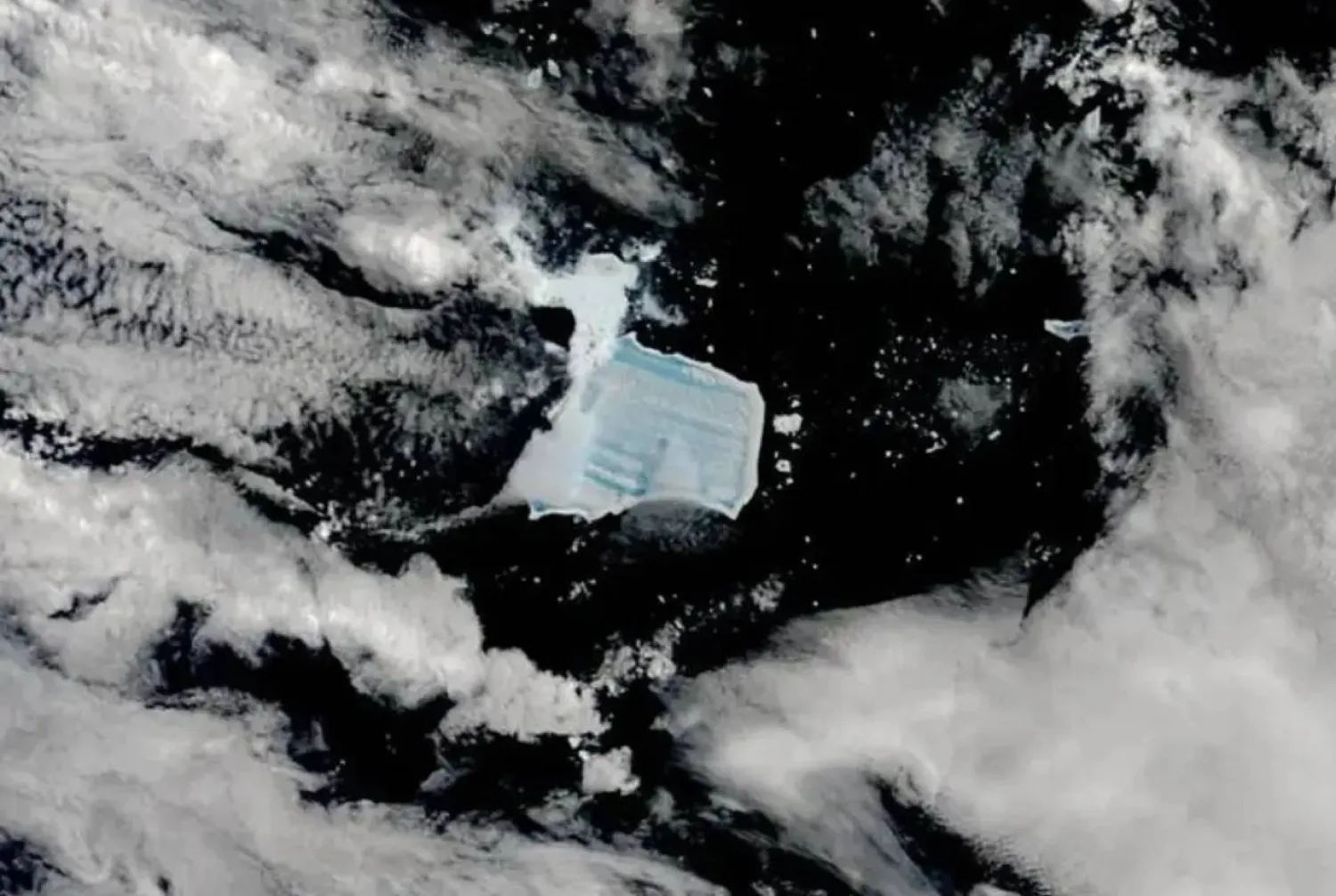
Iceberg A23a has turned blue and is “on the verge of complete disintegration,” NASA said. This photo was taken on December 26, 2025 (NASA)
TT

Massive Iconic Iceberg 'on Verge of Complete Disintegration'

Iceberg A23a has turned blue and is “on the verge of complete disintegration,” NASA said. This photo was taken on December 26, 2025 (NASA)

One of the largest and oldest icebergs ever tracked by scientists has turned blue and is “on the verge of complete disintegration,” NASA said on Thursday.

A23a, a massive wall of ice that was once twice the size of Rhode Island, is drenched in blue meltwater as it drifts in the South Atlantic off the eastern tip of South America, NASA said in a new release, according to CBS News.

A NASA satellite captured an image of the fading berg the day after Christmas, showing pools of blue meltwater on its surface. A day later, an astronaut aboard the International Space Station captured a photograph showing a closer view of the iceberg, with an even larger melt pool.

The satellite image suggests that the A23a has also “sprung a leak,” NASA said, as the weight of the water pooling at the top of the berg punched through the ice.

Scientists say all signs indicate the so-called “megaberg” could be just days or weeks from totally disintegrating as it rides currents that are pushing it toward even warmer waters.

Warmer air temperatures during this season could also speed up A23a's demise in an area that ice experts have dubbed a “graveyard” for icebergs.

“I certainly don't expect A-23A to last through the austral summer,” retired University of Maryland, Baltimore County scientist Chris Shuman said in a statement.

Blue and white linear patterns visible on A23a are likely related to striations, which are ridges that were scoured hundreds of years ago when the iceberg was part of the Antarctic bedrock, NASA said.

“The striations formed parallel to the direction of flow, which ultimately created subtle ridges and valleys on the top of the iceberg that now direct the flow of meltwater,” said Walt Meier, a senior research scientist at the National Snow & Ice Data Center.

The berg detached from Antarctica in 1986. It remained stuck for over 30 years before finally breaking free in 2020.

According to current estimates from the US National Ice Center, in early January 2026, the berg's area is 1,182 square kilometers -- still larger than New York City but a fraction of its initial size.



Prince William Shares a Post Remembering His Late Mother Princess Diana on UK Mother’s Day

The prince, 43, posted a photo showing Diana with a 2-year-old William in a field of flowers that was taken at the family’s main home at Highgrove, Gloucestershire, in 1984. (Kensington Royal/X)
TT

Prince William Shares a Post Remembering His Late Mother Princess Diana on UK Mother’s Day

The prince, 43, posted a photo showing Diana with a 2-year-old William in a field of flowers that was taken at the family’s main home at Highgrove, Gloucestershire, in 1984. (Kensington Royal/X)

Prince William said Sunday he remembers his late mother Princess Diana “today and every day” as he shared a photo of them together on social media to mark Mother's Day in the UK.

“Remembering my mother, today and every day. Thinking of all those who are remembering someone they love today. Happy Mother’s Day,” the royal wrote on Instagram, signing off with “W.”

The prince, 43, posted a photo showing Diana with a 2-year-old William in a field of flowers that was taken at the family’s main home at Highgrove, Gloucestershire, in 1984.

Diana was killed in a car crash in Paris in August 1997, when William was 15 and his brother Prince Harry was 12. She was 36.

The royal family also posted other photos on social media to mark Mothering Sunday, which is celebrated in the UK on the fourth Sunday of Lent.

They included a black-and-white photo from 1953 of the late Queen Elizabeth II sitting on a garden bench with King Charles III and his sister Anne, the Princess Royal — both still young children at the time — at Balmoral in Scotland.


Australian Government Deploys Military to Assist Flood-Hit Northern Territory

 Australian Prime Minister Anthony Albanese addresses a press conference at Parliament House in Canberra, Australia, Tuesday, March 10, 2026. (Mick Tsikas/AAP Image via AP)
Australian Prime Minister Anthony Albanese addresses a press conference at Parliament House in Canberra, Australia, Tuesday, March 10, 2026. (Mick Tsikas/AAP Image via AP)
TT

Australian Government Deploys Military to Assist Flood-Hit Northern Territory

 Australian Prime Minister Anthony Albanese addresses a press conference at Parliament House in Canberra, Australia, Tuesday, March 10, 2026. (Mick Tsikas/AAP Image via AP)
Australian Prime Minister Anthony Albanese addresses a press conference at Parliament House in Canberra, Australia, Tuesday, March 10, 2026. (Mick Tsikas/AAP Image via AP)

Australia's Prime Minister Anthony Albanese said on Sunday that troops would be deployed to help communities hit by a days-long flood emergency in the country's north.

Albanese said the center-left government had approved deployment of Australian Defense Force personnel to ‌help communities around the ‌flood-hit Northern Territory ‌town ⁠of Katherine, about 264km (164 ⁠miles) south of territory capital Darwin.

"To everyone doing it tough right now, know we are with you through the response and through the ⁠recovery," Albanese said on social ‌media ‌platform X.

Emergency Services Minister Kristy McBain ‌said in televised remarks that ‌the troops would be deployed for up to 14 days.

Authorities, grappling with floods sparked by ‌heavy rain in the Northern Territory and neighboring Queensland ⁠state, ⁠said this week they recovered two bodies in a search for two Chinese backpackers who went missing in floods in Queensland's Gympie region.

Climate change is causing heavy short-term rainfall events to become more intense in Australia, the country’s science agency has previously said.


The Environment, Another Casualty of War in the Mideast

Experts say that war harms the climate and pollutes the air, water and soil.  AFP
Experts say that war harms the climate and pollutes the air, water and soil. AFP
TT

The Environment, Another Casualty of War in the Mideast

Experts say that war harms the climate and pollutes the air, water and soil.  AFP
Experts say that war harms the climate and pollutes the air, water and soil. AFP

From the jet fuel used in bombing raids to acrid smoke from burning oil depots, the conflict in the Middle East is inflicting a significant toll on nature and the climate.

AFP interviewed experts about the environmental cost of war that often goes under the radar:

- Bombers and warships -

US and Israeli aircraft use a considerable amount of fuel reaching the Gulf and flying sorties over Iran, said Benjamin Neimark at the Queen Mary University of London.

Deploying stealth bombers and fighter jets around the clock adds a significant amount of planet-warming greenhouse gas emissions into the atmosphere.

"The US Navy also has a significant fleet which will be operating remotely for some time," Neimark told AFP.

"That is a significant number of US troops that need to be fed, housed, and working around the clock. These floating cities all need energy."

This is provided in part by polluting diesel generators, even if most larger aircraft carriers are nuclear powered, an energy source that produces far less emissions than fossil fuels.

But many experts take into account everything from the manufacture of weapons and explosives to post-war reconstruction efforts when estimating the total environmental impact of conflict.

According to one study published in the peer-reviewed journal One Earth, the Gaza conflict generated some 33 million tons of carbon dioxide equivalent -- an amount comparable to 7.6 million gasoline-powered cars, or the annual emissions of a small country like Jordan.

And by one estimate, the war in Ukraine has caused more than 300 million tons of additional emissions -- equivalent to France's annual output.

This estimate, by the Initiative on GHG Accounting of War, takes into account military operations and reconstruction efforts, forest fires, and longer flight routes.

- Climate cost -

This conflict is playing out on the Strait of Hormuz, a crucial artery for the passage of oil and gas supplies to global markets dependent on energy from the Gulf.

Ships transporting these highly flammable fuels through the narrow waterway -- along with the region's oil and gas refineries and storage facilities -- were "all a target" in this war, said Neimark.

"Clearly this conflict is different," he said.

"We have already seen a significant amount of refineries targeted. These toxic flames are deadly and have a severe climate cost."

The oil wells set ablaze in Kuwait in the 1990s during the first Gulf War took months to extinguish and released an estimated 130 to 400 million tons of CO2 equivalent.

- Ripple effect -

Since erupting on February 28, the conflict has sent oil prices soaring and focused fresh attention on the global transition to cleaner, more climate-friendly forms of energy.

Andreas Rudinger, from the Institute for Sustainable Development and International Relations, said the economic knock-on effects of the war had put policy makers "under pressure to reduce the burden on prices over climate action".

Brussels has faced pressure to relax its emissions trading rules in response to surging energy prices, while other governments have taken steps to help motorists fill up at the pump.

But there's also a "glass half-full perspective", said Rudinger.

"From a purely economic standpoint... rising fossil fuel prices make decarbonization and electrification solutions more attractive," he said.

He pointed to the rise in popularity of heat pumps in the aftermath of Russia's invasion of Ukraine, which caused energy prices in Europe to rise sharply.

In general, the increase in energy costs stemming from the war in the Middle East should temper demand in what economists call price elasticity.

- Pollution risks -

Apart from climate concerns, strikes on energy infrastructure, oil tankers and military targets pollute the surrounding air and water and spread highly toxic chemicals far and wide, experts say.

In Tehran, attacks on fuel depots last weekend plunged the capital into darkness as poisonous black clouds rose from burning oil facilities.

Mathilde Jourde, from the Institute for International and Strategic Relations (IRIS), said targeting nuclear, military and energy sites had "extremely polluting" consequences for air, water and soil.

"We're just scratching the surface but can already see that there are hundreds of damaged facilities in Iran and neighboring countries that pose pollution risks to people and the environment," Doug Weir, director of the Conflict and Environment Observatory (CEOBS), told AFP.

"We have particular concerns around damaged oil infrastructure, military facilities and the sensitive marine environment of the Arabian Gulf."