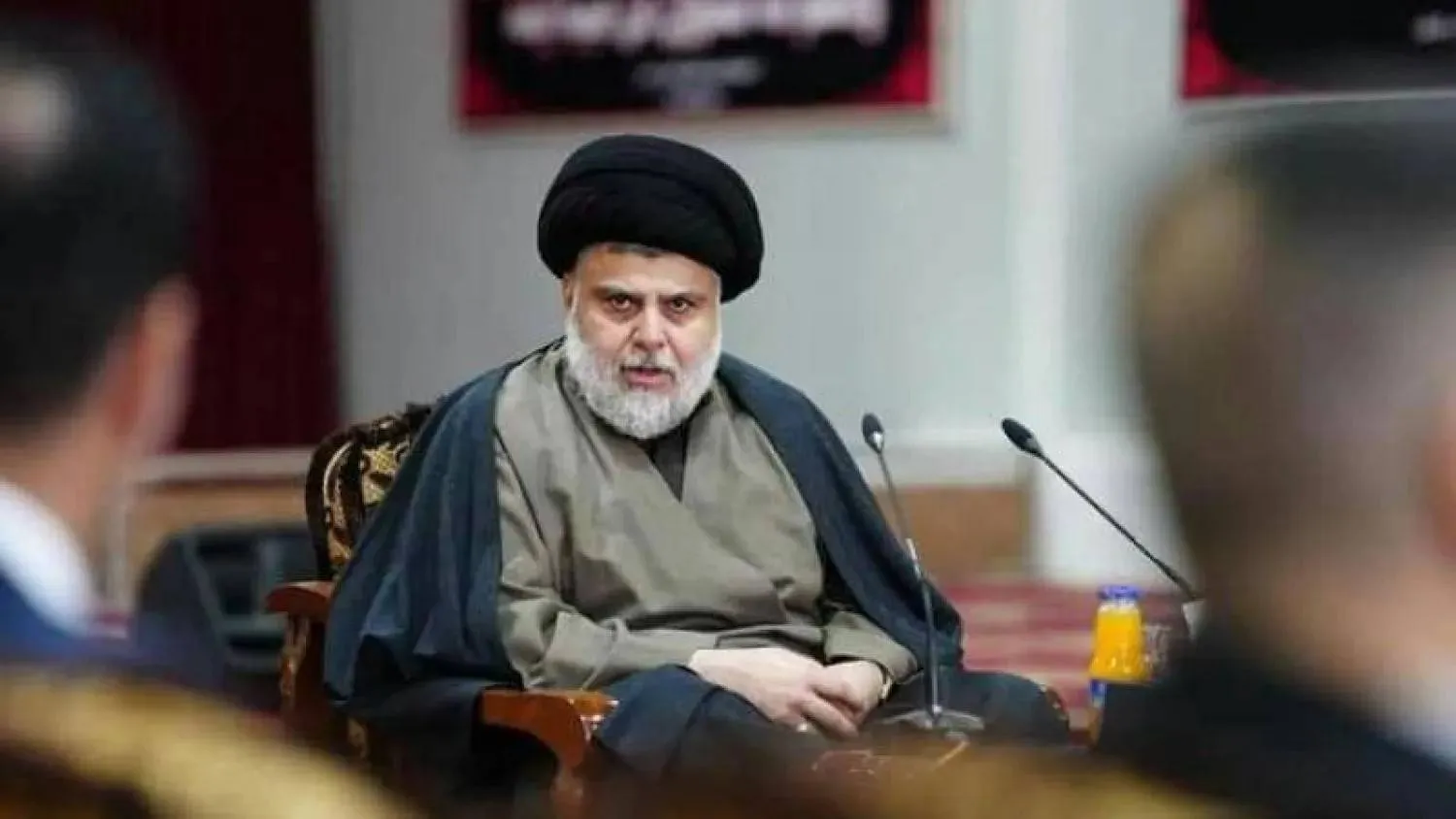

Shiite cleric Moqtada al-Sadr, leader of the Shiite National Current, has offered what amounts to an amnesty to a group of former followers who had broken away from his movement and joined armed factions, most of which have strained relations with him.
The majority of leaders and fighters in the Shiite armed factions trace their origins to the religious authority of the late Mohammed Sadiq al-Sadr, the father of Moqtada al-Sadr.
Among them is Qais al-Khazali, secretary general of Asaib Ahl al-Haq, who had been one of al-Sadr’s aides before defecting in mid-June 2006, as did other faction leaders. Local and regional interventions, particularly by Iran, played a significant role in those defections, as part of broader efforts to weaken al-Sadr and his movement.
Al-Sadr’s remarks came in response to a question submitted by a “group from Baghdad” of his former followers, who asked him to reopen the door for their return to his movement.
“I am aware of your suffering, and I know your needs,” al-Sadr said. “I am absolutely certain that your affiliation with them is merely physical.”
“I know that your hearts are with us, and your minds are with us. You love the homeland as we love it, and you reject subservience as we reject it,” he added.
“Just as your hearts are with us, my heart is with you. I have not forgotten you in my prayers for success, guidance, and righteousness.”
“You are welcome whenever you wish. Whoever does not wish to return may remain among them, but not be one of them; that is my assumption of you.”
“Yes, my assumption is that you are still faithful to the covenant, the covenant of our father al-Sadr. You are welcome at any time and in any place. The door of the al-Sadr family is always open, as you have always known.”
The open invitation to the “repentant” came just days after the assassination of Hussein al-Alaq, a senior figure in the Sadrist movement and the Peace Brigades, in the southern city of Amarah.
Asaib Ahl al-Haq was accused of involvement in the killing, an allegation denied last week by its secretary general, Qais al-Khazali.
Southern provinces have witnessed rising tensions in recent days between the Sadrist movement and armed factions, particularly following the assassination.
The killing prompted al-Sadr to lift a decision freezing the activities of the Peace Brigades, the armed wing of his movement, in the southern provinces of Basra and Wasit.
On Friday, al-Sadr called for a unified Friday prayer in Amarah, attended by thousands of his supporters, in what appeared to be a direct response to the assassination. Maysan province, whose capital is Amarah, is considered one of the Sadrist movement’s main strongholds in southern Iraq.
The movement dominated the province’s local government for more than 15 years before al-Sadr decided to withdraw his bloc from parliament and refuse participation in the federal government and local administrations.
That move allowed forces from the Coordination Framework, led by Asaib Ahl al-Haq, to expand their influence in the province.
A senior Sadrist figure told Asharq Al-Awsat that al-Sadr’s recent moves “send clear warning messages to his rivals among the armed factions, some of which al-Sadr labels ‘insolent militias.’”
He said lifting the freeze on the Peace Brigades and holding the prayer were also intended as a show of force toward factions “that do not hesitate to commit crimes against Sadrist followers.”
While the Sadrist official played down the likelihood of armed clashes at this stage, he did not rule out the possibility in the future “if those groups continue targeting Sadrist leaders.”
He said the aggressive conduct of some factions cannot be separated from the fears surrounding them, particularly those linked to concerns over Iran’s regional role.
“They are seeking to undermine the strength of the Sadrist movement to prevent it from later filling any vacuum that regional developments may create,” he said.