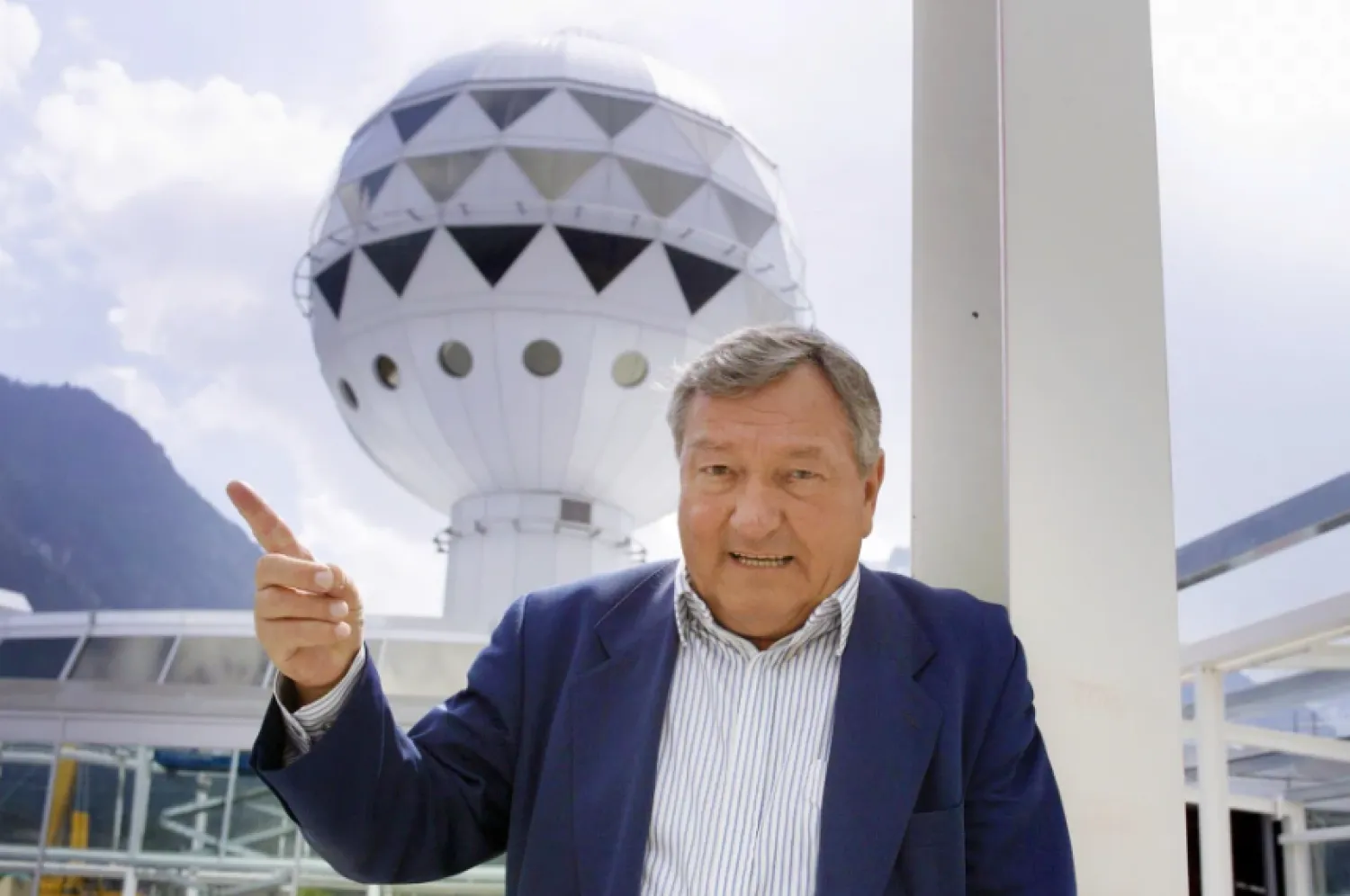
Swiss Author Erich von Daeniken Dies at 90

Erich von Daeniken, co-founder and co-owner of Mystery Park, poses in front of the Panorama Tower at Mystery Park in Interlaken, Wednesday, April 23, 2003. (Gaetan Ball)/Keystone via AP, File)
TT

Swiss Author Erich von Daeniken Dies at 90

Erich von Daeniken, co-founder and co-owner of Mystery Park, poses in front of the Panorama Tower at Mystery Park in Interlaken, Wednesday, April 23, 2003. (Gaetan Ball)/Keystone via AP, File)

Swiss author Erich von Daeniken, who helped popularize the idea that astronauts from outer space visited Earth ​to help lay the foundations for human civilization, has died aged 90.

Swiss media including national broadcaster SRF reported his death, and a note on his website said it occurred on Saturday, The AP news reported.

Von Daeniken rose to ‌prominence with ‌his 1968 book "Chariots of ‌the ⁠Gods?" ​which posited ‌that structures such as the pyramids of Ancient Egypt, Britain's Stonehenge and Peru's Nazca lines were too advanced for their time, and needed outside help.

"In my opinion, ancient structures were made ⁠by humans, not by the extraterrestrials, but it was ‌the extraterrestrials who guided them, ‍who them, ‍who gave them the knowledge how to ‍do it," von Daeniken says in a video on his YouTube channel.

His theories were controversial with historians, scientists and fellow ​writers. But they were popular, and his books, which included "The Gods were ⁠Astronauts", sold nearly 70 million copies worldwide, appearing in more than 30 languages, SRF said.

Von Daeniken argued that ancient religions, myths and art contained evidence that millennia ago, the ancestors of modern humans had made contact with advanced extraterrestrial beings who appeared godlike to them and enabled them to progress.

One ‌day, von Daeniken said, those beings would return.


Four Out of Every 10 Cancer Cases Are Preventable, Says WHO

Visitors walk past a sculpture of a pink ribbon installed to promote the "Pink Ribbon" breast cancer awareness campaign in this illustration, October 5, 2011. (Reuters)
TT

Four Out of Every 10 Cancer Cases Are Preventable, Says WHO

Visitors walk past a sculpture of a pink ribbon installed to promote the "Pink Ribbon" breast cancer awareness campaign in this illustration, October 5, 2011. (Reuters)

Nearly four out of every 10 cancer cases could be prevented if people avoided a range of risk factors including smoking, drinking, air pollution and certain infections, the World Health Organization said Tuesday.

New research published on the eve of World Cancer Day estimated that 38 percent of all new cancer cases globally in 2022 -- 7.1 million -- were linked to preventable causes.

The large team of researchers, which included the WHO's International Agency for Research on Cancer, looked at 30 factors that increase the risk of getting cancer.

Tobacco was the leading offender, responsible for 15 percent of all new cancer cases, followed by cancer-causing infections with 10 percent and drinking alcohol with three percent, according to the study published in the journal Nature Medicine.

Other risk factors included being overweight, a lack of exercise, UV radiation and being exposed to threats such as asbestos while working.

"This is the first global analysis to show how much cancer risk comes from causes we can prevent," senior study author Andre Ilbawi, the WHO's team lead for cancer control, said in a statement.

Almost half of all the preventable cases were lung, stomach or cervical cancer.

Lung cancer was linked to smoking and air pollution, while stomach cancer was largely linked to a bacteria called Helicobacter pylori.

Cervical cancer cases were overwhelmingly caused by human papillomavirus (HPV), which vaccines are effective against.

Men were far more likely to get preventable cancer, with 45 percent of new cases compared to 30 percent for women.

And nearly a quarter of all preventable cancer cases among men were from smoking, compared to 11 percent for women.

To address the problem, the researchers called for countries to adopt strong tobacco control measures and alcohol regulation, and to vaccinate against common infections such as HPV, improve air quality and ensure safer workplaces, healthy diets and exercise.

"If we want to reduce the cancer burden we also need to reduce the noncommunicable disease (NCD) burden -- it is indisputable that tobacco, alcohol, ultra-processed food and air quality are major drivers of multiple kinds of cancer," said Katie Dain, CEO of the NCD Alliance.


Spain to Ban Social Media Access for Children Under 16

FILE PHOTO: Instagram, TikTok, Snapchat, Kick, YouTube, Facebook, Twitch, Reddit, Threads and X applications are displayed on a mobile phone ahead of new law banning social media for users under 16 in Australia, in this picture illustration taken on December 9, 2025. REUTERS/Hollie Adams/Illustration/File Photo
TT

Spain to Ban Social Media Access for Children Under 16

FILE PHOTO: Instagram, TikTok, Snapchat, Kick, YouTube, Facebook, Twitch, Reddit, Threads and X applications are displayed on a mobile phone ahead of new law banning social media for users under 16 in Australia, in this picture illustration taken on December 9, 2025. REUTERS/Hollie Adams/Illustration/File Photo

Spain will ban access to social media for minors under 16 and platforms will be required to implement ‌age verification ‌systems, Prime ‌Minister ⁠Pedro Sanchez said ‌on Tuesday at the World Government Summit in Dubai.

"Our children are exposed to a space they were never meant to navigate ⁠alone... We will no longer ‌accept that," Sanchez said. "We ‍will protect ‍them from the digital ‍Wild West."

He added that his government would also introduce a new bill next week to hold social media executives accountable for illegal and ⁠hateful content.

Australia in December became the first country to ban social media for children under 16.

It's a move being closely watched by other countries considering similar age-based measures, such as Britain and France.


Saudi Media Ministry and SDAIA Launch Key Initiatives at Saudi Media Forum

Officials are seen at the fifth Saudi Media Forum in Riyadh on Monday. (SPA)
TT

Saudi Media Ministry and SDAIA Launch Key Initiatives at Saudi Media Forum

Officials are seen at the fifth Saudi Media Forum in Riyadh on Monday. (SPA)

The Saudi Ministry of Media, in partnership with the Saudi Data and AI Authority (SDAIA), launched on Monday two key initiatives at the fifth Saudi Media Forum in Riyadh.

The Media Innovation Bootcamp (Saudi MIB) and the AI principles in media document were announced by Minister of Media Salman Al-Dossary and SDAIA President Abdullah Alghamdi.

The initiatives aim to enhance the national media ecosystem and integrate artificial intelligence technologies into content creation.

The bootcamp trains a new generation of journalists and content creators in smart journalism tools, emphasizing automated data collection and deepfake detection for accurate reporting.

The AI track enables participants to collaborate with software engineers to create digital characters that mimic human behavior, facilitating 24/7 multilingual broadcasts with real-time audience interaction.

The AI principles in media document provides guidelines for responsible AI use in the media lifecycle. Developed with SDAIA, the Saudi Broadcasting Authority, and the General Authority for Media Regulation, it aims to ensure content integrity, address challenges posed by misleading content and deepfake technologies, and boost efficiency by leveraging AI to accelerate content production and deliver personalized user experiences.

The initiatives represent a partnership between the Ministry of Media and SDAIA to empower national talent and promote responsible technology use, aligned with Saudi Vision 2030.