


Japan Aims to Dig Deep-sea Rare Earths to Reduce China Dependence

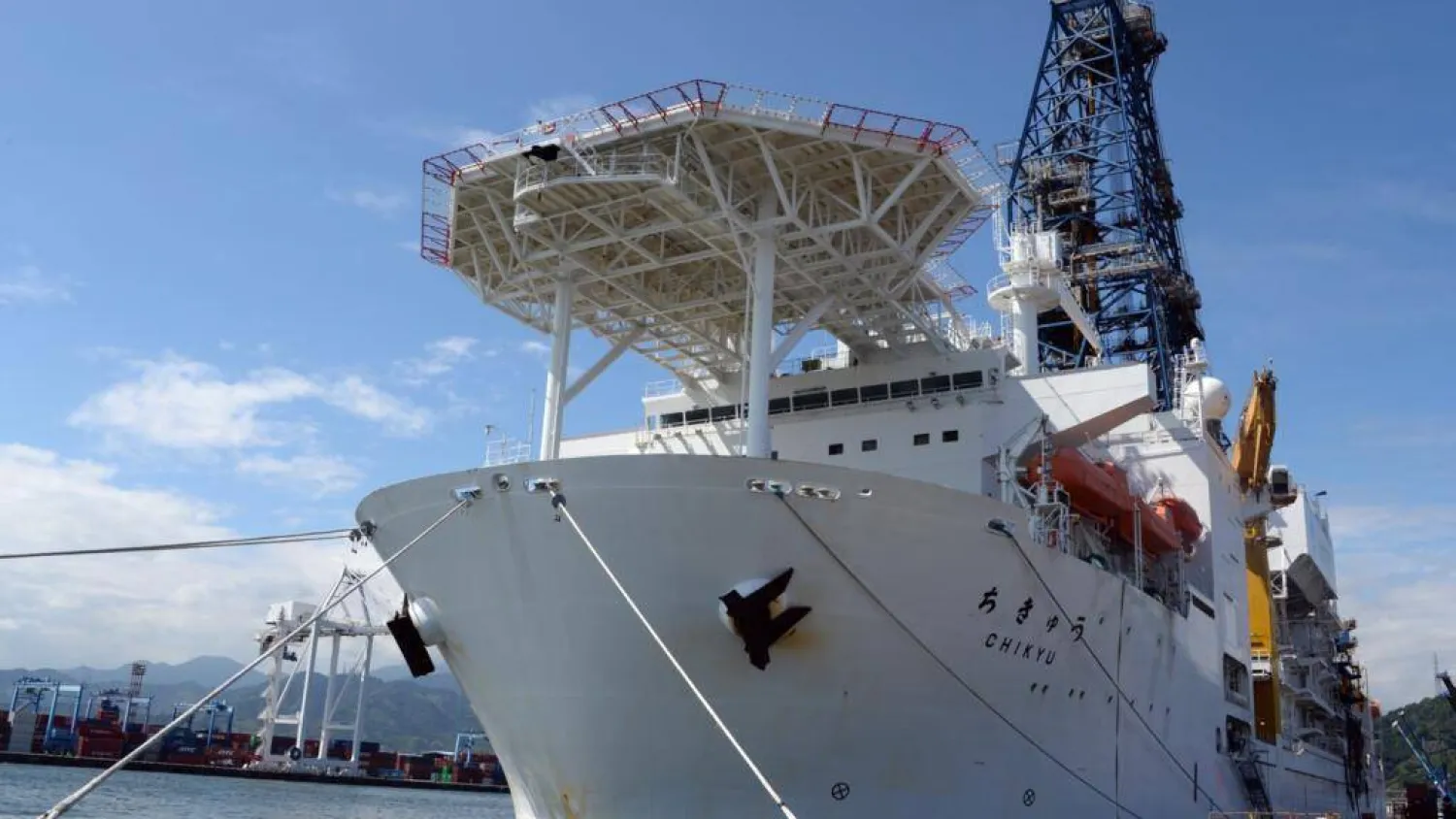
Japan's deep-sea drilling vessel, Chikyu is anchored at a pier in Shimizu port, Shizuoka prefecture on September 11, 2013. TOSHIFUMI KITAMURA / AFP/File
TT

Japan Aims to Dig Deep-sea Rare Earths to Reduce China Dependence

Japan's deep-sea drilling vessel, Chikyu is anchored at a pier in Shimizu port, Shizuoka prefecture on September 11, 2013. TOSHIFUMI KITAMURA / AFP/File

A Japanese research vessel on Monday began a historic voyage to attempt to dig deep-sea rare earths at a depth of 6,000 meters to curb dependence on China.

Scientific drilling boat called the Chikyu left Shimizu Port in Shizuoka around 9:00 am (0000 GMT) for the remote island of Minami Torishima in the Pacific, where surrounding waters are believed to contain a rich trove of valuable minerals.

The test cruise comes as China -- by far the world's biggest supplier of rare earths -- ramps up pressure on its neighbor after Prime Minister Sanae Takaichi suggested in November that Tokyo could react militarily to an attack on Taiwan.

Beijing claims self-ruled Taiwan as part of its territory and has vowed to seize it by force if necessary.

China has long used its dominance in rare earths for geopolitical leverage, including in its trade war with US President Donald Trump's administration.

Chikyu's voyage, delayed by one day due to bad weather, could lead to domestic production of rare earths, said Shoichi Ishii, program director at the Cabinet Office.

"We are considering diversifying our procurement sources and avoiding excessive reliance on specific countries," he told reporters at the port as the ship prepared to leave.

"One approach I believe could be pursued is establishing a process to achieve domestic production of rare earths," he said.

Rare earths -- 17 metals difficult to extract from the Earth's crust -- are used in everything from electric vehicles to hard drives, wind turbines and missiles.

The Japan Agency for Marine-Earth Science and Technology (JAMSTEC) has touted the test as the world's first at such depths.

The area around Minami Torishima, which is in Japan's economic waters, is estimated to contain more than 16 million tons of rare earths, which the Nikkei business daily says is the third-largest reserve globally.

These rich deposits contain an estimated 730 years' worth of dysprosium, used in high-strength magnets in phones and electric cars, and 780 years' worth of yttrium, used in lasers, Nikkei said.

"If Japan could successfully extract rare earths around Minami Torishima constantly, it will secure domestic supply chain for key industries," Takahiro Kamisuna, research associate at The International Institute for Strategic Studies (IISS), told AFP.

"Likewise, it will be a key strategic asset for Takaichi's government to significantly reduce the supply chain dependence on China."

The cruise is scheduled to last until February 14.

Recent media reports said Beijing was delaying Japanese imports as well as rare-earth exports to Tokyo, as their two-month-old spat escalates.

China this month blocked exports to Japan of "dual-use" items with potential military uses, fueling worries in Japan that Beijing could choke supplies of rare earths, some of which are included in China's list of dual-use goods.



US Consumer Prices Likely Increased in February Ahead of Iran Conflict

09 December 2025, Saxony, Dresden: A woman walks into a supermarket. (dpa)
TT

US Consumer Prices Likely Increased in February Ahead of Iran Conflict

09 December 2025, Saxony, Dresden: A woman walks into a supermarket. (dpa)

US consumer prices likely picked up in February as the cost of gasoline increased in anticipation of an escalating war in the Middle East, and with the conflict driving up oil prices, a further rise in inflation is expected in March.

The anticipated increase in the Consumer Price Index last month would also reflect the continued, but staggered pass-through from President Donald Trump's sweeping tariffs, which he pursued under a law meant for use in national emergencies, that have since been struck down by the US Supreme Court.

The Labor Department's consumer inflation report on Wednesday is, however, expected to show underlying price pressures rising moderately last month, thanks to relatively cheaper used motor vehicles and airline fares. It is unlikely to have any impact on near-term monetary policy, with the Federal Reserve expected to keep interest rates unchanged next week.

"The February CPI is likely to show that progress on lowering inflation is stalling out again," said Sarah House, ‌a senior economist at Wells ‌Fargo.

"Although the conflict in the Middle East started at the end of February, oil ‌and ⁠gasoline prices were ⁠already rising last month in anticipation of an escalation," House said.

The CPI likely increased 0.3% last month after climbing 0.2% in January, a Reuters survey of economists predicted. Estimates ranged from a 0.1% rise to a 0.3% increase. In the 12 months through February, the CPI was estimated to have advanced 2.4%, which would match January's increase, and reflect last year's high readings dropping out of the calculation.

The US central bank tracks the Personal Consumption Expenditures price indexes for its 2% inflation target.

Economists estimated that gasoline prices rose by about 0.8% in the CPI report after declining for two straight months.

Prices at the pump have jumped by more than ⁠18% to $3.54 per gallon since the US-Israeli war on Iran started at the end of February, ‌data from motorist advocacy group AAA showed. Oil prices shot up well ‌above $100 per barrel, before pulling back on Tuesday after Trump stated the war could end soon.

UPSIDE RISK TO FOOD PRICES FROM WAR

"The ‌recent 15% move alone suggests a 0.15-0.30 percentage point lift to headline inflation depending on how the conflict evolves," said ‌Andy Schneider, a senior US economist at BNP Paribas Securities.

Food prices likely maintained a moderate pace of increase, though Schneider added "a sustained oil price shock would raise fertilizer and transportation costs that could push food inflation higher later in the year."

Excluding the volatile food and energy components, the CPI was forecast to have gained 0.2% after rising 0.3% in January. The so-called core CPI inflation was likely curbed by a ‌decline in used motor vehicle prices, as well as smaller increases in rents and airline fares.

But prices for goods like apparel and household furnishings likely increased solidly as businesses passed ⁠on tariffs. January's Producer Price Index ⁠report showed a widening in margins, including for apparel, footwear and accessories retailing.

Though businesses have absorbed much of the import duties, economists said they were unlikely to continue doing so, citing among others persistently higher readings of input costs in the Institute for Supply Management surveys.

Trump has responded to the Supreme Court ruling by imposing a 10% global tariff, which he said would rise to 15%.

"The trouble is that there is evidence that input costs continue to escalate, even as the level of tariffs has mostly stabilized," said Stephen Stanley, chief US economist at Santander US Capital Markets. "The pass-through dynamic could persist for a while."

In the 12 months through February, the core CPI inflation is forecast to have increased 2.5% after rising by the same margin in January, also reflecting favorable base effects.

Economists said the tame core CPI readings were unlikely to translate into moderate core PCE inflation gains in February. January's delayed PCE price index data due on Friday is expected to show a solid increase in core inflation.

"Weighting differences and unexpected strength in PPI service prices are likely to produce a significantly larger increase in the broader consumption index," said Lou Crandall, chief economist at Wrightson ICAP. "Similar effects are likely to give the core PCE price index an upward bias in the February data due out on April 9."


Asian Shares Advance as Markets Await Signals on When the War with Iran May End

 South Korean dealers work in front of monitors at the Hana Bank in Seoul, South Korea, 09 March 2026. (EPA)
South Korean dealers work in front of monitors at the Hana Bank in Seoul, South Korea, 09 March 2026. (EPA)
TT

Asian Shares Advance as Markets Await Signals on When the War with Iran May End

 South Korean dealers work in front of monitors at the Hana Bank in Seoul, South Korea, 09 March 2026. (EPA)
South Korean dealers work in front of monitors at the Hana Bank in Seoul, South Korea, 09 March 2026. (EPA)

Asian shares were mostly higher Wednesday with several benchmarks giving up much of their early gains as investors awaited signals on when the war with Iran may end.

US futures rose and oil prices were mixed.

Tokyo's Nikkei 225 gained 1.3% to 54,926.50 and South Korea's Kospi picked up 0.6% to 5,562.40 after gaining more than 3% earlier in the day.

In Hong Kong, the Hang Seng fell back, slipping 0.2% to 25,921.02, while the Shanghai Composite index edged 0.2% higher to 4,131.39.

Australia's S&P/ASX 200 rose 0.6% to $8,743.50.

Taiwan's benchmark climbed 4.1% and the Sensex in India fell 1.1%. In Bangkok, the SET gained 1.3%.

Oil prices have remained sharply below their peaks hit on Monday. Such spikes have been rocking financial markets worldwide because of worries that the war could block the global flow of oil and natural gas for a long time.

“Asian equities and global futures managed to steady the ship today, helped by crude holding just below the psychologically charged $90 line. In the current regime, that single number functions less like a price and more like a pressure valve,” Stephen Innes of SPI Asset Management said in a commentary.

Early Wednesday, the price for a barrel of Brent crude, the international standard, was down 2 cents at $87.78. That’s about 10% below its settlement price the day before.

US benchmark crude oil gained 53 cents to $83.98 per barrel.

Oil prices plunged Monday afternoon from a high of nearly $120 per barrel, its most expensive level since 2022, after President Donald Trump told CBS News he thinks “the war is very complete, pretty much.” That raised hopes that the war may end relatively soon, which could allow oil to flow freely again from the Middle East to customers around the world.

However, both sides have sharpened their rhetoric as the war enters its 11th day. US Defense Secretary Pete Hegseth promised the most intense strikes yet while the Pentagon detailed the broader toll of injuries sustained by US troops.

The US said it took out more than a dozen minelaying Iranian vessels Tuesday, and Tehran vowed to block the region’s oil exports, saying it would not allow “even a single liter” to be shipped to its enemies.

One point where Trump has remained clear was his desire to keep the Strait of Hormuz open. The war has effectively blocked the waterway off Iran’s coast, where a fifth of the world’s oil sails on a typical day.

“If Iran does anything that stops the flow of Oil within the Strait of Hormuz, they will be hit by the United States of America TWENTY TIMES HARDER than they have been hit thus far,” Trump said in a posting on his social media network late Monday.

On Tuesday, the S&P 500 dipped 0.2% to 6,781.48, a day after its latest wild swings caused by extreme moves in the oil market. The Dow Jones Industrial Average fell 34 points, or 0.1% to 47,706.51 and the Nasdaq composite edged higher by less than 0.1% to 22,697.10.

Oracle's shares on the Nasdaq surged 12% in premarket trading early Wednesday after the company reported its earnings and revenue jumped 20% in the last quarter, much better than analysts had forecast.

Stock markets have a history of bouncing back relatively quickly from military conflicts, as long as oil prices don’t stay too high for too long. Uncertainty about whether that may happen this time around has led to stunning swings up and down for markets worldwide, often hour-to-hour.

If oil prices do stay high for long, household budgets already stretched by high inflation could snap under the pressure. Companies would see their own bills jump for fuel and to stock items on their store shelves or in their data warehouses. It all raises the possibility of a worst-case scenario for the global economy, “stagflation,” where growth stagnates and inflation remains high.

In other dealings early Wednesday, the dollar rose to 158.08 Japanese yen from 158.05 yen. The euro rose to $1.1638 from $1.1610.


Report: IEA Proposes Largest Ever Oil Release from Strategic Reserves

A display shows fuel prices at a petrol station in Munich, Germany, 10 March 2026. Fuel prices have risen since the start of US and Israeli military strikes on Iran and retaliatory attacks by Iran. (EPA)
TT

Report: IEA Proposes Largest Ever Oil Release from Strategic Reserves

A display shows fuel prices at a petrol station in Munich, Germany, 10 March 2026. Fuel prices have risen since the start of US and Israeli military strikes on Iran and retaliatory attacks by Iran. (EPA)

The International Energy Agency has proposed the largest release of oil reserves in its history to restrain soaring crude prices amid the US-Israel war with Iran, the Wall Street Journal reported, citing officials familiar with the matter.

The release would exceed the 182 million barrels of oil that IEA member nations put on the market in two releases in 2022 when Russia launched its full-scale invasion of Ukraine, the newspaper said.

The IEA called an extraordinary meeting of members on Tuesday, with nations expected to decide ‌on the proposal ‌the following day, the paper said.

The plan ‌would ⁠be adopted if ⁠there were no objections, it said, but protests by even one country could delay the effort.

G7 energy ministers stopped short of agreeing on a release of strategic oil reserves but in a statement on Wednesday said they supported the idea in principle.

French President Emmanuel Macron is due to chair a meeting of G7 leaders ⁠later on Wednesday.

"In principle, we support the implementation ‌of proactive measures to address the ‌situation, including the use of strategic reserves," the G7 energy ministers said. "G7 ‌members will carefully consider the recommendations."

One G7 source told Reuters ‌that although no country currently faced a physical shortage of crude, prices were rising sharply, and leaving the situation unattended was not an option.

However, any actual release cannot start immediately because decisions on aspects such as ‌total volume, country allocations, and timing require further discussion, the source said.

"The IEA secretariat is expected ⁠to propose ⁠scenarios, based on expected market impact, and outreach may extend to non-IEA members like China and India," the source said.

The IEA and the White House did not immediately respond to Reuters' requests for comment.

IEA member South Korea is participating in the discussion "and reviewing its position," a spokesperson for the country's industry ministry said on Wednesday.

Oil prices see-sawed on Wednesday as markets doubted whether the IEA's reported plan for a record release of oil reserves could offset potential supply shocks from the conflict in the Middle East.
