

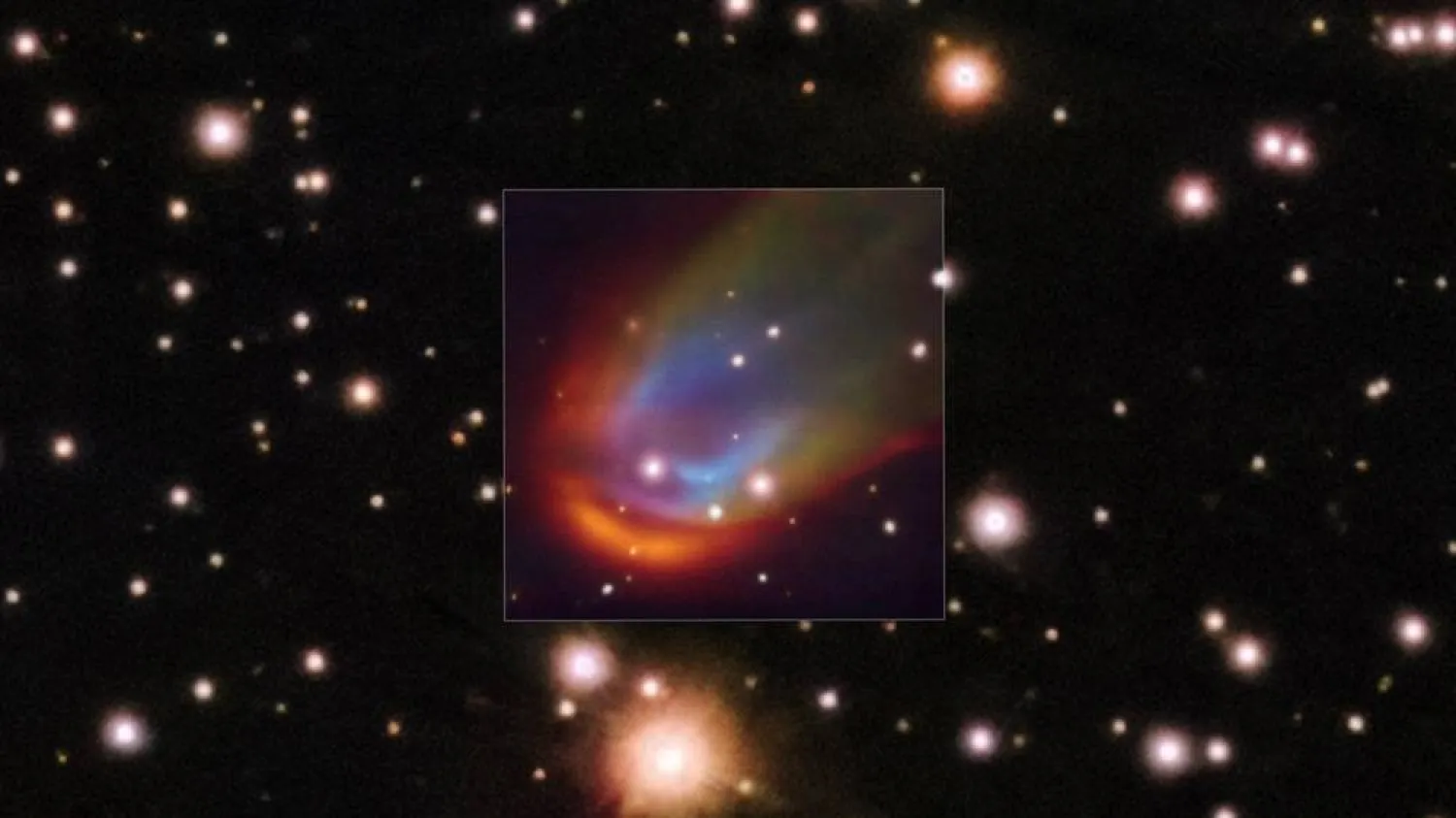

Astronomers Spot White Dwarf Star Creating a Colorful Shockwave

The central square image, taken with the MUSE instrument on ESO's Very Large Telescope, shows shock waves around the dead star RXJ0528+2838. (European Southern Observatory (ESO)/K. Ilkiewicz and S. Scaringi et al./Handout via Reuters)
TT

Astronomers Spot White Dwarf Star Creating a Colorful Shockwave

The central square image, taken with the MUSE instrument on ESO's Very Large Telescope, shows shock waves around the dead star RXJ0528+2838. (European Southern Observatory (ESO)/K. Ilkiewicz and S. Scaringi et al./Handout via Reuters)

Astronomers have observed a white dwarf - a highly compact Earth-sized stellar ember - that is creating a colorful shockwave as it moves through space, leaving them searching for an explanation.

The highly magnetized white dwarf is gravitationally bound to another star in what is called a binary system. The white dwarf is siphoning gas from its companion as the two orbit close to each other. The system is located in the Milky Way about 730 light-years from Earth - relatively nearby in cosmic terms - in the constellation Auriga.

A light-year is the distance light travels in a year, 5.9 trillion miles (9.5 trillion km).

The shockwave - more specifically a bow shock - caused by the white dwarf was observed using the European Southern Observatory's Chile-based Very Large Telescope. The shockwave was seen in an image released by the scientists glowing in various colors produced when material flowing outward from the white dwarf collided with interstellar gas.

"A shockwave ‌is created when ‌fast-moving material plows into surrounding gas, suddenly compressing and heating it. A ‌bow shock ⁠is the curved ‌shock front that forms when an object moves rapidly through space, similar to the wave in front of a boat moving through water," said astrophysicist Simone Scaringi of Durham University in England, co-lead author of the study published on Monday in the journal Nature Astronomy.

"The colors come from interstellar gas that is being heated and excited by the shock. Different chemical elements glow at specific colors when this happens," Scaringi added.

In this shockwave, a red hue represented hydrogen, green represented nitrogen and blue represented oxygen residing in interstellar space.

A handful of other white dwarfs have been observed creating shockwaves. But all of those were ⁠surrounded by disks of gas siphoned from a binary partner. Although this white dwarf is siphoning gas from its companion, it lacks any such disk and ‌is releasing gas into space for unknown reasons.

White dwarfs are among the ‍universe's most compact objects, though not as dense as ‍black holes.

Stars with up to eight times the mass of the sun appear destined to end up as ‍a white dwarf. They eventually burn up all the hydrogen they use as fuel. Gravity then causes them to collapse and blow off their outer layers in a "red giant" stage, eventually leaving behind a compact core - the white dwarf.

"There are plenty of white dwarfs out there, as these are the most common endpoints of stellar evolution," Scaringi said.

The sun appears fated to end its existence as a white dwarf, billions of years from now.

This white dwarf has a mass comparable to the sun contained in a body slightly larger than Earth. Its binary companion is ⁠a type of low-mass star called a red dwarf that is about a tenth the mass of the sun and thousands of times less luminous. It orbits the white dwarf every 80 minutes, with the two extremely close to each other - approximately the distance between the moon and Earth.

The gravitational strength of the white dwarf is pulling gas off the red dwarf. This siphoned material is being pulled into the white dwarf along its strong magnetic field, eventually landing at its magnetic poles. While this process releases energy and radiation, it cannot account for the outflow of material needed to produce the observed shockwave, Scaringi said.

"Every mechanism with outflowing gas we have considered does not explain our observation, and we still remain puzzled by this system, which is why this result is so interesting and exciting," Scaringi said.

"The shape and length of the (shockwave) structure show that this process has been ongoing for at least about 1,000 years, making it long-lived rather than a one-off event," Scaringi added.

The ‌researchers took note of the aesthetics of the colorful shockwave.

"Beyond the science, it's a striking reminder that space is not empty or static as we may naively imagine it: it's dynamic and sculpted by motion and energy," Scaringi said.



Teen Swims Four Hours to Save Family Lost at Sea off Australia

Manly Beach in Australia. (Getty Images)
TT

Teen Swims Four Hours to Save Family Lost at Sea off Australia

Manly Beach in Australia. (Getty Images)

Rescuers praised a teenage boy's "superhuman" survival instincts after he swam four hours through choppy waters off Australia to find help for his family.

The 13-year-old boy swam four kilometers (2.5 miles) back to shore to raise the alarm after his mother and two younger siblings were swept out to sea while kayaking and paddleboarding near the Western Australian tourist town of Quindalup.

Marine rescue volunteer Paul Bresland said the teenager's four-hour swim saved his family, who were eventually found clinging to a paddleboard in the open ocean.

"He swam, he reckons, the first two hours with a life jacket on," Bresland told national broadcaster ABC.

"And the brave fella thought he's not going to make it with a life jacket on, so he ditched it, and he swam the next two hours without a life jacket.

"I thought, mate, that is incredible," said Bresland, describing the boy's efforts as "superhuman".

Police inspector James Bradley said the boy's actions "cannot be praised highly enough".

"His determination and courage ultimately saved the lives of his mother and siblings," he told the ABC.


Snakebites Kill 50,000 People Every Year in India

Healthcare workers in India face challenges administering antivenom - the life-saving antibodies that neutralize toxins in venom. (Getty Images)
TT

Snakebites Kill 50,000 People Every Year in India

Healthcare workers in India face challenges administering antivenom - the life-saving antibodies that neutralize toxins in venom. (Getty Images)

Devendra, who was a farmer in India, still remembers the moment a snake sank its fangs into his leg while he was picking mulberry leaves.

“I went to the hospital four days after I was bitten, when the pain became unbearable. But the delay cost me my leg,” he said in a short film released by Global Snakebite Taskforce (GST), an initiative working to reduce deaths and injuries by snakebites, reported the BBC.

But Devendra is still among the lucky few to have survived.

According to the federal government, around 50,000 Indians are killed by snakebites each year - roughly half of all deaths worldwide. Some estimates suggest the toll could be even higher: between 2000 and 2019, India may have seen as many as 1.2 million deaths, an average of 58,000 per year, a 2020 study said.

Now, a new report by GST has found that 99% of healthcare workers in India face challenges administering antivenom - the life-saving antibodies that neutralize toxins in venom.

Researchers surveyed 904 medical professionals across India, Brazil, Indonesia and Nigeria, the countries most affected by snakebites, and found similar barriers: poor infrastructure, limited access to antivenom and insufficient training.

In 2017, the World Health Organization (WHO) formally listed snakebite envenoming or poisoning as a “highest priority neglected tropical disease” because of the high number of deaths caused by it. An estimated 5.4 million people worldwide are bitten by snakes each year and more than 100,000 die from annually, according to the WHO.

It also states that snakebites disproportionately affect poor rural communities in low and middle-income countries.

In India, a high concentration of snakebite deaths and injuries are reported in the central and eastern regions, said Dr. Yogesh Jain, a GST member and practitioner in the central Chhattisgarh state. He added that people working in farms, including those from poor tribal communities, remain most vulnerable.

In 2024, India launched the National Action Plan for Prevention and Control of Snakebite Envenoming (NAPSE) with the aim to halve snakebite deaths by 2030. The plan focuses on better surveillance, improved antivenom availability and research, enhanced medical capacity and public awareness campaigns.

Experts agree it is a step in the right direction, but implementation has been inconsistent.

“In India, snakebites are seen as a poor person's problem,” Jain said. “That's why there isn't enough outrage or action over these completely avoidable deaths. When it comes to treating snakebites, every second counts.”


Media Minister Opens Fifth Saudi Media Forum in Riyadh

Saudi Minister of Media Salman Al-Dossary launches the fifth edition of the Saudi Media Forum 2026 in Riyadh. (SPA)
TT

Media Minister Opens Fifth Saudi Media Forum in Riyadh

Saudi Minister of Media Salman Al-Dossary launches the fifth edition of the Saudi Media Forum 2026 in Riyadh. (SPA)

Under the patronage of Custodian of the Two Holy Mosques King Salman bin Abdulaziz Al Saud, Saudi Minister of Media Salman Al-Dossary launched on Monday the fifth edition of the Saudi Media Forum 2026 in Riyadh.

The minister stressed that the royal patronage of the forum by King Salman is a badge of pride and honor for media professionals, as it grants the forum broader dimensions and a deeper vision and views media as a tool for awareness and a means of development.

Held under the theme “Media in an Evolving World,” the forum is witnessing the participation of more than 300 media leaders and experts from over 20 countries. They will engage in more than 150 specialized dialogue sessions discussing the intersection of media with politics, economy, culture, technology, and innovation, with the attendance of international and regional think tanks, reflecting the Kingdom’s leadership in the media industry.

The forum is accompanied by the creative edition of the Future of Media Exhibition (FOMEX), with the participation of more than 250 local and international companies.

Al-Dossary stressed the responsibility of media toward younger generations, noting that protecting future generations in the digital age is not achieved through prohibition or isolation, but through creating aware media environments governed by ethics and values and present content as a tool for building awareness rather than a commodity for consumption.

The objective of safeguarding children is to prepare them to interact with the world with confidence without losing their identity or moral compass, he added.

He announced the launch of 12 flagship initiatives at the forum, most notably the Saudi Media Innovation Bootcamp (Saudi MIB) in the fields of augmented journalism, intelligent content creation, and virtual presenters, in partnership with the Saudi Data and Artificial Intelligence Authority (SDAIA).

Other initiatives include the Tamkeen Initiative to support entrepreneurial ideas and startups, and the Numo Initiative in partnership with the Kafalah Program, to transform media ideas into sustainable business models.

Al-Dossary announced the issuance of the Artificial Intelligence Principles in Media document in partnership with SDAIA, to entrench the principle of responsible use of modern technologies and open the door to advanced stages of activation, support, and empowerment.

The minister announced the hosting of more than 2,000 content creators and influencers from over 90 countries within the Influence Track, as part of the second edition of "The ImpaQ Impact Makers Forum" in Qiddiya City.

He congratulated the winners of the Saudi Media Award 2026, held in partnership with the Human Capability Development Program across four main tracks and 16 categories. The award received more than 500 nominated works from over 20 countries, with international participation growing by more than 200%.

The first day of the forum witnessed several dialogue sessions and the launch of FOMEX, which includes exhibitor pavilions attracting government entities and local and international private companies to showcase their contributions and products in media, radio, and television, as well as a platform that allows exhibitors to present their services and innovations to visitors.

The exhibition includes the Launch Zone, a dedicated space where companies can showcase their latest media innovations and technologies and conclude strategic partnerships that help develop the future media ecosystem.

The FOMEX Theater presents comprehensive insights into the media sector through discussion sessions, dialogues, and workshops featuring leading local and international speakers, while also providing opportunities to sign cooperation agreements and partnerships.