


AI Helps Fuel New Era of Medical Self-testing

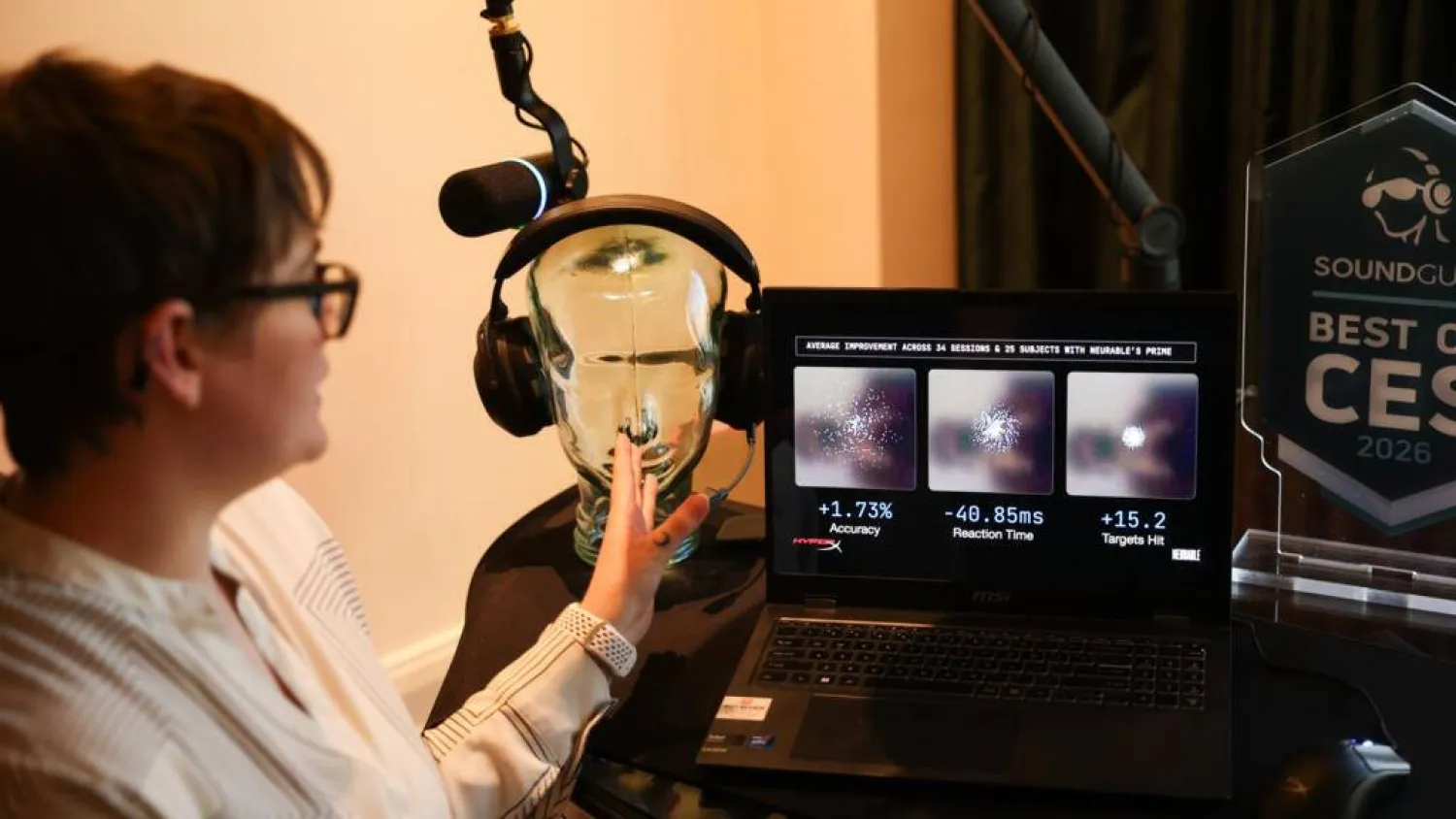
Neurable research scientist Alicia Howell-Munson demonstrates the company's headset, which it says can detect early signs of Alzheimer's disease. Patrick T. Fallon / AFP
TT

AI Helps Fuel New Era of Medical Self-testing

Neurable research scientist Alicia Howell-Munson demonstrates the company's headset, which it says can detect early signs of Alzheimer's disease. Patrick T. Fallon / AFP

Beyond smart watches and rings, artificial intelligence is being used to make self-testing for major diseases more readily available -- from headsets that detect early signs of Alzheimer's to an iris-scanning app that helps spot cancer.

"The reason preventive medicine doesn't work right now is because you don't want to go to the doctor all the time to get things tested," says Ramses Alcaide, co-founder and CEO of startup Neurable.

"But what about if you knew when you needed to go to the doctor?"

Connected rings, bracelets and watches -- which were everywhere at last week's Consumer Electronics Show in Las Vegas -- can already monitor heart rate, blood pressure and glucose levels, with varying degrees of accuracy.

These gadgets are in high demand from consumers. A recent study published by OpenAI showed that more than 200 million internet users check ChatGPT every week for information on health topics.

On Wednesday, OpenAI even launched a chatbot that can draw on a user's medical records and other data collected by wearable devices, with their consent, to inform its responses.

Using electroencephalogram (EEG) technology, Neurable has developed a headset that records and deciphers brain activity.

The linked app compares data with the user's medical history to check for any deviation, a possible sign of a problem, said Alcaide.

"Apple Watch can pick up Parkinson's, but it can only pick it up once you have a tremor," Alcaide said. "Your brain has been fighting that Parkinson's for over 10 years."

With EEG technology, "you can pick these things up before you actually see physical symptoms of them. And this is just one example."

Detection before symptoms

Some people have reservations about the capabilities of such devices.

"I don't think that wearable EEG devices are reliable enough," said Anna Wexler, a University of Pennsylvania professor who studies consumer detection products, although she acknowledges that "AI has expanded the possibilities of these devices."

While Neurable's product cannot provide an actual diagnosis, it does offer a warning. It can also detect signs of depression and early development of Alzheimer's disease.

Neurable is working with the Ukrainian military to evaluate the mental health of soldiers on the front lines of the war with Russia, as well as former prisoners of war, in order to detect post-traumatic stress disorder (PTSD).

French startup NAOX meanwhile has developed EEG earbuds linked to a small box that can help patients with epilepsy.

Rather than detect seizures, which are "very rare," the device recognizes "spikes" -- quick, abnormal electrical shocks in the brain that are "much more difficult to see," said NAOX's chief of innovation Marc Vaillaud, a doctor by training.

NAOX's device -- which has been cleared by the US Food and Drug Administration -- is designed to be worn at night, to track several hours of data at a time.

The company is working with the Rothschild and Lariboisiere hospitals in Paris to try to better understand the links between these brain "spikes" and Alzheimer's disease, which have been raised in scientific papers.

Advances in AI and technology in general have paved the way for the miniaturization of cheaper detection devices -- a far cry from the heavy machinery once seen in medical offices and hospitals.

IriHealth is preparing to launch, for only about $50, a small smartphone extension that would scan a user's iris.

The gadget relies on iridology, a technique by which iris colors and markings are believed to reveal information about a person's health, but which is generally considered scientifically unreliable.

But the founders of IriHealth -- a spin-off of biometrics specialist IriTech -- are convinced that their device can be effective in detecting anomalies in the colon, and potentially the lungs or the liver.

Company spokesman Tommy Phan said IriHealth had found its device to be 81 percent accurate among patients who already have been diagnosed with colon cancer.



Deforestation in Brazil's Amazon Drops to Lowest Level Since 2019

(FILES) Smoke from illegal fires lit by farmers rises in Manaquiri, Amazonas state, on September 6, 2023. (Photo by MICHAEL DANTAS / AFP)
TT

Deforestation in Brazil's Amazon Drops to Lowest Level Since 2019

(FILES) Smoke from illegal fires lit by farmers rises in Manaquiri, Amazonas state, on September 6, 2023. (Photo by MICHAEL DANTAS / AFP)

Deforestation in the Brazilian Amazon fell last year to its lowest level since 2019, according to a report published Wednesday that will be seen as good news for leftist President Luiz Inacio Lula da Silva.

South America's biggest country lost 985,000 hectares (2.4 million acres) of native vegetation last year, down 20.6 percent from 2024, the MapBiomas monitoring network announced.

The figure is the lowest since the network began keeping records in 2019, AFP reported.

It notably does not include forest lost to fires, but after a record fire season in 2024, the country was relatively spared major infernos last year.

Lula, who is seeking a fourth term in October elections, has made the fight against deforestation a central tenet of his administration.

Preserving forest cover is essential to fighting climate warming as trees act as a natural carbon sink.

After four years of widespread logging under his far-right predecessor Jair Bolsonaro, Lula has pledged to eradicate illegal deforestation altogether by 2030.

The reduction in deforestation was noted across Brazil's six major ecosystems.

"We are seeing an increase in enforcement actions and sanctions (...) which have a direct correlation with the drop in deforestation in all Brazilian biomes," Marcos Rosa, MapBiomas's technical coordinator, told AFP.

Even so, the rate of destruction remains breathtaking.

In the Amazon, the world's largest rainforest, where deforestation slowed by 23.5 percent, five trees are still felled every second.

The hardest-hit biome last year was once again the Cerrado, a vast, biodiverse savanna south of the Amazon.

It alone accounted for more than half of the deforestation.

MapBiomas -- a consortium of universities, NGOs and technology companies -- said agriculture accounted for 99 percent of vegetation loss.

Lula is keen to showcase his environmental achievements ahead of the election.

Last year, he hosted the COP30 climate summit in the Amazonian city of Belem.

He has however been criticized by environmentalists for his support of a massive oil exploration project near the mouth of the Amazon River.


Putin Gifts 4 Amur Tigers to Kazakhstan Ahead of Visit

In this pool photograph distributed by the Russian state agency Sputnik, Russia's President Vladimir Putin meets with graduates of the "Time of Heroes" program, at the Kremlin in Moscow on May 22, 2026. (Photo by Alexey NIKOLSKY / POOL / AFP)
TT

Putin Gifts 4 Amur Tigers to Kazakhstan Ahead of Visit

In this pool photograph distributed by the Russian state agency Sputnik, Russia's President Vladimir Putin meets with graduates of the "Time of Heroes" program, at the Kremlin in Moscow on May 22, 2026. (Photo by Alexey NIKOLSKY / POOL / AFP)

Russia has handed Kazakhstan four Amur tigers, two of them cubs, to help the country restore its numbers of the animals, President Vladimir Putin said in an article issued ahead of his visit to the Central Asian nation this week.

Rich in energy resources and critical minerals, Kazakhstan shares a border with Russia and is a close ally of Moscow in a region where China and the ⁠United States are ⁠also expanding their influence.

The four animals captured in Russia's far eastern region of Khabarovsk were flown to Kazakhstan, Putin said on the Kremlin's website on Tuesday, and are soon to be released into the wild.

Putin ⁠is no stranger to using animals to advance diplomatic efforts.

In 2022, Russia sent 30 grey thoroughbred horses to North Korea, as the nations have boosted ties since Ukraine's invasion that year. North Korean leader Kim Jong Un is a keen horseman.

Kazakhstan, which is trying to restore the tiger population in Central Asia, sees the Amur tiger as a ⁠close ⁠relative of the extinct Caspian tiger. The Russian gesture boosts the country's tally of the animals previously sent by the Netherlands, Reuters reported.

On his visit, Putin will oversee the signing of a deal for a nuclear power project in Kazakhstan, which has no nuclear power generation now, and will discuss efforts to boost the transit of Russian oil to China through the country, the Kremlin has said.


RFK Jr. Snatches Snakes in Viral Video, the Latest of his Many Animal Encounters

Health and Human Services Secretary Robert F. Kennedy Jr. speaks as Centers for Medicare & Medicaid Services Administrator Dr. Mehmet Oz, right, and Assistant Attorney General for the Fraud Division Colin McDonald listen during a press conference Thursday, May 21, 2026, in Minneapolis. (AP Photo/Glen Stubbe)
TT

RFK Jr. Snatches Snakes in Viral Video, the Latest of his Many Animal Encounters

Health and Human Services Secretary Robert F. Kennedy Jr. speaks as Centers for Medicare & Medicaid Services Administrator Dr. Mehmet Oz, right, and Assistant Attorney General for the Fraud Division Colin McDonald listen during a press conference Thursday, May 21, 2026, in Minneapolis. (AP Photo/Glen Stubbe)

A video of Robert F. Kennedy Jr. wrangling two snakes bare-handed captured the internet’s fascination Tuesday, the latest animal encounter the US health secretary has shared publicly that has sparked intrigue and in some cases concern.

Kennedy shared the clip of himself grabbing the tails of the non-venomous black racer snakes on his personal social media accounts, noting in the caption that he was removing them from the patio of Centers for Medicare and Medicaid Services Administrator Dr. Mehmet Oz.

An avid outdoorsman, Kennedy has posted numerous photos and videos over the years of himself interacting with wild animals, The Associated Press reported. He's also shared tales of such interactions, including admitting once planting a bear carcass in New York's Central Park as a prank.

Internet users reacted with joy, incredulity and outcry at Kennedy's latest clip, which shows the snakes biting in the direction of his fingers as Oz asks questions about the snakes.

Kennedy’s wife, actress Cheryl Hines, can be heard saying “Why?” and telling her husband to let them go.

Herpetologists said the species in the clip is largely harmless to humans, even if it bites. But they said people should be mindful of the stress that handling snakes can put on the creatures, and to avoid grabbing them by the tails as Kennedy does in the video, because it can cause injuries to their spines.

“That is not how I would handle the snakes, but I’m a trained professional,” said Bonnie Keller, a herpetologist and former board member of the Virginia Herpetological Society.

Sean McKnight, director of programs at the nonprofit Rattlesnake Conservancy, said he encourages people to minimize the duration that they’re handling any kind of wildlife, because they are “potentially stressing out the animals more than needed.”

Earlier this month, Kennedy posted a snapshot of himself holding a bird in his enclosed hand in what he wrote was the rescue of a starling at Dulles Airport in northern Virginia.

In 2024, while running for president, he posted a video of himself using a small net and a trowel to capture a rattlesnake in his California driveway. In that video, he cautiously secures the venomous snake in his bare hands and displays its fangs to the camera. McKnight said he doesn’t advise anybody to handle rattlesnakes like that, because there’s no way to restrain them safely with your hands.

Also in 2024, Kennedy generated criticism when he admitted to taking a bear carcass from the side of the road and placing it in Central Park as a prank in 2014. He said at the time that he had been picking up roadkill his “whole life” and once had a “freezer full of it” at home. His campaign spokesperson Stefanie Spear, now a top adviser at the nation's health department, said roadkill was how Kennedy, a longtime falconer, fed his birds.