
Egypt Says All Parties Agree on Gaza Technocratic Committee Members

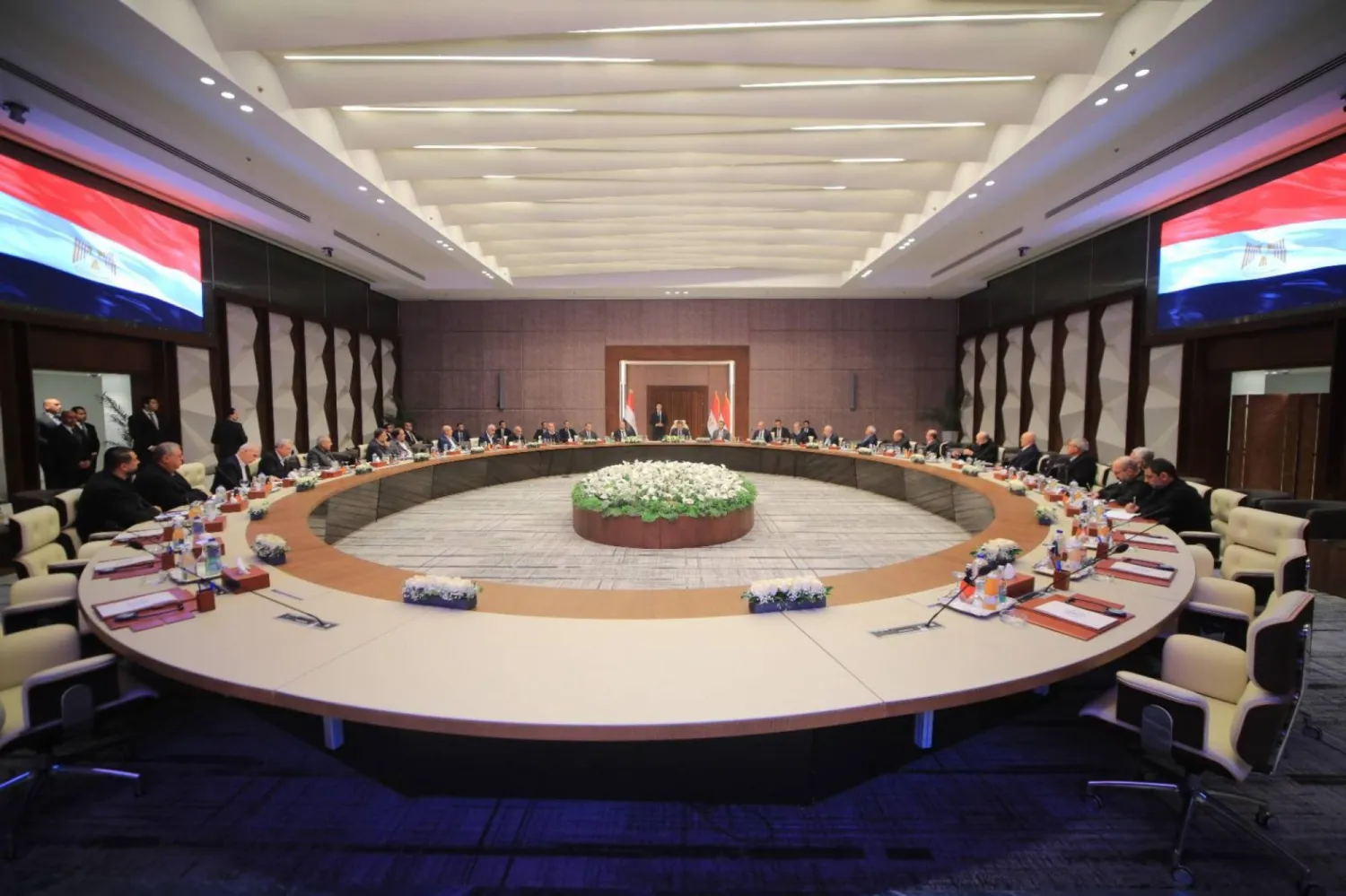
A handout photo made available by Egyptian State Press Office shows Egyptian authorities holding talks with a Hamas delegation and representatives of various Palestinian factions, in Cairo, Egypt, 14 January 2026, to select a technical committee for Gaza. (EPA/Egyptian State Press Office)
TT

Egypt Says All Parties Agree on Gaza Technocratic Committee Members

A handout photo made available by Egyptian State Press Office shows Egyptian authorities holding talks with a Hamas delegation and representatives of various Palestinian factions, in Cairo, Egypt, 14 January 2026, to select a technical committee for Gaza. (EPA/Egyptian State Press Office)

Egypt said Wednesday that all the members of a 15-person Palestinian technocratic committee meant to administer post-war Gaza had been agreed upon by all Palestinian factions, who swiftly offered their support. 

Under a 20-point Gaza truce plan brokered by US President Donald Trump in October, the Palestinian territory would be governed by the committee operating under the supervision of a so-called "Board of Peace", to be chaired by Trump himself. 

Hamas officials said earlier in the day that the group had opened talks with Egyptian mediators in Cairo on the committee, which forms part of Trump's truce plan for Gaza. 

"We hope that following this agreement, the committee will be announced soon... and will then be deployed to the Gaza Strip to manage daily life and essential services," Abdelatty said. 

The majority of the Palestinian factions offered their support to the committee after Abdelatty's announcement. 

In a statement, the factions including Hamas and Islamic Jihad said they had agreed "to support the mediators' efforts in forming the Palestinian National Transitional Committee to administer the Gaza Strip, while providing the appropriate environment" for it to begin its work. 

The Ramallah-based Palestinian presidency also announced its support in official media, with a source from the office telling AFP the statement "reflects the position of the Fatah movement because President (Mahmoud) Abbas is also the head of Fatah". 

The Cairo meeting aimed to address the formation of the committee and its operational mechanisms, a senior Hamas official had previously told AFP on condition of anonymity. 

- Potential committee heads - 

Separately, the Hamas delegation was also to hold talks in Cairo with leaders of other Palestinian factions on "political, national and field developments" and the state of the Gaza ceasefire, the official added. 

Hamas has repeatedly said it does not seek a role in any future governing authority in the Palestinian territory and would limit its role to monitoring governance to ensure stability and facilitate reconstruction. 

Talks with Egyptian mediators were also focused on the withdrawal of Israeli forces from Gaza, the reopening of the Rafah crossing, the entry of aid currently stockpiled on the Egyptian side of the border, and preparations for launching the second phase of the ceasefire plan, the official said. 

Abdelatty did not name any of the agreed-upon committee members. 

But two names circulating as potential heads were Ali Shaath, a former deputy minister of planning in the Palestinian Authority, and Majed Abu Ramadan, the current minister of health, the second official said. 

The Trump proposed Board of Peace is expected to be led on the ground by Bulgarian diplomat and politician Nickolay Mladenov, who has recently held talks with Israeli and Palestinian officials. 

Mladenov previously served as the United Nations envoy for the Middle East peace process from early 2015 until the end of 2020. 

Media reports say Trump is expected to announce the members of the Board of Peace in the coming days, with the body set to include around 15 world leaders. 


Maliki Nears Exit From Race to Form Iraqi Gov’t

Iraqi Prime Minister Mohammed Shia al-Sudani, with Nouri al-Maliki to his left in the picture (AFP)
TT

Maliki Nears Exit From Race to Form Iraqi Gov’t

Iraqi Prime Minister Mohammed Shia al-Sudani, with Nouri al-Maliki to his left in the picture (AFP)

Former Iraqi Prime Minister Nouri al-Maliki is seeing his bid for a third term unravel, undermined by rising US pressure and deepening splits within the Shiite Coordination Framework, as Kurdish parties insist the presidency cannot be decided until agreement on the next prime minister is reached.

A senior figure in the Coordination Framework told Asharq Al-Awsat that Maliki’s prospects for a third term had “fallen dramatically,” saying his continued insistence on running was aimed less at returning to office than at blocking Mohammed Shia al-Sudani from becoming prime minister.

The source, who requested anonymity, said Sudani had previously stepped aside in Maliki’s favor in exchange for a pledge of support if Maliki failed to form a government, an understanding Maliki is now trying to exploit politically.

Even if he does not win, the source said, Maliki wants to retain decisive influence over the choice of an alternative candidate.

The source added that all factions within the Coordination Framework were aware of US messages rejecting Maliki’s candidacy even before he formally announced it.

In a televised interview, Maliki denied that Sudani had sought guarantees in return for backing him, saying Sudani had voluntarily withdrawn from the race for prime minister, a move that “surprised me,” he said.

Efforts in Kurdistan fall short

Meanwhile, a Coordination Framework delegation's visit to Erbil and Sulaimaniyah failed to soften the Kurdish position on the presidency, according to informed political sources.

The delegation, led by Sudani and including Hadi al-Amiri, head of the Badr Organization, and Muhsin Al-Mandalawi, leader of the Al-Asas Alliance, had sought to resolve a dispute over the presidency. Instead, it returned facing two interconnected crises from the Kurdish perspective: the presidency and the premiership.

Sources said Kurdish leaders felt that Shiite factions had effectively settled the choice of prime minister.

In Erbil and Sulaimaniyah, the delegation encountered a unified Kurdish stance calling for deciding on the prime minister first, particularly amid US pressure following a tweet by US President Donald Trump warning of the consequences of appointing Maliki as prime minister.

The two main Kurdish parties fear being placed on the front line of confrontation with Washington, the sources said, especially after the arrival of a new US envoy who visited Baghdad, met Sudani in his capacity as caretaker prime minister, and spoke by phone with Masoud Barzani, leader of the Kurdistan Democratic Party, one day after Trump’s tweet.

Two-day deadline

After returning to Baghdad, Coordination Framework factions decided to give Kurdish parties an additional two days to reach a consensus on a presidential candidate before moving toward a parliamentary majority option that could cost one of the Kurdish parties the post.

At the same time, Kurdish political and media discourse has grown more ambiguous, with both the Kurdistan Democratic Party and the Patriotic Union of Kurdistan insisting the presidency is their established entitlement.

In this connection, Farhad al-Atrash, second deputy speaker of the Iraqi parliament and a senior Kurdistan Democratic Party figure, denied any internal party disputes over the presidency, describing media reports as “far from the truth and reality.”

In a statement, Atrash said any decision taken by the Kurdish leadership, including Masoud Barzani, would be respected and pursued in the public interest.

Maliki deepens rifts

Maliki’s recent televised remarks have further complicated matters within the Coordination Framework, with informed sources describing them as confused and contradictory, deepening internal divisions.

While some Framework factions have sought to downplay Trump’s tweet, dismissing it as paid for or written from inside Iraq, sources said the greater damage stemmed from Maliki’s own statements rather than from external pressure.

In a notable development, Bloomberg reported that Washington had warned Iraqi officials it could restrict Iraq’s access to oil export revenues if Maliki were appointed prime minister, citing his perceived closeness to Iran.

The warning was conveyed during a meeting last week in Türkiye between Iraqi Central Bank Governor Ali al-Allaq and senior US officials, coinciding with Trump’s tweet that said Iraqi politicians could not choose Maliki.

Sources familiar with Tehran’s strategy said Iran had urged its allies in Iraq to resist Trump’s pressure, adding that Supreme Leader Ali Khamenei had last month dispatched Esmail Qaani, commander of the Quds Force, to Baghdad with a message congratulating Maliki on his nomination, a move that angered Washington.

“Ready to step aside under conditions”

In the interview, Maliki said he was ready to withdraw his candidacy if a majority within the Coordination Framework requested it, denying that his nomination would trigger US sanctions on Iraq.

He said his candidacy was “a purely Iraqi matter,” adding that internal and external parties had misled the US president, and suggesting the tweet may have been written from inside Iraq.

With the political deadlock continuing, the battle over the premiership appears set to grow more complex as external pressure intersects with internal calculations and consensus within the Shiite camp continues to erode.


Egypt’s Sisi, Türkiye’s Erdogan Ink Partnership Deals

A handout photo made available by the Turkish Presidential press office shows Egyptian President Abdel Fattah al-Sisi (R) and Turkish President Recep Tayyip Erdogan (L) posing before their meeting in Cairo, Egypt, 04 February 2026. (EPA/ Turkish Presidential Press Office Handout)
TT

Egypt’s Sisi, Türkiye’s Erdogan Ink Partnership Deals

A handout photo made available by the Turkish Presidential press office shows Egyptian President Abdel Fattah al-Sisi (R) and Turkish President Recep Tayyip Erdogan (L) posing before their meeting in Cairo, Egypt, 04 February 2026. (EPA/ Turkish Presidential Press Office Handout)

Turkish President Recep Tayyip Erdogan met Egyptian President Abdel Fattah al-Sisi in Cairo on Wednesday, sealing a raft of new partnership deals and signaling a united front on regional crises in Iran, Sudan and Gaza.

Relations between Cairo and Ankara have thawed sharply after nearly a decade of estrangement over the Muslim Brotherhood.

But since 2023 the two leaders have met a handful of times, exchanged visits, normalized ties and signed more than a dozen cooperation agreements, including on defense.

On Wednesday, ministers from both countries signed 18 additional agreements spanning defense, tourism, health and agriculture.

At a joint news conference, Sisi said they agreed on the need to implement all phases of the Gaza truce agreement, speed up humanitarian aid deliveries and maintain a focus on "a two-state solution, establishing a Palestinian state".

Egypt and Türkiye now form half of the mediating bloc for the current Gaza truce, back the Sudanese army in its war with paramilitary forces and share increasingly convergent positions across the region.

On Sudan, Sisi said Wednesday both sides want to see a "humanitarian truce that leads to a ceasefire and a comprehensive political path".

Sisi also called for efforts to avoid escalation in the region, advance diplomatic solutions and "avert the specter of war, whether regarding the Iranian nuclear file or concerning the region in general".

Erdogan echoed the need for diplomacy, saying foreign interference poses "significant risks to the entire region" and that dialogue remained "the most appropriate method" for addressing disputes with Iran.

Both leaders also underscored support for Somalia's territorial integrity amid heightened regional friction.

Both countries have backed the government of Somalia and condemned Israel's recognition of the breakaway region of Somaliland.

Türkiye supplied Egypt with advanced drones in 2024 and the two countries plan to manufacture them jointly.

Erdogan arrived in Cairo after a stop in Riyadh, with his tour coinciding with US-Iran contacts initially planned for Türkiye before Tehran requested a shift to Oman.


Red Cross ‘Outraged’ as On-Duty Paramedic Killed in Gaza

 Rubble from destroyed buildings lies in the north of Gaza, as seen from the Israeli side of the Israel-Gaza border in Israel, February 4, 2026. (Reuters)
Rubble from destroyed buildings lies in the north of Gaza, as seen from the Israeli side of the Israel-Gaza border in Israel, February 4, 2026. (Reuters)
TT

Red Cross ‘Outraged’ as On-Duty Paramedic Killed in Gaza

 Rubble from destroyed buildings lies in the north of Gaza, as seen from the Israeli side of the Israel-Gaza border in Israel, February 4, 2026. (Reuters)
Rubble from destroyed buildings lies in the north of Gaza, as seen from the Israeli side of the Israel-Gaza border in Israel, February 4, 2026. (Reuters)

The International Federation of Red Cross and Red Crescent Societies said it was "outraged" by the killing of an on-duty colleague on Wednesday in Gaza, where Israel is battling Hamas. 

The IFRC said Hussein Hassan Hussein Al-Samiri, "a dedicated paramedic" with the Palestine Red Crescent Society, "was killed while performing life-saving humanitarian duties in Khan Younis during an attack in the Al-Mawasi area" of the southern Gaza Strip. 

"The IFRC sends its deepest condolences to his family, friends and colleagues and expresses its full solidarity with PRCS." 

Despite a US-brokered truce entering its second phase last month, violence in the Palestinian territory has continued, with Israel and Hamas accusing each other of violating the agreement. 

The IFRC said the death brings the number of PRCS staff and volunteers killed in Gaza in the line of duty to 30 since the conflict began in October 2023. 

The federation said humanitarian workers and medical staff needed to be respected and protected at all times. 

"The Red Cross and Red Crescent emblems are symbols of protection, humanity, neutrality, and hope. Yet too often, our volunteers and staff are killed while performing life-saving work," it said. 

"The loss of Hussein is a tragic reminder of the dangers faced by those who dedicate their lives to helping others." 

The Geneva-based IFRC is the world's largest humanitarian network, with more than 17 million volunteers in more than 191 countries. 

Gazan health officials said Israeli air strikes on Wednesday killed 23 people, with Israel's military saying it struck after one of its officers was wounded by enemy gunfire.