


Oil Drops as Trump Calms Iran Fears; Tech Stocks Slide in Asia

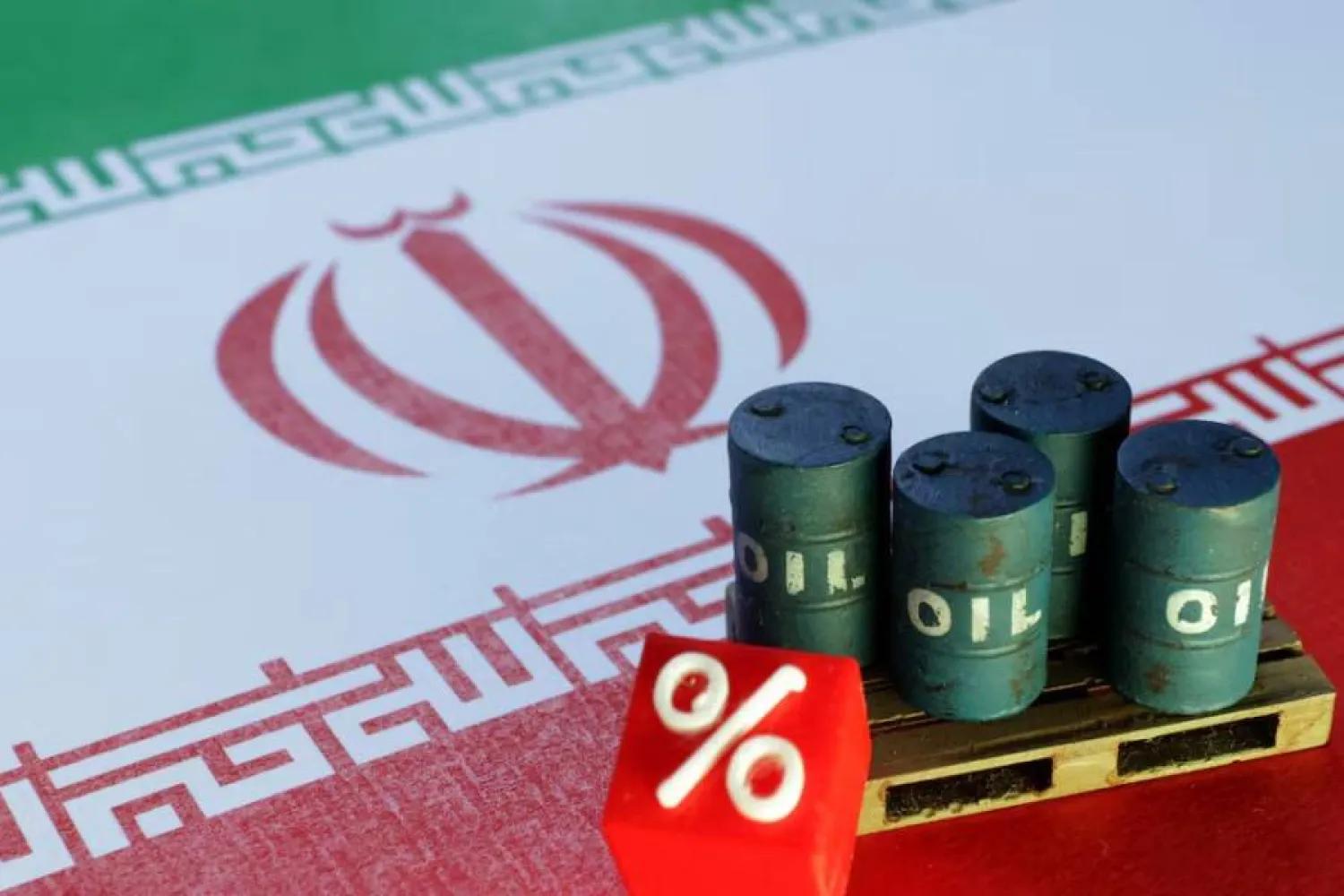
The Iranian flag and 3D printed oil barrels miniature are seen in this illustration taken June 23, 2025. (Reuters)
TT

Oil Drops as Trump Calms Iran Fears; Tech Stocks Slide in Asia

The Iranian flag and 3D printed oil barrels miniature are seen in this illustration taken June 23, 2025. (Reuters)

Oil prices retreated from multi-month highs on Thursday and gold eased from a record peak after US President Donald Trump calmed market anxiety over potential US military action against Iran.

A selloff in tech stocks extended into Asian trading, following declines on Wall Street, as investors rotated out of high-flying chip and artificial intelligence-related names while searching for bargains in other parts of the market.

Currencies paused for breath after the yen dropped to its weakest point since July 2024 against the US dollar overnight and then bounced back sharply amid warnings of possible intervention by Japanese authorities, Reuters said.

Japanese bond yields eased back from record peaks following a spike driven by speculation - which was later confirmed - ‌that the government will ‌call snap elections, a scenario that is expected to lead to ‌bigger ⁠fiscal stimulus.

Brent crude ‌futures dropped 3.4% to $64.25 and Nymex futures sank 3.4% to $59.89, after vaulting as high as $66.82 and $62.36, respectively, in the previous session.

Trump said on Wednesday afternoon that he had been told that killings in Iran's crackdown on nationwide protests were subsiding and he believed there was currently no plan for large-scale executions.

Gold fell 0.5% to around $4,598 per ounce. On Wednesday, it reached an unprecedented $4,642.72.

Stocks in Asia were mixed, but tech shares were met with more selling.

In Japan, the tech-heavy Nikkei eased 0.9% after hitting an all-time peak in ⁠the previous session, though the broader Topix extended its own record high on Thursday with a 0.8% advance.

Taiwan's TAIEX sank 0.4% and Hong ‌Kong's Hang Seng slipped 0.5%, with tech shares weighing.

Chinese blue ‍chips edged 0.1% lower, while South Korea's KOSPI ‍added as much as 1.3% to a fresh record high. The Bank of Korea left interest ‍rates unchanged on Thursday, as expected by economists, and signaled an end to its current easing cycle to prioritize financial stability.

FTSE futures pointed 0.6% higher, suggesting the cash index would open with an extension of its record high from Wednesday. Pan-European STOXX 50 futures tacked on 0.3%.

S&P 500 E-mini futures were flat after the cash index sank 0.5% overnight. The tech-focused Nasdaq Composite dropped 1%.

"There’s a rotation playing out on Wall Street that’s ultimately weighing on indices but indicates that the internals of the market ⁠are holding up reasonably well," said Kyle Rodda, an analyst at Capital.com.

"The strength in cyclicals, in no small part due to the positive outlook for the US economy, is propping up stocks and providing constructive signals to market participants of broadening market strength."

The US dollar was steady against its major peers on Thursday, with the dollar index up very slightly at 99.137.

It was unchanged at 158.44 yen after surging as high as 159.45 yen on Wednesday before pulling back sharply.

Japanese Finance Minister Satsuki Katayama issued another verbal warning on Wednesday, saying officials would take "appropriate action against excessive FX moves without excluding any options."

Prime Minister Sanae Takaichi plans to dissolve parliament's lower house next week and call a snap parliamentary election as early as February 8.

Expectations of bigger fiscal stimulus on an improved mandate have spurred investors to sell the yen ‌and government bonds, sending longer-dated yields to record highs in recent days.

Japan's 20-year yield shed 2.5 basis points on Thursday to 3.135% after vaulting to an unprecedented 3.165% in the prior session.



Iraq in Talks with Gulf States on Pipeline Exports beyond Hormuz

Workers carry out maintenance on a pipeline at a gas separation station in the Zubair oil field near Basra (AP). 
TT

Iraq in Talks with Gulf States on Pipeline Exports beyond Hormuz

Workers carry out maintenance on a pipeline at a gas separation station in the Zubair oil field near Basra (AP). 

Iraq is in talks with Gulf countries to use their pipeline networks to secure alternative oil export routes beyond the Strait of Hormuz, the state oil marketer SOMO said Thursday.

The move is part of an emergency strategy by the oil ministry to tap regional infrastructure and bypass maritime chokepoints, ensuring Iraqi crude continues to reach global markets while offsetting higher transport costs linked to the current crisis.

Ali Nizar al-Shatari, head of the State Organization for Marketing of Oil (SOMO), said the ministry is prioritizing negotiations to access Gulf pipeline systems extending beyond the Strait of Hormuz and into the Arabian Sea, allowing exports to avoid areas of military tension.

“The goal is to secure stable routes that guarantee efficient flows of Iraqi oil at lower transport costs,” Shatari said, adding that Iraq generated about $2 billion in oil revenues in March, up 28 percent from February.

He said SOMO exported around 18 million barrels of crude from Basra, Kirkuk and the Kurdistan region by using all available outlets, including southern ports that operated until early March and northern routes to Türkiye’s Mediterranean port of Ceyhan.

As part of efforts to diversify export options, Shatari revealed that the first shipments of fuel oil and Basra Medium crude successfully reached Syrian ports.

He noted that Iraq had signed a deal to export 50,000 barrels per day via this route, describing cooperation with Syria as “very significant,” with storage and security provided to ensure safe delivery to the port of Baniyas.

The route has proven effective and could become a permanent option after the crisis, he added.

Shatari further noted that the oil ministry is close to completing repairs on the Iraq-Türkiye pipeline, which suffered extensive damage in previous years.

Technical teams have inspected the most difficult terrain, with about 200 kilometers (125 miles) still to be assessed in the coming days before full pumping of Kirkuk crude resumes.

In a notable logistical move, Iraq has begun pumping Basra crude northwards for export via Ceyhan.

Flows started at 170,000 barrels per day and are expected to stabilize between 200,000 and 250,000 bpd, helping offset disrupted southern exports and supply energy-hungry markets in Europe and the Americas.

Shatari said Iraq has benefited from rising global prices by selling Kirkuk crude — a medium-grade oil — at strong premiums.

He also confirmed the reactivation of an agreement with the Kurdistan region to reuse the pipeline through the region to Ceyhan, helping lift total exports to 18 million barrels in March.

This came despite a drop in production in Kurdistan fields to about 200,000 bpd due to security threats, he added.


World Food Prices Rose in March as Iran War Lifted Energy Costs, FAO Says

 A farmer carries harvested rice at a paddy field in Samahani, Aceh province on April 2, 2026. (AFP)
A farmer carries harvested rice at a paddy field in Samahani, Aceh province on April 2, 2026. (AFP)
TT

World Food Prices Rose in March as Iran War Lifted Energy Costs, FAO Says

 A farmer carries harvested rice at a paddy field in Samahani, Aceh province on April 2, 2026. (AFP)
A farmer carries harvested rice at a paddy field in Samahani, Aceh province on April 2, 2026. (AFP)

The war in the Middle East has pushed food commodity prices higher due to higher energy and fertilizer costs, the UN's food agency said Friday. 

The UN's Food and Agriculture Organization (FAO) said its Food Price Index, which measures the monthly changes in international prices of a basket of food commodities, had increased 2.4 percent in March from February. 

It was the second rise in a row, which the agency said was largely due to higher energy prices linked to conflict in the Middle East. 

Within the index, the category of vegetable oil saw the sharpest rise, of 5.1 percent over February, as palm oil prices reached their highest point since the middle of 2022, due to effects from spiking crude oil prices, FAO said. 

However, a "broadly comfortable" supply of cereal has cushioned the damaged from the conflict, FAO said. 

"Price rises since the conflict began have been modest, driven mainly by higher oil prices and cushioned by ample global cereal supplies," said FAO Chief Economist Maximo Torero in a statement. 

But he warned that if the conflict goes on beyond 40 days and the high prices on fertilizer continue, "farmers will have to choose: farm the same with fewer inputs, plant less, or switch to less intensive fertilizer crops". 

"Those choices will hit future yields and shape our food supply and commodity prices for the rest of this year and all of the next." 

Disruptions to production and supply chain routes had also introduced "additional uncertainty" into the outlook for wheat and maize, FAO found. 


Turkish Inflation Near 2% Monthly in March, Below Forecasts

A full moon rises behind Galata Tower, in Istanbul, Türkiye, Thursday, April 2, 2026. (AP)
TT

Turkish Inflation Near 2% Monthly in March, Below Forecasts

A full moon rises behind Galata Tower, in Istanbul, Türkiye, Thursday, April 2, 2026. (AP)

Turkish consumer price inflation was 1.94% month-on-month in March, while the annual figure fell to 30.87%, data from the Turkish Statistical Institute showed ‌on Friday.

In ‌a Reuters ‌poll, ⁠monthly inflation was ⁠forecast to be 2.32%, with the annual rate seen at 31.4%, driven by ⁠a rise in ‌fuel prices ‌and weather-related pressures ‌on food inflation.

In ‌February, consumer prices rose 2.96% month-on-month and 31.53% year-on-year, broadly in ‌line with estimates and reinforcing expectations that ⁠the ⁠disinflation process may be stalling.

The data also showed the domestic producer index rose 2.30% month-on-month in March for an annual increase of 28.08%.