



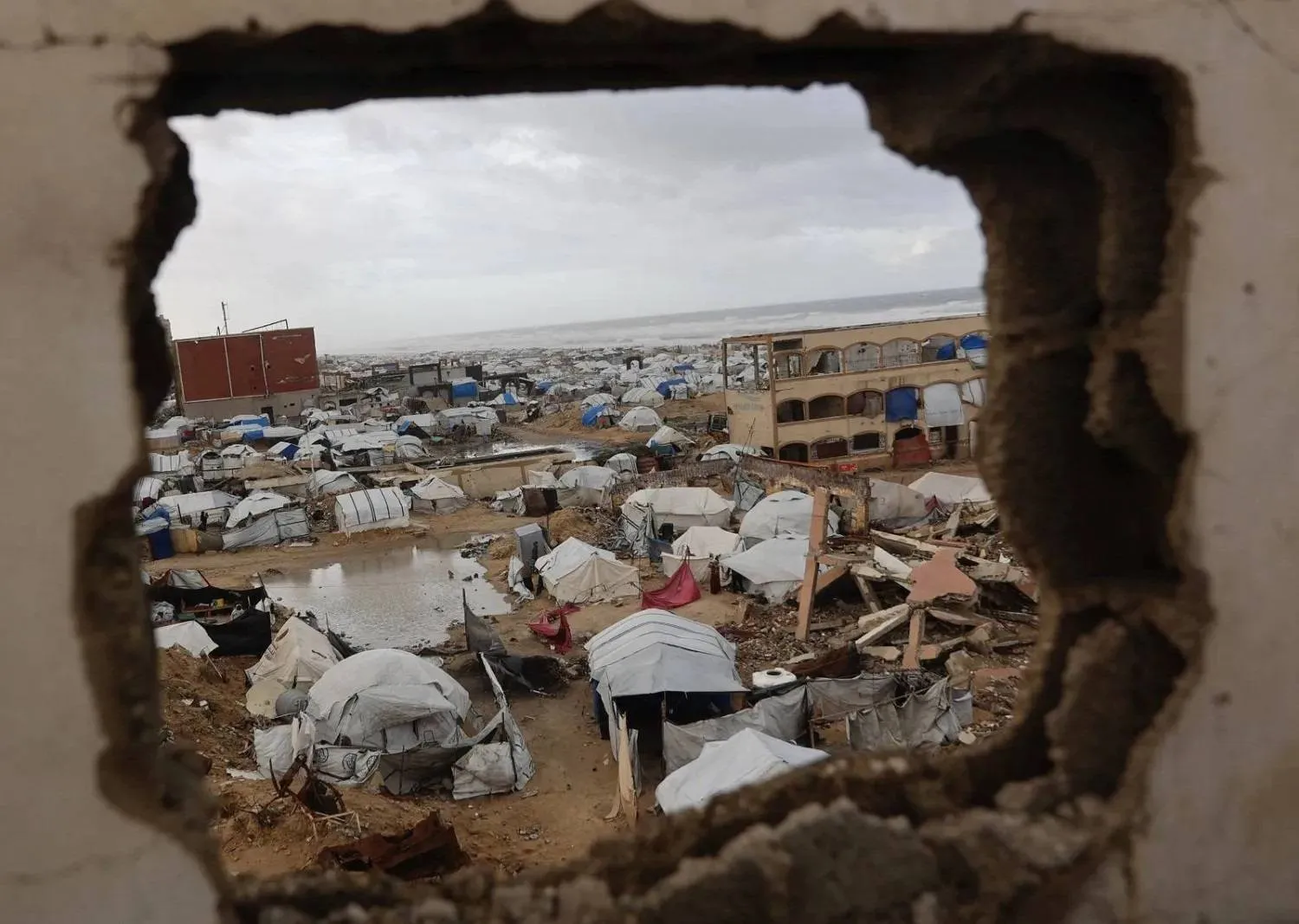

A US announcement launched the second phase of a ceasefire agreement in the Gaza Strip, as questions swirl over the future of Hamas after nearly two years of an unprecedented war with Israel that has only partially subsided.
The ceasefire is part of a peace plan proposed by US President Donald Trump, which entered into force in October and stipulates an end to Hamas rule in Gaza and the disarmament of the movement.
Hamas believes there is a clear distinction between not governing Gaza, which it accepts, and being removed entirely from the political landscape, senior Hamas official Mohammed Nazzal said, accusing Israeli Prime Minister Benjamin Netanyahu of seeking to sabotage the ceasefire.
“There is a difference between Hamas not being part of governance and administration in Gaza, which we accept, and between its absence or exclusion from the political scene,” Nazzal told Asharq Al-Awsat.
“Hamas is deeply rooted in Palestinian society in general and Gazan society in particular. Anyone who believes Hamas can be erased from the political scene is delusional.”
Nazzal said that since Hamas joined negotiations to end what he described as a war of genocide in Gaza, representing Palestinian resistance factions, it had shown high flexibility and worked to facilitate mediators’ efforts.
He accused Netanyahu and his governing coalition of repeatedly derailing talks through stalling and maneuvering.
When a ceasefire was first reached in January 2025 under direct pressure from the new Trump administration, Netanyahu was forced to accept the deal but intended to undermine it, Nazzal said, adding that the agreement collapsed in March 2025.
Talks then returned to square one, he said, and stagnated until an attempted assassination of Hamas leaders in Doha in September 2025 embarrassed Washington, particularly after the operation failed and triggered regional and international repercussions.
According to Nazzal, Trump again pressured Netanyahu to reach a new deal, betting that Hamas would reject the plan. “The surprise was that Hamas accepted it as a negotiating framework,” he said.
“That left Netanyahu cornered and forced him to approve the plan against his will.”
Attempts to evade commitments
Nazzal warned that since the signing of the Sharm el-Sheikh agreement in October, Netanyahu has sought to evade and escape the deal through various pretexts.
He said Hamas and other resistance factions thwarted those efforts by maintaining constant communication with the three mediators and briefing them on Israeli violations, as well as keeping the US administration informed, while continuing along the political negotiating track.
“We know Netanyahu does not want to move to the second phase,” Nazzal said. “He is still obstructing the implementation of the first phase and working to undermine it.”
Low-intensity war
Nazzal said Netanyahu wants the war to continue, albeit at a lower intensity, for personal reasons linked to maintaining a wartime atmosphere until Israel’s parliamentary elections at the end of 2026.
He said this helps Netanyahu avoid, in practice, judicial accountability over corruption charges predating Oct. 7 and over the military and security failures of the Oct. 7 attack, for which the opposition holds him responsible.
Regarding the implementation of the first-phase provisions, particularly the Rafah crossing, Nazzal said that efforts by the mediators, led by Egypt, to reopen the crossing have not stopped.
He accused Netanyahu of seeking to open it in one direction only to enable what he described as the forced displacement of Palestinians from Gaza by allowing departures without returns.
Gaza committee
On consultations hosted by Cairo to form a Gaza administration committee, Nazzal said Hamas has made clear it is ready to hand over management of Gaza to a technocratic committee of Palestinian professionals.
He said Hamas, in coordination with other Palestinian factions, submitted 40 names to Egyptian authorities, with none of the proposed figures having any organizational ties to Hamas.
He said the issues of resistance weapons and an international stabilization force in Gaza remain under discussion, with ambiguity persisting on the US side.
Final decisions on both matters, he said, should be made within a comprehensive Palestinian national framework that includes all relevant factions.
Addressing Israeli claims over the remains of hostages, Nazzal said efforts are ongoing to recover the body of the last Israeli captive held by the resistance.
He said US sponsors and mediators are aware that Hamas has exerted intensive efforts and has no interest in withholding the remains, as Israel alleges, since Hamas seeks to prevent Israel from using the issue to avoid moving to the second phase.
Separately, the Gaza mediators Qatar, Egypt, and Türkiye welcomed on Wednesday the formation of a technocratic committee to administer Gaza, chaired by Ali Shaath, according to a joint statement issued by Qatar’s foreign ministry.
The statement described the move as an important step toward reinforcing stability and improving humanitarian conditions in the enclave.
At the same time, US special envoy Steve Witkoff announced the launch of the second phase of Trump’s 20-point plan to end the Gaza conflict, saying it shifts from a ceasefire toward disarmament, technocratic governance, and reconstruction.


