


EU States Condemn Trump Tariff Threats, Consider Countermeasures

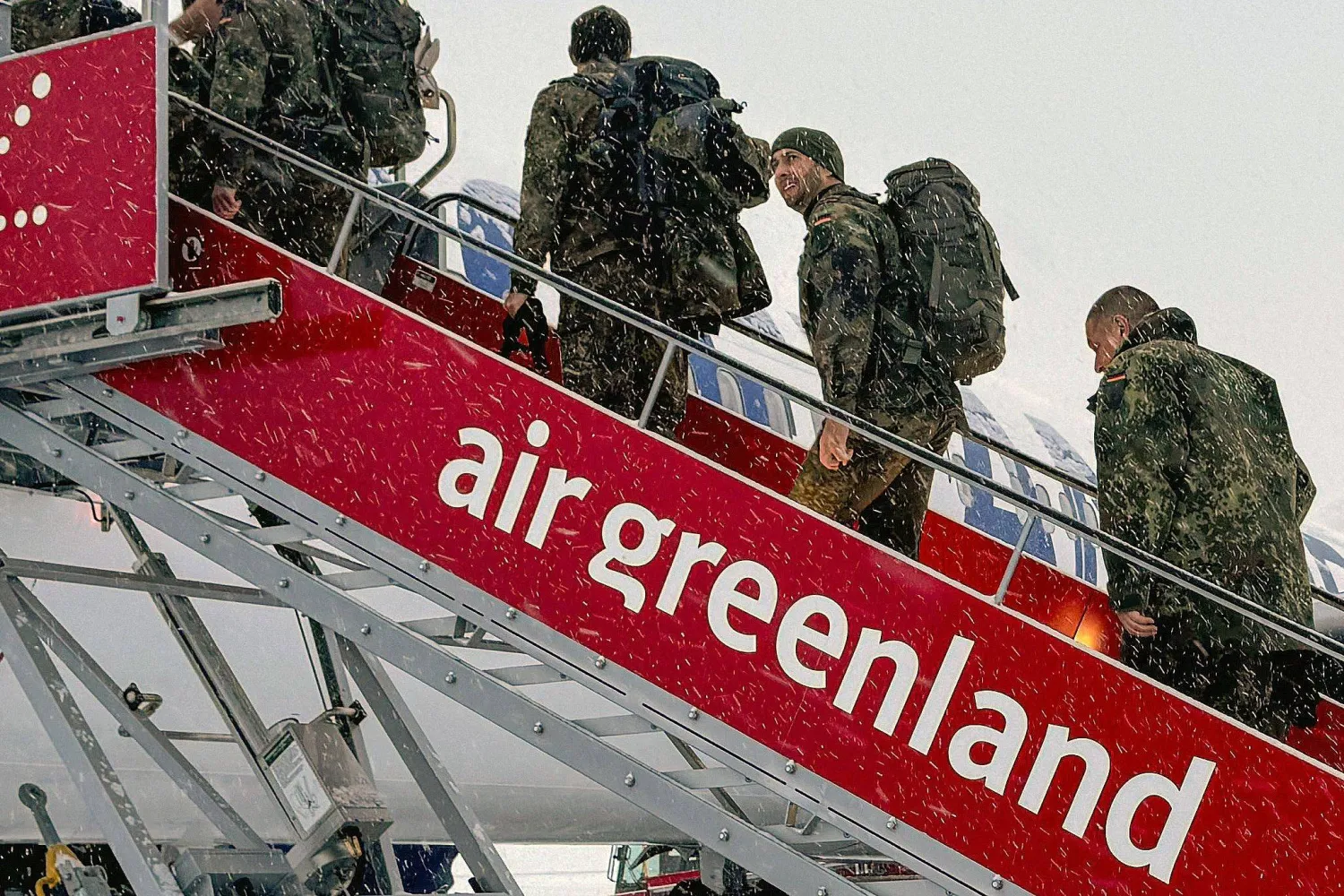
Military personnel from the German armed Forces Bundeswehr board Icelandair flight leaving Nuuk airport for Reykjavik on January 18, 2026 in Nuuk, Greenland. (AFP)
TT

EU States Condemn Trump Tariff Threats, Consider Countermeasures

Military personnel from the German armed Forces Bundeswehr board Icelandair flight leaving Nuuk airport for Reykjavik on January 18, 2026 in Nuuk, Greenland. (AFP)

Major European Union states decried US President Donald Trump's tariff threats against European allies over Greenland as blackmail on Sunday, as France proposed responding with a range of previously untested economic countermeasures.

Trump vowed on Saturday to implement a wave of increasing tariffs on EU members Denmark, Sweden, France, Germany, the Netherlands and Finland, along with Britain and Norway, until the US is allowed to buy Greenland.

All eight countries, already subject to US tariffs of 10% and 15%, have sent small numbers of military personnel to Greenland, as a row with the United States over the future of Denmark's vast Arctic island escalates.

"Tariff threats undermine transatlantic relations and risk a dangerous downward spiral," the eight-nations said in a joint statement published on Sunday.

They said the Danish exercise was ‌designed to strengthen Arctic ‌security and posed no threat to anyone. They said they were ready to ‌engage ⁠in dialogue, based ‌on principles of sovereignty and territorial integrity.

Danish Prime Minister Mette Frederiksen said in a written statement that she was pleased with the consistent messages from the rest of the continent, adding: "Europe will not be blackmailed", a view echoed by Germany's finance minister and Sweden's prime minister.

"It's blackmail what he's doing," Dutch Foreign Minister David van Weel said on Dutch television of Trump's threat.

COORDINATED EUROPEAN RESPONSE

Cyprus, holder of the rotating six-month EU presidency, summoned ambassadors to an emergency meeting in Brussels on Sunday, which diplomats said was due to start at 5 p.m. (1600 GMT) as EU leaders stepped up contacts.

A source close to French President Emmanuel Macron said he was pushing for ⁠activation of the "Anti-Coercion Instrument", which could limit access to public tenders, investments or banking activity or restrict trade in services, in which the US has a surplus with ‌the bloc, including digital services.

Bernd Lange, the German Social Democrat who ‍chairs the European Parliament's trade committee, and Valerie Hayer, head of ‍the centrist Renew Europe group, echoed Macron's call, as did Germany's engineering association.

Meanwhile, Irish Prime Minister Micheal Martin said ‍that while there should be no doubt that the EU would retaliate, it was "a bit premature" to activate the anti-coercion instrument.

And Italian Prime Minister Giorgia Meloni, who is closer to the US President than some other EU leaders, described the tariff threat on Sunday as "a mistake", adding she had spoken to Trump a few hours earlier and told him what she thought.

"He seemed interested in listening," she told a briefing with reporters during a trip to Korea, adding she planned to call other European leaders later on Sunday.

Italy has not sent troops to Greenland.

BRITAIN'S POSITION 'NON-NEGOTIABLE'

Asked how Britain would respond to new ⁠tariffs, Culture Secretary Lisa Nandy said allies needed to work with the United States to resolve the dispute.

"Our position on Greenland is non-negotiable ... It is in our collective interest to work together and not to start a war of words," she told Sky News on Sunday.

The tariff threats do though call into question trade deals the US struck with Britain in May and the EU in July.

The limited agreements have already faced criticism about their lopsided nature, with the US maintaining broad tariffs, while their partners are required to remove import duties.

The European Parliament looks likely now to suspend its work on the EU-US trade deal. It had been due to vote on removing many EU import duties on January 26-27, but Manfred Weber, head of the European People's Party, the largest group in parliament, said late on Saturday that approval was not possible for now.

German Christian Democrat lawmaker Juergen Hardt also mooted what he told Bild newspaper could be a last resort "to bring President Trump to his senses on the Greenland issue", ‌a boycott of the soccer World Cup that the US is hosting this year.


Israel Court Extends Detention of Gaza Flotilla Activists

Brazilian activist Thiago Avila gestures upon his arrival at a court in Ashkelon on May 3, 2026. Photo by Ilia YEFIMOVICH / AFP)
TT

Israel Court Extends Detention of Gaza Flotilla Activists

Brazilian activist Thiago Avila gestures upon his arrival at a court in Ashkelon on May 3, 2026. Photo by Ilia YEFIMOVICH / AFP)

An Israeli court has extended by two days the detention of two activists arrested aboard a Gaza-bound flotilla that was intercepted by Israeli forces in international waters near Greece, their lawyer said on Sunday.

Saif Abu Keshek, a Spanish national, and Brazilian Thiago Avila were detained by Israeli authorities late on Wednesday and brought to Israel, while more than 100 other pro-Palestinian activists aboard the boats were taken to the Greek island of Crete.

A court spokesperson confirmed that their remand had been extended until May 5.

The governments of Spain and Brazil issued a joint statement on Friday calling their detention illegal.

The activists were part of a second Global Sumud flotilla, launched in an attempt to break Israel’s blockade of Gaza by delivering humanitarian assistance. The ships had set sail from Barcelona on April 12.

Israeli authorities requested a four-day extension of their arrest on suspicion of offences that include assisting the enemy during wartime, contact with a foreign agent, membership in and providing services to a terrorist organisation, and the transfer of property for a terrorist organization, said rights group Adalah, which is assisting in the activists' defense.

Hadeel Abu Salih, the men's attorney, said that the two deny the allegations. Their arrest was unlawful due to a lack of jurisdiction, she told Reuters at the Ashkelon Magistrate's Court after the hearing, adding that the mission was meant to provide aid to civilians in Gaza, not to any militant group.

Abu Salih said that Abu Keshek and Avila were subjected to violence en route to Israel and kept handcuffed and blindfolded until Thursday morning.

The Israeli military did not immediately respond to a request for comment.

Israel's foreign ministry had on Thursday called the flotilla organizers "professional provocateurs".

"Israel will not allow the breach of the lawful naval blockade on Gaza," it said.


Iran Guards: US Options Are ‘Impossible' Military Operation or 'Bad Deal'

An Iranian woman holds Iran's flag during a rally in Tehran, Iran, April 29, 2026. Majid Asgaripour/WANA (West Asia News Agency) via REUTERS
TT

Iran Guards: US Options Are ‘Impossible' Military Operation or 'Bad Deal'

An Iranian woman holds Iran's flag during a rally in Tehran, Iran, April 29, 2026. Majid Asgaripour/WANA (West Asia News Agency) via REUTERS

Iran's Revolutionary Guards said on Sunday that the United States faced a choice between an "impossible" military operation or a "bad deal" with Tehran.

The Middle East war, launched by the United States and Israel in late February, has been on hold since April 8, with one failed round of peace talks having taken place in Pakistan.

Negotiations have since stalled as the US imposed a naval blockade on Iranian ports, while Iran has kept the key Strait of Hormuz largely closed.

The Guards intelligence organization said that US President Donald "Trump must choose between 'an impossible operation or a bad deal with the Islamic Republic of Iran'", in an online post carried by state television.

It added that the window for US decision-making "has been narrowed", citing what it described as a "shift in tone" from China, Russia and Europe towards Washington as well as what it called an Iranian "deadline" over the US naval blockade, without elaborating.

US outlet Axios, citing two sources briefed on a recent Iranian proposal to the US, reported that Tehran had set "a one-month deadline for negotiations on a deal to reopen the Strait of Hormuz, end the US naval blockade and permanently end the war in Iran and in Lebanon".

On Sunday, Trump said in a post on Truth Social that he would be reviewing Iran's latest proposal but added that he "can't imagine that it would be acceptable".

Iranian media, including the Tasnim and Fars news agencies, reported Saturday on the contents of the proposal.

According to Tasnim, Iran has said the outstanding issues between the two sides "should be resolved within 30 days" and should focus "on ending the war instead of extending the ceasefire".

The issues, Tasnim said, included "the withdrawal of US military forces from Iran's periphery, lifting the naval blockade, releasing Iran's frozen assets and lifting sanctions".

The report mentioned "ending the war on all fronts, including Lebanon and agreeing a new mechanism for the Strait of Hormuz".


Israel Approves Plan to Buy F-35 and F-15IA Jets from Lockheed, Boeing

FILE PHOTO: Lockheed Martin's logo is seen during Japan Aerospace 2016 air show in Tokyo, Japan, October 12, 2016.   REUTERS/Kim Kyung-Hoon/File Photo
FILE PHOTO: Lockheed Martin's logo is seen during Japan Aerospace 2016 air show in Tokyo, Japan, October 12, 2016. REUTERS/Kim Kyung-Hoon/File Photo
TT

Israel Approves Plan to Buy F-35 and F-15IA Jets from Lockheed, Boeing

FILE PHOTO: Lockheed Martin's logo is seen during Japan Aerospace 2016 air show in Tokyo, Japan, October 12, 2016.   REUTERS/Kim Kyung-Hoon/File Photo
FILE PHOTO: Lockheed Martin's logo is seen during Japan Aerospace 2016 air show in Tokyo, Japan, October 12, 2016. REUTERS/Kim Kyung-Hoon/File Photo

Israel gave final approval for a plan to purchase two new combat squadrons of F-35 and F-15IA advanced fighter aircraft from Lockheed Martin and Boeing in a deal worth tens of billions of dollars, the defense ministry said on Sunday.

The deal, approved by Israel's Ministerial Committee on Procurement, is a first step in a 350 billion shekel ($119 billion) plan to bolster Israel's military and "strengthen readiness ahead of a demanding decade for Israeli security," it said.

It added that the new squadrons will serve as a ⁠cornerstone of the military's ⁠long-term force development, addressing regional threats and preserving Israel’s strategic air superiority.

"Alongside immediate wartime procurement needs, we have a responsibility to act now to secure the IDF’s military edge ten years from now and beyond," said ministry director general Amir Baram, referring to the Israel Defense Forces.

The recent war with Iran "reinforced just how critical the US-Israel strategic relationship is, and how essential advanced air power ⁠remains," he added.

Under the deal, Israel would buy a fourth F-35 squadron from Lockheed Martin and a second squadron of F-15IA fighter jets from Boeing, Reuters reported.

In December, Boeing was given an $8.6 billion contract for Israel including 25 new F-15IAs and an option for 25 more.

Baram said the next step would be to move forward with finalizing the agreements with the US government and military counterparts.

The US and Israel launched airstrikes on Iran on February 28, but a ceasefire has been in place since April 8. The US Navy maintains a blockade of Iranian ports.

Defense Minister Israel Katz said the Iranian conflict demonstrated ⁠the air ⁠force's power and its decisive role in protecting Israel.

"The lessons of that campaign require us to keep pressing forward on force buildup, to ensure air superiority for decades to come," he said.

Israeli aircraft have also attacked Iranian-backed Hamas militants in Gaza and Hezbollah militants in Lebanon, since the October 7, 2023 Hamas attacks on Israel.

Katz said the new aircraft would lead to a significant technological leap in integrating autonomous flight capabilities, next-generation defense systems, and establishing Israeli military dominance in space.

"Our mission is clear: to ensure the IDF has the tools, capabilities, and strength to operate anywhere, at any time," Katz said. "We will continue to invest, to grow stronger, and to stay ahead of our enemies - to keep Israel secure today and in the future."
