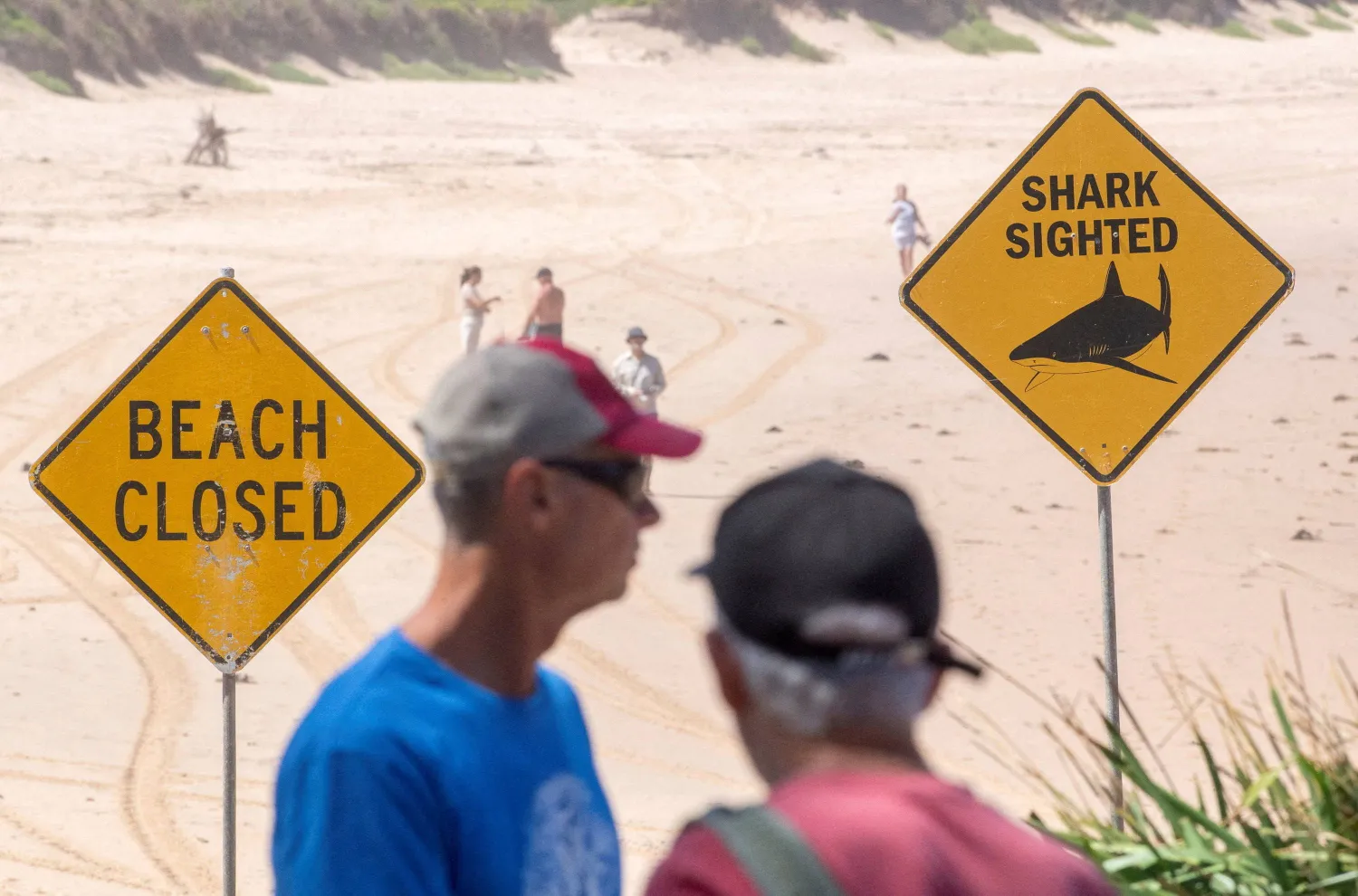
Shark Mauls Surfer in Sydney, 3rd Attack in Two Days

People stand next to warning signs in place, and beaches are closed after a surfer suffered a shark attack at Dee Why Beach in Sydney, Australia, January 19, 2026. REUTERS/Jeremy Piper
TT

Shark Mauls Surfer in Sydney, 3rd Attack in Two Days

People stand next to warning signs in place, and beaches are closed after a surfer suffered a shark attack at Dee Why Beach in Sydney, Australia, January 19, 2026. REUTERS/Jeremy Piper

A shark mauled a surfer off an ocean beach in Sydney on Monday in the Australian city's third shark attack in two days, authorities said.

The surfer, believed to be in his 20s, was in a critical condition in hospital with serious leg injuries after the attack at a northern Sydney beach, police said.

"The man was pulled from the water by members of the public who commenced first aid before the arrival of emergency services," New South Wales state police said in a statement.

All of Sydney's northern beaches were closed until further notice.

The attack at North Steyne Beach in the suburb of Manly came hours after a shark bit a large chunk out of a young surfer's board about 4 kilometers (2.5 miles) north along the coast at Dee Why Point.

That surfer, reportedly a boy aged about 11, was uninjured but the beach was closed immediately, AFP reported.

On Sunday, a large shark bit a 12-year-old boy in the legs as he played with friends at a beach in Sydney harbor, leaving him fighting for survival in hospital.

The boy and his friends were jumping from a six-meter (20-foot) rock into the water off Shark Beach in the eastern suburb of Vaucluse when the predator struck, police said.

"It was a horrendous scene at the time when police attended. We believe it was something like a bull shark that attacked the lower limbs of that boy," said Superintendent Joseph McNulty, New South Wales marine area police commander.

"That boy is fighting for his life now," he told reporters on Monday.

Recent heavy rain had drained into the harbor, and authorities believed the combination of the brackish seawater and the children's splashing created a "perfect storm" for a shark attack, McNulty said.

He warned people not to go swimming in the harbor or other river systems in New South Wales because of the risks.

He praised the boy's "brave" young friends for pulling him out of the water on Sunday.

Officers put the unconscious child in a police boat and gave him first aid, applying two tourniquets to stem the bleeding from his legs, McNulty said.

They tried to resuscitate the boy as they sped across the harbor to a wharf where ambulance paramedics were waiting.

The child, confirmed by police to be 12 years old, was in intensive care at Sydney Children's Hospital surrounded by family and friends, McNulty said.


Thousands of Authors Publish ‘Empty’ Book to Protest AI Using their Work

Thousands of authors published an “empty” book to protest AI (Shutterstock)
TT

Thousands of Authors Publish ‘Empty’ Book to Protest AI Using their Work

Thousands of authors published an “empty” book to protest AI (Shutterstock)

Thousands of authors including Kazuo Ishiguro, Philippa Gregory and Richard Osman have published an “empty” book to protest against AI firms using their work without permission.

About 10,000 writers have contributed to Don’t Steal This Book, in which the only content is a list of their names.

Copies of the work were distributed to attenders at the London book fair on Tuesday, a week before the UK government is due to issue an assessment on the economic cost of proposed changes in copyright law.

By March 18, ministers must deliver an economic impact assessment as well as a progress update on a consultation about the legal overhaul, against a backdrop of anger among creative professionals about how their work is being used by AI firms.

The organizer of the book, Ed Newton-Rex, a composer and campaigner for protecting artists’ copyright, said the AI industry was “built on stolen work ... taken without permission or payment.”

He added: “This is not a victimless crime – generative AI competes with the people whose work it is trained on, robbing them of their livelihoods. The government must protect the UK’s creatives, and refuse to legalize the theft of creative work by AI companies.”

Other authors who have contributed their names to the book include the Slow Horses author, Mick Herron; the author Marian Keyes; the historian David Olusoga; and Malorie Blackman, the writer of Noughts and Crosses.

“It is not in any way unreasonable to expect AI companies to pay for the use of authors’ books,” said Blackman.


Wildlife to Replace Humans on Next Series of UK Banknotes

Banknotes and coins that feature an image of Britain's King Charles III are pictured on display during a photocall for "The Future of Money" exhibition, at the Bank of England Museum, City of London, UK, Feb. 27, 2024. (AFP)
TT

Wildlife to Replace Humans on Next Series of UK Banknotes

Banknotes and coins that feature an image of Britain's King Charles III are pictured on display during a photocall for "The Future of Money" exhibition, at the Bank of England Museum, City of London, UK, Feb. 27, 2024. (AFP)

Images of ‌animals will feature on the next series of banknotes from the Bank of England, as the central bank shifts away from historical figures such as William Shakespeare, Winston Churchill and Jane Austen over the coming years.

"Nature is a great choice from a banknote authentication perspective and means we can showcase the UK's rich and varied wildlife on the next series of ‌banknotes," Victoria ‌Cleland, the BoE's chief cashier, said.

Bank ‌of ⁠England banknotes have ⁠featured monarchs since Queen Elizabeth first appeared on one in 1960, while Shakespeare was the first historic figure to appear in 1970.

King Charles' portrait will continue to appear on the next series of notes as well, the ⁠BoE said.

The BoE held a ‌consultation on a change ‌to the design of banknotes in July 2025, ‌inviting views from the public.

The theme of ‌nature was supported by 60% of the 44,000 responses, narrowly beating the category of "architecture and landmarks" on 56% and "notable historical figures" on 38%. Other categories included "arts, ‌culture and sport", "innovation" and "noteworthy milestones".

The new notes will feature wildlife native ⁠to ⁠the United Kingdom and will not include household pets, the BoE said. It plans to run a second consultation in the coming months asking for the public's views on specific animals to feature on the notes taken from a list created by British wildlife experts.

The BoE is not the only producer of banknotes in the United Kingdom. Notes are also produced by seven commercial banks in Scotland and Northern Ireland.


North Korea and China to Resume Passenger Train Service After Six-Year Gap

A North Korean flag flutters from a train believed to be carrying North Korean leader Kim Jong Un, as it arrives in Beijing, China, September 2, 2025. (Reuters)
TT

North Korea and China to Resume Passenger Train Service After Six-Year Gap

A North Korean flag flutters from a train believed to be carrying North Korean leader Kim Jong Un, as it arrives in Beijing, China, September 2, 2025. (Reuters)

South ‌Korea's Unification Ministry said on Tuesday that passenger train services between Pyongyang and Beijing are set to resume this week, marking the end of a six-year suspension caused by the COVID-19 pandemic.

The resumption restores a critical transport link between North Korea and its primary economic ally, after ‌years of ‌strict border closures that began ‌in ⁠early 2020.

China's state ⁠railway told the Yonhap News Agency that the Pyongyang–Beijing train will begin the round-trip service on March 12, operating four times a week.

Only the last two carriages will ⁠initially carry passengers, mainly diplomats or ‌others on ‌official business, with ticket sales to the general ‌public possible if seats are ‌available, Yonhap quoted a railway official as saying.

North Korea remains closed to most foreign tourism, with limited exceptions largely for ‌Russian tour groups under restricted arrangements, according to travel agencies organizing trips ⁠to ⁠the country.

Before the pandemic, Chinese visitors made up the largest share of foreign tourists to North Korea, the agencies said.

Tour organizers said on Monday that North Korea had cancelled next month's Pyongyang Marathon for unspecified reasons. The race is one of the few events that has been open to international participants in the isolated state.