

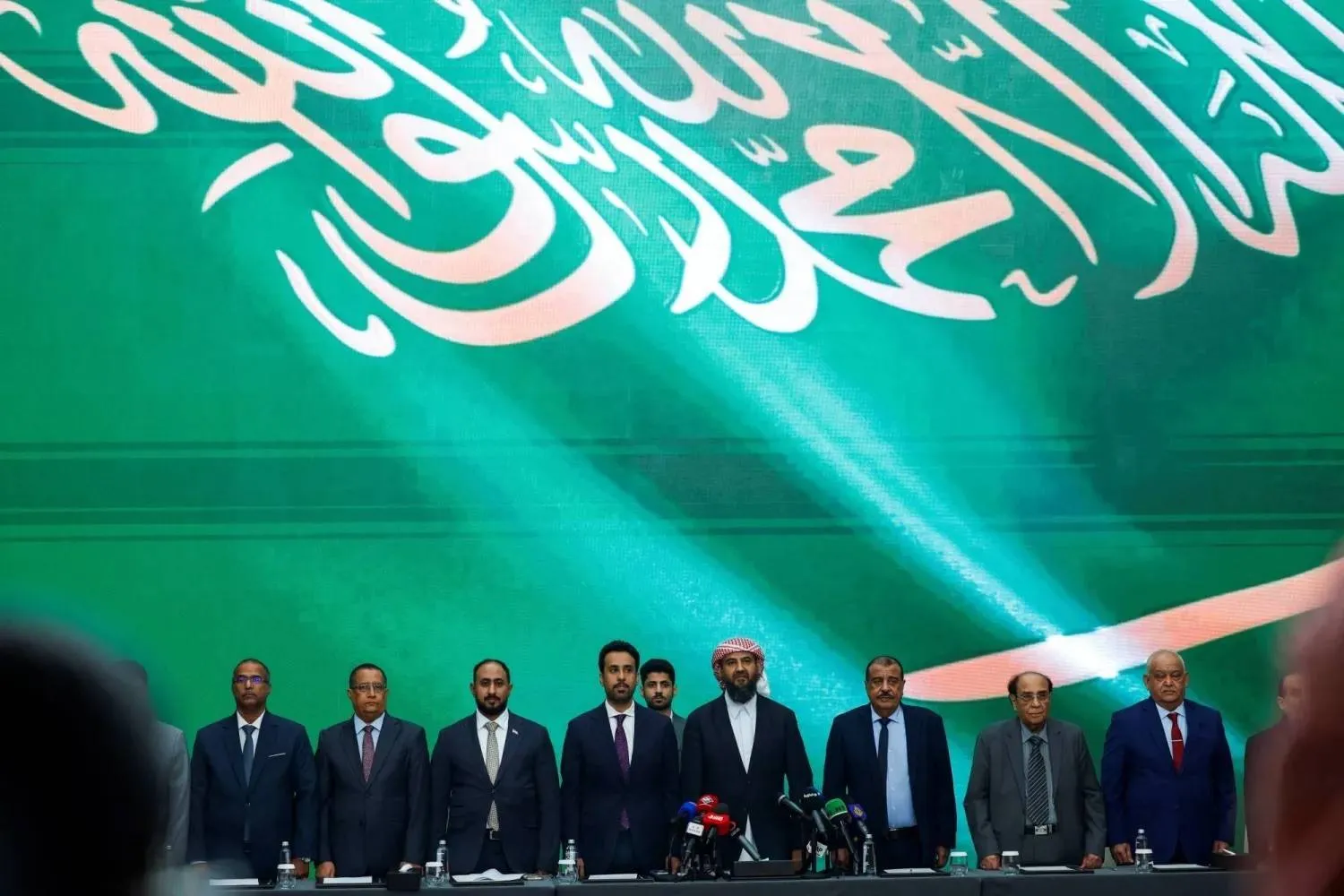

Saudi Support for Inclusive Southern Dialogue Without Monopoly or Exclusion

Caption: Saudi Arabia seeks comprehensive solutions for southern Yemenis through the forthcoming dialogue (Reuters).
TT

Saudi Support for Inclusive Southern Dialogue Without Monopoly or Exclusion

Caption: Saudi Arabia seeks comprehensive solutions for southern Yemenis through the forthcoming dialogue (Reuters).

Riyadh has hosted the Southern Consultative Meeting as a prelude to a comprehensive Southern Dialogue Conference, signaling the return of southern Yemen as a core issue in the country’s peace process. The meeting brought together a broad range of southern leaders and groups, including advocates of restoring the state that existed in southern and eastern Yemen before the 1990 unification with the north.

The consultative talks were attended by Yemeni Presidential Leadership Council Vice President Abdul Rahman Al-Mahrami, who read the final communiqué.

Saudi sponsorship reflects a shift in the Kingdom’s role from primarily military support for Yemen’s internationally recognized government to that of a key political sponsor of a comprehensive settlement.

The communiqué underscored this approach, stressing that Saudi Arabia “does not adopt a hostile position toward any southern option,” provided it is the outcome of an inclusive, non-exclusive intra-dialogue.

Beyond politics, Saudi backing extended to urgent economic measures, including the allocation of SAR 1.9 billion to support the economy and ensure payment of salaries for civil servants and military personnel. Observers say these steps give Saudi mediation tangible credibility and directly link economic stability with the success of the political process.

Criticism of External Interference

The final statement, and reactions surrounding it, carried pointed — if indirect — criticism of the United Arab Emirates.

Analysts accuse Abu Dhabi of deepening southern divisions by backing specific factions, particularly those previously led by Aidarous al-Zubaidi, former head of the dissolved Southern Transitional Council, who reportedly moved to Abu Dhabi after refusing to join the Riyadh-sponsored dialogue.

This contrast casts Riyadh as an alternative to what critics describe as “chaotic” Emirati interference, emphasizing inclusive dialogue among southerners and support for state institutions as part of a pathway toward broader Yemeni stability.

Southern visions remain diverse. Some leaders seek secession and restoration of the pre-1990 state, others favor a federal Yemen with self-governing regions, while additional voices propose alternative arrangements they see as fairer and less centralized. These differing perspectives place Saudi Arabia in the role of mediator seeking to unify southerners, while Abu Dhabi is increasingly portrayed by critics as a force fueling fragmentation.

Yemen’s Presidential Leadership Council Chairman Rashad al-Alimi has previously called on the UAE to withdraw militarily from Yemen and halt interference in internal affairs, accusing it of backing unilateral moves to impose control by force over Hadramout and Al-Mahra.

Internal Reckoning and a Historic Chance

The consultative meeting also highlighted internal challenges that have weakened the southern cause. Participants rejected any monopoly over representation or attempts to reduce the issue to a single leader or group. The statement distinguished between the legitimacy of the southern cause as a political and rights-based demand and the harmful practices of some leaders accused of exploiting it for regional agendas or corruption.

This self-criticism, particularly from figures once associated with the Transitional Council, suggests a desire to correct course and rebuild credibility with the southern public and the international community. Calls for popular support “with awareness and responsibility” aim to restore grassroots legitimacy and prevent the manipulation of protests for narrow interests.

The communiqué described the upcoming comprehensive Southern Dialogue Conference as a “rare historic opportunity,” enabled by Saudi sponsorship and a growing southern consensus on dialogue as the only safe path forward.

Regionally and internationally, resolving the southern issue is increasingly seen as a key gateway to a comprehensive peace in Yemen. However, success will depend on overcoming deep internal divisions and shielding the process from destabilizing interference.


Saudi Arabia Condemns RSF Attacks on Civilians and Aid Convoys in Sudan

 An elderly man picks up his food aid ration at the Umdulu Camp, in Engpung County, Sudan, January 30, 2026. (Karl Schembri/Norweigan Refugee Council/Handout via Reuters)
An elderly man picks up his food aid ration at the Umdulu Camp, in Engpung County, Sudan, January 30, 2026. (Karl Schembri/Norweigan Refugee Council/Handout via Reuters)
TT

Saudi Arabia Condemns RSF Attacks on Civilians and Aid Convoys in Sudan

 An elderly man picks up his food aid ration at the Umdulu Camp, in Engpung County, Sudan, January 30, 2026. (Karl Schembri/Norweigan Refugee Council/Handout via Reuters)
An elderly man picks up his food aid ration at the Umdulu Camp, in Engpung County, Sudan, January 30, 2026. (Karl Schembri/Norweigan Refugee Council/Handout via Reuters)

Saudi Arabia strongly condemned on Saturday the Rapid Support Forces’ attack against a humanitarian aid convoy in Sudan’s Kordofan.

A Foreign Ministry statement said the Kingdom expressed its strong condemnation of the attack against Al-Kuweik Military Hospital, a humanitarian aid convoy affiliated with the World Food Program, and a vehicle transporting displaced civilians.

“These acts are unjustifiable under any circumstances and are flagrant violations of all humanitarian norms and relevant international agreements,” it stressed.

“The Kingdom called on the RSF to immediately cease these violations and to fulfill their moral and humanitarian obligations by ensuring the safe and unhindered delivery of humanitarian assistance to those in need, in accordance with international humanitarian law and the Jeddah Declaration signed on May 11, 2023,” it added.

The Kingdom reiterated its firm position in support of Sudan’s unity, security, and stability, the need to preserve its legitimate institutions.

It voiced its rejection of “foreign interference and the continued actions of certain parties in supplying illicit weapons, mercenaries, and foreign fighters, despite their stated support for a political solution,” saying such “conduct is a primary factor in prolonging the conflict and exacerbating the suffering of the Sudanese people.”

A drone attack by the RSF hit a vehicle carrying displaced families in central Sudan Saturday, killing at least 24 people, including eight children, a doctors’ group said, a day after a World Food Program aid convoy was targeted.

The attack occurred close to the city of Rahad in North Kordofan province, said the Sudan Doctors Network, which tracks the country’s ongoing war. The vehicle was transporting displaced people who fled fighting in the Dubeiker area, the group said in a statement. Among the dead children were two infants.


OIC Condemns Terrorist Bombing of Mosque in Islamabad

A Pakistani man reacts as people attend a protest against the suicide bomb blast that killed dozens of people, in Peshawar, Pakistan, 07 February 2026. (EPA)
TT

OIC Condemns Terrorist Bombing of Mosque in Islamabad

A Pakistani man reacts as people attend a protest against the suicide bomb blast that killed dozens of people, in Peshawar, Pakistan, 07 February 2026. (EPA)

The Organization of Islamic Cooperation (OIC) General Secretariat strongly condemned on Saturday the terrorist bombing that targeted a mosque in Islamabad.

The secretariat stressed its categorical rejection of terrorism in all its forms, especially those targeting places of worship.

It underlined its firm stance in condemning these criminal acts, which are contrary to human values and religious principles.

The OIC offered its sincere condolences to the government and people of Pakistan and to the families of the victims.

It also reiterated its full solidarity with Pakistan in its efforts to combat terrorism and boost its security and stability.

At least 30 people killed in a suicide bombing at a Muslim mosque during Friday prayers.


Bahrain, France Sign Defense Cooperation Agreement

Sheikh Nasser bin Hamad Isa Al Khalifa, Bahrain's King Hamad bin Isa Al Khalifa, France's President Emmanuel Macron and Junior Minister at the Ministry of Defense, Alice Rufo, pose after signing a bilateral agreement at the Elysee Palace in Paris, France, February 6, 2026. (Thibault Camus/Pool via Reuter)
TT

Bahrain, France Sign Defense Cooperation Agreement

Sheikh Nasser bin Hamad Isa Al Khalifa, Bahrain's King Hamad bin Isa Al Khalifa, France's President Emmanuel Macron and Junior Minister at the Ministry of Defense, Alice Rufo, pose after signing a bilateral agreement at the Elysee Palace in Paris, France, February 6, 2026. (Thibault Camus/Pool via Reuter)

Bahrain and France signed on Friday a joint defense cooperation agreement during talks between King Hamad bin Isa Al Khalifa met with President Emmanuel Macron in Paris.

The French presidency said the agreement consolidates cooperation in the field of defense, training and exchange of strategic information.

“This agreement will ⁠also open ‌up ‍new ‍opportunities for industrial ‍cooperation in defense, and strengthen solidarity between our two countries in a ⁠global and regional geopolitical context marked by increasing tensions,” it added.

The agreement was signed by Bahrain’s National Security Adviser and Secretary General of the Supreme Defense Council Sheikh Nasser bin Hamad Al Khalifa and France’s Minister Delegate to the Minister of the Armed Forces and Veterans Alice Rufo.

Macron highlighted the depth of the historical relations between Bahrain and France, as well as the progress achieved across various domains in support of common interests, reported Bahrain’s state news agency (BNA).

For his part, King Hamad commended the French president’s keenness to strengthen relations between the two countries.

The talks also addressed means to bolster bilateral relations across all sectors to achieve shared interests.

Both sides commended the efforts of the Joint Bahraini-French High Committee. They highlighted the positive outcomes achieved in advancing cooperation and underlined the importance of continuing the committee’s work to expand cooperation across various domains.

The talks addressed regional and international developments, and efforts aimed at resolving conflicts through dialogue and diplomatic solutions and reducing tensions.
